An LED advertising board is a modular digital screen used to show changeable ads, prices, video, and wayfinding. Buyers comparing an outdoor billboard, a shop display, or a rental screen should start with the viewing distance and site conditions, then compare pixel pitch, brightness, weather protection, service access, and the full installed cost. This guide explains those choices and shows what to request from a manufacturer before ordering.
Quick answer: For an outdoor LED advertising board, confirm the native resolution at the proposed size, measured daylight brightness and dimming range, front and rear IP ratings, mounting design, and a safe maintenance route. Request an itemized quote covering the display, control system, structure, electrical work, freight, installation, and spares. If you already know your site dimensions, send EagerLED your project brief for a configuration-specific proposal.
1. What marketing problems can LED advertising boards solve?
LED advertising boards solve a practical communication problem: a printed sign cannot change instantly, while a digital display can rotate offers, update a price, show event information, or switch creative by time of day. Their light output can make messages visible in settings where ordinary printed media is hard to read. That does not guarantee attention or footfall; the message still has to fit the audience and location.
01. Speed and relevance
A content management system can schedule morning, lunch, and evening messages without replacing physical posters. A shopping center can advertise a live event, then replace the message when it ends. A venue can publish wayfinding and sponsor messages on the same surface. For LED advertising boards, the operational advantage is the ability to change approved creative quickly and consistently across locations.
02. Visibility with appropriate restraint
High brightness helps in daylight, but maximum brightness all day is neither comfortable nor economical. Specify automatic dimming, check local sign rules, and test the display from actual pedestrian and driver sightlines. A concise message and strong contrast usually matter more than a rapid animation. Where traffic is moving, prioritize safe legibility and comply with local restrictions on motion and luminance.
03. Reusable advertising inventory
Media owners can allocate time slots to multiple advertisers; businesses can rotate product, service, and seasonal campaigns. Inventory only has value when playback is reliable and documented. Keep proof-of-play logs, a clear slot schedule, and a process for removing expired offers. Compared with a static board, LED advertising boards add flexibility but also power, software, and service responsibilities.

2. Which LED advertising board format fits the site?
Start by describing where viewers stand, how long they look, and whether the screen is exposed to weather. A street-facing billboard, a storefront display, and an event screen are different projects even if all are called LED advertising boards. The table below gives a starting point for a specification discussion, not a substitute for a site survey or product data sheet.
| Application | Audience and content | Specification priorities | Questions to ask |
|---|---|---|---|
| Outdoor roadside or facade | Distant viewers; short, high-contrast messages | Daylight readability, structural design, weather rating, remote monitoring | What are the viewing angle, local sign limits, wind load, and service route? |
| Storefront or mall | Closer pedestrians; promotions, menus, wayfinding | Finer pitch, comfortable brightness, clean integration with the facade | Will viewers see the screen from the sidewalk, inside, or both? |
| Event or rental | Changing venues; sponsor loops and live content | Fast assembly, rigging, camera-friendly performance, transport protection | Who supplies the processor, crew, spares, and safe rigging plan? |
| Stadium perimeter | Live audience and broadcast cameras | Impact protection, refresh performance, control redundancy, safety | What does the venue require for broadcast and field access? |
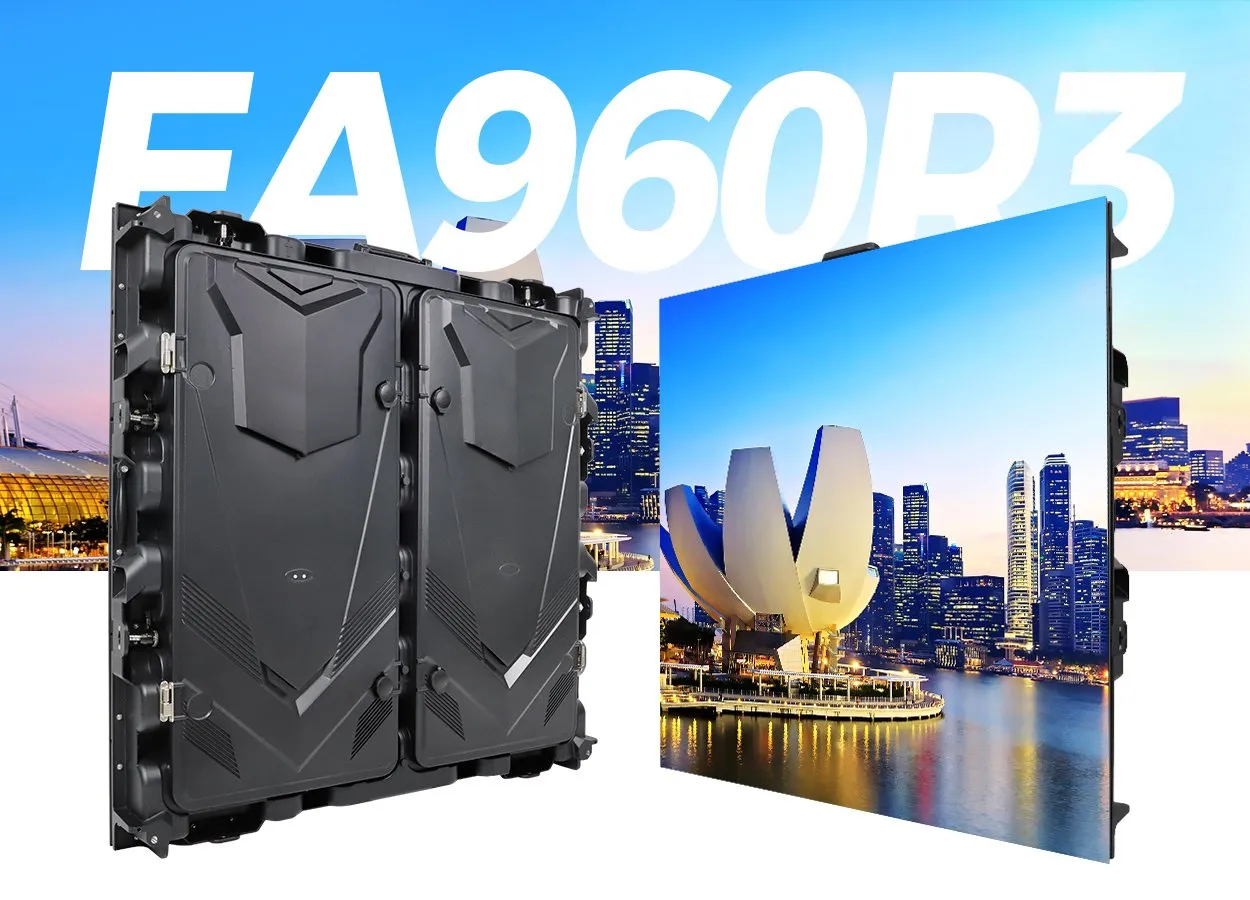
Permanent outdoor LED advertising boards generally need a more involved engineering and permitting process than indoor screens. Rental displays emphasize handling and rapid replacement. For a concrete outdoor example, EagerLED’s EA960R4 LED display billboard uses a 960 × 960 mm cabinet with rear service. The product page lists P2.5–P10 pitch options, an IP65 outdoor cabinet rating, brightness of 5,000–8,000 cd/m² depending on configuration, and a refresh frequency of at least 3,840 Hz. These are model-specific specifications, not minimum requirements for every advertising board; verify the selected variant and installation design before purchase. The broader commercial LED display range offers another route for comparing formats.

3. How to specify LED advertising boards
01. Pixel pitch, size, and viewing distance
Pixel pitch is the center-to-center spacing between pixels, measured in millimeters. A smaller pitch packs more pixels into the same area and can improve detail for nearby viewers, but usually increases cost. Do not buy the smallest pitch by default. Record the nearest normal viewing distance, content type, screen width and height, and the pixel dimensions of the final canvas. For example, a 6 m wide screen at 6 mm pitch has about 1,000 horizontal pixels before allowing for the exact cabinet layout. That calculation is a planning estimate; the supplier must confirm the native resolution.
02. Brightness, contrast, and dimming
Brightness is specified in nits, equivalent to cd/m². Outdoor LED advertising boards need enough output for the site’s sun exposure; an indoor board usually needs much less. Request both typical and maximum brightness, the test conditions, and an ambient-light sensor with adjustable schedules. Assess black level and reflections as well as peak output. A board that is readable at noon but glaring at night is poorly configured.
03. Weather protection and serviceability
Ask for the protection rating of the front and rear separately. An IP rating describes resistance to dust and water under defined test conditions; it does not replace drainage, corrosion control, ventilation, or installation quality. Confirm operating temperature, cabinet materials, access clearance, and whether a module, power supply, and receiving card can be replaced from the front or rear. LED advertising boards installed against a wall may need front service because there is no rear walkway.
04. Control, refresh, and reliability
Confirm how creative reaches the screen: local player, network, or cloud platform. Ask about offline playback, user permissions, approval workflow, emergency override, and proof of play. For filmed events or broadcasts, test refresh and camera behavior with the intended equipment; a high refresh-rate figure alone does not prove flicker-free footage. Require a wiring diagram, spare-parts list, and a plan for a failed controller or network connection.
| Item | Why it matters | Evidence to request |
|---|---|---|
| Pixel pitch and native resolution | Sets text detail at the intended viewing distance | Module layout and final canvas in pixels |
| Brightness and dimming | Controls daylight readability, night comfort, and power use | Measured nit range and sensor/schedule demonstration |
| Front and rear IP ratings | Exposure differs across cabinet faces | Product data sheet and installation details |
| Typical and maximum power | Determines circuits, cooling, and running cost | W/m² values with test conditions |
| Service method and spares | Determines repair time and access cost | Maintenance drawing, spare list, warranty terms |
| Control and monitoring | Determines campaign updates and fault response | Live software demonstration and offline behavior |
Do not compare LED advertising boards only by cabinet price. Two quotations can describe the same screen area while omitting different essentials. Record the exact model, bill of materials, warranty exclusions, delivery terms, and who is responsible for commissioning.

4. What affects LED advertising board price and ownership cost?
There is no reliable single price for LED advertising boards. The quote changes with pixel pitch, area, brightness, cabinet construction, control hardware, installation, and location. A screen price per square meter can be useful for comparing similar modules, but it is not the installed project cost. Ask each vendor for the same scope and currency, and avoid treating an online starting price as a committed quote.
01. Budget for the whole system
Include display cabinets, processor and player, mounting structure, structural review, electrical work, network, permits, freight, taxes, installation labor, calibration, training, and initial creative. For outdoor LED advertising boards, the mounting and access plan can be a major cost. Clarify whether a lift, crane, or traffic-control permit is needed for installation and future service.
02. Estimate electricity and service
A practical planning formula is annual energy (kWh) = average operating power (kW) × operating hours per day × operating days. Multiply by the local electricity tariff for an energy estimate. Use measured or supplier-provided average power for realistic content and brightness settings; maximum rated power is used for electrical capacity, not as a prediction of every hour’s consumption. Add preventive maintenance, replacement modules, connectivity, software fees, and insurance if applicable.
Illustrative energy example: An 8 m² board averaging 300 W/m² draws 2.4 kW. At 12 hours a day for 365 days, that is 10,512 kWh a year; at an assumed $0.15/kWh, electricity would be $1,576.80 before demand charges and taxes. These are example inputs, not an EagerLED product rating or a promised bill. Replace them with the supplier’s measured average power, your schedule, and your local tariff.
| Cost line | One-time or recurring? | Common omission to check |
|---|---|---|
| Display and control system | Primarily one-time | Processor, player, cabling, calibration |
| Structure and installation | One-time, with possible later access costs | Engineering, lift, permits, weather sealing |
| Energy and connectivity | Recurring | Actual hours, dimming schedule, data plan |
| Creative and campaign operations | Recurring | Design, localization, approval, proof of play |
| Maintenance and spares | Recurring or reserve | Modules, power supplies, labor, response time |
For a media owner, separate the cost of buying LED advertising boards from the price charged to advertisers. Advertising rates depend on location, audience, screen share, duration, season, and reporting. A hardware supplier’s quotation cannot establish a local media rate. Ask the screen operator for a rate card, estimated share of voice, and evidence of playback.

5. How to create effective advertising on LED screens
01. Design for a glance
People rarely read a display as they would a web page. Give each creative one message, a recognizable brand cue, and a short action such as “Enter today,” “Scan for the menu,” or “Visit level 2.” Use large type, high contrast, and enough time on screen to understand the offer. Avoid dense paragraphs, small QR codes viewed from a distance, and animation that hides the main point. LED advertising boards can show video, but movement should support comprehension.
02. Match the location and time
Map a real customer journey before placing LED advertising boards. A board seen before a store entrance can direct a shopper to a timely offer; one after the entrance may need wayfinding. At an event, show the next session or sponsor while people are waiting. Dayparting can make a message more relevant, but it should be based on opening hours, traffic patterns, and campaign goals rather than assumptions about the audience.
03. Keep content operationally sound
Prepare creative at the native pixel dimensions and approved aspect ratio. Establish a review process for dates, prices, claims, and accessibility. Preview the file on the actual LED advertising boards: color and text can look different from a laptop. Test the worst-case sightline and the fastest realistic passing speed. Archive versions and set an expiry date so old promotions do not keep running.
For additional design ideas, EagerLED’s article on making an LED advertising screen stand out may help; verify any tactic against the specific site’s rules and sightlines.
6. Can LED advertising boards increase footfall, and how do you measure it?
LED advertising boards can help a business present an offer where potential customers can see it. Whether they increase footfall depends on the location, message, competing stores, season, and baseline traffic. Avoid attributing every store visit to the screen. Define the outcome before launch and compare it with a sensible control period or comparable location.
01. Choose a measurable action
For a store, track visits, offer redemptions, and sales of the advertised item. For an event, use registrations or check-ins. For a media network, track proof of play and advertiser outcomes where available. A unique landing-page URL, short code, or QR code can help connect a campaign to an action, but a scan is not the same as a sale. Record the denominator: impressions are estimates unless measured with an agreed method.
02. Run a fair test
Compare similar weekdays and hours before and during the campaign, accounting for weather, holidays, price changes, and other advertising. If possible, rotate two creatives with equal screen time while keeping the offer and location stable. Report the result as an observed change, not proof of causation. The useful question is whether LED advertising boards generated enough incremental value to justify the campaign and operating cost.
| Goal | Primary measure | Useful comparison | Caution |
|---|---|---|---|
| Bring people into a store | Door-counter visits during campaign hours | Comparable days or a similar store | Weather and promotions also affect traffic |
| Promote an offer | Redemptions and product sales | Pre-campaign baseline | Do not count scans as purchases |
| Sell media inventory | Proof-of-play logs and booked slots | Contracted delivery | Playback is not verified human attention |
| Improve wayfinding | Questions to staff and destination visits | Prior signage period | Changes in venue traffic can distort results |
7. How to install and maintain LED advertising boards
01. Survey before installation
Confirm structural capacity, wind exposure, power distribution, grounding, data path, ventilation, drainage, and safe access. Check the local authority’s sign, brightness, and planning requirements. For outdoor LED advertising boards, engineering documents and approved mounting details matter more than a visual mockup. Agree on the exact responsibilities of the display vendor, structural engineer, electrician, and site owner.
02. Commission the complete system
Test pixel mapping, color uniformity, daytime and nighttime brightness, network loss, restart behavior, and the content schedule. Verify that the operator can upload, approve, and remove a campaign. Keep cabinet serial numbers, configuration backups, wiring diagrams, and a labeled spare kit. Photograph the commissioned display from normal viewing positions rather than judging it only from directly in front.
03. Plan routine service
Inspect seals, fasteners, ventilation paths, cables, and corrosion on a schedule appropriate to the environment. Clean with methods approved by the manufacturer and isolate power when required by the service procedure. Monitor temperature and fault alerts. Replace failed modules promptly and retain calibrated spares to reduce visible color mismatch. The maintenance plan for LED advertising boards should state response times and who pays for access equipment.
8. Buyer checklist before ordering LED advertising boards
Send every supplier the same brief: site photos and dimensions, nearest and farthest viewing distances, audience movement, operating hours, sun and weather exposure, intended content, power and network availability, installation deadline, and service access. Ask for a drawing that identifies the actual LED advertising boards, not a generic rendering.
- Confirm pixel pitch, native resolution, brightness range, and dimming controls in writing.
- Check front and rear protection ratings, cabinet materials, and a safe service route.
- Require typical and maximum power figures with the conditions used to measure them.
- Compare complete scope, warranty, spare parts, training, and local support.
- Ask for an on-site or representative demo using your own creative and viewing distance.
- Document permits, structure, electrical responsibility, and acceptance tests before payment milestones.
What should you ask an LED advertising board manufacturer?
Ask for a model-specific data sheet, cabinet drawing, pixel map, brightness test conditions, front and rear IP ratings, typical and maximum power, control-system compatibility, warranty exclusions, spare-parts list, and a written service plan. Confirm whether the proposed model supports front or rear access at your site. Request photographs or a demonstration of a comparable installation and define who handles structural design, permits, commissioning, and training. An itemized answer makes manufacturer quotes easier to compare than a single price per square meter.
A strong quotation explains the assumptions behind each specification. If the site changes, revisit the design rather than copying the same board to every location. For complex outdoor projects, obtain engineering and regulatory advice specific to the site. Share your dimensions, viewing distance, location, and installation date with EagerLED to request an appropriate configuration.
9. Frequently asked questions about LED advertising boards
How much does an LED advertising board cost?
There is no reliable universal price. Screen area, pixel pitch, brightness, cabinet design, control hardware, and the installation site all change the quote. Compare the full scope—including structure, electrical work, freight, permits, commissioning, energy, and maintenance—rather than a panel-only price per square meter.
What should I check before choosing a manufacturer?
Ask for the exact model and configuration, verified specifications, service-access drawing, warranty terms, spares, control-system plan, and an itemized project quote. For outdoor sites, have the structure and local sign requirements checked by qualified local professionals.
Are LED advertising boards better than printed billboards?
They are better when frequent updates, multiple messages, or scheduled content create value. Printed billboards can be simpler and cheaper for a long-running message. Compare the full installed and operating cost against the campaign need rather than assuming digital is always superior.
What pixel pitch should I choose?
Choose pitch after measuring the closest normal viewing distance and deciding how much text or detail viewers need. Smaller pitch is useful close up; a larger pitch can be economical for distant viewing. Ask the supplier to show the proposed content at the real distance and confirm the final native resolution.
How bright should outdoor LED advertising boards be?
The answer depends on orientation, shade, local rules, and viewing time. Request a measured brightness range and test daylight readability at the site. Automatic dimming is important for night comfort and energy use. Do not rely on maximum nit output alone.
Can LED screens increase footfall?
They can support a clear offer near a relevant audience, but the effect is not guaranteed. Compare visits or redemptions with a baseline or control location and account for other changes such as weather and discounts. See the measurement plan above.
How are LED screen advertising rates set?
Rates for buying ad time usually reflect location, audience, share of voice, campaign length, season, and reporting. They are separate from the purchase cost of the screen. Request the operator’s current rate card, delivery terms, and proof-of-play method.
What maintenance do LED advertising boards need?
Plan inspections of seals, ventilation, cables, power components, and mounting, plus approved cleaning and software backups. Keep compatible spare modules and a service-access plan. Exact intervals depend on climate, operating hours, and the manufacturer’s instructions.
10. Conclusion: make LED advertising boards useful, measurable, and serviceable
The best LED advertising boards start with a defined audience and a real site, then align pitch, brightness, weather protection, control, and maintenance with that use. Budget for the complete installation and operation, create short messages that work from the intended viewing distance, and measure campaign outcomes with an honest baseline. A well-specified board can become a flexible communication channel; its results still depend on the offer, placement, creative, and disciplined operation.
To scope a project, compare EagerLED’s commercial LED display options and request a site-specific proposal that includes drawings, system specifications, service access, and total cost. That gives you a practical basis for deciding whether LED advertising boards fit your marketing goal.