LED poster display advertising turns a narrow, eye-level space into a reusable campaign channel. A commercial LED poster display is a self-emitting digital screen in a tall cabinet, typically used at a store entrance, window, event booth, hotel lobby, or transit corridor. It can show motion, scheduled offers, and location-specific messages without printing a new poster for every change. The best result comes from matching the hardware, creative, placement, and measurement plan to a specific audience.
This guide is for marketers, retail operators, venue teams, and AV buyers deciding whether an LED poster display belongs in their advertising mix. It explains where the format works, how to specify a legible screen, how to design a campaign people can understand in seconds, and how to judge results. If you need a model-by-model procurement checklist, see our poster LED display buying guide. Specifications below are planning considerations, not promises for every model; confirm the chosen unit’s datasheet and site conditions before ordering.
1. What LED poster display advertising does
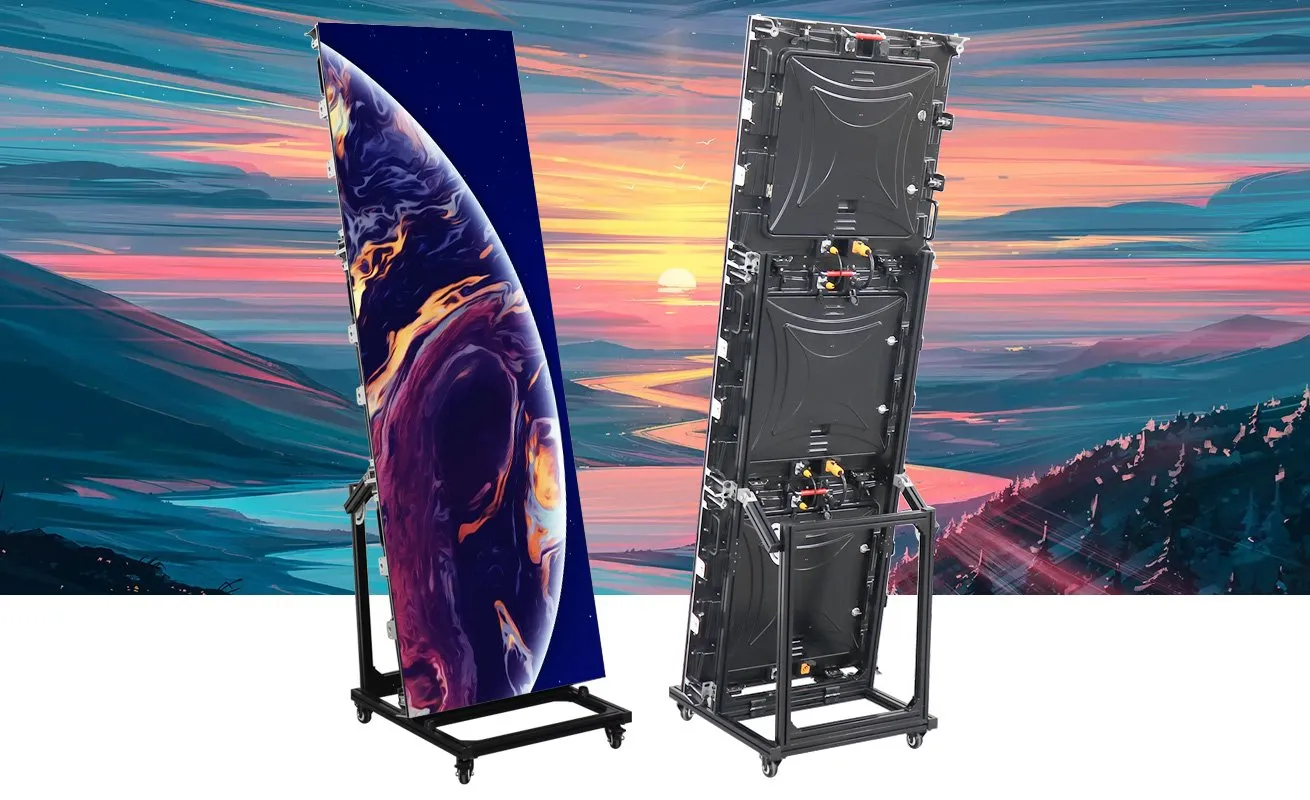
An LED poster display presents video, still images, text, or a playlist on a slim direct-view LED surface. Unlike an LCD poster, its pixels emit light rather than filtering a backlight. Unlike a printed poster, the message can change by time of day, venue, inventory position, or campaign. A single unit can be freestanding; compatible units may also join into a wider canvas if the cabinet and controller support splicing. An LED poster display is therefore a screen, media player, mounting system, and content workflow together.
The commercial value is operational. A café can move from breakfast to lunch messages without replacing print. A showroom can run a product launch across several branches, then retire the creative on one schedule. An exhibition team can reuse an LED poster display at the next event. These possibilities matter only if the campaign owner has a repeatable process for preparing, approving, publishing, and removing content.
There is no universal rule that an LED poster display will outperform print or LCD. Print can be cheaper for a stable message; LCD can offer very fine detail at close range in controlled light. The LED poster display becomes attractive when visibility, repeated creative changes, mobility, or modular scale justify its higher initial investment. Evaluate it against the job, not against a generic claim about attention.
2. Where an LED poster display earns attention
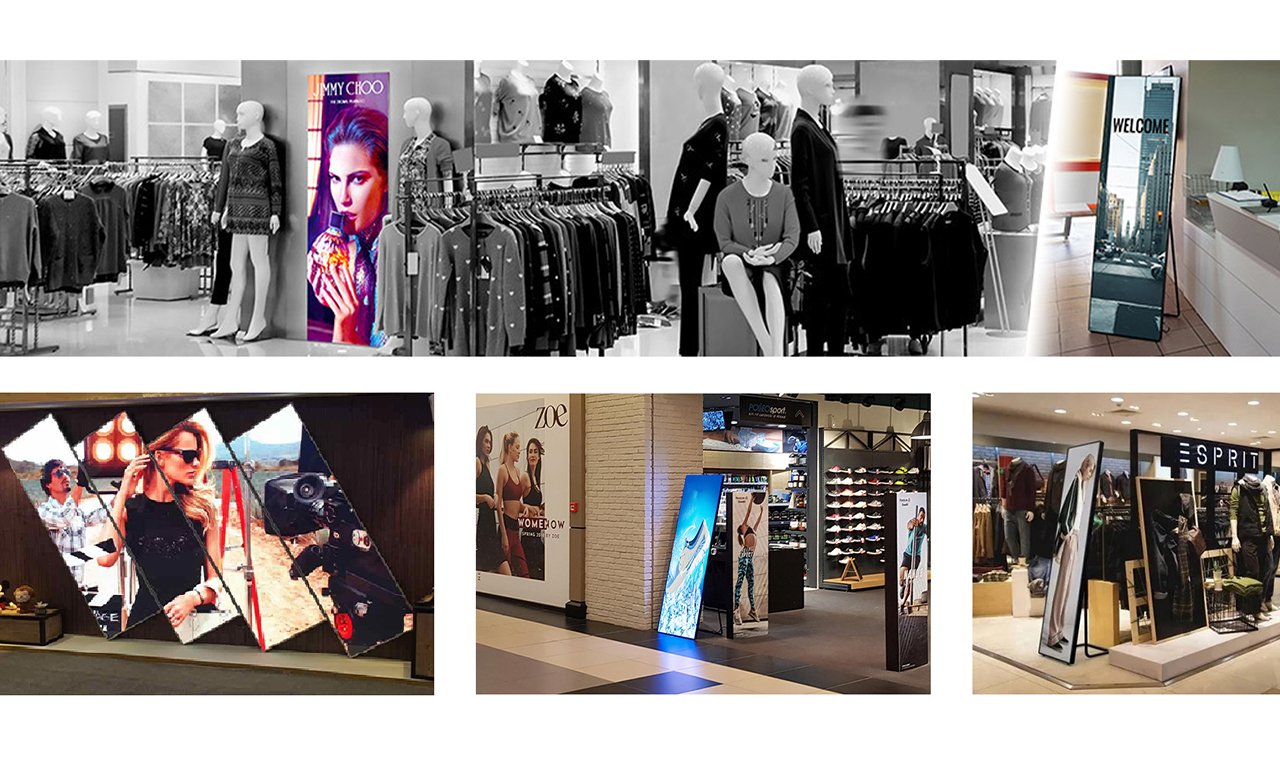
Placement decides whether a digital poster is seen at all. Map the pedestrian path, viewing angle, likely dwell time, competing light, and any obstruction before choosing a cabinet. Place the call to action where a person can respond: near a store entrance, a queue, a product display, or a staffed booth. The LED poster display should reinforce a real next step, not simply loop a brand animation.
| Location | Audience task | Useful LED poster display message | Practical check |
|---|---|---|---|
| Retail entrance or window | Decide whether to enter | One hero product, offer, and store direction | Test readability through glazing at midday and after dark |
| Shopping mall corridor | Find a destination | Tenant promotion with floor or unit number | Check sightline and traffic from both directions |
| Trade-show booth | Choose which stand to visit | Problem solved, product demonstration, booth number | Secure the base and protect cables in public circulation |
| Hotel or venue lobby | Find an event or service | Schedule, wayfinding, or time-limited offer | Set a lower evening brightness profile |
| Showroom or dealership | Compare options | Feature sequence and a staffed next step | Keep detailed specifications on a separate close-view screen |
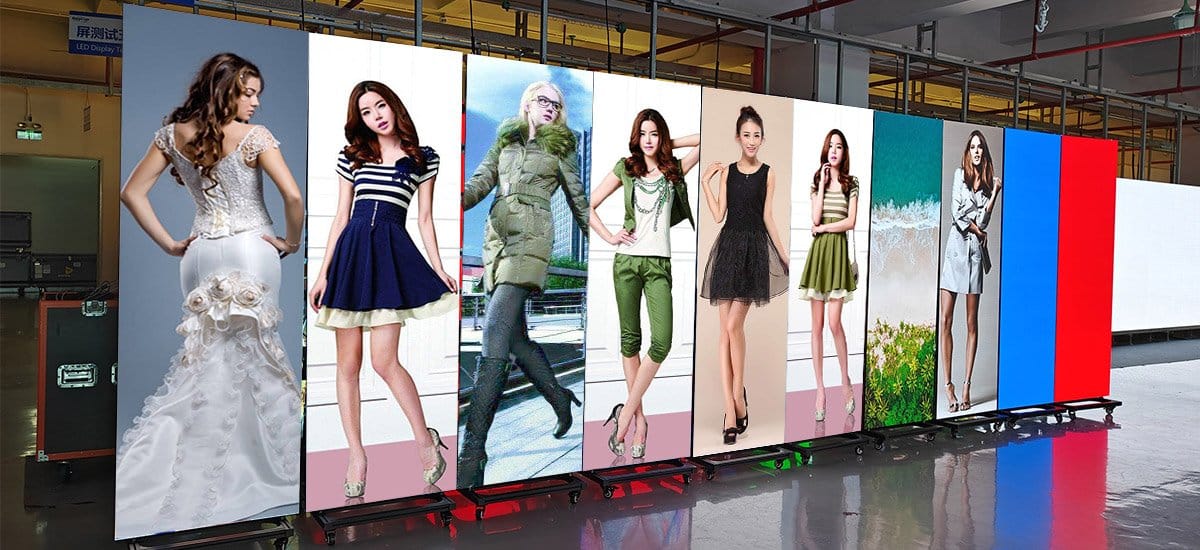
A single LED poster display suits a narrow footprint and one clear sightline. A double-sided unit may suit a central aisle, but its power, weight, and content requirements are different. A large video wall makes sense when people view a broad canvas from farther away. If a shopper must read dense terms at arm’s length, an LCD kiosk or printed card may be the better companion. This division of jobs helps avoid forcing every message onto one screen.
For an indoor window, treat the glass as part of the optical system. Reflection, tint, direct sun, and nighttime glare can change what a passerby sees. An indoor LED poster display behind glass is not automatically an outdoor-rated product. Where rain, condensation, or exposed wiring are possible, specify the enclosure and electrical protection for the actual environment.

3. Specify an LED poster display for the site
Start with three measurements: the nearest realistic viewing distance, the ambient light at the screen throughout operating hours, and the exact physical space including base, door swing, ventilation, and service access. Then ask a supplier for a complete configuration, not a pixel-pitch number alone. An LED poster display that looks impressive in a showroom can disappoint when placed behind tinted glass or loaded with artwork made for a different aspect ratio.
01 Pixel pitch and native resolution
Pixel pitch is the center-to-center distance between neighboring pixels, expressed in millimeters. Smaller pitch increases pixel density and usually cost. For a fixed screen width, native horizontal pixels are approximately width in millimeters divided by pitch in millimeters. For example, a 640 mm wide face at P2 has about 320 pixels across. This is an estimate for content planning; request the actual controller map and active pixel dimensions for the quoted LED poster display.
For a concrete format reference, EagerLED’s EA1920iP5 indoor foldable LED poster screen uses a 640 × 1920 mm display and lists a refresh rate of at least 3,840 Hz. Those are model specifications, not requirements for every campaign. Use the actual model datasheet and a site test to decide whether its resolution, brightness, and service arrangement fit your location.
Do not select pitch from a single distance rule. Look at the smallest required text, the nearest viewer, whether the campaign uses product detail, and whether the screen is viewed from the side. A store window seen across a walkway has different detail needs from a hotel queue where guests stand close. A practical trial is to show the final artwork on the proposed pitch at the real viewing distance before approving a fleet.
02 Brightness, refresh, and color
Brightness is measured in nits, equivalent to candelas per square meter. Ask for the operating brightness range, automatic or scheduled dimming, and uniformity across modules. Maximum brightness alone is a poor buying criterion: an over-bright LED poster display in a dim lobby can be uncomfortable and waste power, while an under-bright one behind sunny glass can become unreadable. Review the actual site at its brightest and darkest hours.
If the screen will appear in social video, photography, or a live event feed, request a camera test with the intended camera shutter settings. Refresh rate, scan method, and driver behavior can all affect visible banding. Also inspect low-brightness grayscale, skin tones, and color consistency between modules. The datasheet refresh figure is useful, but filmed and in-person samples reveal how the full LED poster display behaves.
03 Control, protection, and service access
Confirm whether the LED poster display has a built-in player, accepts USB or network playlists, or requires an external PC. Ask how content is scheduled, who can approve it, how the unit behaves when the network fails, and whether several screens can be managed centrally. For public areas, check base stability, cable routing, tamper resistance, and the local rules for installation. Confirm front or rear module access before placing a unit against a wall.
| Item | Ask the supplier | Why it affects advertising |
|---|---|---|
| Pixel pitch and active pixels | What are the exact dimensions and native resolution? | Determines text size, artwork template, and close-view clarity |
| Brightness and dimming | What is the usable range and how is it controlled? | Protects legibility by day and comfort by night |
| Refresh and driver | Can we test the intended camera and low-brightness content? | Reduces banding and poor color in campaign footage |
| Player and network | Which formats, scheduling features, permissions, and offline behavior are included? | Keeps promotions accurate across locations |
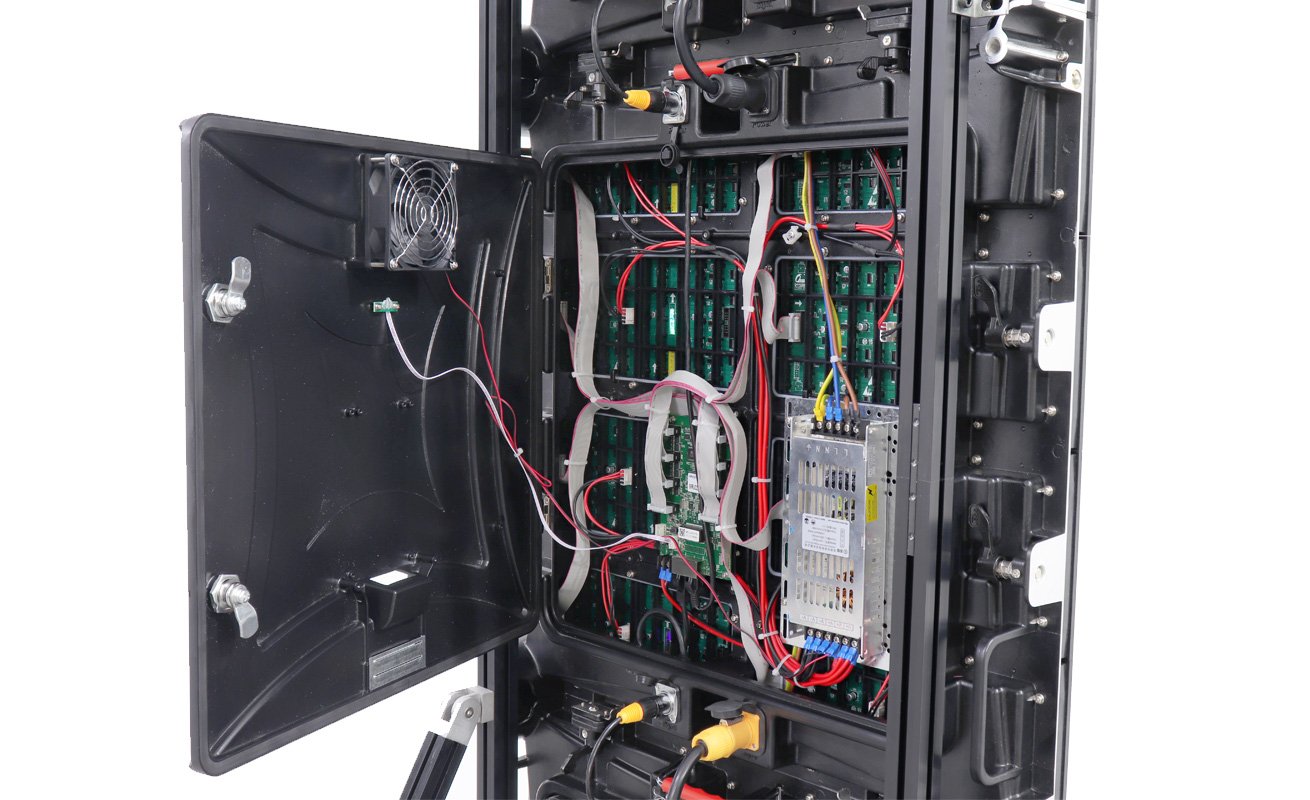
| Cabinet and access | How are modules, power supplies, and control cards replaced? | Limits downtime and determines clearance |
| Environment and electrical | What ratings, certificates, power figures, and fixing instructions apply to this model? | Supports safe placement and realistic running costs |
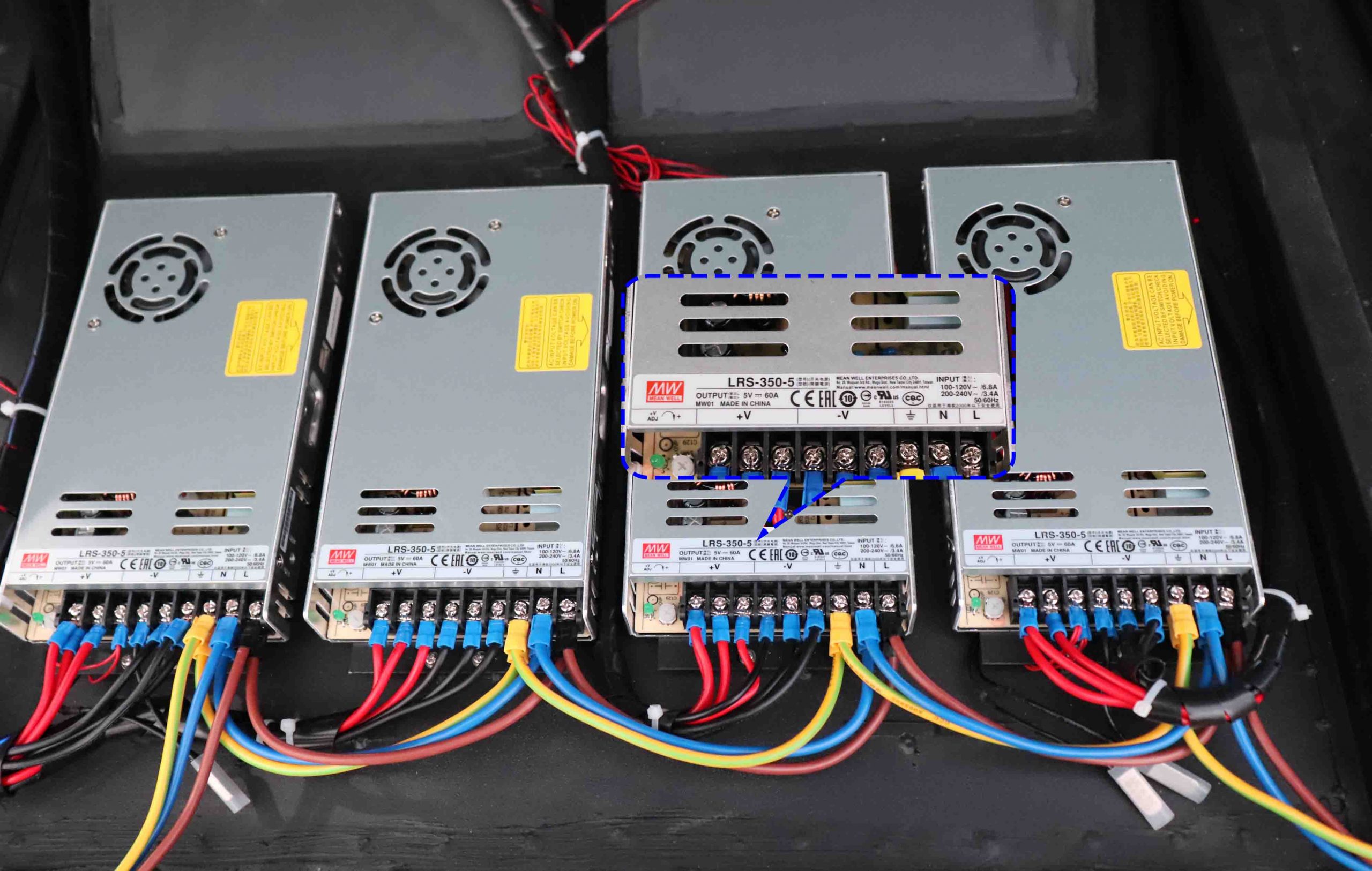
These questions describe a commercial LED poster display, not a DIY strip-light poster. A finished system needs matched modules, power supplies, receiving electronics, a stable cabinet, and a suitable controller. Improvised wiring is not an appropriate substitute for a rated product in an occupied retail or event space.
4. Build LED poster display creative that people can understand
The strongest LED poster display campaign answers three questions almost immediately: what is being offered, why it matters now, and what the viewer should do next. A passing audience may have only a few seconds. Use a short headline, one visual focal point, and a call to action that fits the location. For a window campaign, “See the new collection inside” can be more useful than a small QR code placed too far away to scan.
01 Design for the tall canvas
Build creative at the LED poster display’s native pixel dimensions and aspect ratio. Do not stretch a landscape television advertisement into a portrait screen. Keep critical text away from cabinet edges and from areas where a joined display may show seams. Test actual text size on the hardware; a design that looks large on a laptop can be unreadable from five meters. High contrast, restrained motion, and a clear product silhouette usually travel better than fine textures or long paragraphs.
Use motion to reveal a product, demonstrate a change, or direct the eye. Constant flashing can reduce comprehension and may be restricted by venue policy. A silent loop should still convey the message because sound is often absent in shops and public corridors. Include offer dates and conditions in a place customers can inspect more closely if they are too small for the primary LED poster display.
02 Schedule messages to match decisions
Dayparting means changing the playlist by time of day. A restaurant might show breakfast before 11 a.m., lunch later, and an evening menu after work. A retail chain might run a national brand asset plus a locally available product. Assign an owner who checks stock and promotion dates before the LED poster display goes live; a bright sign amplifies an incorrect price as effectively as a correct one.
Build a simple approval route: draft, factual check, brand check, publish, and expiry. Name files by campaign, location, orientation, and version. Keep a fallback slide with evergreen information if a network connection drops or an offer expires. Where many screens are managed together, permissions and a change log matter as much as the display specification.
| Element | Recommended approach | Field test |
|---|---|---|
| Headline | One concrete benefit or offer | Can a passerby repeat it after one glance? |
| Image or video | One subject with clean contrast | Does it remain clear from the planned sightline? |
| Call to action | One reachable next step | Can the viewer act before leaving the area? |
| Timing | Show the key message early in the loop | Does it work if the viewer sees only part of the sequence? |
| Accuracy | Price, dates, availability, and legal copy approved | Who removes it at expiry? |
| File format | Match native pixels and supported codec | Does the actual LED poster display play it without crop or stutter? |
For multi-unit compositions, decide whether every LED poster display carries a complete message or whether the group presents one image. Separate messages are resilient if one unit goes offline. A shared canvas can be striking, but it requires compatible cabinets, synchronized controllers, consistent calibration, and artwork designed around the overall pixel map.
5. Plan cost and measure results
The screen price is only one part of LED poster display advertising. A useful budget includes the cabinet and controller, stand or fixing, shipping, installation, power, network, artwork, content management, maintenance, spares, and eventual replacement. A lower purchase price can become expensive if a failed module is difficult to access or the control software cannot schedule a campaign reliably.
To estimate energy rather than guess, multiply measured average power in kilowatts by daily operating hours and days, then by the local electricity tariff. For example, a measured 0.25 kW average used for 10 hours on 30 days is 75 kWh; the cost is 75 times the local tariff. This is an illustrative calculation, not an energy claim for any EagerLED model. Ask for both maximum and typical operating power under the intended brightness and content.
Set a campaign objective before the LED poster display is installed. Store visits, product inquiries, coupon redemptions, QR scans, event registrations, or sales of an advertised item are different outcomes. Count only what you can attribute reasonably. A QR scan shows interaction, not a completed purchase; a sales lift may also reflect price, seasonality, or stock. Where possible, compare matched time periods or similar locations and record what else changed.
| Objective | Primary measure | Useful comparison | Caution |
|---|---|---|---|
| Bring people into a store | Entrance counts during the campaign | Comparable days before installation or a similar store | Weather and nearby events affect footfall |
| Generate product interest | Qualified staff inquiries | Same product without the screen message | Train staff to record the source consistently |
| Drive a specific offer | Unique code or landing-page visits | Other media using different codes | Do not equate scans with revenue |
| Support event traffic | Booth visits or demo bookings | Previous comparable event or aisle position | Booth location is a major confounder |
| Improve content operations | Time and cost to deploy a new promotion | Previous print replacement process | Include staff time and software costs |
A simple payback estimate is total project cost divided by the incremental contribution generated per period, after ongoing costs. Do not plug in impressions as revenue. If incremental contribution cannot be isolated, report the observable measures and uncertainty. An LED poster display can still make sense for service information, wayfinding, or brand presentation, but those benefits need their own success criteria.
6. Install and operate the LED poster display reliably
Before delivery, confirm dimensions, loaded weight, base footprint, power socket, circuit capacity, network method, and who is responsible for moving and fixing the unit. Check floor level, trip hazards, fire exits, access routes, and the venue’s display rules. Follow the manufacturer’s installation instructions and use qualified personnel for electrical and structural work. A movable LED poster display still needs a stable position and protected cabling when people can touch it.
01 Commission the image and playlist
Commissioning is a site test, not only a power-on check. Inspect the LED poster display for dead pixels or modules, color variation, panel alignment, playback stutter, and legibility from real audience positions. Test the morning and evening brightness settings. Confirm that the first approved playlist runs, the schedule uses the correct local time zone, and the unit recovers after a planned power interruption. If screens are joined, test synchronization and seams with the intended content.
02 Maintain a clear owner and spare-parts plan
Give one team ownership of artwork and another clear responsibility for hardware faults, even if the same supplier supports both. Record model, serial number, controller configuration, firmware version, and content template for each LED poster display. Ask about spare modules, power supplies, receiving cards, warranty scope, response time, and whether service is from the front or rear. Keep vents clear and clean the screen only as the manufacturer specifies.
For a multi-site rollout, pilot one or two representative locations before standardizing. A bright flagship window and a dim lobby may need different brightness and creative rules. Document lessons from the pilot: sightlines, customer behavior, actual power draw, content approval time, and support calls. Then use the evidence to refine the next LED poster display deployment.
7. Common LED poster display advertising mistakes
Buying on brightness alone. More nits do not fix poor placement, reflective glass, tiny text, or an unusable night setting. Test the entire viewing environment. Choosing pitch without creative. A fine-pitch LED poster display can be wasted on simple graphics viewed from far away, while coarse pitch may make a close-view price difficult to read. Confirm final artwork on real hardware.
Running an endless generic loop. Content that never changes loses relevance, even on an attractive screen. Give every campaign a purpose, target audience, approval owner, start date, and expiry date. Ignoring the service path. A screen installed tight against a wall may be difficult to repair if it needs rear access. Plan clearances before the unit arrives.
Assuming all poster displays are equivalent. A printed light box, LED-backlit LCD, direct-view LED poster display, and outdoor-rated LED cabinet solve different problems. State the technology and environmental requirement in the purchase request. Claiming results from exposure alone. An LED poster display can show a message, but sales impact requires a suitable measurement plan and careful attribution.
8. LED poster display FAQ
01 What is an LED poster display?
An LED poster display is a tall digital signage screen whose LED pixels emit the image directly. It normally combines modules, cabinet, power supplies, controller, and a stand or mounting system. It is used for replaceable advertising, promotions, and information in places with limited floor or wall space.
02 Is an LED poster display better than an LCD poster?
It depends on the site. Direct-view LED offers configurations for higher ambient light and modular expansion, while LCD usually offers fine close-range detail at a lower initial cost in controlled indoor light. Compare viewing distance, brightness, content, service, and lifetime cost for the specific installation.
03 What pixel pitch should a retail LED poster display use?
Choose pitch after measuring the nearest viewing distance and checking the smallest required text on the actual screen. A smaller P value means denser pixels, but it increases cost. Request the native resolution and test finished artwork rather than relying only on a generic distance formula.
04 Can an indoor LED poster display face a shop window?
Yes, if its brightness and dimming range make the message legible through that glazing under the site’s light conditions. Indoor equipment behind glass is still indoor equipment. If the screen or connections are exposed to weather or moisture, specify a suitable rated system.
05 How do I update content on an LED poster display?
Methods depend on the controller. A unit may accept USB files, local network updates, a built-in media player, or cloud scheduling. Confirm file formats, user permissions, time-zone behavior, and what plays during a network outage before deployment.
06 How should LED poster display advertising be measured?
Choose an outcome such as store entries, qualified inquiries, offer redemptions, or demo bookings. Record a comparable baseline and campaign dates. Treat QR scans and exposure as intermediate signals, and account for stock, seasonality, and other media when interpreting sales.
07 Can several LED poster displays form one screen?
Some compatible models can be joined and synchronized, but the cabinet locks, controller capacity, pixel map, and color calibration must support it. Confirm the exact configuration with the supplier and design artwork for the assembled canvas.
9. Conclusion: make the LED poster display serve a campaign
An LED poster display is most valuable when its location, specification, content, and operating process work together. Measure the site, test the final creative at the real distance, assign an owner to the playlist, and define success before the campaign starts. That turns LED poster display advertising from a bright fixture into a managed communication channel.
For available configurations, control options, and installation examples, review EagerLED’s LED poster display range. Share the site dimensions, viewing distance, light conditions, and campaign objective through our contact page when requesting a recommendation; those details lead to a more useful specification than screen size alone.