

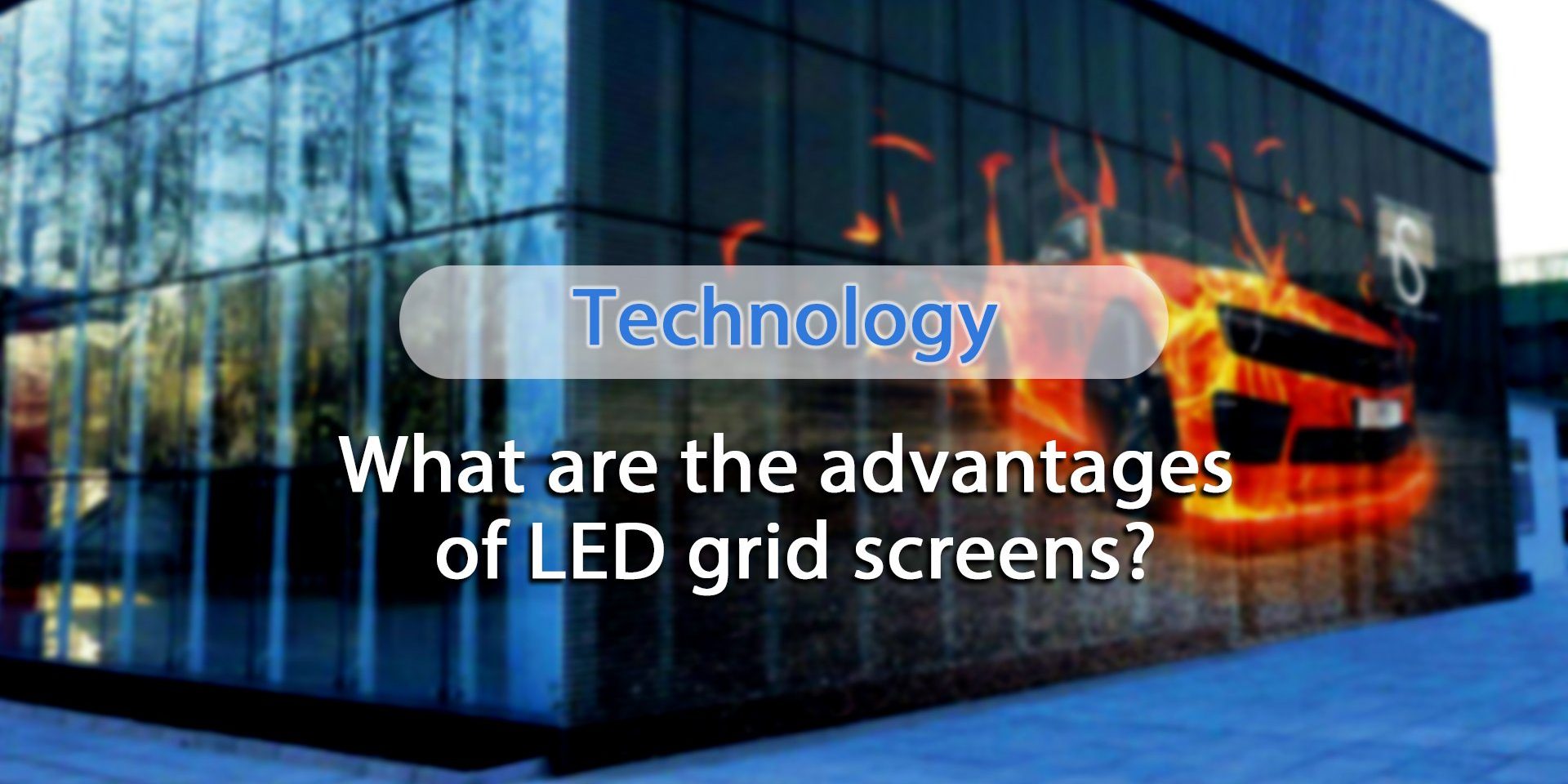
LED grid screens offer seven practical advantages: lower panel weight, reduced wind resistance, partial transparency, ventilation, modular sizing, accessible component layouts and potential energy savings. Their open structure suits large outdoor displays where airflow and visibility through the screen matter. The trade-off is image detail: a coarse-pitch grid display is usually better for distant viewers than small text seen up close.
By Shenzhen Eager LED Co., LTD. This guide explains the design benefits and the checks needed to turn them into a workable display specification.
What is an LED grid screen?
An LED grid screen uses spaced LED bars or strips instead of a fully closed display surface. The gaps allow light and air to pass through. Suppliers also use the terms grid LED display, LED grille screen and LED mesh screen, although rigid bar panels and flexible mesh systems are not necessarily interchangeable.
Transparent LED displays are a broader category. Some are designed for indoor windows; others are built for exposed outdoor locations. Compare construction, pixel pitch, protection rating and mounting method, rather than choosing by the word “transparent” alone. See EagerLED’s transparent LED screen options for related display formats.
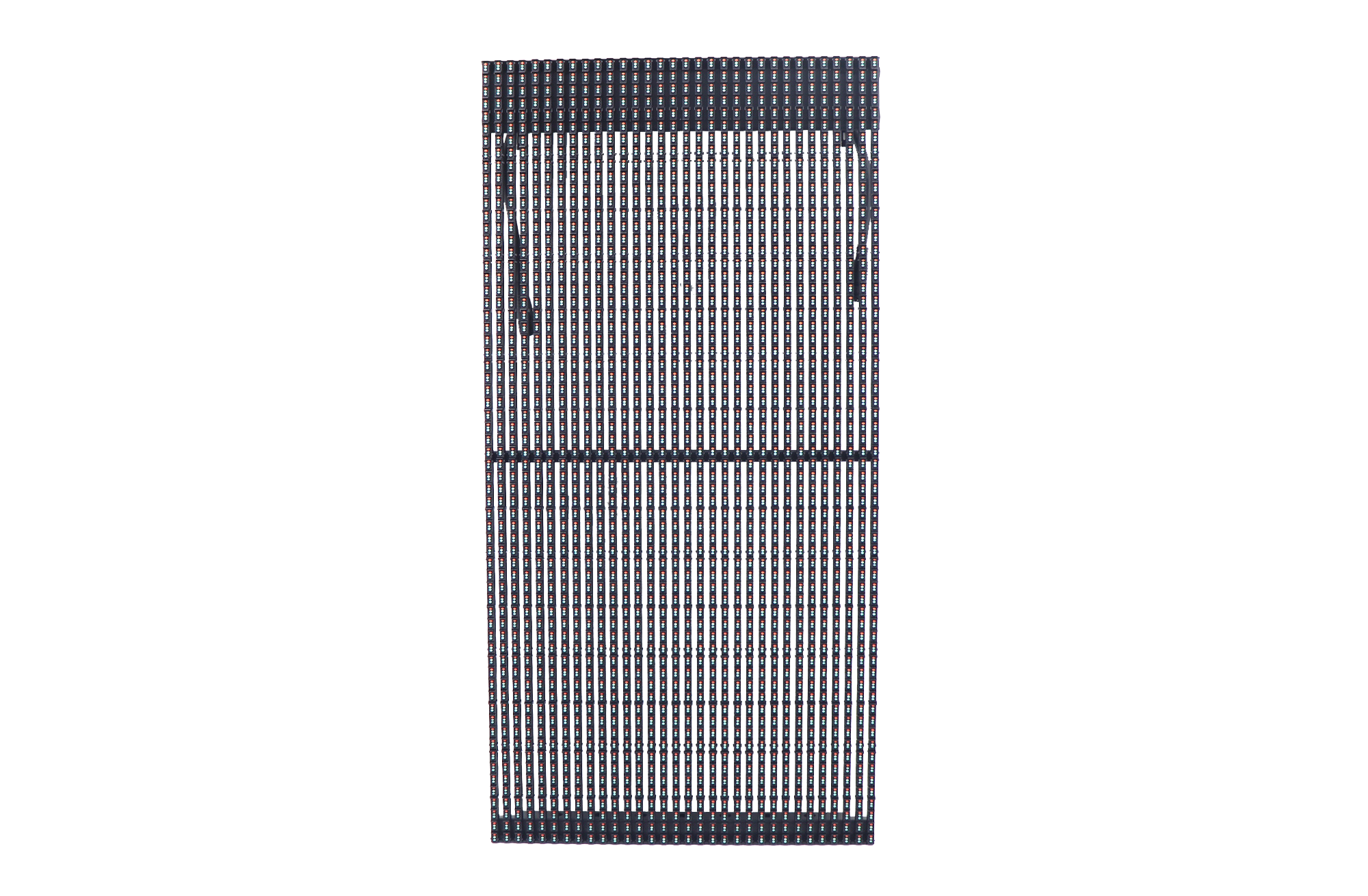
7 advantages of LED grid screens, with practical limits
1. Lower panel weight can simplify handling
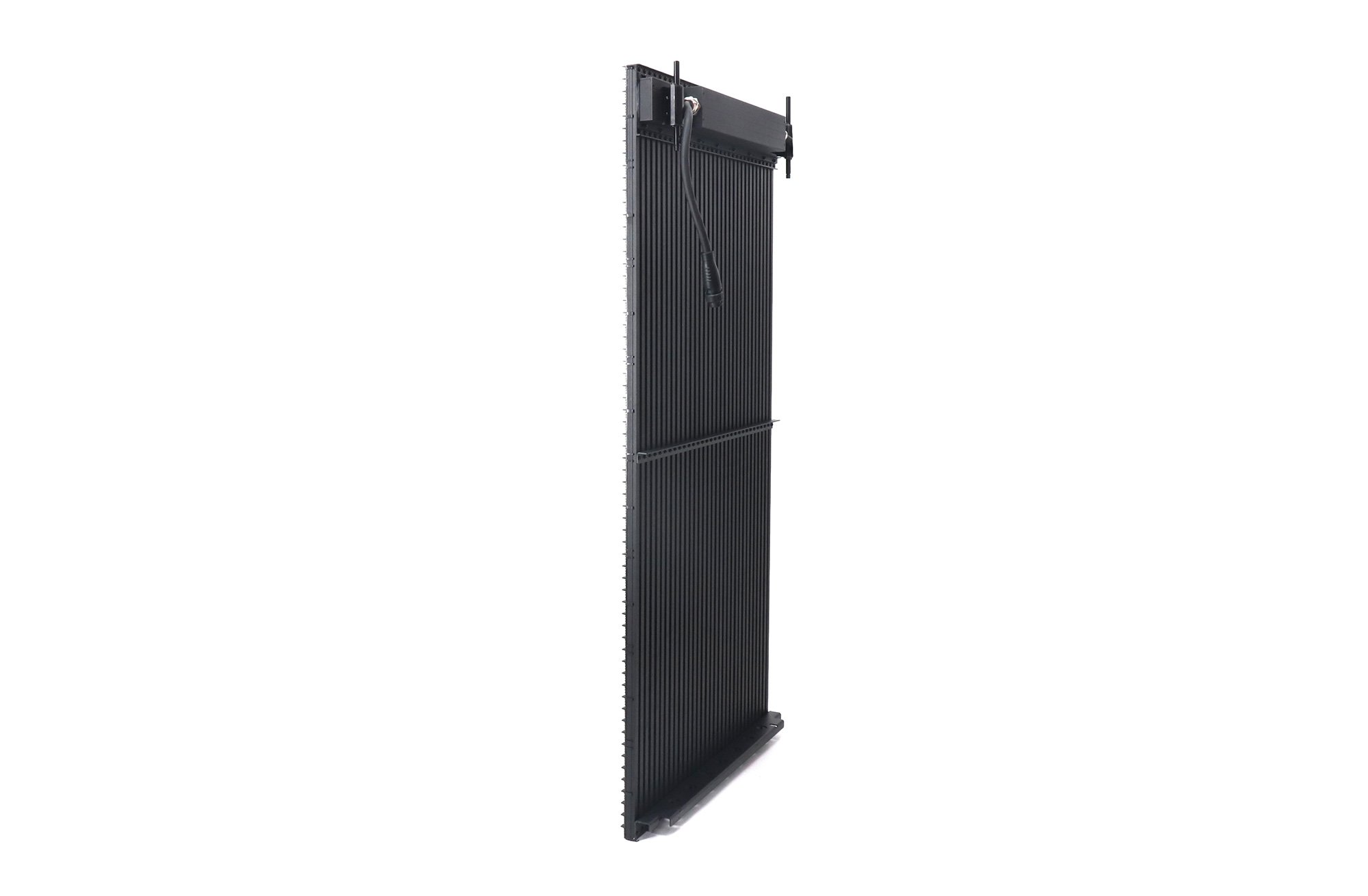
An open panel can use less enclosure material than a comparable closed cabinet. Lower unit weight helps with transport and positioning, particularly when assembling a large display. It does not mean the finished installation has the same weight as the LED panels alone: include frames, power equipment, cables and access equipment in the project assessment.
For example, EagerLED’s EA1000G reference table lists approximately 6.5 kg, 7.5 kg or 10 kg per 500 x 1000 mm cabinet, depending on the pixel configuration. The lowest weight is a model-specific value, not a specification for every grid screen.
2. Openings can reduce wind resistance
Air can pass through the openings instead of meeting a completely closed face. This can be useful on exposed facades and large outdoor structures. However, the actual forces depend on the panel geometry, support frame, installation height and local wind conditions.
Do not convert a transparency percentage directly into a wind-load reduction percentage. An open screen still needs an engineered support system and suitable fixings. No universal safe wind speed follows from the term “grid screen.”
3. Partial transparency preserves some light and views
The gaps make a grid display less visually closed than a solid LED wall. This can matter where a building facade or background should remain partly visible. Transparency also creates a compromise: increasing the open area can reduce the number of pixels available for a given display size.
The EA1000G reference configurations below illustrate this trade-off, with listed transparency of 40% or 70%. These are panel specifications. Framing, viewing angle and the structure behind the panel affect how transparent the installed screen appears.
4. The grille structure supports ventilation
Open channels allow air movement around the LED bars and can support heat dissipation. Maintain the clearances specified for the selected product; covering the rear with cladding or placing it against a wall can change the cooling conditions.
Ventilation is not a substitute for verifying ambient temperature limits, direct sun exposure and the thermal design of enclosed power components. Nor does it prove that a particular project can operate without additional cooling.
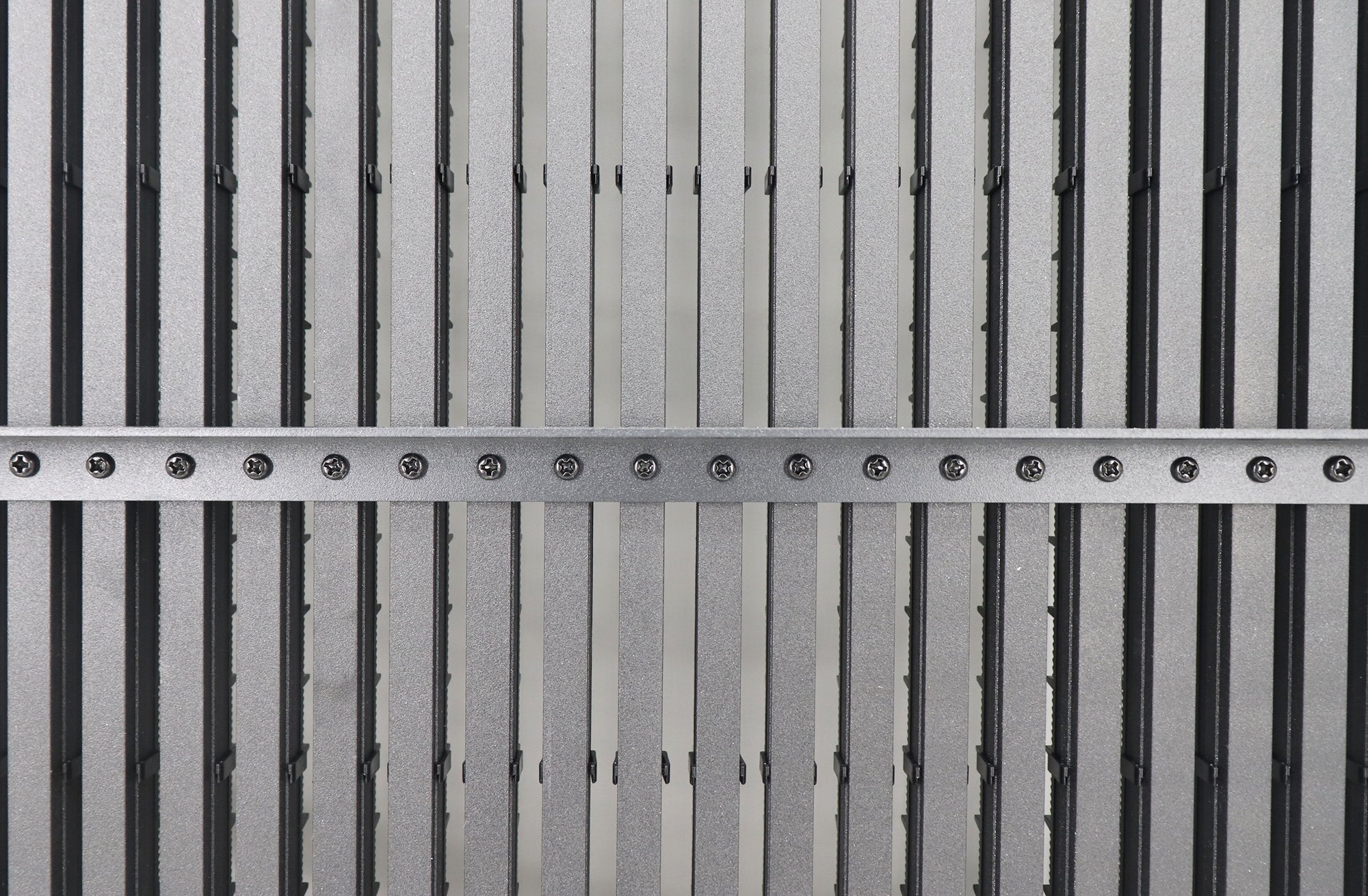
5. Modular panels support large display layouts
Repeated cabinet sizes allow a display to be assembled to suit the available width and height. This makes grid construction a candidate for building-scale advertising and large event visuals, subject to the selected product’s mounting permissions.
Physical size and image resolution are different. A larger screen with coarse pixels may still have too few pixels for small lettering. Confirm total pixel dimensions, content format, viewing distance and controller capacity before finalizing the cabinet layout.
6. Integrated components can make servicing more organized
A panel with an integrated enclosure and defined cable routes can simplify assembly and fault isolation. The practical benefit depends on whether technicians can reach the power supply, receiving card, connectors and replaceable display parts after installation.
Check the actual front or rear service method, replacement procedure and spare-part plan. A neat cabinet design cannot compensate for a screen mounted where its service side is inaccessible.
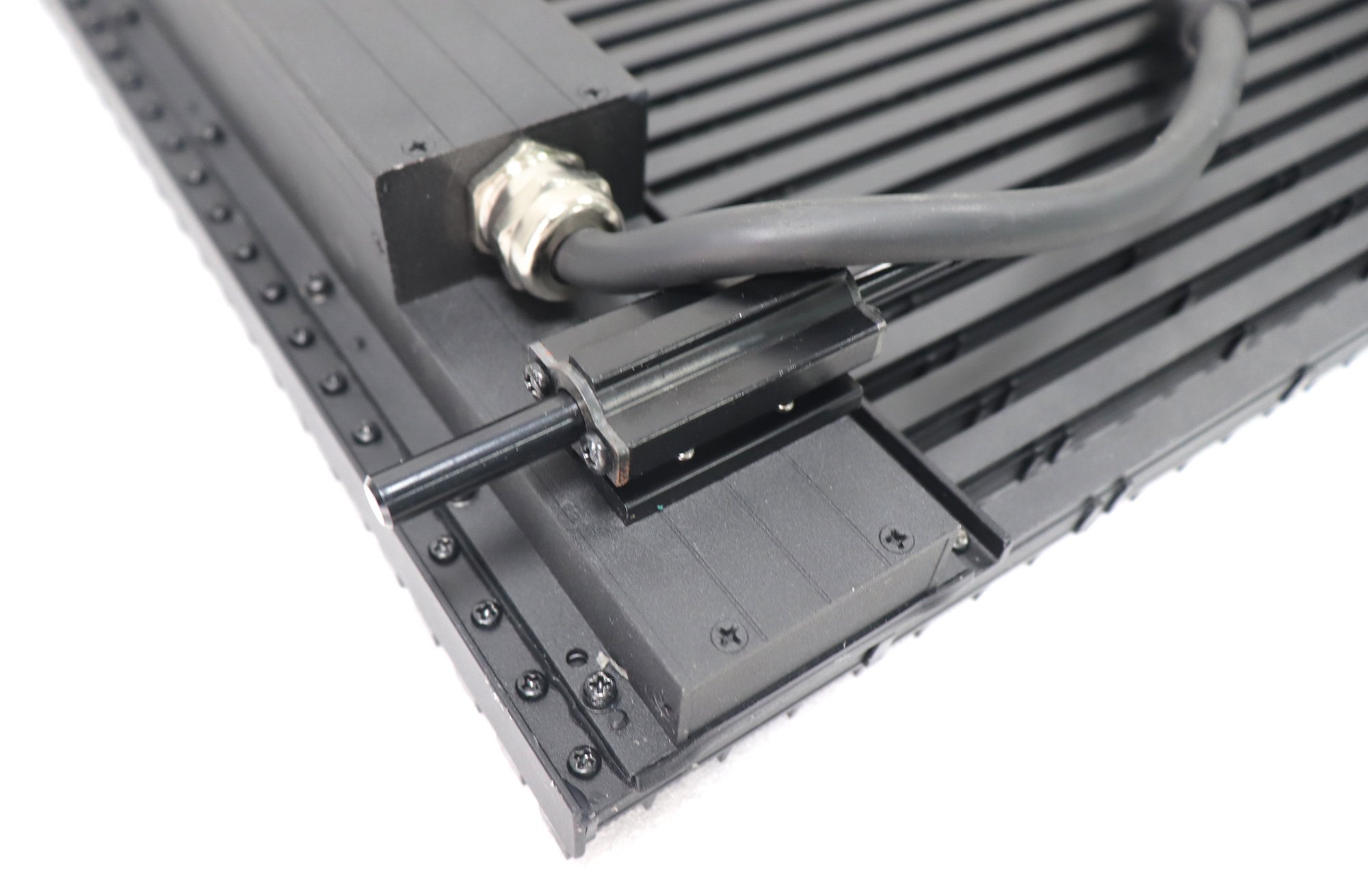
7. Energy savings are possible when configurations are compared fairly
A grid display can use fewer LEDs per unit area than a denser alternative, but brightness, drive design and displayed content also affect consumption. Compare the same screen area and operating conditions. Avoid assuming that every grid screen consumes less electricity than every LCD display, projector or solid LED screen.
Request both average and maximum power in W/m2. Use a representative operating profile to estimate energy costs and the manufacturer’s electrical requirements to design the power supply. Brightness scheduling and operating hours should be part of that comparison.
LED grid screen vs solid LED display: which fits?
| Decision factor | Grid LED display | Solid LED display |
|---|---|---|
| Light and airflow | Open areas let some light and air through. | A closed display face obstructs the background. |
| Image detail | Coarse-pitch models favor large graphics viewed from farther away. | Finer-pitch models can suit detailed content at shorter distances. |
| Outdoor structure | Open geometry may reduce wind resistance; engineering is still required. | A closed face requires assessment for its full geometry and mounting conditions. |
| Best starting point | Projects prioritizing openness, low panel mass and large visuals. | Projects prioritizing a continuous image surface and fine detail. |
Neither category is automatically the better choice. For a conventional advertising installation, compare the grid option with EagerLED’s commercial LED display solutions using the same content and viewing conditions.
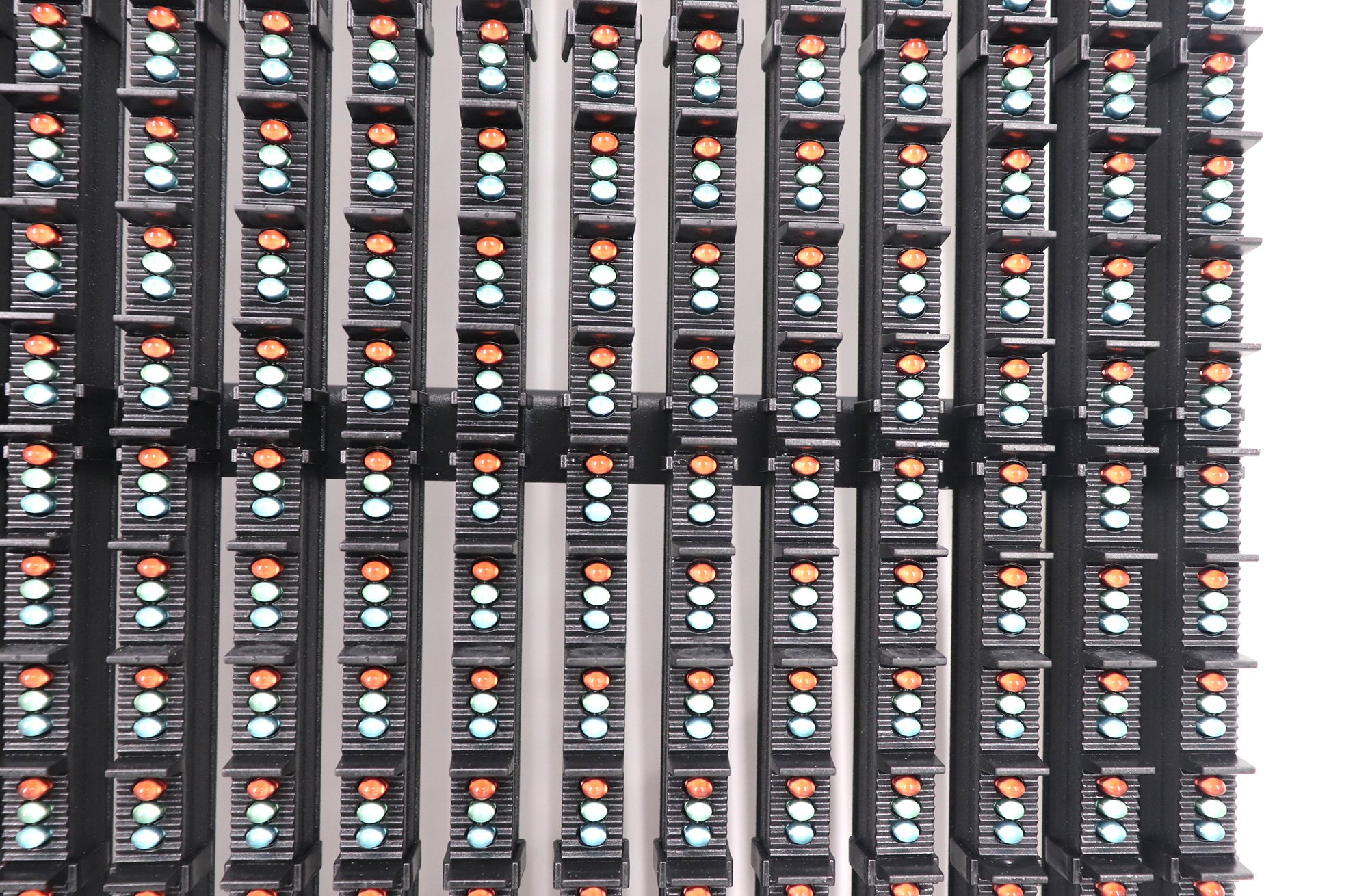
EA1000G reference specifications: the trade-offs in numbers
These values are from EagerLED’s EA1000G specification table, reviewed on September 7, 2026. They are configuration examples, not universal grid-display specifications or a statement of current stock. Confirm the current model datasheet and availability before ordering.
| Specification | P15.6-15.6 | P31.2-15.6 | P31.2-31.2 |
|---|---|---|---|
| Pixel pitch, horizontal x vertical | 15.6 x 15.6 mm | 31.2 x 15.6 mm | 31.2 x 31.2 mm |
| Cabinet size | 500 x 1000 x 67 mm | 500 x 1000 x 67 mm | 500 x 1000 x 67 mm |
| Approximate cabinet weight | 10 kg | 7.5 kg | 6.5 kg |
| Listed transparency | 40% | 70% | 70% |
| Listed brightness | 10,000 cd/m2 | 8,500 cd/m2 | 7,000 cd/m2 |
| Listed average power | 150 W/m2 | 150 W/m2 | 120 W/m2 |
| Listed maximum power | 450 W/m2 | 450 W/m2 | 350 W/m2 |
Illustrative energy calculation: using the listed 120 W/m2 average for a 20 m2 display gives 2.4 kW; 10 operating hours would equal 24 kWh. Using its listed 350 W/m2 maximum gives 7 kW. This is arithmetic from reference values, not a measured project result; actual energy use and the required electrical design must be established for the installation.
What should you check before ordering?
- Viewing task: specify the nearest and typical viewing positions, text size, video content and required pixel resolution. Review representative content at those distances.
- Transparency: compare open area and installed appearance, including the frame, cables and building background. Do not assess it only from a front-facing product photo.
- Structure and exposure: have the full assembly and its fixings assessed for the site. Verify the product’s environmental ratings, installation limits and service clearances.
- Power and control: obtain average and maximum consumption, power-distribution requirements, controller capacity and the signal-routing plan.
- Maintenance and total cost: confirm access, replacement parts, transport, mounting, commissioning and ongoing service. Compare the total installed scope, not panel price alone.
Send the screen dimensions, installation location, viewing distances, site photos and content requirements to EagerLED for a project-specific display recommendation. State whether the priority is transparency, fine image detail or a balance of both.
Frequently asked questions
What is an LED grid screen?
An LED grid screen is a display built from spaced LED bars or strips. The openings let light and air pass through the panel. Grid LED display, grille LED screen and LED mesh screen are overlapping industry terms; the actual construction and specifications determine suitability.
What are the main advantages of LED grid screens?
The main advantages are lower panel weight, reduced wind resistance compared with a closed surface, partial transparency, ventilation, modular sizing, accessible component layouts and potential energy savings. Each benefit depends on the selected model and installation.
Are LED grid screens suitable for close viewing?
Coarse-pitch grid displays are usually intended for longer viewing distances. Small text and detailed images can appear fragmented nearby. Check horizontal and vertical pixel pitch, total screen resolution and sample content at the nearest viewing position before choosing a screen.
Do LED grid screens always use less electricity?
No. Power use depends on the LED configuration, brightness, image content, screen area and operating schedule. Compare average and maximum power in W/m2 under equivalent conditions; an open structure alone does not prove lower consumption than LCD, projection or another LED display.
Does a grid screen need structural engineering?
Yes. Open areas can reduce wind resistance, but the screen, support frame, fixings and host structure still require a project-specific assessment. Transparency percentage is not a wind-load reduction factor. Follow the selected product documentation and local engineering requirements.