

Indoor LED screens suit controlled interiors, flexible LED screens create curved display surfaces, and outdoor LED screens are engineered for daylight and weather exposure. These categories overlap: “flexible” describes construction, while “indoor” and “outdoor” describe the operating environment. A bendable module is not automatically suitable for rain, and a bright display is not automatically comfortable in a meeting room.
This buying guide explains how to compare the three options, select pixel pitch, assess glare, plan installation, and request a complete quotation from EagerLED. Start with the closest viewer, actual content, available space, and service access. Those inputs matter more than choosing the smallest pitch or the highest brightness on a specification sheet.
1. Indoor LED Screens: Improving the Visual Experience in Enclosed Spaces
01. What is an indoor LED screen?
An indoor LED screen is a direct-view display assembled from light-emitting modules, typically mounted in cabinets or on a support frame. Unlike an LED-backlit LCD television, its visible pixels produce the image directly. Modular construction allows a continuous canvas sized for a lobby, conference room, shop, auditorium, or control space.
Indoor LED screens prioritize image detail, uniform color, usable low-brightness performance, and access for maintenance. Cabinet alignment and calibration determine how well modules blend together. The technology avoids LCD-style bezels, but poor mechanical alignment can still create visible seams.
02. Where indoor LED screens work best
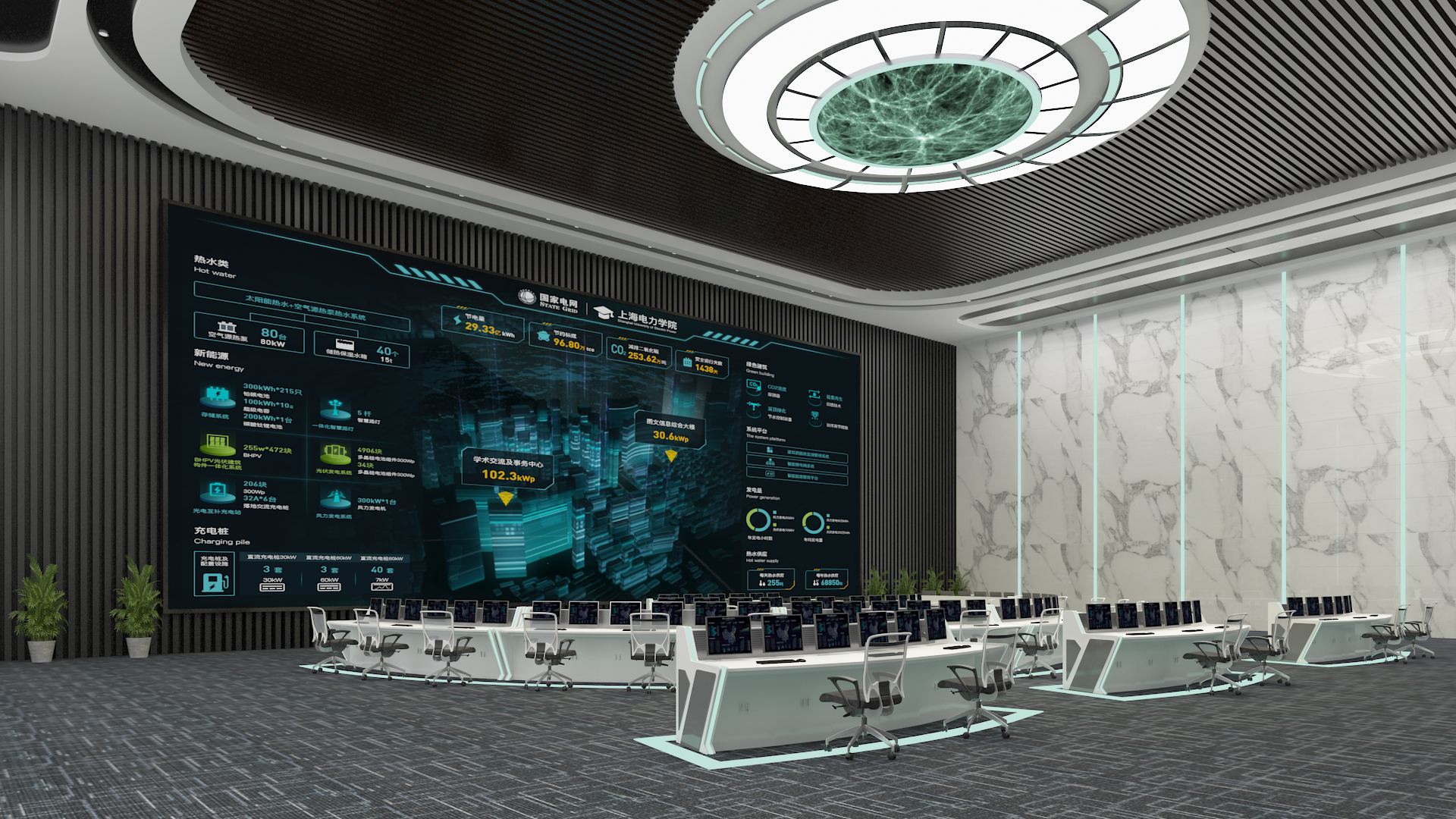
Meeting rooms need readable presentation text and predictable integration with conferencing equipment. Retail interiors benefit from schedules that change with campaigns. Auditoriums need enough image size for the back row, while control rooms require legible data, consistent color, and an operating plan for long daily use.
Consider alternatives for small screens and very close seating. A commercial LCD may meet a modest room’s requirements with simpler installation. Indoor LED screens become especially useful when a project needs a large continuous image, custom dimensions, or modular servicing. Decide using a demonstration of your real material at the intended viewing distance.
| Decision factor | Indoor LED screens | Flexible LED screens | Outdoor LED screens |
|---|---|---|---|
| Primary requirement | Comfortable, detailed images inside a building | A curved or custom-shaped video surface | Visibility and reliability in exposed locations |
| Environment | Controlled interior; verify humidity and cooling | Model-specific; many soft modules are indoor only | Rated exposure, temperature, and weather protection |
| Image priorities | Text clarity, low-brightness grayscale, color uniformity | Curve geometry, mapping, reflections, and viewing angles | Daylight contrast, readable content, and night dimming |
| Installation | Wall, frame, suspended, or freestanding design | Accurate custom frame and permitted bending radius | Engineered structure, weather seals, and service access |
| Main buying risk | Paying for resolution the audience cannot use | Assuming flexibility guarantees glare control or outdoor suitability | Treating brightness or an IP claim as a complete site specification |
2. Why Choose EagerLED for Indoor LED Screens?
EagerLED’s indoor product range provides a starting point for matching cabinet format, pixel pitch, and maintenance direction to the room. Evaluate the proposed configuration rather than relying on general claims about picture quality. Ask for its native resolution, calibrated brightness, cabinet weight, service clearances, controller model, and documented power requirements.
For indoor LED screens installed close to a wall, confirm that technicians can reach modules, receiving cards, and power supplies from the intended service side. Front-access modules alone do not prove that every component can be replaced from the front. Allow space for ventilation, cable routes, and safe removal of parts.
Use EagerLED’s detailed indoor LED screen buying guide for a deeper room-specific assessment. Request an acceptance demonstration using small text, dark gradients, skin tones, and the intended meeting or signage system. A showroom video is useful context, but it does not replace a test of the configuration being purchased.
3. How to Choose the Perfect Indoor LED Screen for Your Space
01. Match pixel pitch to viewing distance and content
Pixel pitch is the center-to-center spacing between adjacent pixels, measured in millimeters. Smaller pitch places more pixels in the same area. The best indoor LED screen buying guide therefore starts with the nearest regular viewer and the smallest information that person must read, not simply a desired “4K” label.
Planar’s pixel-pitch guidance distinguishes visual-acuity distance from subjective comfortable viewing distance. Simple distance rules are useful for an initial shortlist, but they cannot guarantee readable spreadsheets or an invisible pixel structure. Compare samples at the planned distance with the actual font sizes and graphics.
02. Calculate native resolution before ordering
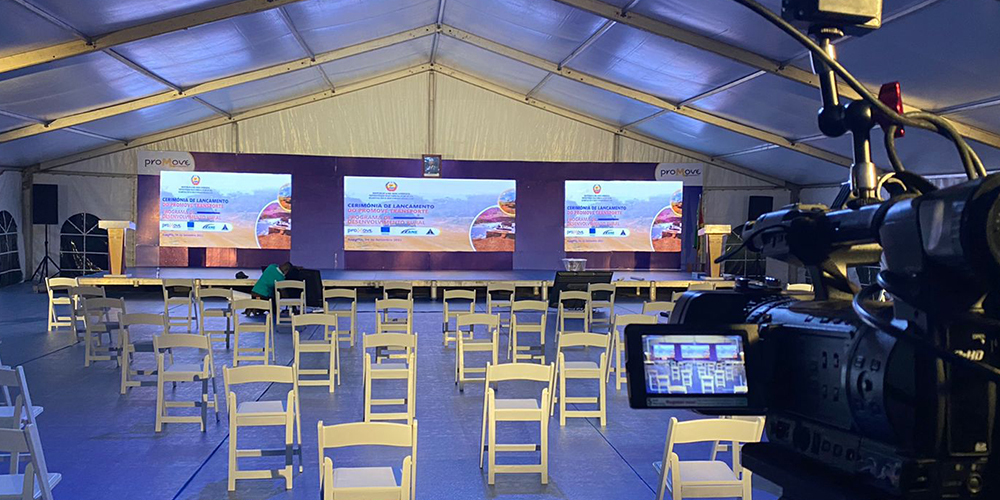
For a regular flat array, horizontal pixels equal active width in millimeters divided by horizontal pixel pitch. Vertical pixels follow the same calculation using height. A hypothetical 4,800 × 2,700 mm active surface at exactly 2.5 mm pitch contains 1,920 × 1,080 pixels. At exactly 1.25 mm, the same area contains 3,840 × 2,160 pixels.
These are design calculations, not a promise that any cabinet system can achieve those dimensions. Confirm whole-module increments and the final pixel map. A processor accepting a 4K input does not make a lower-resolution LED surface a native 4K display. Scaling can fit the source, but it cannot create additional physical pixels.
| Specification | What to request | How to verify |
|---|---|---|
| Pixel pitch and resolution | Exact pitch, active size, and total pixel matrix | Read the smallest required text from the closest seat |
| Brightness and grayscale | Calibrated operating range and low-level performance | View dark gradients at the intended room brightness |
| Refresh and camera behavior | Configuration-specific refresh, scan mode, and synchronization options | Record with the actual camera, shutter settings, and frame rates |
| Signal processing | Input formats, scaling, output capacity, and latency requirements | Run the complete source-to-screen signal chain |
| Service and cooling | Component access drawing, ventilation, and replacement procedure | Demonstrate a module and power-supply replacement |
| Power | Maximum load and representative measured consumption | Record operating brightness, content, and measurement conditions |
03. Balance brightness, integration, and maintenance
Indoor LED screens should remain comfortable under typical room lighting. Excess brightness can cause discomfort, while reflected windows or spotlights can reduce apparent contrast. Test the room during its brightest period and check dark content as well as bright demo footage. Dimming should preserve useful shadow detail and color consistency.
Specify the complete signal chain: source device, conferencing system or media player, processor, sending equipment, receiving cards, and cabinets. Confirm required inputs on the processor rather than assuming each LED cabinet accepts HDMI. For events that involve frequent transport, compare rental LED display systems with permanent-installation cabinets.
Refresh specifications also need context. A high quoted LED refresh rate does not guarantee freedom from camera banding or moiré. Shutter timing, scan behavior, camera distance, and synchronization matter. Test the intended camera setup and agree on acceptable results before shipping.
4. Flexible LED Screens: The Future of Creative Display Solutions
01. What is a flexible LED screen?
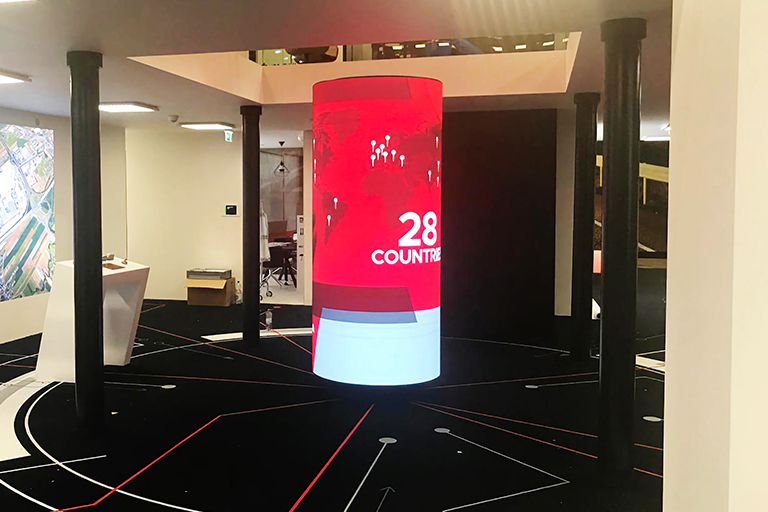
A flexible LED screen uses bendable modules to follow an engineered curved surface. Common applications include column wraps, concave walls, retail features, and exhibition structures. Flexible LED screens differ from flexible OLED panels in phones and televisions; they are modular commercial displays with their own mounting and control requirements.
Flexibility has limits. Obtain the model’s minimum bending radius, permitted bending direction, fastening method, and support drawings. A soft module should not be folded, twisted, or forced around a tighter radius than its specification allows. Its light weight does not remove the need for a stable, accurately fabricated frame.
02. Do flexible LED display screens reduce glare?
Flexibility alone does not reduce glare. Reflected light depends on the display surface, surrounding light sources, viewing angle, and installation geometry. Excess emitted brightness is a separate source of discomfort. Curving a screen changes reflection directions, but may improve one viewing position while worsening another.
For flexible LED screens in bright retail spaces, request information about the actual mask or surface treatment and inspect a sample under comparable lighting. Check reflections with dark content and with the display off. Then test operating brightness from several audience positions. Avoid applying an unapproved film or coating that could affect optics, cooling, or servicing.
03. Plan creative content and access
A cylindrical display needs a mapped canvas and a clear decision about where content begins and ends. Logos can distort around curves, and text may disappear around the back of a column. Keep essential messages within the audience’s usable viewing sector and test animation across module boundaries.
Flexible LED screens also need a practical replacement route. Record module orientation, cable routing, and configuration files so a technician can restore the image correctly. For overhead or publicly accessible installations, have the support and retention design assessed for the actual location and loads.
5. Why Choose EagerLED for Flexible LED Screens?
EagerLED’s flexible LED screen range includes indoor soft-module formats and examples of cylindrical and other custom installations. Its published 320 × 160 mm module information lists a P2 option at 160 × 80 pixels and 650 nits, and P2.5 at 128 × 64 pixels and 700 nits; both listed configurations have a 3,840 Hz refresh rate.
Those figures are product-specific examples, not specifications for all flexible LED screens. Confirm the selected module, driving configuration, brightness after calibration, and permitted curve in the quotation. Request a drawing that identifies the active area, structural supports, cable routes, controller allocation, and maintenance openings.
When comparing suppliers, review a project with similar geometry and audience distance. A sphere, cylinder, and gentle concave wall pose different fabrication and mapping challenges. Agree on a factory demonstration of the assembled shape, spare-module matching, and the files needed to restore calibration after maintenance.
6. Outdoor LED Screens: High-Performance Displays for Outdoor Environments
01. Define the exposure before selecting hardware
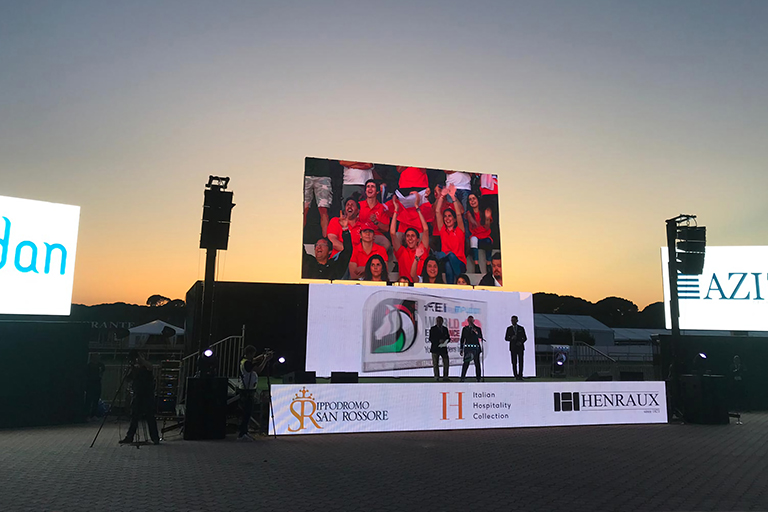
Outdoor LED screens are designed for locations where ambient light, moisture, dust, temperature changes, and structural loads affect operation. Typical uses include fixed advertising, public information, venue displays, and commercial plazas. An installation under a canopy may still encounter wind-driven rain, condensation, or strong sunlight.
Specify site conditions rather than relying on the word “outdoor.” Ask about the protection of the display face, rear enclosure, connectors, and cable entries. Also confirm the rated temperature and humidity conditions. An ingress-protection rating alone does not establish corrosion resistance, cooling capacity, wind resistance, or suitability for every climate.
02. Design daylight visibility and night operation
Outdoor LED screens need sufficient brightness and contrast for their orientation and sunlight exposure. Maximum output is not the correct setting for every hour. Plan automatic or scheduled dimming, verify sensor placement where used, and check readability during both daylight and evening operation.
Content design is equally important. Distant viewers need large lettering, concise messages, strong contrast, and enough display time to understand the information. Adding more pixels will not rescue crowded advertisements. Use a site photograph or viewing simulation to check whether buildings, trees, or sightlines obstruct the useful display area.
03. Plan structure, power, and servicing
The support design must account for cabinet weight, local site loads, anchoring, and maintenance access. Qualified local professionals should assess structural and electrical requirements. Confirm the relevant local signage requirements before finalizing size and brightness controls; this guide is not a substitute for a project-specific approval process.
Ask where technicians will stand, how they will replace a failed component, and how ventilation and drainage remain clear. Outdoor LED screens that are inexpensive to buy can be costly to maintain when access requires special lifting equipment or repeated closure of a public area.
7. Why Choose EagerLED for Outdoor LED Screens?
The EagerLED EA320F outdoor LED display is a concrete example to evaluate. Its product page describes front and rear service, 320 × 320 mm serviceable modules, an IP65 design, and brightness up to 8,000 cd/m². One cd/m² equals one nit. The 960 × 960 mm cabinet description also identifies four cooling fans.
“Up to” describes a product capability, not the required output for every installation. Confirm the quoted pitch, cabinet version, calibrated brightness, environmental limits, power, and protection details. Do not extend the EA320F specifications to other outdoor LED screens without checking their individual documentation.
Before ordering, request cabinet drawings, access requirements, a spare-parts list, and an itemized service scope. Agree on who supplies the structure, local electrical work, commissioning, and ongoing maintenance. Clear responsibilities make a supplier comparison more useful than an isolated price per square meter.
8. What Are the Benefits of Utilizing Outdoor LED Screens?
01. Update messages without replacing printed signs
Outdoor LED screens allow scheduled advertising, event announcements, and information changes on one surface. The practical benefit is control over what appears and when. Assign an operator, define approval steps, and keep a fallback message available if a source or network connection fails.
Measure results against the project’s purpose. A venue might track information accuracy and service availability; an advertiser might assess campaign response using an appropriate measurement method. Visibility does not guarantee sales, and the purchase of a screen does not establish an advertising return on investment.
02. Build a lifecycle budget
Modular servicing can reduce the scope of a repair, but outdoor LED screens still require inspection, cleaning appropriate to the product, replacement parts, and electrical energy. Compare realistic consumption at the planned brightness and content rather than treating a maximum power figure as the expected daily average.
Illustrative calculation: a 10 m² display averaging an assumed 250 W/m² for 12 hours uses 30 kWh per day: 10 × 250 ÷ 1,000 × 12. This is a budgeting example, not a measured EagerLED specification. Use the selected system’s measured load and the local electricity tariff; include cooling, control equipment, and other auxiliary loads where applicable.
9. How to Choose the Right LED Screen for Your Needs
01. Compare complete project quotations
Select indoor LED screens for controlled interiors, flexible LED screens when geometry requires bendable modules, and outdoor LED screens for the specified exposed environment. Then compare equivalent image quality, service access, and delivery scope. The lowest panel price may exclude essential parts of the installed system.
| Cost or deliverable | Confirm in writing | Why it matters |
|---|---|---|
| Display hardware | Model, pitch, cabinet count, active size, and spares | Makes proposals comparable at the same scope |
| Control system | Processor, sending and receiving equipment, licenses, and capacity | Ensures the native canvas and source formats are supported |
| Structure and installation | Drawings, fabrication, mounting, lifting, and local labor | Separates hardware cost from a usable installation |
| Electrical and environmental work | Distribution, cable routes, protection, ventilation, and site work | Prevents essential infrastructure being overlooked |
| Delivery and commissioning | Packaging, freight terms, taxes, testing, and training | Clarifies landed cost and handover responsibilities |
| Service over time | Warranty coverage, exclusions, response process, parts, and access costs | Supports repair planning and lifecycle budgeting |
02. Agree on acceptance before shipment
Write down the test content, operating brightness, viewing positions, camera requirements, and acceptable module uniformity. Record the supplied configuration and agree how defects will be handled. Demonstrate startup, content recovery, brightness changes, and component replacement instead of accepting only a bright promotional loop.
At handover, retain the wiring diagram, cabinet map, processor settings, calibration data, spare-parts inventory, and maintenance instructions. Train the person responsible for daily operation. Indoor LED screens, flexible LED screens, and outdoor LED screens all perform more predictably when ownership of the system is clear after installation.
10. Frequently Asked Questions About LED Screens
01. What is the difference between indoor, flexible, and outdoor LED screens?
Indoor LED screens are designed for interior conditions. Outdoor LED screens are specified for daylight and environmental exposure. Flexible LED screens use bendable modules for curved geometry and must separately be rated for their intended environment. Shape and weather suitability are different selection decisions.
02. Do flexible LED screens reduce glare automatically?
No. Flexibility changes shape, not necessarily surface reflectance. Check the module’s actual surface treatment, lighting, brightness controls, and viewing angles. Test a sample with dark content and from multiple positions before choosing flexible LED screens for a bright interior.
03. Which pixel pitch is best for an indoor LED screen?
The answer depends on viewing distance, active dimensions, and the smallest content detail. Shortlist pitches using the required pixel matrix, then test real content at the closest normal seat. A finer pitch can improve detail but also raises hardware and processing requirements.
04. Can an indoor LED screen be installed outdoors under a roof?
A roof does not necessarily prevent moisture, condensation, dust, or temperature exposure. Use a product explicitly approved for the actual site conditions. Do not assume an indoor module becomes suitable for an exposed location because direct rainfall is reduced.
05. How much do LED screens cost?
There is no single installed price that applies across these categories. Pixel pitch, total area, module design, brightness, custom framing, control equipment, installation, freight, and service scope all affect cost. Request an itemized quotation using Table 3 and compare the same deliverables.
06. Does a high refresh rate guarantee perfect camera images?
No. Camera banding and moiré also depend on shutter settings, frame rate, scan behavior, synchronization, and the relationship between camera and screen. Test the actual production setup rather than relying only on a refresh-rate number.
07. How long will an LED screen last?
Useful service life depends on brightness, operating hours, temperature, environment, component quality, and maintenance. An LED lifetime claim is not a whole-system warranty. Ask for the rating’s test conditions, warranty terms, and the expected availability of compatible replacement components.
11. Conclusion: Match LED Screens to the Installation
The right choice begins with the environment and the audience. Indoor LED screens need readable, comfortable images; flexible LED screens need accurate geometry and realistic glare assessment; outdoor LED screens need verified exposure limits, controlled brightness, and serviceable installation.
Send EagerLED the active dimensions, closest viewing distance, example content, site photographs or drawings, operating hours, desired shape, and installation schedule. Use those inputs to request a technical proposal with a complete cost breakdown, then agree on acceptance tests before placing the order.