


Black lamp outdoor LED screens use dark LED package surfaces to reduce visible ambient-light reflection and make inactive pixels appear darker. The main result is stronger perceived contrast, especially for video with shadows, fine detail and fast light-to-dark transitions. Black packages can also reduce surface glare and help colors look more saturated. However, package color alone does not determine screen brightness, power consumption, weather resistance or lifespan; those results depend on the complete module and cabinet design.
Key takeaways
- A black package usually improves the screen’s dark-state appearance and perceived contrast.
- Lower visible reflection can improve color separation and viewing comfort in bright environments.
- A white package may still be appropriate when maximum brightness per watt or a lower purchase price is the priority.
- Compare samples at the same measured luminance, pixel pitch, content and ambient light before selecting a lamp type.
In this guide:
- What is a black lamp outdoor LED screen?
- Black lamps vs. white lamps
- Six technical advantages
- Brightness, power and cost trade-offs
- How to compare LED samples
- Best applications
- Frequently asked questions
- Final recommendation
What Is a Black Lamp Outdoor LED Screen?
A black lamp outdoor LED screen uses LED components whose visible package frame or face is dark rather than white. The red, green and blue semiconductor dies still generate the image. The difference is the surface surrounding those dies: when a pixel is off or displaying a low gray level, a black surface contributes less visible background light than a pale surface.
This distinction matters outdoors because the audience sees two light sources at once: light emitted by the display and ambient light reflected from the module surface. The darker package is intended to reduce the second source. It does not create contrast by itself; the module mask, coating, louvers, calibration and installation angle also affect the result.
For example, Nationstar describes its RS-1921 black-cased LED component as having a “Full Black Frame, High Contrast” and lists P3-P6 applications. Its page also shows a P3.9, 1/8-scan, 5,000-nit reference configuration. These are component and reference-configuration details, not a guaranteed specification for every complete display. A finished cabinet must still be tested with its actual driver ICs, power supplies, mask, thermal design and calibration.
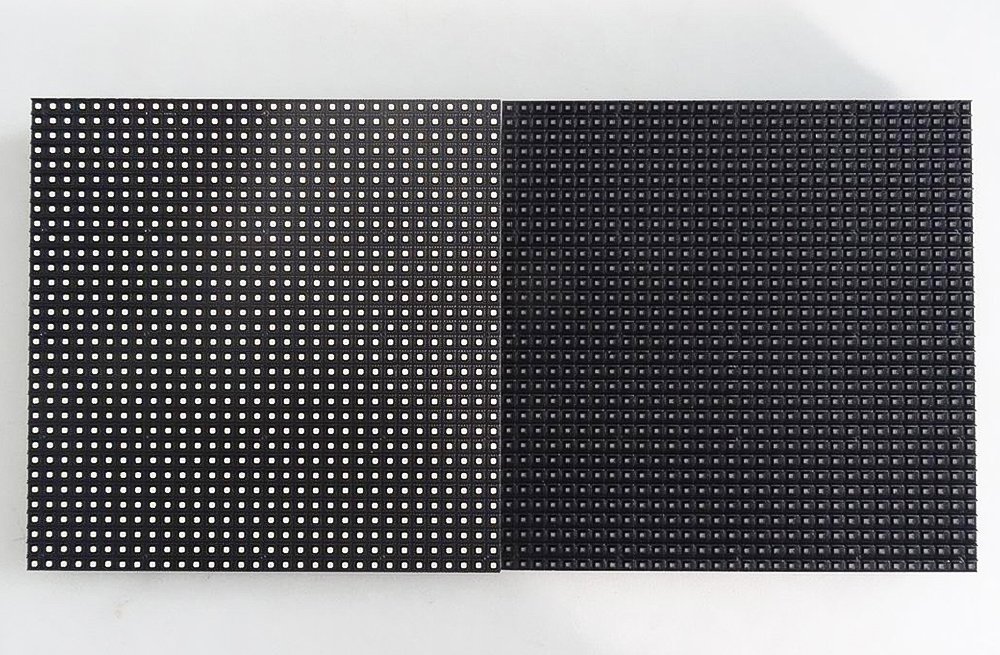
Black Lamps vs. White Lamps: Quick Comparison
| Decision factor | Black LED package | White LED package |
|---|---|---|
| Dark-state appearance | Darker inactive surface | Paler inactive surface |
| Ambient reflection | Usually lower when surface finish is comparable | Usually more visible in bright light |
| Perceived contrast | Often stronger at matched brightness | May require more emitted light to overcome the brighter background |
| Optical efficiency | Depends on the package and module design | Reflective package surfaces may support high apparent brightness |
| Power use | Not determined by package color alone | Not determined by package color alone |
| Typical priority | Image depth, color separation and premium viewing | Peak-output or budget-led specifications |
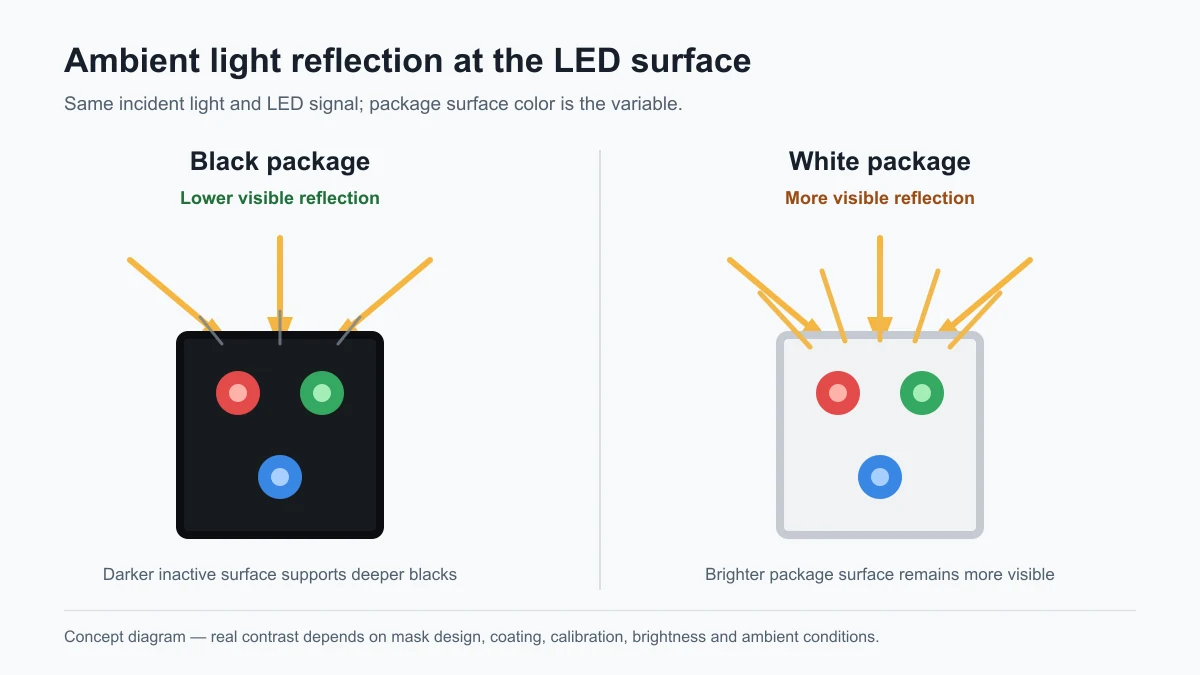
Concept diagram: a darker package can make reflected ambient light less visible, but real contrast also depends on the mask, coating, calibration and viewing conditions.
Six Technical Advantages of Outdoor Black Lamp LED Screens
1. Deeper black levels and higher perceived contrast
Contrast is the relationship between the bright and dark parts of an image. A black package lowers the visible baseline around the emitting chips, so an off pixel looks closer to black. At the same calibrated luminance, that darker baseline can make bright content stand out more clearly.
The improvement is most noticeable in shaded footage, night scenes, black backgrounds and content that mixes very bright highlights with dark detail. It is less meaningful when the screen displays full-white graphics continuously or when direct sunlight overwhelms both package types.
2. Less visible ambient-light reflection
Outdoor modules receive light from the sun, sky, buildings and venue lighting. Pale package surfaces can reflect part of that light toward the viewer. A dark, matte package absorbs more of the incident light and can reduce the washed-out appearance caused by surface reflection.
Package color is only one layer of reflection control. A well-designed black mask, non-gloss coating, deep louvers and correct screen orientation may be equally important. When reviewing a sample, examine the complete module under the intended viewing light rather than inspecting a loose LED component indoors.
3. Better color separation at low and medium brightness
Red, green and blue light is easier to distinguish when it is surrounded by a neutral dark surface. This can make saturated colors appear cleaner and reduce the milky cast that a bright package surface may add to darker content. The practical benefit is stronger color separation without automatically increasing the output level.
Accurate color still requires correct white balance, grayscale calibration and consistent binning. A black package cannot correct mismatched LED wavelengths or poor calibration, so buyers should request measured color-uniformity results for the complete screen.
4. Clearer shadow detail and motion transitions
Video content often contains rapid transitions between dark and bright areas. When the dark-state surface is less visible, the eye can distinguish edge detail and low-gray transitions more easily. This supports sports replays, stage video, cinematic advertising and other material where texture would otherwise disappear into a gray background.
Motion quality also depends on refresh rate, scan mode, driver behavior and camera settings. Black packaging improves the optical background; it does not replace a high-quality control system or eliminate scan lines and flicker.
5. Lower perceived glare in some viewing conditions
A darker matte surface may produce fewer bright reflections than a white or glossy surface. That can improve viewing comfort where spectators see the display from a shallow angle or where strong venue lights strike the screen. The effect is especially useful when the content does not need to run at maximum luminance.
This is a perceived-glare benefit, not a safety certification. Maximum luminance, installation angle, automatic brightness control and operating schedule still need to be selected for the site and local requirements.
6. A more uniform appearance when pixels are off
Black-package pixels visually blend with a dark mask and cabinet face. This can make module boundaries, service panels and inactive areas less obvious before the screen powers on and during black frames. The result is a cleaner visual surface for close-view outdoor stages, broadcast backgrounds and premium advertising installations.
Physical uniformity still depends on mask flatness, module alignment and consistent surface finish. Inspect the screen both powered and unpowered; a bright demo reel can hide mechanical variation that becomes visible during black content.
Brightness, Power and Cost Trade-Offs
The most important purchasing correction is simple: a black LED package is not automatically lower-power, and a white package is not automatically brighter. Package color influences optical behavior, but total screen performance also depends on chip efficacy, drive current, scan ratio, driver IC, power-supply efficiency, heat management, brightness calibration and the content being shown.
Nationstar lists “Low Power Dissipation” and “High Luminous Intensity & High Reliability” for its RS-1921 black component. Those statements apply to that product family and its reference conditions. They should not be copied directly into a finished-screen specification without system-level measurements.
Compare these trade-offs before purchase:
- Peak brightness: confirm the sustained calibrated luminance after warm-up, not only the highest laboratory value.
- Power: request maximum and typical input power at a stated brightness and content pattern.
- Heat: compare module and cabinet temperatures after the same operating period.
- Cost: black packages and tighter binning may add cost, but the better contrast may allow a lower operating brightness at some sites.
- Weather protection: confirm the completed module and cabinet IP rating; a waterproof lamp component does not establish the IP rating of the full screen.
For permanent roadside or facade projects, review the full outdoor fixed LED display specification. For touring stages and frequent assembly, compare the package together with cabinet weight, locks and service access on the rental LED display page.
How to Compare Black and White LED Samples
A useful comparison changes one variable at a time. If the black sample uses a newer driver, different mask or different brightness setting, the result cannot be attributed to package color. Ask the supplier to document the test configuration and retain the readings with the quotation.
- Match the hardware. Use the same cabinet size, pixel pitch, scan ratio, driver IC, power supply, receiving card and refresh-rate setting.
- Prepare both samples. Run the modules for the same warm-up period and confirm that brightness and color calibration are current.
- Match measured luminance. Use a luminance meter to set both samples to the same nit level at the main viewing position.
- Control the environment. Record ambient illuminance, light direction, viewing distance and viewing angle. Repeat the test in shade and in the brightest expected condition when possible.
- Use identical content. Include full white, full black, grayscale ramps, saturated colors, faces, shadow detail and fast motion.
- Measure rather than guess. Record black level, white luminance, calculated contrast, color coordinates, uniformity, input power and surface temperature.
- Check off-axis performance. Repeat key readings and visual checks from the side positions that real viewers will use.
- Document limitations. Note whether the samples differ in mask, coating or LED bin, and do not generalize a component result to every screen model.
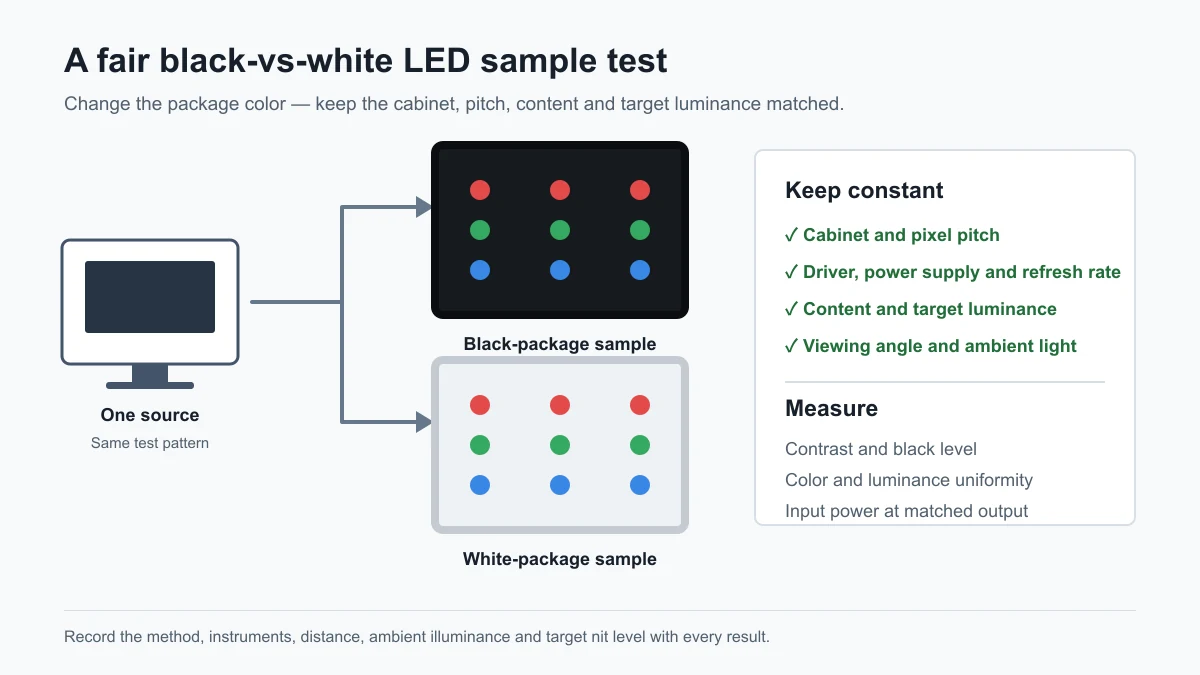
Controlled comparison setup: keep the cabinet, pitch, signal, target luminance and ambient conditions constant; then measure contrast, color and input power.
Best Applications for Black Lamp Outdoor Screens
Black packages are most valuable when image quality matters as much as raw output. Strong candidates include outdoor stages, stadium video boards, airport information displays, hotel and retail facades, premium digital advertising and broadcast-visible installations. Nationstar lists outdoor stage, stadium, airport and hotel applications for its RS-1921 black component, which aligns with the use cases where contrast and a dark inactive surface are useful.
A white-package display may still be the practical choice for a high-mounted sign viewed mainly in strong daylight, a project with a strict capital budget, or an application dominated by high-brightness text and simple graphics. The correct decision depends on the site’s ambient light, viewing distance, content, operating hours and energy target.
For sports venues, also consider impact protection, viewing angle and front-service access; the stadium perimeter LED screen overview explains those system-level requirements. For component-level service planning, review the available outdoor LED display modules.
Frequently Asked Questions
What is a black lamp LED display?
It is an LED display built with components whose visible package frame or face is dark. The dark surface reduces the amount of background reflection seen around the red, green and blue emitters, which can improve perceived contrast.
Are black LED lamps brighter than white LED lamps?
Not necessarily. Brightness depends on chip output, package optics, drive current, scan mode, thermal design and calibration. Compare sustained measured luminance for complete cabinets under the same conditions.
Do black lamp LED screens use less power?
Package color alone does not determine power consumption. A higher-contrast screen may meet a visual target at a lower brightness in some environments, but the only reliable comparison is measured input power at the same luminance, content and operating temperature.
Are black LED packages waterproof?
Some outdoor black components are designed with waterproof features, but the finished screen’s protection depends on the module, seals, cabinet, connectors and installation. Specify and verify the IP rating for the complete product.
Are black lamp LED screens better for direct sunlight?
They can reduce visible surface reflection and improve contrast, but direct-sun performance also requires sufficient sustained brightness, a suitable mask and louver design, automatic brightness control and correct screen orientation.
How should I choose between black and white LED lamps?
Choose from matched samples, not component color alone. Define the site’s ambient light, target brightness, viewing angles, content, power limit and budget; then compare contrast, color, power and temperature with every other test condition held constant.
Final Recommendation
Choose black lamp outdoor LED screens when deeper blacks, lower visible reflection and stronger perceived contrast are central to the project. Choose white packages when the tested system better satisfies a peak-output or budget requirement. In either case, require a matched cabinet comparison and a written test record before approving the bill of materials.
EagerLED can prepare a sample comparison around your pixel pitch, cabinet type, target luminance, viewing distance and installation environment. Send the project requirements through the form below or contact EagerLED for a configuration recommendation.