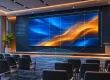
A flexible LED display is a modular direct-view LED screen designed to follow a curved supporting surface. Its soft modules allow designers to wrap columns, build concave walls, create wave forms, or fit a display into architecture where a flat cabinet would leave visible steps. That design freedom helps explain the growing interest in flexible LED displays across retail, exhibitions, hospitality, and entertainment.
Popularity alone does not make a flexible LED display the right choice for every project. The screen still needs a rigid, accurately made structure behind it; the modules have a specified bending direction and minimum radius; and power, content, ventilation, and service access still need planning. A flat LED wall may be simpler and less expensive when the shape is flat.
This guide explains why flexible LED displays are popular, where they work best, the specifications that matter, and the tradeoffs a buyer should check before ordering. It separates design benefits from claims that depend on a particular product model.
Contents
1. What Is a Flexible LED Display?
A flexible LED display uses bendable LED modules rather than conventional flat, rigid cabinets as its visible surface. Each module carries LEDs, driver electronics, connectors, and a flexible backing. The modules attach to a purpose-built frame, often with magnetic or mechanical fasteners, to form one continuous image. The frame sets the final geometry; the electronics do not hold a free-standing curved shape by themselves.
01. Flexible modules versus curved cabinets
These terms are sometimes confused. A curved cabinet is usually a rigid panel joined to its neighbors at an angle. Several cabinets can approximate a large-radius curve, but the surface may look faceted at close range. A flexible LED display can follow a smoother form because the module itself bends within its approved range. That distinction matters for a small column, tight concave corner, or close-view architectural feature. For a broad, gentle curve, curved rigid cabinets may be adequate and easier to service.
02. What “flexible” does and does not mean
Flexible does not mean rollable like fabric, foldable without limits, or safe to bend in any direction. The allowable bend radius, axis, mounting method, and handling procedure differ by model. A flexible LED display is commonly intended for a fixed indoor installation; weather resistance and repeated rental handling must be verified separately. Ask for drawings and a sample before committing to a complex shape.
2. Why Are Flexible LED Displays Popular?
01. They turn architecture into an image surface
A flat rectangle often competes with a curved interior. A flexible LED display can instead follow a pillar, circular reception desk, ceiling feature, or concave wall. The result can use space that would otherwise be difficult to monetize or design around. Continuous motion across the curve can attract attention from several walking directions, especially in a retail or exhibition environment. The business value depends on content and location, not merely on the screen’s shape.
02. They offer modular size and service options
Modules can be assembled into custom widths and heights, and a damaged module can usually be replaced without replacing the entire display. A front-service flexible LED display can be useful where there is no rear corridor, provided the chosen fasteners, tools, power supplies, and receiving cards are all accessible from the front. Confirm the actual replacement sequence in the supplier’s installation manual. “Front service” on a quotation should describe every component that may need maintenance, not just the LED tile.
03. They support close-view creative content
Many flexible LED displays are offered in indoor fine pitches suitable for lobbies, brand environments, and immersive exhibits. Pixel pitch is the center-to-center distance between neighboring pixels; a smaller pitch gives more pixels on the same area and generally supports closer viewing. It also raises the number of LEDs and often the price. Content should be designed for the geometry: text around a column can disappear as viewers move, while broad motion and high-contrast graphics often remain legible.
04. They can reduce visible segmentation
When the module size, mechanical tolerances, calibration, and content mapping are well matched, a flexible LED display can make a smooth visual transition around a curve. It does not automatically eliminate seams or color differences. Poor frame accuracy, uneven module pressure, mismatched batches, and incorrect mapping can create visible defects. A factory test with the final curve and representative content is more useful than a flat showroom demo.
| Buyer need | Potential benefit | Condition to verify |
|---|---|---|
| Wrap a column or curved wall | Use architecture as a continuous media surface | Radius, frame tolerance, cable route |
| Serve viewers from many angles | Image remains visible around a form | Viewing geometry and content layout |
| Fit a narrow footprint | Custom depth and shape | Power, ventilation, service clearance |
| Refresh branded environments | Dynamic visuals without rebuilding the entire feature | Content management and long-term spare parts |
3. Where Does a Flexible LED Display Work Best?
The strongest applications are places where the curve solves a real design problem. A flexible LED display is less compelling when a flat screen already fits the viewing angle and architectural intent.
01. Retail, hospitality, and corporate spaces
Column wraps in shopping centers can carry branding without occupying a separate wall. Curved reception displays can help visitors see messages from a wider approach path. In a hotel or corporate lobby, an inward curve can create a focused visual experience. For these spaces, check glare, ambient light, viewing distance, opening hours, and the ability to replace a module while the venue remains open.
02. Exhibitions, museums, and entertainment
A flexible LED display can form an immersive arc, curved exhibit backdrop, or sculptural element. Permanent exhibits usually allow a custom metal frame and hidden cable paths. Touring installations have different priorities: repeated assembly, shock protection, fast connectors, and replacement stock. Do not assume a soft-module product designed for a permanent wall is also suitable for frequent rental cycles.
03. Shapes that need extra engineering
Cylinders, S-curves, tight corners, spheres, and overhead ribbons can require custom module sizes, support segments, and content mapping. A “sphere” may combine several surface directions; a product that bends on one axis may not cover it cleanly. An overhead flexible LED display also needs a structural load calculation and a secure secondary restraint where applicable. The screen supplier, structural engineer, and installer should agree on the final drawing before fabrication.
| Geometry | Likely option | Why |
|---|---|---|
| Flat wall | Rigid LED cabinets | Simple structure and service |
| Broad curve | Angled or curved rigid cabinets; flexible modules if seamless curvature matters | Compare visual smoothness with cost |
| Small column or tight continuous curve | Flexible LED display | Soft modules follow the form within their rated radius |
| Frequently rebuilt stage wall | Rental cabinets designed for repeated handling | Durability and setup speed may outweigh tight curvature |

4. Which Flexible LED Display Specifications Matter?
01. Pixel pitch and viewing distance
Start with the nearest typical viewer, not a generic “HD” label. Pitch describes physical pixel spacing; it does not by itself state the full screen resolution. For example, a 2.5 mm pitch has approximately 400 pixels per meter in each direction before allowing for module dimensions and edge treatment. A four-meter-wide image at that pitch is approximately 1,600 pixels wide. A close-view text installation may need a finer pitch than a high-level decorative ribbon. Check final screen dimensions and source content together.
02. Bend radius and direction
Minimum bend radius is the tightest approved curve, usually measured in millimeters from the center of the arc. A smaller radius means a tighter curve. Confirm whether the quoted radius applies to concave and convex mounting, whether the module bends horizontally or vertically, and whether cables or connectors reduce the practical limit. A supplier’s drawing should identify the measurement reference. Do not force a flexible LED display beyond the tested radius; excessive stress may affect the circuit, LED packages, or connectors.
03. Brightness, refresh, and color
Brightness should suit ambient light and viewer comfort. More nits are not automatically better in a dim indoor lobby. Ask for adjustable calibrated brightness, not only a peak figure. Refresh rate matters for cameras and filmed events, but a number such as 3,840 Hz is model-specific and does not guarantee flicker-free recording under every shutter setting. Also request grayscale performance at the intended brightness, viewing-angle data, calibration method, and the expected appearance at the tightest curve.
04. Power, protection, and reliability
Compare maximum and typical power per square meter under stated test conditions. Average consumption depends on brightness and content, so one universal wattage claim would be misleading. Include electrical distribution, thermal management, grounding, and access to power supplies in the design. Outdoor use requires a product and enclosure explicitly rated for the environment; flexible modules alone should not be assumed weatherproof.
| Specification | Ask the supplier | Why it matters |
|---|---|---|
| Pixel pitch and finished resolution | What is the actual pixel matrix at the proposed size? | Text size and source mapping |
| Minimum bend radius | For which direction and reference surface? | Prevents an impossible or damaging curve |
| Module size and edge treatment | How are seams and endpoints finished? | Visual continuity |
| Brightness and calibration | At what setting were figures measured? | Usable image and consistent color |
| Power and heat | Maximum and typical W/m², with test conditions? | Electrical and ventilation design |
| Service method | Can modules, power supplies, and cards be replaced from the front? | Long-term access and downtime |
5. How Should a Flexible LED Display Be Installed and Maintained?
Begin with a surveyed surface and a dimensioned drawing. The supporting frame should follow the specified radius while holding the module contact points in one consistent surface. Small alignment errors can become visible across a long curved image. Plan cable slack and bend protection so removal of one module does not tug on a neighboring connector.
01. Build the structure before fitting modules
Confirm wall capacity, frame material, attachment points, access panels, electrical zones, and heat dissipation. For a column wrap, check whether an existing sprinkler, ventilation grille, access hatch, or signage rule limits the available area. For a concave flexible LED display, verify that technicians can reach the center and edges safely. Install and test a small curved sample before the full array if the geometry is new.
02. Commission the whole image
After mounting, test the receiving-card layout, pixel mapping, color calibration, gray gradients, low-brightness behavior, and content crossing the curve. View the screen from its real audience positions, not only straight on. Photograph the installed curvature and retain a module map. A flexible LED display that looks uniform on a workbench may show seams or perspective distortion once wrapped around a structure.
03. Plan a maintainable service life
Keep spare modules from the same production batch when possible, along with compatible power and control parts. Record serial numbers, calibration files, and software versions. Define safe power-off and module-removal steps. Clean only by the manufacturer’s method; hard pressure or an unsuitable solvent can damage masks or LEDs. A written handover should identify who can remove modules and how quickly replacements can be supplied.
6. What Does a Flexible LED Display Cost Compared With Alternatives?
A flexible LED display often carries a premium over a straightforward flat wall because of soft modules, custom framing, more detailed engineering, and commissioning. The exact cost depends on pixel pitch, area, radius, brightness, access, protection, controls, and site work. A price per square meter alone cannot show the installed cost of a curved project.
Request separate lines for modules, structure, processor, power distribution, installation, calibration, spares, shipping, and support. Ask whether the quotation includes a factory curve test. Compare lifetime maintenance access as well as purchase price: a low initial quote can be costly if a failed power supply requires dismantling the whole feature. A flat or gently curved rigid system may be the better value when the audience cannot perceive the difference.
| Option | Strength | Tradeoff |
|---|---|---|
| Flexible LED display | Close-fitting continuous curved forms | Custom frame and radius constraints |
| Curved rigid LED cabinets | Robust modules and familiar service workflow | May show facets on a tight curve |
| Flat LED wall | Simple structure and often lower installed cost | Cannot follow a column or sculptural surface |
| Projection mapping | Can cover irregular surfaces without an LED skin | Ambient light and shadows may limit performance |
7. Flexible LED Display Buying Checklist
Send vendors the same brief so their proposals can be compared fairly: finished dimensions, dimensioned radius, concave or convex direction, closest viewer, ambient-light conditions, operating hours, source format, access restrictions, and expected service life. Ask for a module layout and a cross-section of the frame, not just a rendered image.
Before ordering a flexible LED display, request a written statement of the approved bend radius and direction; a sample or factory acceptance test at the intended curve; the final pixel resolution; maximum and typical power assumptions; service procedure for modules and electronics; environmental rating if relevant; a spare-parts plan; and responsibility for structural design. The more unusual the geometry, the more valuable a mock-up becomes. Review actual photographs or video of comparable installations, with permission to discuss their operating conditions.
If the design brief permits a flat wall or broad faceted curve, price that alternative too. The reason to choose a flexible LED display should be the quality of the finished viewing experience and fit with the space, supported by a maintainable installation plan.
8. Frequently Asked Questions
01. Can a flexible LED display be installed outdoors?
Only if the complete product and installation are specified for the outdoor environment. Confirm ingress protection, sealing at edges and connectors, temperature range, wind load, drainage, and service access. Many soft-module systems are intended for indoor use.
02. Can one flexible LED module bend both inward and outward?
Some products allow both concave and convex curves, but the limits may differ. Confirm the allowed direction and minimum radius for the exact module, including any restriction caused by connectors or mounting hardware.
03. How do you calculate the resolution of a curved LED screen?
Use the installed pixel count across the developed surface width and height, based on the final module layout. Do not calculate only from the straight-line chord of a curved wall. Ask the supplier for a pixel map and match the content canvas to it.
04. Is a flexible LED display suitable for repeated rental events?
Some are, but a fixed-install soft module should not be assumed suitable for frequent transport and rebuilding. Check protective cases, connectors, handling rules, frame repeatability, and the time needed to replace a damaged module.
05. How much clearance is needed behind a flexible LED display?
There is no universal number. The required depth depends on the frame, power supplies, ventilation, cabling, and whether every serviceable component is accessible from the front. Request a section drawing for the actual site.
9. Conclusion
Flexible LED displays are popular because they let a digital image follow architecture that a flat screen cannot. A well-specified flexible LED display can make a column, concave wall, or sculptural feature useful for communication and visual storytelling. The result depends on radius, pixel pitch, frame accuracy, content mapping, power design, and service access. Define those requirements first, compare rigid alternatives where appropriate, and test the intended curve before approving production.