

Choosing the wrong LED display size is the number one mistake first-time buyers make. Too small, and your audience can’t read the content. Too large, and you waste budget on hardware, power, and structural work you never needed.
The right LED display size depends on three things: how far away your audience sits, what content you plan to show, and where the screen will be installed. This guide gives you the formulas, tables, and real-world recommendations to get it right — whether you’re buying for a boardroom, church, retail store, or outdoor LED billboard.
Table of Contents
1.What LED Display Size Actually Means
2.Common LED Display Sizes and Where They Fit
3.Main Factors That Affect LED Display Size
4.Standard vs Custom LED Display Sizes
5.Common LED Display Size Ratios for Various Applications
6.Indoor and Outdoor LED Display Size Differences
7.How LED Module and Cabinet Size Affect the Final Screen Size
8.How to Choose the Right LED Display Size
9.Common LED Display Size Mistakes
10.FAQ
11.Conclusion
1.What LED Display Size Actually Means
1.1 LED Display Size vs Resolution
LED display size refers to the physical width and height of the screen, measured in meters or feet. It is different from resolution, which refers to the number of pixels the screen contains.
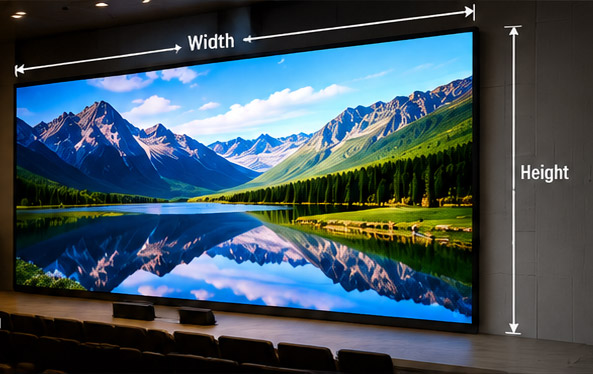
Resolution depends on pixel pitch — the distance between each LED pixel. A larger screen with a coarse pixel pitch can have the same pixel count as a smaller screen with a fine pixel pitch. This is why screen dimensions and pixel pitch must be chosen together.
1.2 Why LED Display Size Is Flexible
Unlike TVs or monitors that come in fixed sizes, LED screen size is modular. Screens are built by tiling individual panels together. You can create almost any dimension your space requires — from a 1m × 1m retail display to a 30m × 20m building wrap.
This modularity means you are never locked into a preset size. But it also means you must plan your LED screen size carefully. The freedom to go custom creates the risk of going wrong.
2.Common LED Display Sizes and Where They Fit
2.1 Small LED Displays for Indoor Spaces
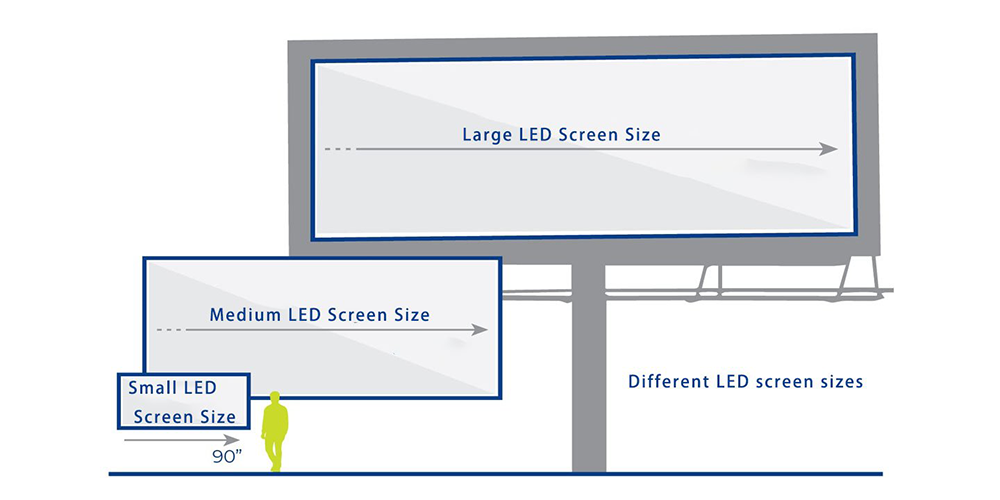
Small LED displays are ideal for close viewing in controlled indoor environments, where image clarity and text readability are important.
|
Screen Size (W×H) |
Pixel Pitch |
Typical Use |
|
1m × 1m to 2m × 1.5m |
P1.2–P2.5 |
Retail windows, small meeting rooms |
|
2.4m × 1.35m (110″ diagonal) |
P1.2–P1.5 |
Executive boardrooms |
| 3m × 1.7m to 3.6m × 2m | P1.5–P2.5 |
Conference rooms, corporate lobbies |
Typical viewing distance: 1–5 meters.
These compact LED screens focus on sharp text, fine details, and accurate color reproduction.
2.2 Medium-Sized LED Displays for Commercial Applications
Medium-sized LED displays work well in commercial and event spaces where viewers are typically 3–15 meters away.
|
Screen Size (W×H) |
Pixel Pitch |
Typical Use |
|
4m × 2.3m to 6m × 3.4m |
P2.5–P3 |
Churches, auditoriums |
|
5m × 3m to 8m × 4.5m |
P3.91–P4.81 |
Wedding venues, corporate events |
|
4m × 2.5m to 8m × 5m |
P1.5–P2.5 |
Flagship retail, museum exhibits |
For most commercial projects, this range offers a good balance between screen size, viewing experience, and cost.
2.3 Large LED Displays for Outdoor and Long-Distance Viewing
Large LED displays are designed for outdoor applications and long viewing distances of 10–200+ meters.
|
Screen Size (W×H) |
Pixel Pitch |
Typical Use |
|
3m × 2m to 6m × 4m |
P5–P6 |
Urban roadside billboards |
|
10m × 6m to 20m × 12m |
P8–P10 |
Highway billboards |
|
8m × 5m to 20m × 12m |
P8–P16 |
Stadium screens |
|
15m × 10m to 30m × 20m+ |
P10–P16 |
Building wraps |
For large outdoor LED displays, brightness and weather protection are just as important as screen size. Choose at least 5,000 nits brightness and IP65 protection for demanding outdoor environments.
3.Main Factors That Affect LED Display Size
3.1 Viewing Distance
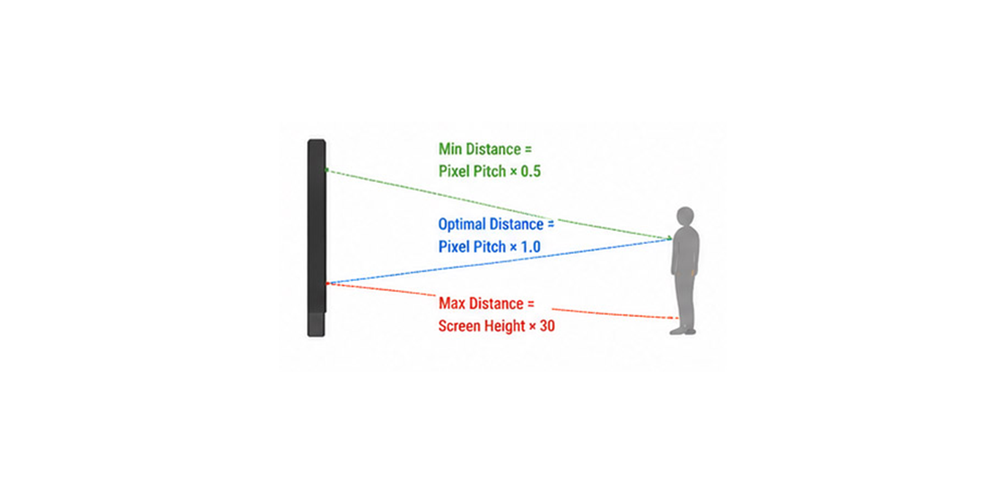
Viewing distance is the most important factor. The 1mm = 1m rule keeps it simple: a P3 screen looks sharpest at 3 meters. Minimum distance is pixel pitch × 0.5. Maximum distance is screen height × 30. Always calculate your LED screen size from the farthest viewer first.
3.2 Installation Space and Structural Conditions
Your wall or mounting structure sets the physical limit. Measure available width, height, and depth before choosing a screen size. Indoor LED walls weigh 25–40 kg/㎡ — a 10㎡ screen adds 250–400 kg. Verify structural load capacity before committing.
3.3 Content Type and Usage
Simple text and logos work on a coarser pitch at any screen size. Spreadsheets, HD video, and live camera feeds need finer pixel pitch. Match your LED screen size to the most demanding content you plan to show.
3.4 Budget and Project Cost
Pixel pitch drives cost. P1.5 costs 2–3× more per square meter than P2.5. With a fixed budget, you face a direct trade-off: finer pitch on a smaller screen, or coarser pitch on a larger screen. For churches, stadiums, and outdoor use, the bigger + coarser combination almost always delivers better value.
3.5 Aspect Ratio and Screen Shape
16:9 is the modern standard. Choosing the wrong aspect ratio means content will have black bars or need cropping. Match your LED screen size to your content format before locking in dimensions.
4.Standard vs Custom LED Display Sizes
4.1 Standard LED Display Sizes
Standard LED screen sizes are built from common cabinet counts and aspect ratios. Typical configurations include:
16:9 ratios: 2.4m × 1.35m, 3m × 1.69m, 3.6m × 2m, 4.8m × 2.7m, 6m × 3.38m
Rental standards: 500mm × 500mm cabinets arranged in grids (4×3, 6×4, 8×6, 10×6, 16×9)
Standard size options reduce engineering time and often lower cost per square meter.
4.2 When Standard Sizes Work Best
Standard LED screen sizes work well for conference rooms, churches, and retail spaces where wall dimensions match common aspect ratios. They also speed up rental and staging builds where cabinets are pre-configured for standard grids.
4.3 When to Choose a Custom LED Display Size
Custom sizing is necessary when your installation space doesn’t fit a standard ratio, when you need a creative shape (curves, arches, columns), or when architectural integration demands exact-fit dimensions. Custom LED display sizes cost more and take longer to engineer but are sometimes the only option.
5.Common LED Display Size Ratios for Various Applications
5.1 16:9 LED Display Aspect Ratio
The 16:9 aspect ratio is the standard for most modern video content, including presentations, YouTube videos, broadcast feeds, and digital signage. It displays content without letterboxing in most cases.
Formula: Height = Width ÷ 1.778
For example, a 4m-wide 16:9 LED display should be approximately 2.25m high.
5.2 4:3 LED Display Aspect Ratio
The 4:3 aspect ratio is mainly used for legacy content, older display systems, educational applications, and some industrial control rooms.
Formula: Height = Width ÷ 1.333
For example, a 4m-wide 4:3 LED display should be 3m high.
5.3 1:1 Square LED Display Aspect Ratio
A 1:1 aspect ratio creates a square LED display with equal width and height. It is suitable for creative digital signage, lobby feature walls, brand installations, and artistic displays.
These displays offer strong visual impact but usually require content designed specifically for a square format.
5.4 Ultra-Wide LED Display Aspect Ratios
Ultra-wide formats such as 21:9 and 32:9 are commonly used for stage backdrops, retail ribbon displays, architectural installations, and immersive environments.
They create a wide visual canvas but typically require custom content production.
5.5 Custom LED Display Size Ratios
Because LED displays are modular, their size and aspect ratio can be customized to fit different spaces and designs. With the right modules and cabinets, LED screens can be built in curved, angled, or irregular shapes.
This flexibility makes LED displays suitable for both standard video formats and creative architectural projects.
5.6 Common LED Display Aspect Ratio Chart
|
Aspect Ratio |
Width:Height |
Best Applications |
|
16:9 |
1.78:1 |
Video, presentations, broadcast, digital signage |
|
4:3 |
1.33:1 |
Legacy systems, education, industrial control |
|
1:1 |
1:1 |
Brand features, artistic lobbies, social media walls |
|
21:9 |
2.33:1 |
Cinema, stage backdrops, immersive retail |
|
32:9 |
3.56:1 |
Ribbon displays, architectural wraps, data walls |
6.Indoor and Outdoor LED Display Size Differences
6.1 Indoor LED Display Size
Indoor screens prioritize close-up image quality. Pixel pitch ranges from P1.2 to P4, brightness from 600 to 1,500 nits. Indoor LED screen sizes tend to be smaller and finer-pitch because viewers are close.
The indoor size limit is usually the room itself — wall dimensions, ceiling height, and seating layout define what fits.
6.2 Outdoor LED Display Size
Outdoor screens prioritize visibility over long distances and in direct sunlight. Pixel pitch ranges from P5 to P10, brightness must reach ≥5,000 nits. Outdoor LED screen sizes are typically larger and coarser because viewers are far away.
Outdoor screens also need IP65 waterproofing on the front and IP54 on the rear. Wind load ratings and structural engineering become critical at larger outdoor dimensions.
7.How LED Module and Cabinet Size Affect the Final Screen Size
7.1 LED Modules and Cabinets
LED screens are built from individual modules mounted into cabinets. The most common module size is 320mm × 160mm, supporting pixel pitches from P1.25 to P10. Cabinets typically hold multiple modules and come in standard sizes like 500mm × 500mm or 500mm × 1000mm.
Your final LED screen size is always a multiple of the cabinet dimensions.
7.2 Why Cabinet Size Affects LED Display Size
Cabinet size impacts three things. First, it determines the minimum increment of your screen — you add or remove whole cabinets. Second, larger cabinets mean fewer seams and faster installation. Third, cabinet size affects shape flexibility: smaller cabinets (500mm × 500mm) allow tighter curves and more creative designs than larger ones.
7.3 Importance of Planning LED Display Size Early
Plan your screen size before ordering cabinets. Changing dimensions later usually means buying new cabinets. Work backward from your content resolution and viewing distance to determine the exact dimensions, then calculate the cabinet grid needed to achieve it.
8.How to Choose the Right LED Display Size
8.1 Evaluate the Installation Space
Measure available width, height, and depth. Account for maintenance access: front-service needs 5–10 cm, rear-service needs 60–100 cm. Your available space sets the upper limit of your LED screen size.
8.2 Consider Viewing Distance
Measure from the screen location to the closest and farthest viewer. The farthest viewer determines the minimum screen size. The closest viewer determines the maximum pixel pitch.
8.3 Match Pixel Pitch to Viewing Distance
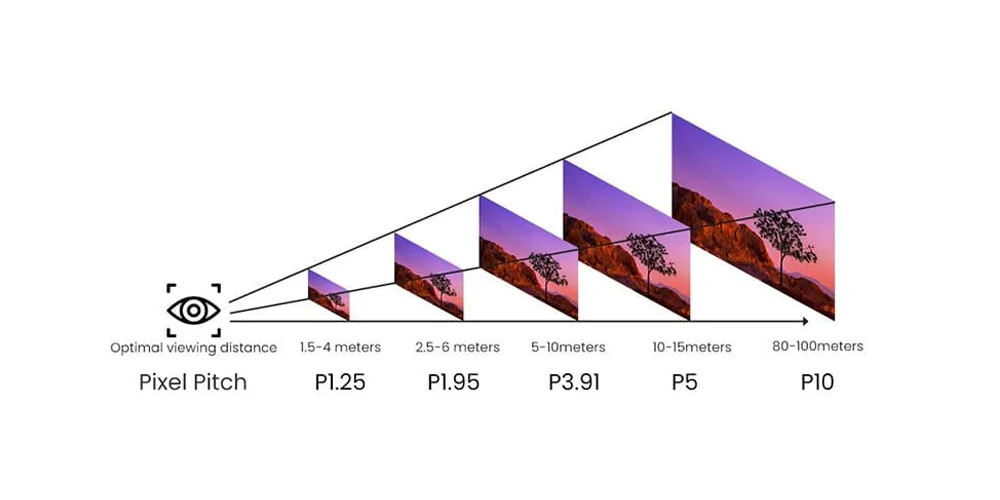
Use the 1mm = 1m rule. At 3m viewing distance, P3 is optimal. At 5m, P5 works. At 1.5m, you need P1.5 or finer. Screen dimensions and pixel pitch are a package deal — choose them together.
8.4 Match the Screen to Your Content
Full HD (1920×1080) needs a minimum pixel count regardless of screen size. Multiply your target resolution by pixel pitch to get physical dimensions. A 1080p screen at P2.5 requires at least 4.8m × 2.7m.
8.5 Consider Aspect Ratio
Choose a screen ratio that matches your content. 16:9 works for nearly all modern applications. Only use 4:3 or custom ratios if your content specifically requires it.
8.6 Consider Your Budget
Know your cost per square meter by pixel pitch. Finer pitch = higher cost per sqm = smaller LED screen size for the same budget. Balance size and clarity based on your audience’s needs.
8.7 Consult a Professional LED Display Supplier
A professional supplier validates your calculations and suggests options you may not have considered. Share your venue dimensions, viewing distance, content type, and budget. An experienced supplier prevents expensive sizing mistakes.
9.Common LED Display Size Mistakes
9.1 Choosing a Screen That Is Too Small
The most common mistake. A screen that looks large in a showroom becomes small in a venue when viewers are 20 meters away. Always calculate your LED screen size from the back row.
9.2 Ignoring Viewing Distance
Picking a screen size without measuring viewing distances leads to pixelation or wasted resolution. Measure first. Choose dimensions second.
9.3 Choosing Screen Size Before Pixel Pitch
Screen size and pixel pitch are inseparable. A large screen with coarse pitch looks good from far away but pixelated up close. Decide on pitch and size together based on your viewing range.
9.4 Ignoring the Installation Space
A calculated LED display size that doesn’t fit the wall is useless. Always verify physical dimensions against your space before ordering. Include clearance for rigging, ventilation, and maintenance.
9.5 Focusing Only on the Screen Price
The lowest price per square meter often means higher long-term costs: more frequent repairs, higher power consumption, and earlier replacement. Factor total cost of ownership, not just the purchase price.
10.FAQ
10.1 What Is the Best LED Display Size?
There is no single best size. The right LED screen size depends on viewing distance, content type, and installation space. A 2.4m × 1.35m screen works for a small boardroom. A 10m × 6m display might be right for a highway billboard. Calculate based on your specific needs.
10.2 How Do I Choose the Right LED Display Size?
Start with farthest viewing distance ÷ 30 to get minimum screen height. Multiply by aspect ratio for width. Verify closest viewer distance against pixel pitch (pitch × 0.5 = minimum). Adjust your LED screen size and pitch until both extremes work.
10.3 Does a Larger LED Display Always Look Better?
No. An oversized screen in a small room forces viewers to turn their heads and causes eye strain. Aim for 30°–40° of the viewer’s horizontal field of view. In large venues, a bigger screen generally improves the experience — but always calculate from distance.
10.4 How Does Pixel Pitch Affect LED Display Size?
Pixel pitch determines the minimum viewing distance. Finer pitch lets you use a smaller screen for close-up viewing. Coarser pitch requires a larger screen viewed from farther away. The two must be chosen together.
10.5 Can LED Display Sizes Be Customized?
Yes. LED screen size is modular, so nearly any dimension is possible. Standard ratios (16:9, 4:3) are cheaper and faster to produce. Custom sizes cost more but are sometimes required for unique spaces or creative designs.
11.Conclusion
Choosing the right LED display size is not guesswork. Start by measuring your venue and viewer distances. Apply the formulas: pixel pitch × 1.0 for optimal distance, screen height × 30 for maximum range. Match your aspect ratio to your content. Get the cabinet count right before you order.
Getting your LED screen size right means your audience sees what you want them to see — clearly, at every seat, for years to come. Take the time to calculate properly before contacting a supplier. The numbers don’t lie, and the effort pays off the moment the screen turns on.