

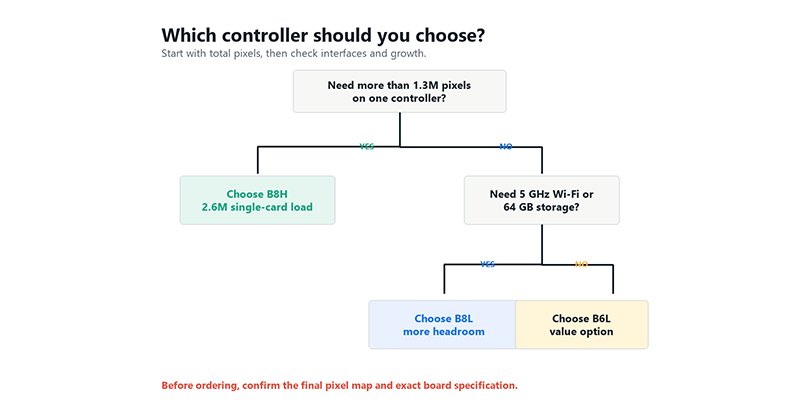
Choosing between the Huidu HD-B8H, B6L and B8L is easier once you ignore the model numbers and focus on the installation.B8H is the high-capacity option, B6L is the budget-friendly choice for a standard poster, and B8L offers the best balance for most commercial projects.
The most important specifications are not video resolution or the number printed on the board. Start with the LED canvas pixel count, then compare RJ45 outputs, HDMI inputs, storage, Wi-Fi and future expansion. This guide uses Huidu’s current official specifications to show exactly where each controller fits.
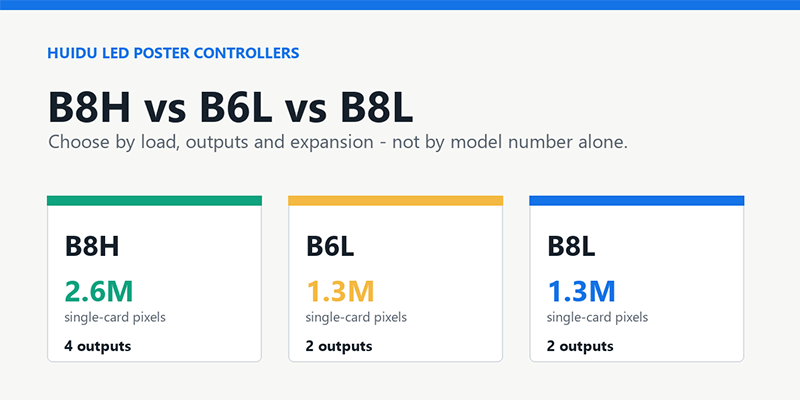
Table of Contents
1. Quick Answer
All three controllers support synchronous and asynchronous playback, HDMI input and output, USB content updates, Huidu software and optional cloud connectivity. Their main differences are capacity and expansion.
1.1 Choose B8H for maximum capacity
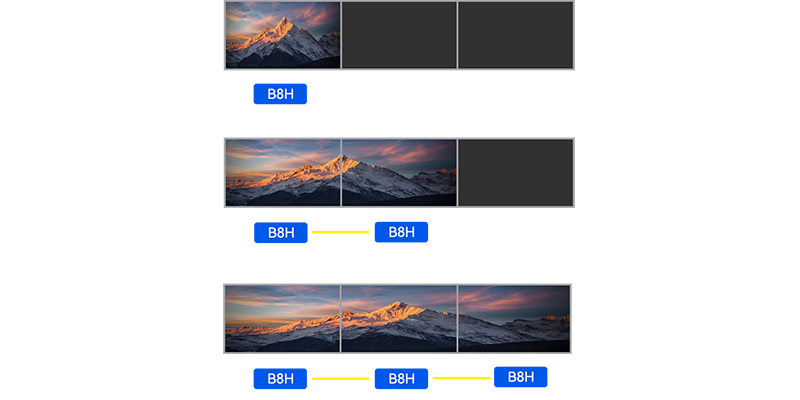
Choose HD-B8H when one controller must load more than 1.3 million pixels, the design needs four RJ45 output chains, or a spliced canvas may exceed 5.24 million pixels. It supports 2.6 million pixels on one controller and 8.8 million pixels in a cascaded configuration.
1.2 Choose B6L for a straightforward single poster
Choose HD-B6L when the project uses one conventional LED poster, 16 GB of local storage is sufficient and 2.4 GHz Wi-Fi meets the control requirement. It is the value option for fixed installations that are unlikely to grow.
1.3 Choose B8L for the best overall balance
Choose HD-B8L for most mainstream commercial projects. Its 1.3-million-pixel single-card capacity covers a common high-resolution poster, while 64 GB storage, dual-band Wi-Fi, two HDMI inputs and 5.24-million-pixel cascaded capacity provide useful expansion headroom.
2. Huidu B8H vs B6L vs B8L Specification Comparison
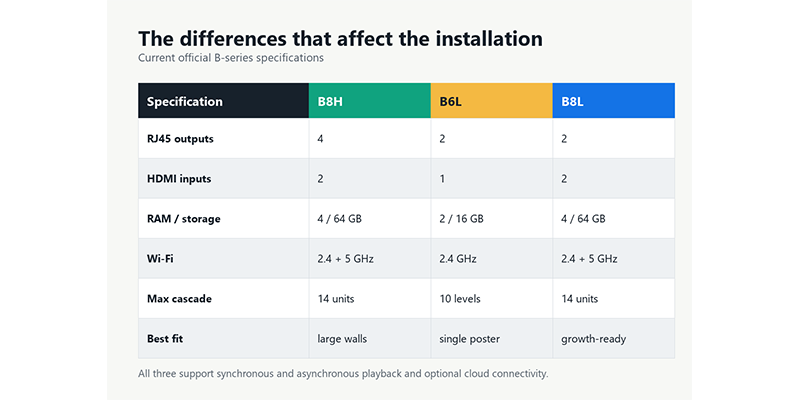
| Specification | HD-B8H | HD-B6L | HD-B8L |
|---|---|---|---|
| Single-card loading capacity | 2.6 million pixels | 1.3 million pixels | 1.3 million pixels |
| Cascaded loading capacity | 8.8 million pixels | 2.6 million pixels | 5.24 million pixels |
| Maximum width / height | 65,536 / 8,192 px | 16,384 / 8,192 px | 65,536 / 8,192 px |
| RJ45 output ports | 4 | 2 | 2 |
| HDMI 1.4 inputs | 2 | 1 | 2 |
| HDMI output | 1 | 1 | 1 |
| RAM / internal storage | 4 GB / 64 GB | 2 GB / 16 GB | 4 GB / 64 GB |
| Wi-Fi | 2.4 + 5 GHz | 2.4 GHz | 2.4 + 5 GHz |
| RS232 / RS485 | Yes / yes | Not listed as standard | Yes / yes |
| Maximum cascade | Up to 14 units | Up to 10 levels | Up to 14 units |
| Best fit | Large, high-resolution walls | Single posters and tight budgets | Mainstream projects with room to grow |
2.1 Pixel loading capacity
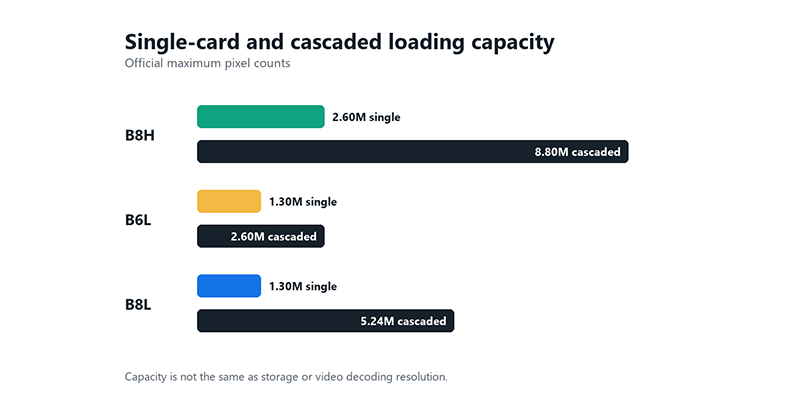
The B8H has double the single-card capacity of B6L and B8L. That difference matters when the LED canvas is wider, taller or built from several cabinet sections that must be handled by one controller.
The cascaded limit also changes the type of video wall each model can support. B6L reaches 2.6 million pixels, B8L reaches 5.24 million and B8H reaches 8.8 million. Huidu notes that when a B8H splicing load exceeds 8.29 million pixels, its simultaneous video-window playback capacity is reduced.
2.2 Output and input interfaces
B8H provides four Gigabit RJ45 outputs. B6L and B8L provide two. More outputs make it easier to divide a large display across receiving-card chains, shorten cable routes and balance the screen mapping.
B8H and B8L also list two HDMI 1.4 inputs, including a primary input and a loop/splicing input. B6L lists one HDMI input. If the installation only plays scheduled advertising, one input may be enough. Live sources, picture-in-picture and more complex splicing can benefit from the additional input.
2.3 Storage and wireless connectivity
B8H and B8L include 4 GB RAM and 64 GB internal storage. B6L includes 2 GB RAM and 16 GB storage. Sixteen gigabytes can handle image playlists and short video campaigns, but 64 GB is more practical for longer rotations, multiple campaigns or sites that are difficult to visit.
B8H and B8L support 2.4 and 5 GHz Wi-Fi with dual Wi-Fi chips. B6L lists 2.4 GHz Wi-Fi. The 5 GHz band can provide lower congestion and better casting performance in busy venues, although wired Ethernet remains the preferred connection for a permanent installation.
3. Real-World Pixel Capacity Examples
For a Huidu HD-B8H vs B6L vs B8L comparison, calculate the mapped LED resolution before selecting a controller:
screen width in pixels x screen height in pixels = total pixels
This calculation is more useful than comparing the source video’s resolution. A controller may decode a 4K video without being able to map a 4K LED canvas.
3.1 One 640 x 1920 LED poster
A 640 x 1920 poster contains 1,228,800 pixels. It fits within the 1.3-million-pixel single-card limit of both B6L and B8L, but leaves only 71,200 pixels of headroom. B8H handles the same poster with much more capacity to spare.
For a fixed poster with a confirmed mapping, B6L can be sufficient. B8L is the stronger choice if you want more storage, 5 GHz Wi-Fi or future expansion. Choose B8H only if the final mapped resolution exceeds the smaller controllers’ limit or the installation requires its extra outputs.
3.2 Two-poster splicing
Two 640 x 1920 posters contain 2,457,600 pixels. This total sits just below B6L’s 2.6-million cascaded rating. B6L can therefore fit the example on paper, but offers little spare capacity for a changed layout.
B8L and B8H provide more comfortable headroom. For an installation that may be reconfigured after commissioning, that margin can be more valuable than the initial price difference.
3.3 Four or Six Poster Walls
Four 640 x 1920 posters total 4,915,200 pixels. This fits B8L’s 5.24-million cascaded rating but exceeds B6L’s limit. Six of the same posters total 7,372,800 pixels, which requires B8H among these three options.
These totals apply when multiple posters form one spliced canvas. If each display plays independent content, calculate and specify the controller for each poster separately.
4. Huidu HD-B8H vs B6L vs B8L: Which Controller Fits Your Project?
4.1 When to choose HD-B8H
Select B8H for large digital-signage walls, creative poster arrays and high-resolution LED canvases. Its 2.6-million single-card load, four RJ45 outputs and 8.8-million cascaded limit make it the strongest model in this comparison.
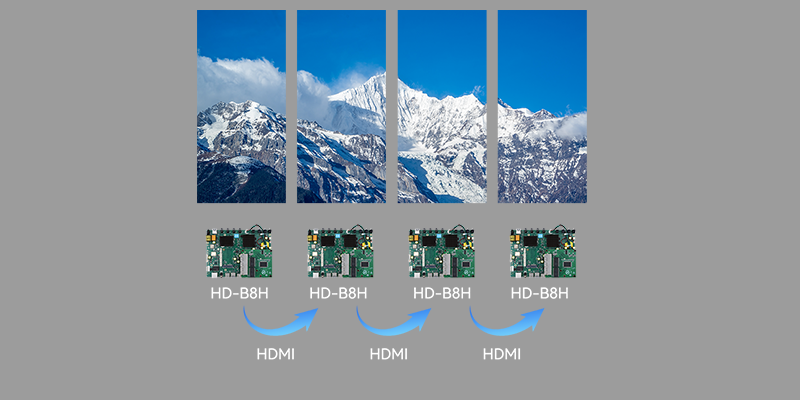
It is also suitable when the system needs 64 GB storage, dual-band Wi-Fi, two HDMI inputs and RS232/RS485 integration. However, a single standard poster may use less than half its capacity, so B8H is not automatically the best value.
4.2 When to choose HD-B6L
Select B6L for a price-sensitive installation with one standard poster, modest local content and no requirement for 5 GHz Wi-Fi or standard RS232/RS485 ports. It still supports HDMI synchronous input, asynchronous local playback, mixed playback, USB updates and optional cloud management.
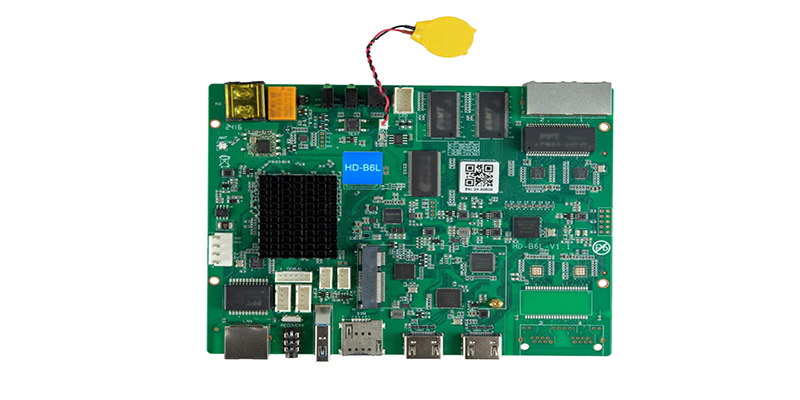
B6L becomes restrictive when the project expands. Its internal storage is one-quarter of the B8H/B8L capacity, its maximum width is lower and its cascaded loading capacity stops at 2.6 million pixels.
4.3 When to choose HD-B8L
Select B8L for retail stores, showrooms, transport terminals, exhibition systems and rental inventory where one poster may later become a small video wall. It combines the same 1.3-million single-card capacity as B6L with much stronger storage, connectivity and cascade capability.
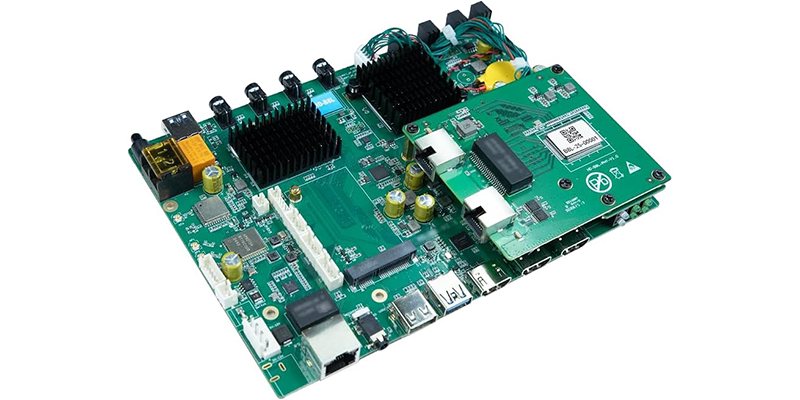
For buyers who do not need B8H’s four outputs or 2.6-million single-card load, B8L is usually the most sensible long-term purchase.
5. Common Selection Mistakes
5.1 Confusing video decoding with LED loading
Huidu rates all three controllers for as many as two 4K, six 1080p, ten 720p or twenty 360p video windows. This describes media playback performance, not the maximum number of physical LED pixels the controller can output. Always design around the loading-capacity figure.
5.2 Using cascaded capacity as a single-card limit
A cascaded rating assumes multiple controllers working together. It does not allow one B6L or B8L to exceed its 1.3-million-pixel single-card limit. Confirm the controller count and screen topology before ordering.
5.3 Designing exactly at the maximum
A design that fits by only a few thousand pixels may become invalid after a cabinet, receiving-card or mapping change. Leave reasonable headroom and have the final connection diagram checked by the integrator.
5.4 Assuming cellular hardware is included
The specifications describe 4G or 5G modules and antennas as optional equipment. Confirm the supported regional module, antenna, SIM requirements and XiaoHui Cloud service in the supplier’s quotation.
6. Frequently Asked Questions
6.1 Is Huidu B8H better than B8L?
B8H is more capable, but B8L can be the better purchase. Choose B8H for more than 1.3 million pixels on one controller, four RJ45 outputs or a cascaded canvas above 5.24 million pixels. Otherwise, B8L provides many of the same operating features at a more appropriate specification level.
6.2 Is B6L enough for a 640 x 1920 LED poster?
Yes. A 640 x 1920 display contains 1,228,800 pixels, which is below B6L’s 1.3-million-pixel rating. Because the remaining margin is small, confirm the exact mapped resolution and receiving-card configuration.
6.3 Can B6L play 4K video?
Yes. Huidu lists multi-window playback of up to two 4K streams for B6L. This does not change its 1.3-million-pixel single-card LED loading limit.
6.4 Do all three controllers support cloud management?
Yes. Huidu lists XiaoHui Cloud in the supporting software and describes optional cellular connectivity. Required modules and antennas may be sold separately.
6.5 Which controller is the safest default choice?
B8L is the safest default for a commercial LED poster that may expand later. B6L is better when cost is the priority and the design is fixed. B8H is necessary when pixel load, output count or wall size exceeds B8L’s limits.
7. Huidu HD-B8H vs B6L vs B8L Final Recommendation
Choose the controller from the screen design, not from the model name:
- HD-B8H: best for high pixel loads, four output chains and large spliced walls.
- HD-B6L: best for a fixed single-poster installation with a controlled budget.
- HD-B8L: best overall choice for mainstream commercial projects and future growth.
Before placing an order, send the supplier the final pixel map, cabinet layout, receiving-card model and required content workflow. A five-minute specification check is less expensive than replacing an undersized controller after installation.
For a complete LED poster solution, explore EagerLED LED display products and project support.