

Budget a foldable LED poster roadshow as one equipment purchase plus a travelling operation. The screen quote covers only part of the cost. Cases, the route, venue handling, content preparation and service readiness determine what you spend to take the same fleet through several cities.
For event marketers in Southeast Asia, first decide whether the screens travel through one continuous route or return to a depot between events. Then separate purchase costs from costs incurred at each stop and on each transport leg. This guide provides a quantity-based budget worksheet; it does not assign unverified market prices.
- How many screens operate together at the busiest stop?
- How many stops and transport legs are planned?
- What are the actual packed case dimensions and gross weights?
- Which venues need indoor, window-facing or outdoor equipment?
In this roadshow budget guide
Fix the equipment scope before comparing prices
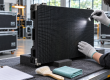
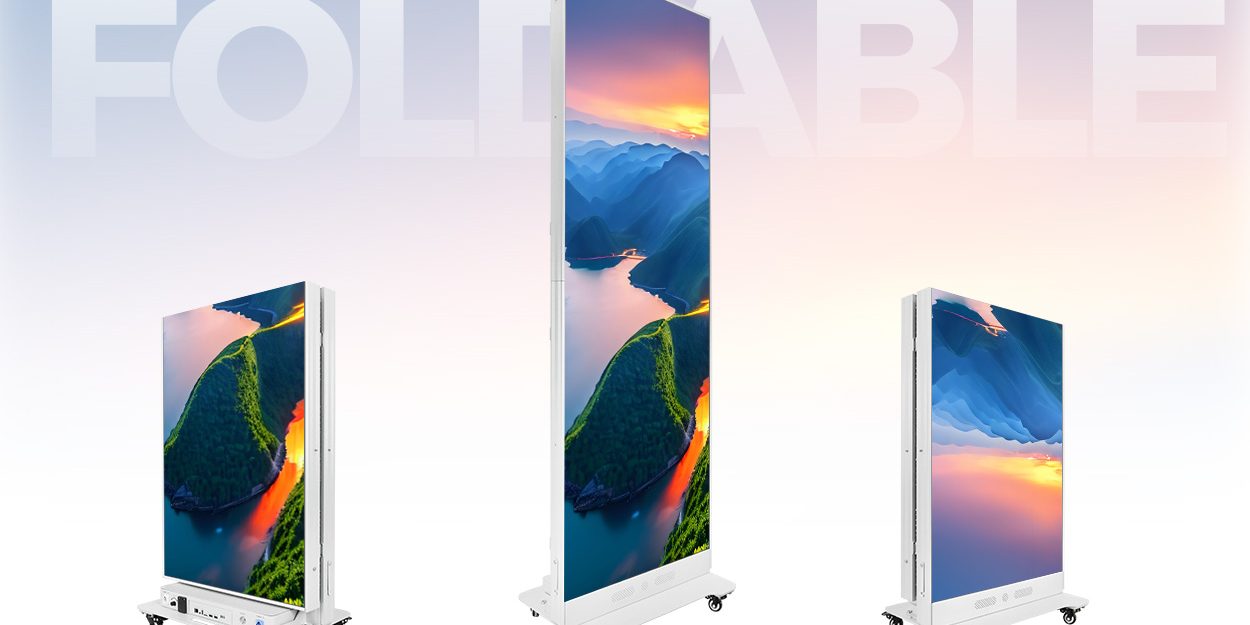
The EA1920iP5 indoor foldable poster uses a 640 × 1920 mm display format, front module access and a wheeled folding design. These features are relevant to repeated indoor deployments. Ask the supplier to state the number of active faces, selected pitch and module technology, playback configuration, and accessories for each quoted unit.
Keep that configuration identical across offers. A higher-resolution module option, a different controller or an excluded case changes the comparison. Have the creative team test its smallest text and product detail at the intended viewing distance before specifying finer pitch across the whole fleet.
List exposure at every venue. EA1920iP5 is an indoor product. For exposed events, review the EA1920OP2 outdoor foldable poster and confirm the complete installation requirements. A covered entrance is not automatically equivalent to a controlled indoor hall. Use venue information to decide whether one fleet can serve the entire route.
Separate purchase, stop and transport-leg costs
Use three budget sections so one-time expenditure does not get multiplied by the number of cities. Give each line a quantity, rate, currency, quote date, included scope and responsible party. When comparing different currencies, record the conversion basis and date instead of silently mixing totals.
| Cost section | Include in the worksheet | Quantity basis |
|---|---|---|
| Acquire the fleet once | Screens and players; cases; initial spares; initial freight, delivery charges and applicable import costs; commissioning and training | Purchased units and one initial delivery scope |
| Operate each stop | Venue unloading and loading; setup and checks; approved fixing and cable protection; staff; venue power; content adaptation | Stop count, operating days and local service quotes |
| Move between locations | Vehicle or carrier charge; transfer handling; insurance scope; temporary storage; delivery time windows | Actual legs, cases, packed dimensions and gross weights |
| Maintain the campaign | Compatible replacement parts; repair labour; recovery transport; reserve equipment and storage | Quoted service plan and explicitly stated contingency assumptions |
Check who owns the last-mile delivery. A supplier quotation ending at a port, airport, warehouse or depot is different from delivery to a venue floor. For a route crossing national borders, obtain destination-specific transport and broker quotations before treating import, temporary movement or return costs as included. Do not assume one country’s charges apply across Southeast Asia.
Worked route: four screens, five sequential stops
Planning assumptions: four units operate together; five city stops run sequentially; one packed unit uses one case; the fleet travels depot → stop 1 → stop 2 → stop 3 → stop 4 → stop 5 → depot. No overlapping bookings or extra reserve unit is included.
| Budget driver | Calculation | Result |
|---|---|---|
| Fleet purchase quantity | 4 units reused at every stop | 4 screens |
| Deployment activity | 4 screens × 5 stops | 20 unit-stops |
| Transport legs | Depot departure + 4 intercity moves + return | 6 legs |
| Case movements by leg | 4 cases × 6 legs | 24 case-leg movements |
| Venue unpacking | 4 units × 5 arrivals | 20 unit-unpacking events |
| Venue repacking | 4 units × 5 departures | 20 unit-repacking events |
A unit-stop measures use; it is not another purchased screen. A case-leg movement measures transport activity; it is not necessarily a separate carrier charge. Carriers may quote a whole vehicle, a consignment or a different chargeable basis. Map the 24 movements to the actual offer rather than multiplying by an assumed rate.
Compare the show-end time, packing time, travel window and next venue’s load-in deadline. If the fleet cannot reach the next stop in time, quote an additional set or local rental. The four-unit assumption then changes.
If each stop runs for two days, the example has 10 event days and 40 unit-days. Use measured operating power for the chosen configuration to estimate energy: average kW per unit × unit-days × daily operating hours. This gives kWh; apply each venue’s actual tariff or power-service charge separately. Maximum rated power is still needed for circuit planning.
Verify the folded case, not just the unfolded screen
Ask for external case length, width and height in metres and its gross packed weight. Rectangular packed volume per case is length × width × height. Multiply by the case count for the fleet volume, then ask the carrier which dimensions, weight basis and minimum charges it uses.
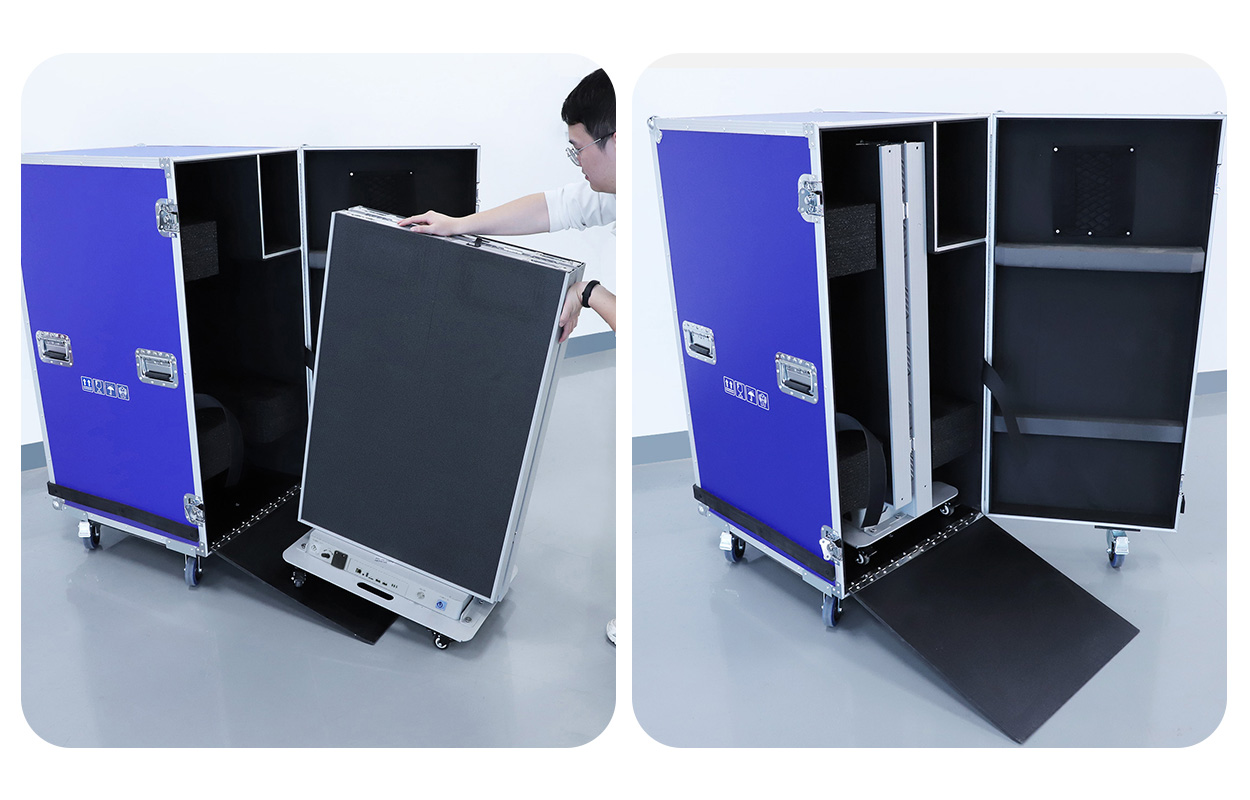
Folding can reduce the screen’s storage footprint, but that does not establish an equal percentage saving in freight. Case walls, protective lining, the base and accessories still occupy space. Check the packing list and rate for the actual consignment.
Repeated deployment also makes handling a budget line. Confirm door and lift clearances, ramps or loading equipment, floor transitions, the venue crew and approved handling instructions. Wheels help reposition a unit on suitable surfaces; they do not settle stairs, loading into a vehicle or required staffing. Inspect hinges, locks, cables, cases and playback after each move, and keep the agreed spares accessible.
Compare ownership with rental on the same route
Ask for a rental offer covering the same screen quantity, dates, locations, image requirements, transport, crew, support and damage terms. Compare that with acquisition plus the owner’s recurring campaign costs. A basic rental headline excluding delivery and setup is not comparable with an owned fleet’s complete route budget.
For repeated campaigns of similar scope, define A as the initial acquisition and setup cost, S as a stated net resale assumption, O as the owner’s recurring cost per campaign, and R as the comparable rental cost per campaign. Ownership cost over K campaigns is A − S + K × O; rental cost is K × R.
When R is greater than O, the simple crossover is K = (A − S) ÷ (R − O), rounded up to a whole campaign. If R is not greater than O, this model does not produce that crossover. Use actual quotations, show the resale assumption separately, and include storage, finance, repairs and staff consistently over the comparison period. This is a budgeting model, not a promise of payback.
For general specification choices, use our poster LED display buying guide. This route worksheet adds the transport and repeated-deployment detail needed for a travelling fleet.
Foldable LED poster roadshow budget FAQ
What should a foldable LED poster roadshow quote include?
Request the exact screen configuration and quantity, controllers and playback, cases and packed weights, spares, initial delivery, and support. Budget the route separately for transport legs, venue handling, power, content changes and staff. Use the same inclusion list for every offer.
Does folding the screen cut freight costs by 50%?
A reduced folded storage footprint does not establish the freight saving. Compare the external dimensions and gross weight of the actual packed cases, then obtain rates for the intended transport service and route. Minimum charges and handling can affect the total.
How many screens are needed for five sequential roadshow stops?
If every stop uses four screens and dates allow the same fleet to travel between venues, four screens can serve five stops. That produces 20 unit-stops, not a requirement to purchase 20 screens. Overlapping dates, transit time and backups can increase the required fleet.
Can an indoor foldable poster be used at an outdoor launch?
Only use a configuration approved for the actual environment. EA1920iP5 is an indoor model; EagerLED also offers the outdoor EA1920OP2. Covered areas can still have moisture, wind or strong daylight. Confirm exposure, support and electrical requirements for every stop.
Request a fleet quote with the route attached
Send the simultaneous screen quantity, cities and dates, indoor or outdoor conditions, viewing distance, desired content workflow, venue access and delivery country. State whether the same fleet moves between stops and whether any dates overlap.
Ask for separate screen, controller, case, spare-part and initial-delivery prices, plus packed dimensions and gross weights. Use those figures to obtain the route transport and venue-service quotes.
Prepared by EagerLED for event equipment buyers. Product references reviewed on 14 October 2026. Route quantities are explicit planning examples; prices, delivery terms and configurations require current quotations.