

For high-contact exhibition screens, specify GOB as one part of a protected, serviceable display system. Match the coating to foreseeable contact and approved cleaning, then test image quality and module replacement on the quoted configuration. GOB alone does not provide touch input, a load-bearing surface or a complete-screen protection rating.
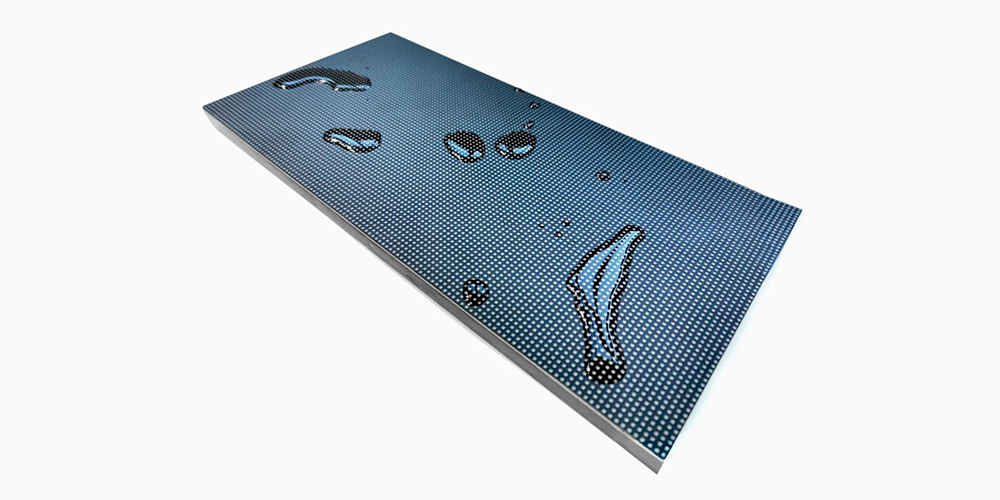
This guide is for integrators specifying booth walls, counters and reachable display features for international exhibitions. It provides a sample acceptance record tied to actual contact points. The featured manufacturer image illustrates a coated LED face with droplets; it is not evidence of a certified whole-screen water test.
- Identify where visitors, cleaning staff and installers can contact the display.
- Approve a sample made with the proposed module and coating.
- Record image settings, cleaning instructions and service tools.
- Specify sensing and interactive software separately if the brief needs them.
On this page
Map contact before choosing the coating
Mark the display elevation with the areas within reach. Separate a vertical wall behind a barrier from a counter edge that bags may brush, a corner that installers grip and a surface intended for repeated interaction. The same exhibition can contain all four conditions. Request a configuration for each exposure instead of treating the whole stand as one undifferentiated GOB order.
EagerLED’s GOB LED module range describes a transparent protective resin over the LED surface and includes 320 × 160 mm and 250 × 250 mm series. These are module families, not interchangeable cabinet specifications. The supplier must confirm the exact pitch, mounting, electronics and coating for the selected screen.
| Contact zone | What to specify | What the GOB label does not settle |
|---|---|---|
| Reachable vertical face | Approved surface contact, cleanability and replaceable modules | Touch sensing or resistance to deliberate scratching |
| Booth corner or counter edge | Edge support, cabinet protection and handling instructions | Strength of exposed corners and frame joints |
| Interactive feature | Sensing method, software, content and response acceptance | Input hardware or the experience’s functionality |
| Walkable platform | Purpose-built floor system and verified loading scope | Permission to stand on a wall module |
Do not transfer a floor product’s load or protection claim to a vertical display. Similarly, do not infer an outdoor cabinet rating from a module-face demonstration. Keep the exact model, test conditions and complete enclosure scope together in the supplier response.
Approve the image under exhibition lighting
Evaluate the proposed GOB face under the booth’s intended lighting and at the planned viewing positions. Inspect fine lettering, dark grey gradients, a neutral background and the actual brand colours. Include an off-axis position near the aisle, because a surface that looks acceptable straight on may show distracting reflections from a spot light.
Use the same artwork and brightness when comparing samples. Ask which settings were used and whether they can be reproduced on the delivered screen. A protective layer cannot compensate for insufficient native pixels, poor module matching or a player that scales the artwork incorrectly. Where filming matters, test the intended camera and shutter settings; a refresh figure is only part of that assessment.

For a general explanation of packaging trade-offs, read the COB versus GOB comparison. The decision here is whether the proposed coated module passes the exhibition’s particular contact, optical and service requirements.
Use a controlled sample acceptance record
Agree a representative sample and a written test plan before ordering. A spare sample or manufacturer-approved coupon is the appropriate place to assess an agreed cleaning procedure. Do not scratch, strike, soak or apply chemicals to a working exhibition screen to see whether a marketing claim is true.
The following is a procurement record, not a laboratory standard. Let the supplier state the permitted method and any test limits. Add a reference photo, sample identifier, coating description, inspector and date to each row. Retain the accepted sample so a later delivery can be compared against it.
| Record item | Controlled check | Evidence and decision |
|---|---|---|
| Surface finish | View the sample with the agreed booth lighting and artwork | Record reflections, visible seams, colour and viewing positions |
| Cleaning | Apply only the written approved method to the agreed sample | Record materials, method and before/after appearance |
| Handling | Demonstrate approved grip points, placement and packing | Record protected edges and whether tools touch the face |
| Interactive input, if ordered | Run the agreed task on the complete sensing and software system | Record the active area, supported gestures and observed response |
| Serviceability | Remove and refit a module using the approved tool | Record access, connectors, calibration and the restored image |
State what happens if the delivered finish differs, a coating is damaged or a spare cannot be colour-matched. Obtain warranty exclusions for physical damage and cleaning separately from the normal product warranty. A display can resist incidental contact yet still be unsuitable for aggressive visitor interaction or repeated unapproved cleaning.
Prove the service route before the booth opens
A protective face changes how a module is handled and repaired. Ask whether on-site work is limited to module replacement, which removal tool is approved and where component-level or coating repair is performed. Do not assume a tool used on exposed SMD will grip or release a coated face safely.
Demonstrate the hardest module to reach in the proposed cabinet and booth structure. Check the removal path, connector access and room to work. Then restore the image with the supplied configuration and a compatible spare. Keep mechanical fit, electrical compatibility and optical matching in the same acceptance record.

Before dispatch, label spare modules and retain the relevant configuration, wiring map and approved handling method. For returning exhibition fleets, inspect the face and edges after unpacking, after assembly and before repacking. Logging the location and type of damage helps distinguish a handling problem from an unsuitable installation detail.
High-contact exhibition GOB FAQ
Does a GOB coating make an exhibition screen a touchscreen?
No. GOB protects the LED surface. Touch input needs a separately specified sensing system, controller, software and a tested interaction workflow. Confirm the required gesture, response and operating area on the offered complete system.
Can staff use their usual exhibition cleaner on a GOB screen?
Only use a method approved for the exact coating and screen. Obtain written instructions covering the cloth, liquid, application method and drying. Do not assume an ordinary glass cleaner, disinfectant or abrasive tool is compatible.
Does GOB mean the complete screen is waterproof?
No. A protected module face does not establish the protection of the cabinet rear, seams, connectors, power system or installation. Require the exact model ratings and supporting scope for the intended environment.
What should a replacement GOB module match?
Confirm dimensions, mounting, active pixels, scan mode, connectors, receiving-card configuration and optical finish. Demonstrate replacement and colour matching on the selected cabinet rather than relying only on the same pitch label.
Request a GOB exhibition specification
Send the booth layout, reachable display zones, dimensions, viewing distances, lighting plan, installation city and required dates. Describe expected contact, cleaning and any real interactive task. Ask for the exact module and coating, cabinet, approved sample plan, service tools and compatible spare scope.
Prepared by EagerLED for exhibition integrators. Product references reviewed on 15 October 2026. The worksheet is a proposed purchasing process, not a completed test or certification. Confirm the exact supplied configuration, care instructions and venue requirements.