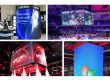


Which LED display manufacturers should you compare? Samsung, Unilumin, Absen, LG, EagerLED, Leyard, Daktronics, Barco, LianTronics, and Ledman provide options across commercial LED video walls, events, outdoor signage, and specialist installations. The right choice depends on the exact product, viewing conditions, integration requirements, and service agreement.
This guide compares ten LED display manufacturers and explains how to evaluate an LED screen supplier before requesting a quotation. It covers direct-view LED screens, where LEDs create the image, rather than LCD televisions that use an LED backlight. Buyers searching for LED panel manufacturers or display manufacturers should establish this distinction first.
Published by Shenzhen EagerLED Co., Ltd. · Updated
Editorial scope: This is an EagerLED-published commercial buying guide, and EagerLED is included in the comparison. The numbering identifies companies; it is not an independently audited ranking by revenue, market share, or reliability. Product references were reviewed in September 2026. Verify current specifications and regional availability with each supplier.

1. The Top 10 LED Display Manufacturers
Use this shortlist to identify relevant product families, then compare specific models. LED display manufacturers often cover several applications, and performance can vary substantially within one brand’s range. The applications below are starting points for evaluation, not exclusive specializations.
| Manufacturer | Product or application reference | What to verify in the proposal |
|---|---|---|
| Samsung | The Wall; commercial direct-view LED | Exact series, processor, installation scope, and regional support |
| Unilumin | Rental LED and installation portfolios | Cabinet suitability, service access, and configuration-specific performance |
| Absen | Rental and staging; commercial displays | Handling protection, rigging system, and local repair arrangements |
| LG | LED signage and MAGNIT | Model-level specifications and compatibility with the control workflow |
| EagerLED | Indoor, rental, outdoor, and module options | Bill of materials, spare parts, and responsibilities after delivery |
| Leyard | Fine-pitch displays and video wall solutions | Product family, regional contracting entity, and calibration workflow |
| Daktronics | Sports displays, billboards, and message signs | Site engineering, control integration, and maintenance access |
| Barco | TruePix LED video walls | Processing architecture and the selected service package |
| LianTronics | Professional visualization and commercial LED | Cabinet geometry, signal design, and installation tolerances |
| Ledman | COB, SMD, and Micro LED product portfolios | Packaging, repair method, brightness, and replacement-module matching |
01. Samsung Electronics

Samsung’s The Wall is a useful reference for buyers investigating MicroLED video walls. This LED display manufacturer merits consideration when a commercial project requires a defined display and processing ecosystem. Request the exact series rather than treating all Samsung LED signage as equivalent. Confirm native resolution, cabinet layout, service clearance, and who commissions the system. A brand name alone does not establish which accessories or on-site services are included.
02. Unilumin

Unilumin maintains a dedicated rental LED display portfolio. Buyers comparing LED display manufacturers for events should review how each proposed cabinet handles repeated assembly, transportation, and servicing. Request a demonstration of alignment locks, module replacement, and the approved hanging or stacking arrangement. For a permanent installation, evaluate an appropriate installation product separately; a rental cabinet is not automatically the most economical or maintainable choice for a wall that stays in place.
03. Absen

Absen’s rental and staging range addresses events, broadcast, and production applications. When evaluating this LED display manufacturer, ask for the proposed cabinet’s handling instructions, corner protection, supported curving arrangements, and replacement procedure. Camera-facing projects require a demonstration using the intended camera and processor settings. Check whether the regional seller stocks compatible spare modules and whether repair turnaround suits the event schedule. These details are more useful than an unsupported claim that one brand is universally best.
04. LG Electronics

LG’s commercial display range includes LED signage and MAGNIT Micro LED. Distinguish direct-view LED from the company’s LCD and OLED products when requesting comparable quotations. This LED display manufacturer can enter a shortlist for indoor commercial projects, subject to the selected model’s suitability. Review input handling, service access, image processing, and mounting requirements together. Request a demonstration with your presentation slides or retail content, because impressive promotional footage does not prove that small text will be readable.
05. EagerLED

EagerLED’s LED display product catalogue includes indoor, outdoor, rental, and other display configurations. Buyers considering this LED display manufacturer should request a project-specific proposal with the cabinet arrangement, control system, power requirements, and spare-parts package identified. For repeat procurement, document the approved component specification and replacement policy. EagerLED publishes this guide, so its inclusion should be evaluated using the same acceptance criteria applied to other suppliers, including samples, delivery scope, and written support terms.
06. Leyard

Leyard provides LED display solutions, including fine-pitch product options. For a control room or presentation wall, compare the proposed system at realistic brightness with text, grayscale patterns, and moving content. Ask this LED display manufacturer or its regional representative how replacement modules are calibrated and how configuration backups are supplied. Confirm which legal entity sells, installs, and services the equipment. A corporate group name does not by itself define the warranty or local response commitment.
07. Daktronics

Daktronics offers video displays, scoring systems, message displays, and digital billboards. It is a relevant LED display manufacturer to investigate for sports and outdoor signage projects. Assess the display alongside the scoring, playback, or advertising workflow rather than as an isolated screen. Specify site exposure, viewing angles, maintenance access, and the permitted operating schedule. Structural design, power distribution, installation, and support should have clearly assigned owners in the contract.
08. Barco

Barco’s TruePix is an LED video wall platform for professional visualization. Buyers comparing LED display manufacturers for demanding indoor applications should investigate alignment, calibration, processing, and maintenance together. Ask which redundancy options and service provisions apply to the quoted configuration. Keep the scope precise: a company’s broader work in projection or medical imaging is not evidence that every LED product is suitable for every specialist use.
09. LianTronics

LianTronics presents professional visualization solutions for LED projects. For custom commercial installations, ask this LED display manufacturer to document cabinet dimensions, allowable curves, corner construction, and service access. An eye-catching demonstration does not establish the requirements for your building. A naked-eye 3D effect also depends on content perspective, viewing position, and screen geometry; it should not be treated as a capability delivered by the LED cabinet alone.
10. Ledman

Ledman’s product portfolio includes COB, SMD, and Micro LED options. Compare the actual model’s image performance, surface protection, and repair process rather than selecting it solely by a technology label. Ask the LED display manufacturer how damaged modules are replaced and how brightness and color are matched after repair. Request the operating brightness and power figures for the quoted configuration, along with sample evidence that reflects your intended viewing distance.
2. What Makes the Best LED Display Manufacturer?
The best LED display manufacturer for a project is the supplier that meets measurable performance, installation, and service requirements at an acceptable lifetime cost. Country of origin, company size, and marketing rankings cannot substitute for that evidence. Establish the intended result before comparing catalogues.
Separate three purchasing scopes. A complete LED video wall normally requires cabinets, modules, power supplies, receiving cards, processing, mounting, and commissioning. An LED display module is a component that must match the rest of the system. An integrator supplies design and installation services and may purchase hardware from another company. Clarify which role your supplier performs.
For LED display module manufacturers, require mechanical dimensions, connector and pinout information, driver configuration, scan arrangement, and calibration compatibility. Matching pitch and physical size alone is insufficient. Review LED display module options separately from complete-screen proposals so that component pricing is not mistaken for an installed-system quotation.
3. LED Display Manufacturers: Strengths by Application
Build a shortlist around the operating environment. The best LED wall brands for a meeting room may not offer the most appropriate cabinet for repeated touring use. Ask LED display manufacturers for references using the proposed product family in comparable conditions.
| Application | Priority requirements | Useful acceptance demonstration |
|---|---|---|
| Meeting room or control room | Text clarity, comfortable brightness, service access | Actual dashboards and slides at the nearest seat |
| Outdoor advertising | Daylight readability, environmental protection, dimming | Site-specific brightness plan and documented enclosure ratings |
| Rental stage | Assembly speed, handling protection, approved rigging | Repeated assembly and a timed module replacement |
| Broadcast or virtual production | Camera compatibility, synchronization, color workflow | Camera tests at intended shutter settings and frame rates |
| Retail or architectural feature | Geometry, sightlines, finish, maintainability | Representative corner or curved section with real content |
| Replacement modules | Electrical, mechanical, firmware, and color compatibility | Trial replacement in the existing cabinet and control system |

4. Key Points for Comparing LED Display Manufacturers
01. Pixel Pitch and Native Resolution
Pixel pitch is the center-to-center spacing between adjacent pixels, expressed in millimeters. Smaller pitch provides more pixels in a given area. Planar’s pixel-pitch guidance connects pitch selection to viewing distance. Test the intended content: small spreadsheet text and a large advertising logo have different demands.
For example, a 4,800 × 2,700 mm active display at a true 2.5 mm pitch contains 1,920 × 1,080 pixels. This calculation assumes the cabinet grid supports those exact dimensions. Ask LED display manufacturers to state native pixel resolution; accepting a 4K input does not make a screen a native 4K display.
02. Brightness, Contrast, and Power
Request usable brightness after calibration, not only a peak specification. Check uniformity, black levels under ambient light, and grayscale at the brightness you will actually use. Compare power measurements under the same content and brightness conditions. Maximum power informs electrical planning; measured operating power supports an energy estimate. Neither number should be substituted for the other.
03. Outdoor Protection and Maintenance
An outdoor LED display manufacturer should identify front and rear enclosure protection separately, plus the operating temperature and humidity limits. Rain exposure, heat, dust, coastal conditions, drainage, and service access need project-specific review. A front-rated cabinet does not automatically protect exposed rear connections. Have qualified site professionals verify structural mounting and electrical design against the installation requirements.
04. Control Systems and Camera Performance
Confirm the processor, receiving cards, signal paths, input formats, and configuration files. For filming, refresh rate alone does not prove clean camera performance. Brompton’s ShutterSync guidance explains why camera shutter timing and LED refresh must work together. Ask LED display manufacturers to demonstrate the complete proposed system with your camera settings, including dim scenes and movement.
05. Factory Quality and Component Traceability
Request a controlled bill of materials, serial identification, production inspection records, and a documented burn-in process. Ask how substitutions are approved. COB and SMD describe different packaging approaches; GOB commonly describes a protective treatment over a module. None is a universal quality guarantee. Compare surface durability, repairability, thermal behavior, and image quality on a representative sample.
06. Support, Warranty, and Spares
LED display manufacturers should explain warranty coverage, exclusions, freight responsibility, response channels, and repair location in writing. Agree on spare modules, power supplies, and receiving cards according to project size and downtime tolerance. Preserve calibration files and controller settings. For color-sensitive applications, ask how replacement stock will match the installed batch throughout the agreed service period.
5. Choosing the Right LED Display Manufacturer
- Define the application: record dimensions, environment, viewing distance, content, and operating hours.
- Shortlist models: compare the same pitch, native resolution, and cabinet requirements.
- Verify the supplier: use the 12 factory checks for an LED screen supplier to request production and quality evidence.
- Test a sample: check real content, module replacement, and the proposed control workflow.
- Agree the full scope: document delivery, installation, acceptance tests, spares, and support before ordering.
Send the same request for quotation to each shortlisted supplier. Include screen dimensions, nearest viewing position, content type, indoor or outdoor location, operating hours, installation method, destination, and target completion date. Request a cabinet drawing and an itemized scope. A low screen-only price is difficult to compare with a complete delivered system.
| Cost or deliverable | Request from every supplier | Why it matters |
|---|---|---|
| Display hardware | Model, quantity, native resolution, and component specification | Prevents comparisons between different configurations |
| Processing and software | Controller model, licenses, input capacity, and configuration files | Reveals missing equipment and recurring charges |
| Structure and installation | Mounting scope, installation labor, access equipment, commissioning | Separates factory supply from site responsibilities |
| Delivery | Packing, freight, agreed delivery terms, and lead time | Clarifies responsibility and landed-cost assumptions |
| Energy and cooling | Maximum load and measured operating power with test conditions | Supports electrical sizing and running-cost estimates |
| Maintenance | Spare quantities, repair pricing, freight, and service response terms | Exposes likely downtime and post-warranty expenses |
| Acceptance | Agreed test patterns, pixel-defect criteria, documentation, sign-off | Creates a measurable basis for accepting delivery |
Estimate display energy as measured operating kW multiplied by operating hours. For illustration only, a display averaging 3 kW for 10 hours daily uses approximately 10,950 kWh per year. Multiply by the applicable electricity rate and account separately for cooling and other equipment. This is a calculation example, not a manufacturer performance claim.
Before release for shipment, agree on visual tests for seams, uniformity, grayscale, dead pixels, playback, and recovery after signal loss. Require photos or video of the actual assembly, packing details, manuals, and backed-up settings. LED display manufacturers should resolve discrepancies against the approved specification before installation creates additional costs.
6. LED Display Manufacturers in China, the USA, and Other Markets
Buyers comparing LED display manufacturers in China can investigate EagerLED, Unilumin, Absen, Leyard, LianTronics, and Ledman. Daktronics is a US-based option, while Samsung Electronics and LG Electronics are South Korean companies and Barco is based in Belgium. Company headquarters do not establish where a particular model is manufactured or where service is delivered. Confirm the contracting entity, production location, export scope, and regional support for the exact proposal.
Global supply can broaden product choice, while a local integrator can provide site surveys, installation, and rapid physical access. These roles can work together. Do not assume that buying directly from LED display manufacturers includes local labor, or that a nearby reseller holds compatible replacement inventory.
Assign responsibility for design approval, transport damage, commissioning, repairs, and software support. Ask where spare parts are stored and how urgent faults are escalated across time zones. For a deadline-sensitive project, compare the complete delivery and service plan as carefully as the hardware price. A documented handover between factory and installer reduces gaps in accountability.
7. Why Consider EagerLED?
EagerLED is an option for buyers seeking a project-specific LED display proposal. Start with the indoor LED screen guide for permanent indoor applications or the rental LED display range for repeated event use. These pages help narrow the product discussion before quotation.
Ask EagerLED to document the same items required from other LED display manufacturers: cabinet configuration, native resolution, control equipment, service access, component specification, spare stock, delivery scope, and support terms. Compare an approved sample with the final production specification. Treat any requested customization as a written engineering requirement rather than an informal sales promise.
Contact EagerLED with your project brief, including dimensions, viewing distance, destination, and intended installation date. Request an itemized proposal and identify the local party responsible for mounting, electrical work, and commissioning.
8. FAQs About LED Display Manufacturers
01. Who are the top five LED screen manufacturers in the world?
There is no single top-five list that answers every purchasing need. Samsung, LG, Leyard, Unilumin, and Absen are five companies buyers can investigate, while Daktronics, Barco, and other specialists may better match particular applications. Compare LED display manufacturers by the proposed model and service scope rather than interpreting this shortlist as a verified market-share ranking.
02. How can I verify an LED display manufacturer?
Check the contracting company’s identity, factory or production arrangements, comparable project references, and model-specific documentation. Request a working sample and written acceptance criteria. Ask the LED display manufacturer who owns the warranty obligation and where repairs happen. A catalogue, factory photograph, or logo on a certificate is not sufficient evidence by itself.
03. Are LED display module manufacturers the same as screen suppliers?
Not necessarily. Module suppliers may sell components without cabinets, power supplies, processing, mounting, or commissioning. Complete-screen suppliers coordinate a larger system. When buying replacements, confirm electrical configuration, firmware, mechanical fit, and color matching. Modules with the same pixel pitch are not automatically interchangeable.
04. Are Chinese LED display manufacturers reliable?
Reliability depends on the supplier, model, quality controls, and operating conditions. Evaluate Chinese LED display manufacturers using the same evidence as any other source: traceable components, representative testing, relevant references, and enforceable support commitments. Avoid judging an entire market from one price or one previous installation.
05. Can I mix LED cabinets from different manufacturers?
Do not assume compatibility. Cabinets can differ in dimensions, power connections, scan configuration, receiver setup, optical characteristics, and calibration. Even batches from one brand can require matching work. Use a documented compatible system and test any replacement before purchasing a large quantity.
06. How much does an LED video wall cost?
A useful price requires dimensions, pitch, environment, cabinet type, processing, and installation scope. Ask LED display manufacturers for itemized quotations using the same specification. Include delivery, structure, commissioning, spares, energy, and maintenance in the comparison. A universal per-square-meter price would conceal important differences between projects.
07. How long should an LED display last?
Useful system life depends on brightness settings, heat, operating hours, maintenance, and parts availability. A quoted LED component lifetime is not a guarantee for the entire video wall. Ask for the product warranty, expected maintenance needs, replacement-stock policy, and any stated brightness-degradation test conditions.
9. Conclusion
Choose LED display manufacturers through a repeatable process: define the application, shortlist suitable models, test representative content, compare complete quotations, and agree on acceptance and service terms. Preserve the specification and configuration records so future repairs remain manageable.
The most useful LED display manufacturer comparison explains what each candidate must prove for your project. Use the three tables as a purchasing checklist, then validate the final choice with a sample, a clear installation plan, and written support commitments.