Choose an LED film supplier for a glass curtain wall by verifying the glass, attachment method, exposure and replacement procedure together. A thin self-adhesive module and a high transparency percentage are only the starting point. Request a documented sample that represents the actual facade.
This guide is for architectural specifiers evaluating Chinese LED film suppliers for Middle East buildings. It provides a glass register and witness plan, keeping the film proposal separate from framed transparent LED cabinets and generic supplier rankings.
- The actual glass surface and proposed active area.
- Attachment compatibility and a repeatable removal method.
- Site exposure against defined product limits.
- Day, night and screen-off appearance on representative glazing.
On this page
Create a glass register before the supplier shortlist
Give each glazing bay an identifier and mark the proposed film area on an elevation. Keep doors, opening panels, mullions, seals, edge covers and existing films visible on the drawing. Record whether the display is attached to an interior surface, and which side must carry a readable image.
| Register field | Evidence to collect | Supplier response required |
|---|---|---|
| Glass identity | Glazing schedule, build-up, surface and existing coatings or films | Written assessment of the actual proposed attachment surface |
| Bay geometry | Measured usable width and height, mullions and obstructions | Approved module and cable map within that boundary |
| Exposure | Orientation, direct-sun periods and interior operating conditions | Applicable operating and installation limits |
| Edges and services | Seals, opening sections, power and data routes | Adhesive, edge treatment and connection detail |
| Future access | Cleaning route, access equipment and replacement path | A workable removal and replacement method |
Ask the facade and glazing teams to review the proposed attachment. Do not apply a film to an unidentified coated surface and treat a successful power-on as proof of long-term compatibility. Mark missing glass information as unresolved; a generic product brochure cannot fill that gap.
Read the EA-iFilm2 reference with its limits
The EA-iFilm2 indoor flexible film LED display is offered for glass curtain walls and shop windows. Its page describes a self-adhesive flexible format, approximately 2 mm thickness, a published transparency range of 90%–95%, 2000 cd/m² brightness and 3840 Hz refresh. Ask which exact module and configuration each figure describes.
The transparency range is a product claim requiring a measurement definition. It is not a promise that a finished facade retains the same optical transmission or an unchanged view. Existing glass, reflections, wiring, edge equipment and displayed content affect the final appearance. Do not add or multiply percentages from unrelated measurement methods to predict the installed result.
The page’s approximately 1 kg statement does not identify a complete facade system load basis. Request module dimensions and the mass of the full supplied assembly, including power and control equipment. Thin and lightweight do not mean that every glass type, attachment surface or support location is approved.
Likewise, “flexible” is not permission to cut any module or bend it to any radius. If the curtain wall has curved panes, require the permitted geometry, bending direction and approved module map for the offered product.
Resolve the attachment and replacement method on a sample
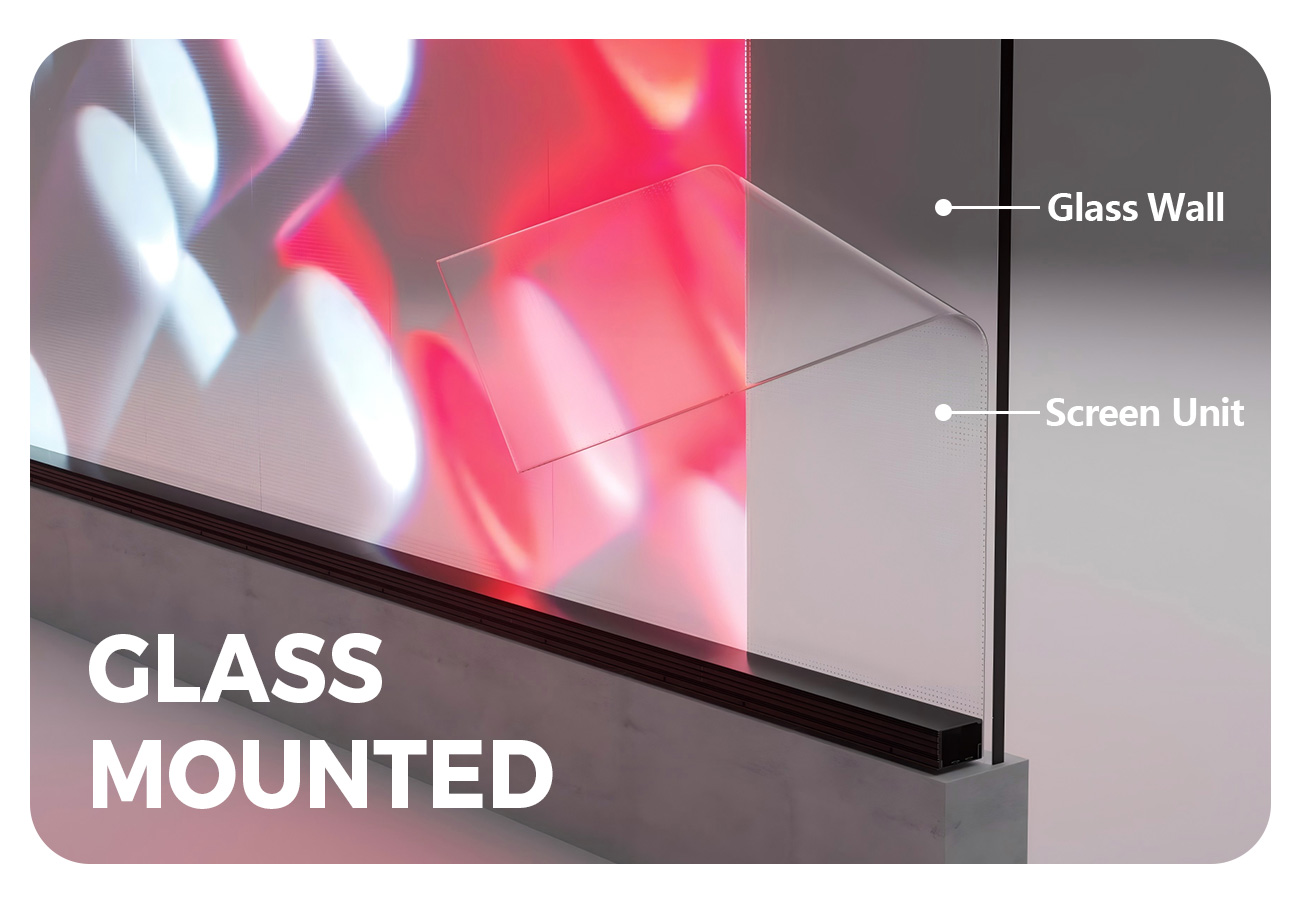
Request the approved surface preparation, adhesive specification, application conditions and inspection method in writing. Ask who confirms compatibility with the actual glass coating, existing film, sealants and cleaning regime. Do not substitute a locally available adhesive or cleaning chemical without approval.
Use a representative glass sample or an approved trial bay. Record the glass identity, product revision, preparation, installer, application conditions and observations. Ask the manufacturer and project team to define the relevant observation period and acceptance limits; this guide does not invent a universal adhesion-test duration.
Have the supplier demonstrate removal and replacement of a defective unit using its approved procedure. Record how residue is addressed, what glass inspection is required, what happens to adjacent modules and how the repaired image is matched. A screen that can be attached quickly is not automatically inexpensive to remove from a finished facade.
Make sun exposure a configuration question
For a Middle East curtain-wall project, identify the site city and orientation instead of relying on the regional label. Record direct-sun exposure and the conditions at the proposed film, glass and power-equipment locations. Exterior weather-station air temperature and temperature at the attachment surface are different inputs.
Ask for the applicable operating and installation temperature limits, the defined measuring points and the evidence relevant to the proposed assembly. The product page’s indoor designation and brightness figure do not establish suitability behind every sunlit facade. Where a required condition exceeds a supported limit, resolve the configuration or location before approval.
Put power supplies and controllers on the drawing with their own environmental and service requirements. Keep heat removal, cable protection and access consistent with the supplied instructions. A self-adhesive film can reduce the need for a screen frame while still requiring supporting arrangements for electrical equipment.
Approve the glass and image together
| Witness condition | What the buyer should inspect | Retained record |
|---|---|---|
| Screen off | View through the actual glazing, visible conductors and edge equipment | Bay ID, viewing positions and representative photographs |
| Bright daytime | Approved message against the actual glass and interior background | Content version, sun condition and brightness setting |
| Evening | Comfort, reflections and useful view from inside | Agreed night output and operating schedule |
| Oblique approaches | Text orientation, legibility and mullion interruptions | Accepted approaches and any excluded viewing positions |
| Service trial | Removal, replacement and restored image | Procedure, tools, spare identity and open issues |
Use bold graphics and the smallest important text from the real campaign. A demonstration on clear glass against a dark background cannot establish the same result on tinted glazing with a brightly lit interior. Review both the outside audience and the occupants’ view.
Agree the exact native pixel map, content orientation and treatment of gaps between bays. Seeing the image through the reverse side does not prove independently controlled double-sided content. Require the actual supported playback arrangement and show how the proposal handles updates and service interruptions.
Shortlist against an evidence packet and clear responsibilities
Ask each Chinese manufacturer to identify the exact film revision, modules, power supplies, controller, connections and permitted substitutions. Request production checks and applicable model-specific documentation, plus a sample that represents the proposed supply. A factory walkthrough is most useful when the supplier can show how those particular modules are inspected and packed.
Compare a written responsibility schedule: who assesses the glass, approves attachment, installs the film, supplies power, commissions the image, removes failed units and handles the glazing after removal. Have the responsible local professionals determine destination and building requirements. Do not treat a display certificate or a brochure statement as approval of the glass assembly.
Itemize the film area, control and power equipment, cable concealment, sample work, access equipment, compatible spares, packing, freight, commissioning and local service. Tie warranty and return terms to the approved glass and environmental conditions. Confirm who pays for access and removal if a repair is needed above an occupied atrium.
The transparent-display manufacturer guide covers broader technology choices. This register and witness plan let architectural specifiers judge the narrower film-on-glass proposal before approving bulk supply.
Questions buyers ask
Can self-adhesive LED film be attached to any curtain-wall glass?
Do not assume that. Identify the actual attachment surface, coatings and existing films, then obtain a product-specific method and the relevant glazing-team review. Use a representative sample or approved trial bay to resolve attachment, appearance and removal.
Does 90%–95% transparency describe the finished glass facade?
Not automatically. The EA-iFilm2 product page gives that range, but the measurement definition and exact configuration must be confirmed. Glass, reflections, conductors, edge equipment and content influence the installed view.
Does an indoor film behind glass avoid all outdoor heat concerns?
No. Direct sun can create demanding conditions at the film, glass or equipment locations. Request defined operating limits and evidence for the actual installation. Do not compare an unspecified product temperature limit with a different measuring point.
What supplier evidence is most useful before buying LED film for a facade?
Retain a glass register, exact product and component identities, approved attachment and removal procedures, a representative witness sample, environmental limits, the module and cable map, and a responsibility schedule for installation and future service.
Request a film-on-glass feasibility review
Send the destination city, glazing schedule, bay elevation, coatings or existing films, proposed attachment side, orientation, operating conditions, viewing positions and content examples. Request the exact product revision, sample plan, attachment method and full supply and service scope.
Prepared by EagerLED. Product references reviewed on 16 October 2026. Examples are planning tools, not completed project results, binding quotations or approvals for a particular installation.