


Are you confused about OLED VS LED? Or you don’t have a comprehensive understanding of the advantages and differences between OLED and LED. That will affect your assessment and selection for your specific activities to a large extent while resulting in a bad visual experience for audiences and damaging your business investments.
This article is tailored to iron out these questions and brings you deeper knowledge on OLED vs LED, which is mainly divided into four aspects: what they are, which one is better, what is the difference, how to choose. Now, Let’s get into it.
1. What is OLED and LED?
1.1 Principle of Electroluminescence
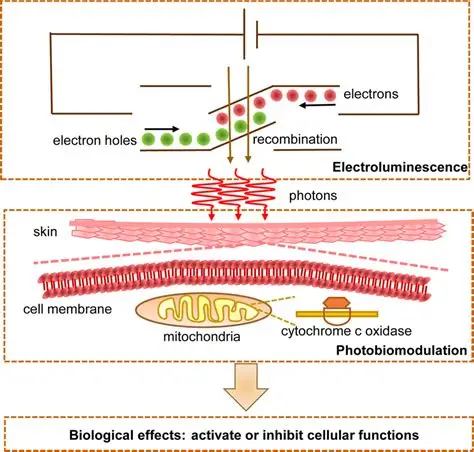
Both OLED (Organic Light Emitting Diode) and LED (Light Emitting Diode) work based on the principle of electroluminescence, which means materials emit light when an electric current passes through them.
In simple terms, when electrons move through a semiconductor material and recombine with electron holes, energy is released in the form of light. However, the way OLED and LED generate and control this light is quite different.
1.2 What is an OLED
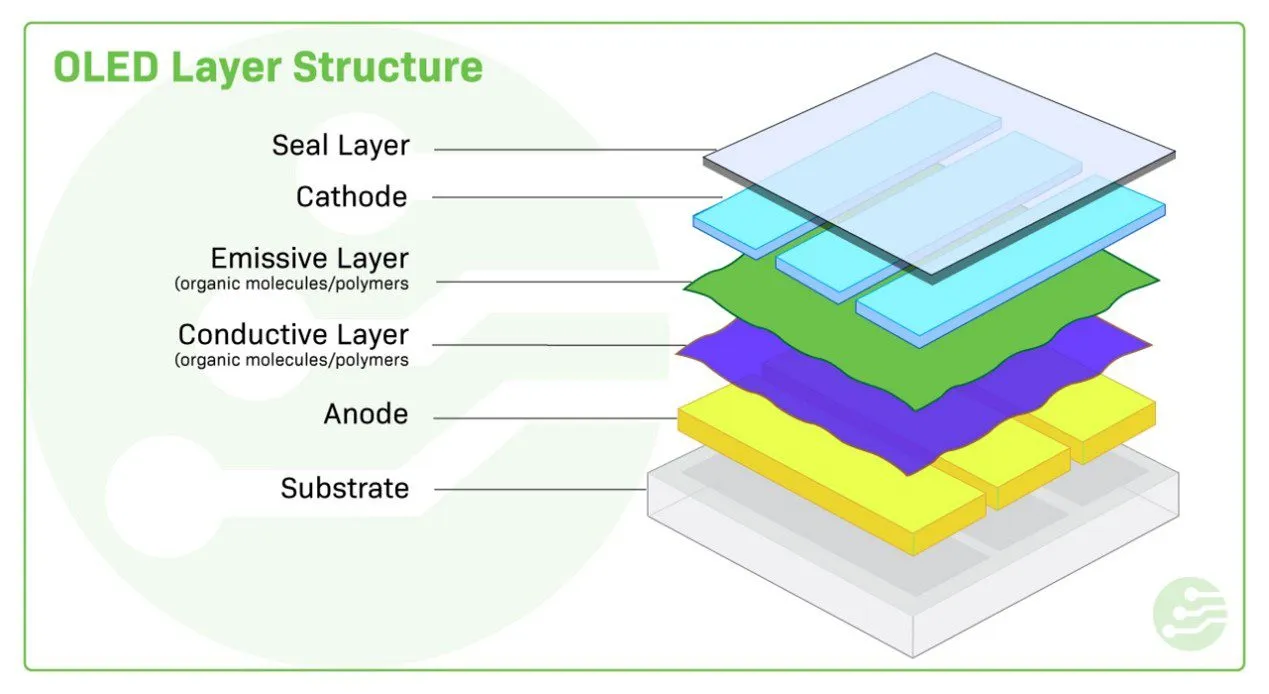
An OLED(Organic Light Emitting Diode) is made of thin organic layers placed between two electrodes. These layers include:
- An anode (positive electrode)
- Organic emissive and conductive layers
- A cathode (negative electrode)
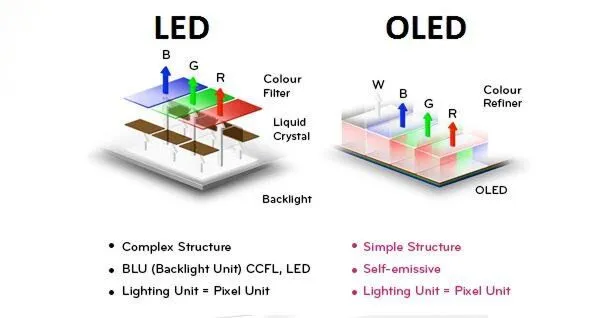
When electricity is applied, each pixel emits its own light. This means OLED displays are self-emissive, requiring no backlight, allowing for thinner and more flexible screens.
1.3 What is an LED(Light Emitting Diode)
A traditional LED display is usually built using:
- A backlight system (LEDs behind the panel)
- Liquid crystal layer (LCD)
- Color filters
The LEDs provide light that passes through the LCD layer to create images. This is why LED displays rely on a backlight system, unlike OLEDs.
1.4 The Specific Applications of the OLED and LED
OLED technology is mainly used in devices where high image quality and design flexibility are important. It is commonly found in smartphones, premium televisions, smartwatches, and high-end indoor display panels. Its ability to deliver deep contrast and accurate colors makes it ideal for close-viewing and luxury visual experiences.
LED technology is widely used in large-scale and high-brightness environments. It is commonly seen in outdoor billboards, stadium screens, shopping mall displays, stage backdrops, and commercial advertising video walls. Because of its strong brightness and durability, LED is better suited for long-distance viewing and demanding environments.
2. Difference Between LED and QLED
The essential difference between OLED and LED is the emitting principle. QLED can light by itself and each pixel can light on and off independently. But LED relies more on a backlight layer and control light to pass through the LCD layer. Here, we will analyze their key differences in technology, structures, materials, lifespans, and flexibility.
2.1 Light Emission Mechanism
The main difference between OLED and LED lies in how they produce light. OLED uses organic materials that emit light directly when electricity is applied, while LED uses inorganic semiconductor materials that emit light but are typically used as a separate light source.
2.2 Material Composition
OLED is made from organic (carbon-based) compounds, which are flexible and can be extremely thin. In contrast, LED is made from inorganic semiconductor materials such as gallium nitride, which are more rigid and durable.
2.3 Structure
OLED has a simpler structure because it does not require additional components to emit light. LED, on the other hand, usually needs supporting structures or systems (such as packaging or integration into larger systems), making it more complex in practical applications.
2.4 Flexibility
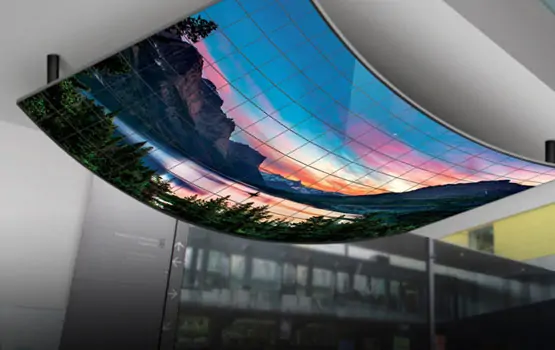
OLED materials are naturally flexible, allowing them to bend or curve without damage. LED components are generally rigid and less adaptable to flexible or curved designs.
2.5 Efficiency and Performance Characteristics
OLED provides high efficiency at lower brightness levels and can achieve excellent color quality. LED is more efficient at high brightness levels and is better suited for applications requiring strong illumination.
2.6 Lifespan and Stability
LED materials are more stable and typically have a longer lifespan. OLED materials can degrade over time, especially when exposed to moisture or high brightness, which affects their longevity.
3. Is QLED Better than LED?
In most cases, QLED is better than standard LED, but it’s important to understand why.
QLED (Quantum Dot LED) is essentially an upgraded version of LED technology. It still uses a backlight like traditional LED displays, but adds a quantum dot layer to enhance color and brightness.
- Better color performance– QLED produces more vivid and accurate colors thanks to quantum dots
- Higher brightness– Ideal for bright environments like living rooms or retail spaces
- Improved efficiency– More efficient light conversion than standard LED
However, QLED still relies on a backlight, so it cannot achieve true black levels like OLED.
OLED VS LED Conclusion:
- QLED = Better than LED in brightness and color
- LED = More budget-friendly and widely available
OLED VS LED: Quick Comparison
| Feature | OLED | LED |
| Technology | Self-emissive pixels | LED backlight (LCD) |
| Contrast | Best (true black) | Moderate |
| Brightness | Medium | High |
| Color | Excellent | Good |
| Cost | High | Low |
| Best Use | Home cinema, premium displays | Large displays, budget use |
4. LED VS OLED VS QLED: Pros and Cons
Here is a detailed comparison of LED, OLED, and QLED display technologies, breaking down their pros and cons to help you understand the differences.

4.1 LED (Light Emitting Diode)
This is the most traditional and foundational display technology. An LED screen is essentially an LCD (Liquid Crystal Display) panel that uses LEDs for backlighting.
Pros
- Affordability: LED TVs are generally the most budget-friendly option, especially for larger screen sizes, due to mature manufacturing processes.
- Durability & Longevity: They have a long lifespan (typically 50,000-100,000 hours) and are not susceptible to image retention or burn-in.
- Brightness: They can achieve high brightness levels, making them suitable for brightly lit rooms.
Cons
- Poor Contrast & Black Levels: Because they rely on a backlight, LEDs cannot produce true black. The backlight can “bleed” through, resulting in grayish blacks and lower contrast, especially in dark scenes.
- Slower Response Time: The liquid crystals take time to switch, which can lead to motion blur or ghosting in fast-paced content like sports or games.
- Limited Viewing Angles: Colors and brightness can shift when viewed from the side, particularly on models with VA panels.
4.2 OLED (Organic Light Emitting Diode)
OLED is a self-emissive technology, meaning each pixel produces its own light and can be turned on or off independently.
Pros
- Perfect Blacks & Infinite Contrast: Since pixels can turn off completely, OLEDs deliver true, pure black and an infinite contrast ratio, creating incredible depth and detail in dark scenes.
- Superior Viewing Angles: The picture quality, including color and contrast, remains consistent from almost any viewing angle.
- Extremely Fast Response Time: With response times often under 1ms, OLEDs provide exceptionally smooth motion with virtually no blur, making them ideal for gaming.
- Thin & Flexible Design: The lack of a backlight allows for incredibly thin, lightweight, and even flexible or rollable screens.
Cons
- Risk of Burn-in: The organic materials can degrade over time. Displaying static images (like news tickers or game HUDs) for extended periods can lead to permanent image retention, known as burn-in. Modern models use various technologies to mitigate this risk.
- Lower Peak Brightness: While improving, OLEDs generally cannot reach the same peak brightness levels as high-end QLEDs, which can make HDR highlights in very bright rooms less impactful.
- Higher Cost: OLED technology is more expensive to manufacture, making these displays a premium, higher-priced option.
4.3 QLED (Quantum-dot Light Emitting Diode)
QLED is an enhancement of traditional LED/LCD technology. It uses a layer of quantum dots to improve the color and brightness of the LED backlight.
Pros
- High Brightness & Vivid Colors: QLEDs can achieve very high peak brightness (often over 1,000 nits) and produce a wide, vibrant color gamut, making HDR content look stunning, especially in bright environments.
- No Burn-in Risk: Since they use inorganic materials for the quantum dot layer and LCD panel, QLEDs are immune to burn-in, making them a durable choice for content with static elements.
- Energy Efficiency: For bright, colorful content, QLEDs can be more energy-efficient than OLEDs.
Cons
- Inferior Contrast to OLED: Like standard LEDs, QLEDs still rely on a backlight. Even with advanced local dimming, they cannot achieve the perfect blacks and pixel-level contrast of OLED, and some light blooming may be visible.
- Limited Viewing Angles: While better than standard LED, QLEDs still cannot match the wide viewing angles of OLED, with some color and contrast shift when viewed from the side.
- Slower Response Time: Although good, their response time is generally slower than OLED, which might result in slight motion blur in very fast scenes.
5. OLED VS LED Comparison: Which is Better for Eyes?
5.1 Eye Health Comparison: Blue Light & Flicker
A. Harmful Blue Light (415–455nm)
OLED: Better
Spectrum is smoother with less high-energy blue light peak. Total blue light is ~36–50% of LCD. Dark scenes emit zero blue light from black pixels.
LED/LCD: Worse
Has a strong, sharp blue peak from LED backlight and constant blue light emission even on dark screens.
B. Flicker (PWM vs. DC Dimming) — The Biggest Factor for Fatigue
LED/LCD: Best (No Flicker)
Uses DC (Direct Current) dimming, adjusting brightness by changing power steadily. 100% stable light with no flicker, ideal for sensitive eyes and night use.
OLED: Depends on PWM Frequency
Uses PWM (Pulse Width Modulation), with pixels flashing on/off rapidly to control brightness. Low-frequency PWM (<1000Hz) causes visible strain, dryness and headaches, while high-frequency PWM (≥1920Hz / 3840Hz+) makes flicker imperceptible. PWM frequency drops sharply in dark environments.
5.2 OLED VS LED: Which Is Better for Your Eyes?
Choose OLED if:
- You want less blue light, better for sleep and long-hour use.
- You use it in dark rooms with deeper blacks and less glare.
- The device has high-frequency PWM (1920Hz+) or DC hybrid dimming.
Choose LED if:
- You are PWM-sensitive and easily get headaches or tired eyes.
- You use devices late at night on low brightness.
- You need a budget screen with most affordable models using DC dimming.
6. OLED Display VS LED Display: How to Choose?
6.1 Choose OLED Display if
- You want deeper blacks, higher contrast ratio, and vivid, accurate colors for watching movies, gaming, or creative media work.
- You prefer a thinner, lighter, and more flexible screen design, such as curved panels or slim mobile devices.
- You need ultra-fast response time for smooth motion, which reduces motion blur in games and videos.
- You care about lower blue light output and more comfortable viewing in dark environments.
- You use the screen mainly in indoor, low-light, or home entertainment scenarios.
6.2 Choose LED Display if
- You need higher peak brightness for clear visibility in bright rooms or near windows and outdoors.
- You prioritize longer service life and want to avoid the risk of screen burn-in.
- You are looking for a more cost-effective choice with reliable daily performance.
- You have eye sensitivity to screen flicker and need stable, flicker-free brightness adjustment.
- You use the display mainly for office work, reading documents, web browsing, and long-hour daily tasks.
Simple Buying Guide: OLED Display VS LED Display
- For home theater, high-end smartphones, gaming monitors, and premium laptops → OLED Display
- For office monitors, budget TVs, outdoor-readable devices, and long-hour work screens → LED Display
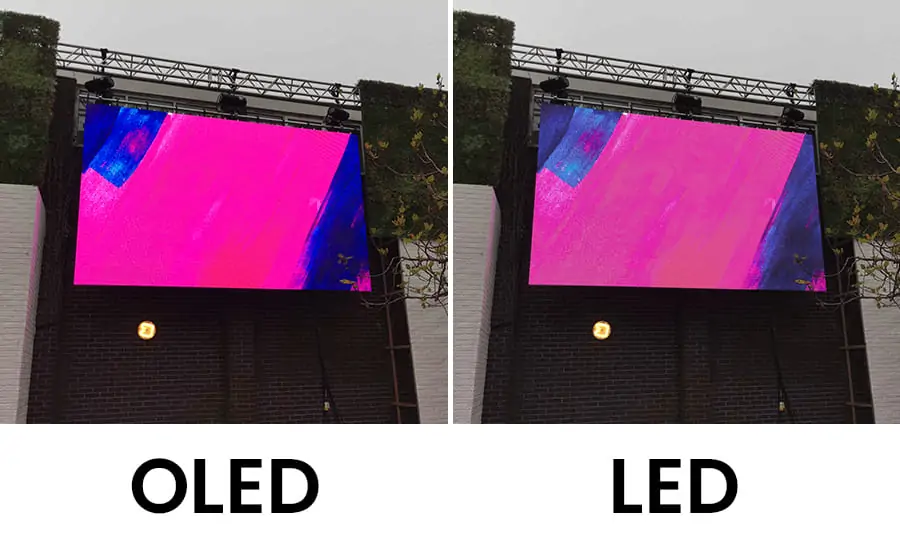
7. FAQs about OLED vs LED
1. Is blue light higher in LED or OLED?
LED displays typically emit more blue light than OLED, which can increase eye fatigue over time.
2. Which is better for kids’ eyes?
OLED is generally preferred due to lower blue light, but proper screen habits are more important than display type.
3. OLED VS LED: Which is better for gaming
OLED is better for gaming due to its faster response time, smoother motion, and near-instant pixel switching, which reduces motion blur and ghosting.
8. Conclusion
To sum up, I think you have gained a comprehensive cognition about OLED vs LED after reading this article. Teasing out their differences and advantages is advisable to make a choice when considering buying OLED displays or LED displays. A high-performance display with the most suitable technology can bring a striking visual feast for audiences. If you still feel confused about OLED and LED, feel free to contact our teams to iron out your problems.