

Brazil has a real ecosystem of LED display suppliers. It is concentrated in São Paulo, growing at roughly 8.8% a year, and big enough that you probably do not need to import from China, pay 60% in taxes, and wait three months for customs.
I put this list together because the existing ones online are thin. Most name ten companies, give each one two sentences pulled from their homepage, and call it a day. That is not enough to make a buying decision. I wanted something you can actually use: who these companies are, what they are good at, what to budget, and how to avoid the mistakes I have watched people make.
1.Why You Probably Want to Buy Locally
2.The Top 11 LED Display Suppliers in 2026
3.What Each LED Display Supplier Actually Does Well
4.How to Compare LED Display Suppliers Once You Have a Shortlist
5.What Things Cost
6.Questions I Would Ask before Requesting a Quote
7.Five Things I Would Tell a Friend before They Buy
8.FAQ
9.Conclusion
1. Why You Probably Want to Buy Locally?
The math on importing LED displays into Brazil is bad. The tax stack alone (II, IPI, PIS/COFINS, ICMS) routinely pushes your landed cost 60% or more above the factory price. On a $10,000 LED wall, you are looking at $16,000 before installation. Then you wait 30 to 45 days for the boat from Shenzhen to Santos, plus however long customs decides to hold your container. Two to eight weeks is normal.
If a panel fails under warranty, a factory in China is not bound by the Código de Defesa do Consumidor. A supplier with a CNPJ and a physical address in Brazil is. When something breaks at 8pm before an event, you call someone who speaks Portuguese and stocks parts locally. That difference alone decides a lot of buying decisions.
There are financing options through BNDES and Proger that international suppliers cannot offer. Some of the companies on this list let you pay over 48 months at low interest. A R$ 50,000 LED wall at 24 installments is a different conversation than a single upfront payment.
Local is not always the answer. If your order is large enough that freight and tax amortize, or you need a spec no local supplier stocks, importing makes sense. For most projects under R$ 500,000, local is the lower stress default.
2. The Top 11 LED Display Suppliers in 2026
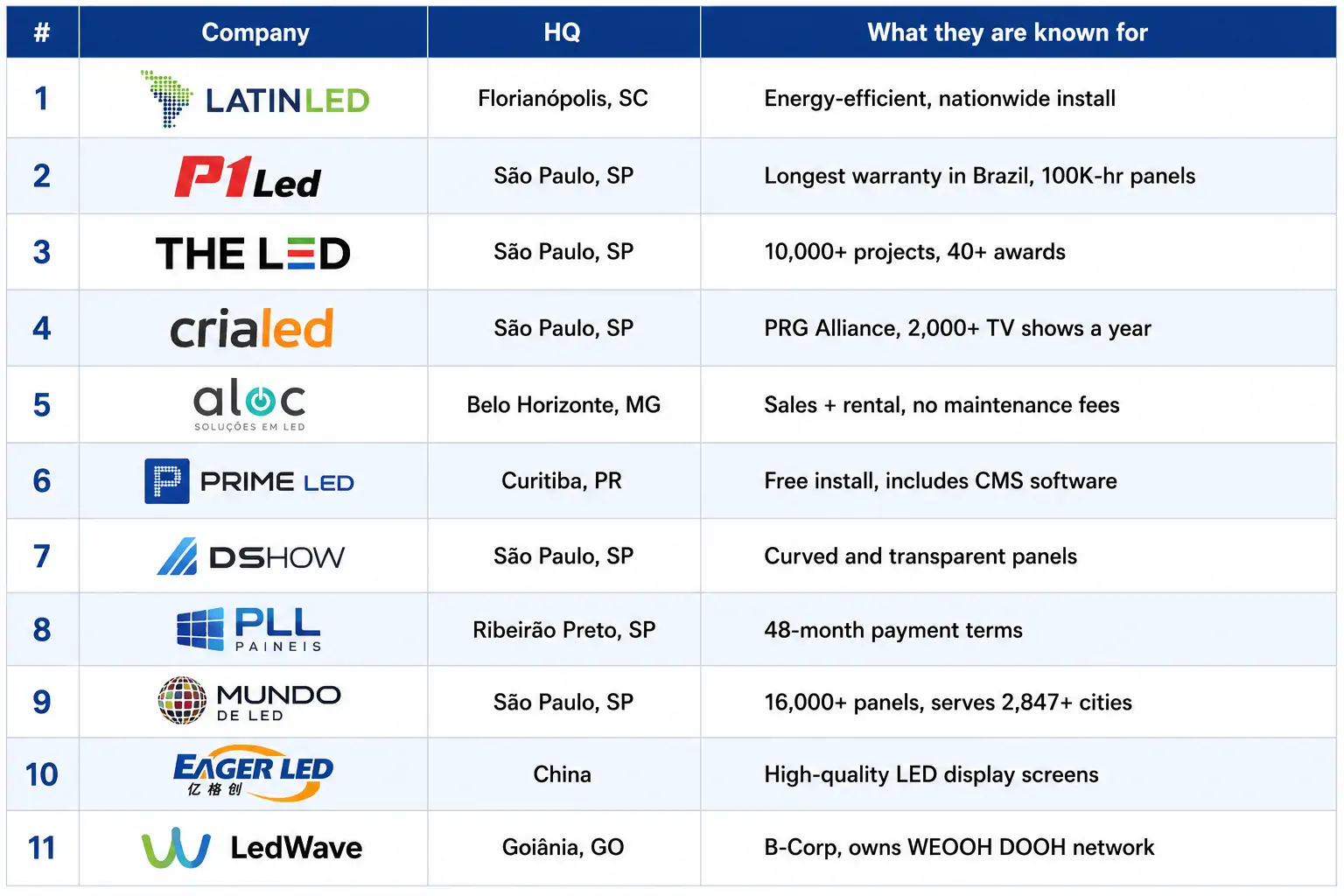
I focused on companies with verifiable physical operations in Brazil, local warranty and support, and enough market visibility that you can check their track record independently. São Paulo state dominates. Belo Horizonte, Curitiba, Florianópolis, and Rio de Janeiro each have strong individual players. I skipped small regional resellers that do not stock inventory.
Here is a quick overview. Profiles follow.
3. What Each LED Display Supplier Actually Does Well
I kept these short on purpose. The website is listed if you want to dig deeper. What matters is what each company is actually good at, not what their homepage says.
3.1 LATINLED
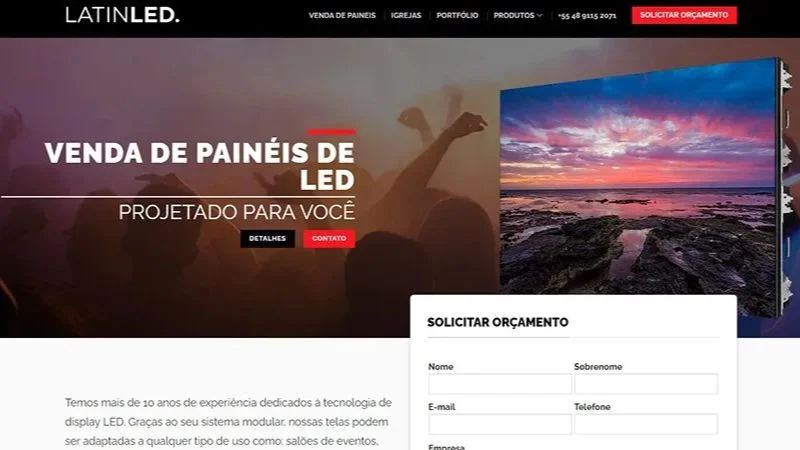
Florianópolis. latinled.com.br. Three year warranty. They push energy efficiency and product lifespan (10+ years rated) rather than competing on price. They stock original spare parts and train your team as part of installation. If you want a supplier that will still pick up the phone three years after the install, they belong on the shortlist. Good fit for corporate buyers who care more about reliability than the lowest upfront cost.
3.2 P1Led
São Paulo. p1led.com.br. Part of the DH Experience Group. Six year warranty. That is twice what anyone else on this list offers. They rate their panels at 100,000 hours without performance loss and assemble custom configurations from globally sourced components. You pay a premium for the warranty, but if you are building something permanent and do not want to think about panel failures until 2031, that premium is cheaper than the alternative.
3.3 The LED
São Paulo. theled.com.br. Founded 2010. They have done more than 10,000 projects across Brazil, the US, and Portugal, and picked up 40 industry awards along the way. Their scale gives them supply chain leverage that smaller suppliers cannot match. If your project is straightforward (standard indoor or outdoor, standard ratio, standard pitch), they have probably installed something like it before.
3.4 Crialed
São Paulo. crialed.com.br. They are a member of PRG Alliance, the global production network, which matters if your event involves broadcast cameras or standardized production workflows. More than 200 employees. Roughly 2,000 TV shows and 600 corporate events every year. Their team handles spec, install, training, and content. If you are building a studio or running large format live production, they operate at that level.
3.5 Aloc
Belo Horizonte, with branches in São Paulo, Rio, and Piracicaba. aloc.com.br. They do both sales and rental, which is less common than it should be, and they do not charge maintenance fees for permanent clients. If equipment fails, they replace it immediately instead of running it through a repair queue. That is more valuable than a long written warranty if your business loses money every minute the screen is down. Rental companies and live events are their core.
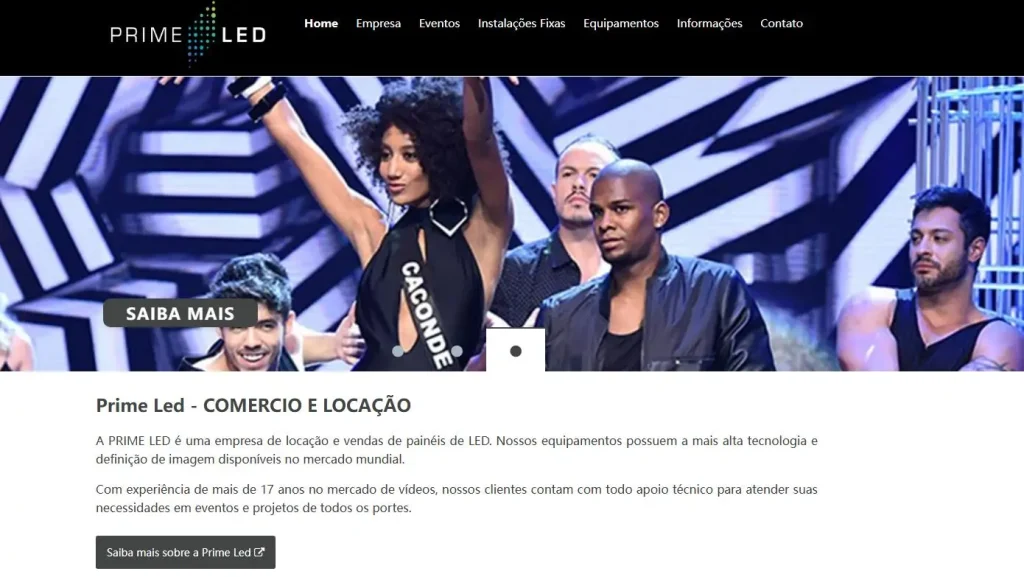
3.6 Prime Led
Curitiba. ledprime.com.br. They offer free installation and access to Proger, a government credit line for small businesses with flexible repayment terms. They also include a content management dashboard for video, weather, and news feeds. For a small business buying its first LED display, free install plus government financing removes the two biggest barriers to pulling the trigger.
3.7 Dshow
São Paulo. dshow.com.br. They do curved and transparent LED panels, which only a handful of Brazilian suppliers can deliver. Full service from design through installation, nationwide. If your project needs a non standard shape or a creative format, Dshow is one of very few options on this list that can execute it.
3.8 PLL Paineis
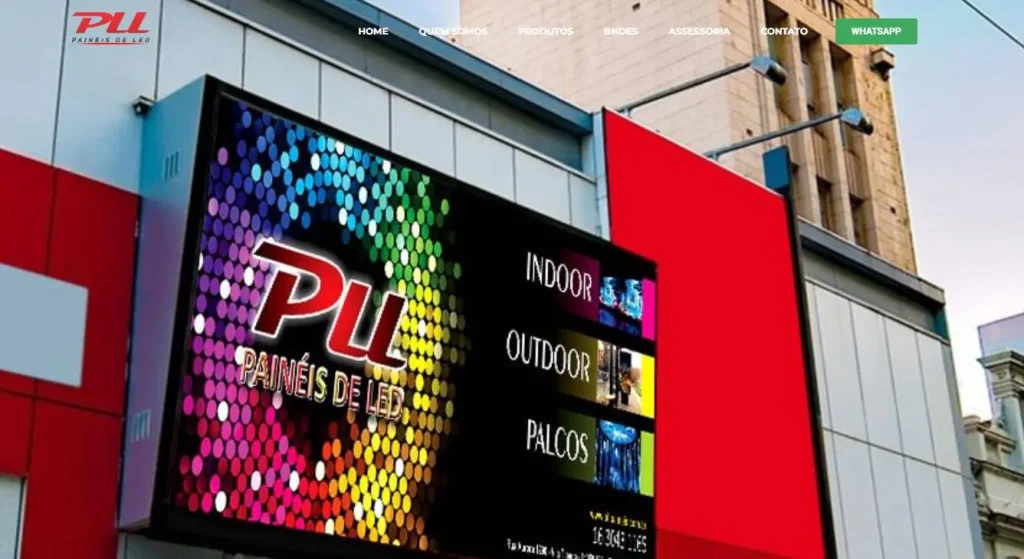
Ribeirão Preto. pllpaineis.com.br. They are approved by BNDES, Brazil’s national development bank, to offer up to 48 months of financing at below market rates. They also do advisory on screen size, location, viewing angle, resolution, and color calibration before you buy. Churches, schools, and municipal projects where capital has to stretch across multiple budget years are their sweet spot. Most LED suppliers do not solve the financing problem. PLL Paineis is built around it.
3.9 Mundo de LED
São Paulo. mundodeled.com.br. Founded 2013. They have sold more than 16,000 panels and serve over 2,847 cities. They report 95% or higher satisfaction and offer 365 day remote support with priority troubleshooting. Their infrastructure is built for customers who are not in São Paulo. If you are in a smaller city and need a supplier with proven national coverage, they have likely installed somewhere near you.
3.10 EagerLED
Founded in 2009 and based in Shenzhen, China, EagerLED is an experienced LED display manufacturer specializing in indoor and outdoor screens, rental displays, transparent screens and commercial advertising products, exporting to over 120 countries with full international certifications such as CE, FCC and UL. Focusing on overseas marketing with YouTube as a key channel, it shares product demos and project cases while strictly following copyright regulations to ensure safe long‑term brand promotion for global clients.
3.11 LedWave
Goiânia and nationwide. They are a certified B Corporation, which is rare in this industry in Brazil. They also own WEOOH, one of Brazil’s largest DOOH media networks. That dual perspective (manufacturer plus media operator) means they understand the ad business side, not just the hardware. If you are building a digital billboard network that needs to generate ad revenue, LedWave can advise on both the panels and the media operations.
4. How to Compare LED Display Suppliers Once You Have a Shortlist
Pick three to five from the list above based on what matches your project type and location. Then dig into the things that separate a reliable supplier from one that will go silent after the invoice is paid.
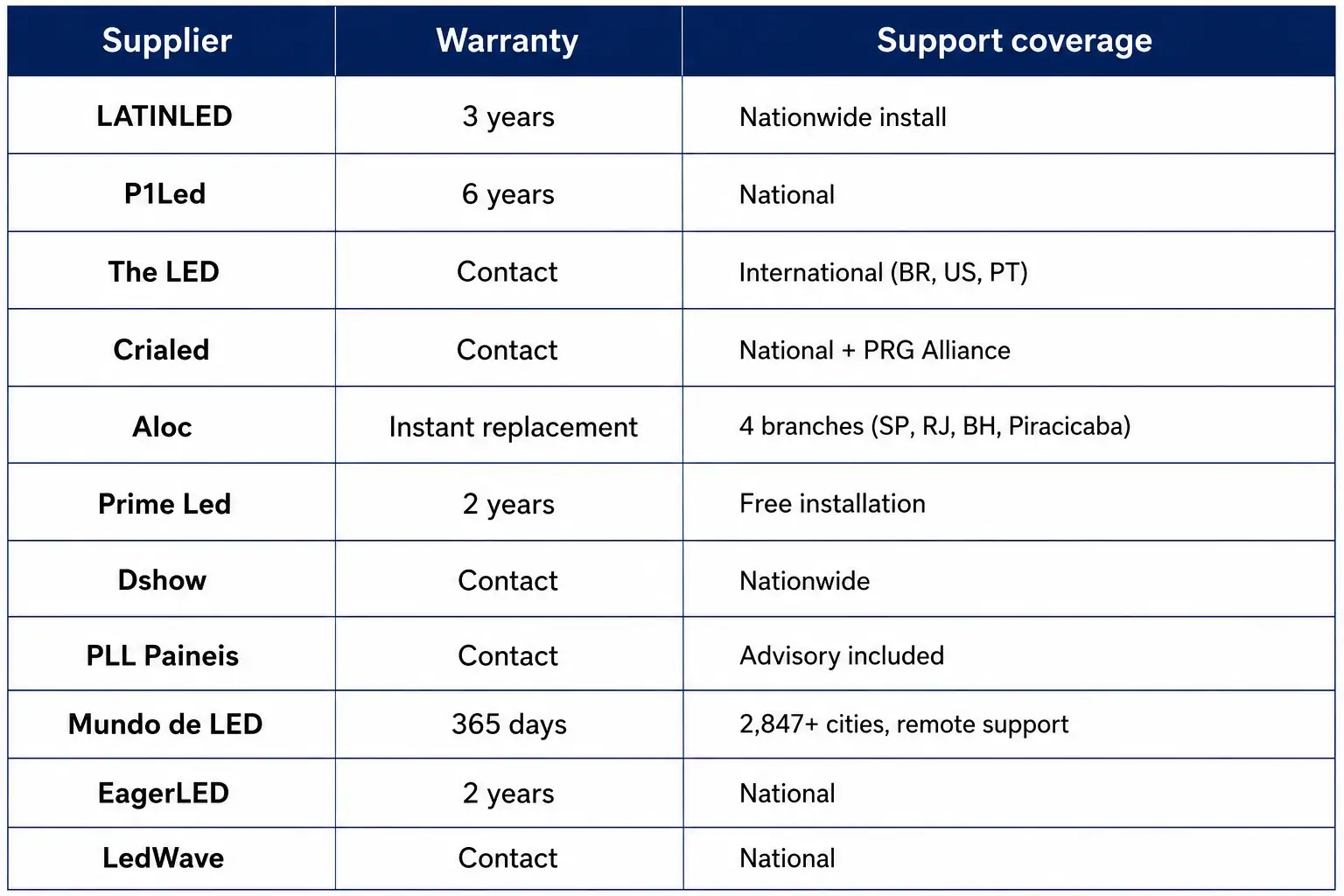
A five year warranty means nothing until you know what it covers. Parts only, or parts and labor? On site service or ship it back? What is the guaranteed response time? Get it in writing. In Portuguese.
Ask whether they stock spare modules, power supplies, and receiving cards in Brazil. If they order replacements from China every time a module fails, your downtime is measured in months.
Check whether technical support is actually available in Portuguese. Some Brazil based suppliers rely on Chinese speaking technicians who use translation apps for customer communication. It works for simple problems and falls apart for complex ones.
Ask for client references in your industry and call them. A supplier who has done ten church installs and is now bidding on your retail project might be fine. A supplier who has done ten retail projects will already know what goes wrong.
And confirm whether the quote includes the full system, not just the panels. Some suppliers quote panel only prices and add the controller, processor, and software as separate line items. A NovaStar or Colorlight controller can add R$ 2,000 to R$ 15,000 to your total depending on the tier.
Warranty and support, side by side:
Red flags
A few things that should make you cross a supplier off the list immediately: no physical address or showroom you can visit, unwilling to share local client references, prices way below the ranges in the pricing section below, no written warranty in Portuguese, cannot name a city in your region where they have installed something similar, communication only through WhatsApp with no formal quote document.
A legitimate supplier has a CNPJ you can look up, a physical address visible on Google Maps, and references who answer the phone. If they hesitate on any of these, move on. There are fourteen other companies on this list.
5. What Things Cost
These are directional ranges based on publicly available pricing and industry averages as of mid 2025. They are not quotes. Prices move with exchange rates, order volume, and negotiation. Always get at least three written proposals before budgeting.
Indoor fine pitch (P1.2 to P1.8, for conference rooms and corporate lobbies) runs roughly R$ 8,000 to R$ 18,000 per square meter. Standard indoor (P2.0 to P3.0, for retail, churches, events) is R$ 3,500 to R$ 8,000. Outdoor advertising (P4 to P6, billboards and facades) costs R$ 4,000 to R$ 10,000. Large pitch outdoor (P8 to P10, stadiums, highway signs) runs R$ 2,500 to R$ 6,000. Rental panels (P2.6 to P3.9) sit around R$ 4,500 to R$ 9,000. Transparent or creative LED is custom territory and starts at R$ 10,000 and goes up from there.
Those are hardware only. They do not cover the controller, the steel mounting structure, the installation crew, the cabling, or the content creation. The steel structure and installation alone typically add 15% to 30% on top. Outdoor installations need an engineered structure rated for wind load, and skipping that line item is how you end up with a collapsed screen and an insurance claim.
Content creation catches people off guard. Most suppliers do not include it in the hardware quote. If you do not have an in house designer who can build animations at the exact pixel dimensions of your display, budget separately. A thirty second LED wall animation runs R$ 1,500 to R$ 8,000 depending on complexity.
Annual maintenance is worth asking about upfront. For outdoor displays in coastal or high humidity areas, paying for a yearly service visit to check seals, connections, and calibration costs less than discovering water damage two years in.
6. Questions I Would Ask before Requesting a Quote
Do you have local stock in Brazil right now, or does this need to be imported? This one question eliminates resellers who are effectively drop shipping from China with a Brazilian domain name. If the answer is anything other than “we have it in our warehouse,” factor in the import timeline and tax burden.
What does your warranty cover, exactly, and who performs on site service in my city? Get the document. Check parts, labor, and response time. If a module fails in Manaus or Porto Alegre, who shows up and how fast?
Can you give me references for projects similar to mine, in Brazil? Not international references, local ones. Someone whose phone you can call.
Do you offer any financing or installment options? BNDES, Proger, or in house plans. If the answer is 100% upfront, that is fine, just know it going in.
Is the controller included in the quote or is it a separate line item? Make sure you are comparing full system prices when you compare quotes. Panel only vs panel plus controller plus software can look like a 20% difference when it is really the same thing packaged differently.
7. Five Things I Would Tell a Friend before They Buy
Importing makes sense for large orders and custom specs. For most projects under R$ 500,000, buying from a supplier with stock already in Brazil and customs cleared is cheaper once you factor in taxes, freight, and time.
BNDES and Proger financing are real options. PLL Paineis does BNDES up to 48 months at low interest. Prime Led does Proger for small businesses. If you are a church or a school, do not pay cash without checking these first. The paperwork takes time but the rates make it worth it.
The cheapest panel quote is rarely the cheapest total cost. A supplier quoting 20% below everyone else is probably using off spec components, or quoting panel only with the controller as a surprise line item later, or both. Get itemized quotes and compare line by line.
São Paulo has the most suppliers, but there are solid options in Belo Horizonte (Aloc), Curitiba (Prime Led), Florianópolis (LATINLED), Rio (LED Expert), and Goiânia (LedWave). You do not have to buy from SP.
If you only need a screen a few times a year, rent it. Aloc, Crialed, LED Expert, and Dshow all rent. For one off events or occasional use, renting is almost always cheaper than buying, and you do not carry the depreciation or storage.
8. FAQs
1. Who are the main LED display suppliers in Brazil?
The 15 covered in this guide: LATINLED, P1Led, The LED, Crialed, Aloc, Prime Led, Dshow, PLL Paineis, Mundo de LED, Rogus Tec, TecnoLED Brasil, LED Brasil, NVC Lighting Brazil, LED Expert, and LedWave.
2. How much should I expect to pay?
Indoor panels range from about R$ 3,500 to R$ 18,000 per square meter depending on pixel pitch. Outdoor runs R$ 2,500 to R$ 10,000. Add 15% to 30% for structure and installation, plus R$ 2,000 to R$ 15,000 for the controller. Content creation is extra. Get three quotes.
3. Should I import or buy locally?
For most projects under R$ 500,000, local. Import taxes on electronics in Brazil can exceed 60%, customs takes weeks to months, and warranty enforcement on imported goods is practically nonexistent. Importing makes sense for very large orders or custom specs no local supplier stocks.
4. Can I finance an LED display purchase?
Yes. BNDES offers up to 48 month financing through approved suppliers like PLL Paineis. Proger provides government backed credit for small businesses through Prime Led. Many suppliers also offer in house installment plans. Ask each supplier what they can do.
5. How do I check if a LED screen supplier is legitimate?
A physical address you can verify on Google Maps, a valid CNPJ, local client references who answer the phone, written warranty terms in Portuguese, and real Google reviews. If they hesitate on any of these, try a different supplier.
6. Which LED display supplier is best for churches?
Prime Led (Proger financing, free installation) and PLL Paineis (BNDES 48 month terms) are the two that solve the budget problem most churches face. Mundo de LED has nationwide support if your church is outside a major city.
9. Conclusion
Brazil has a real ecosystem of LED display suppliers. You do not need to import from China, pay 60% import tax, and wait three months for customs clearance unless your project truly demands it.
Shortlist three to five that match your project type, budget, and location. Ask the five questions in section H2-8. Get written quotes. Call their references. And buy from the one that answers your questions clearly, in Portuguese, with a warranty you can enforce.