A naked eye 3D LED display uses specially rendered video and perspective to make objects appear to extend beyond an LED screen, without glasses. Its appeal comes from the apparent depth, large-scale product storytelling and potential for people to film the experience. The strongest effect depends on the screen geometry, tailored content and a planned viewing position; buying an LED wall alone does not create it.
This guide focuses on anamorphic LED billboards used in outdoor advertising and commercial spaces. It explains why they attract attention, how the illusion works and what to check before specifying a project.
If you are planning a naked eye 3D LED display, start with the audience position and the site survey. Those decisions shape the screen layout, native resolution, animation and commissioning tests. A convincing demonstration should be judged from the real pedestrian viewing area rather than from a carefully cropped promotional video.
1. What is a naked eye 3D LED display?
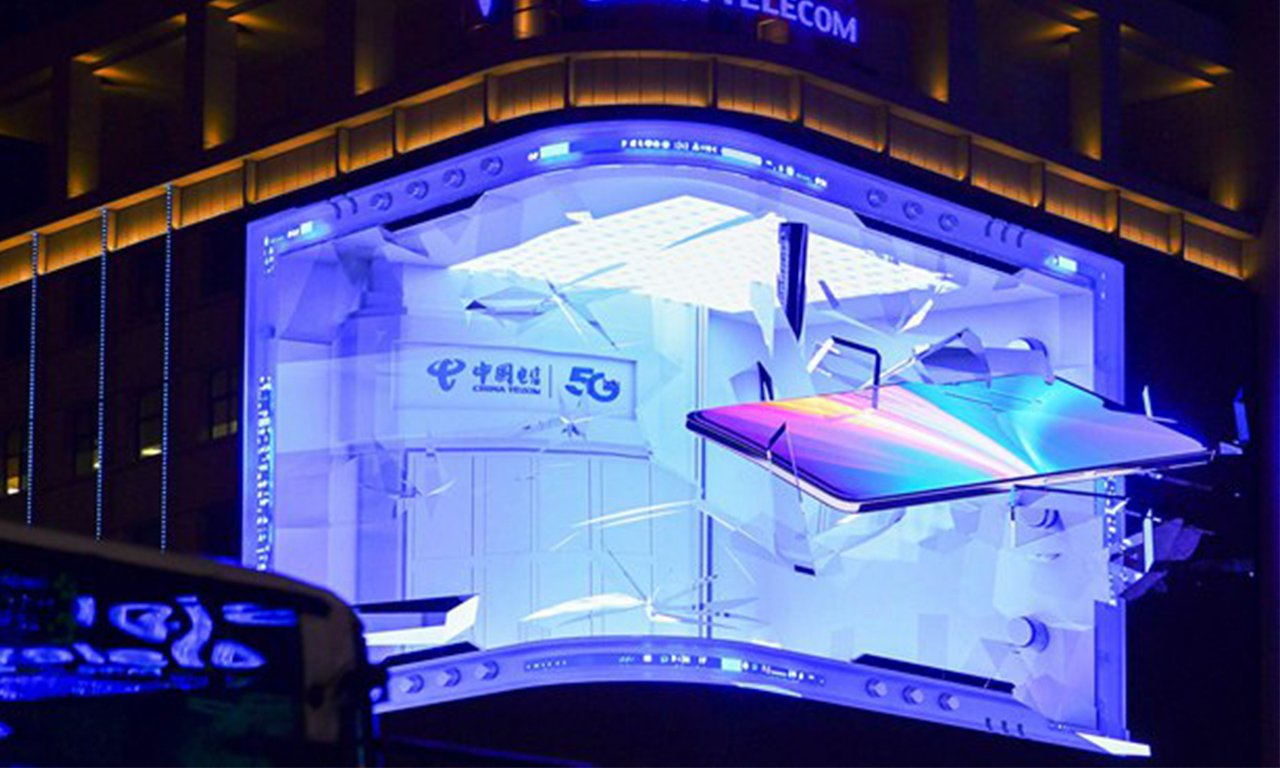
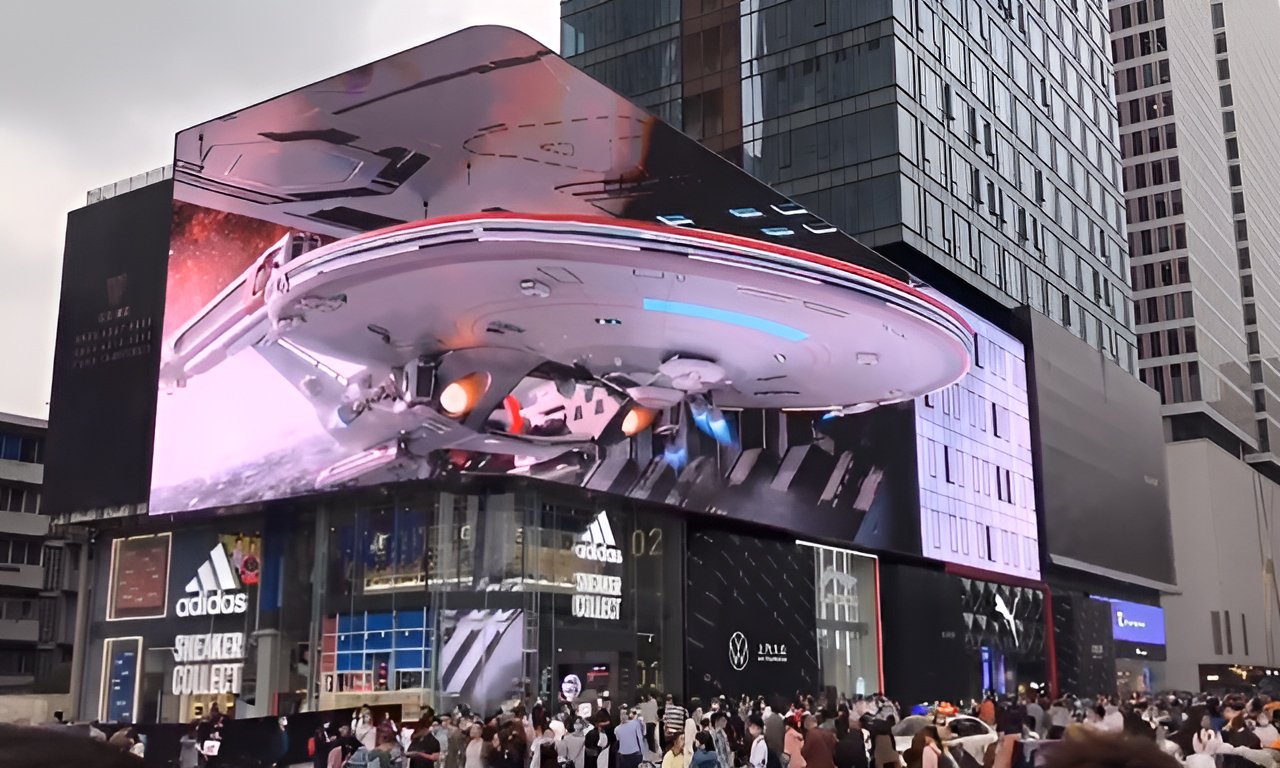
In billboard advertising, a naked eye 3D LED display is an LED video wall playing anamorphic content: an image intentionally shaped for a particular real-world viewpoint. Perspective, shadows, scale and occlusion make the scene look three-dimensional, although the light still comes from the screen surface.
The terms glasses-free 3D billboard, 3D LED screen and anamorphic LED display often describe this advertising format. A corner or curved installation can make the illusion more convincing by showing two connected faces of a virtual scene.
01. Is a naked eye 3D LED display the same as a 3D monitor?
No. An autostereoscopic monitor uses optics such as lenticular lenses or a parallax barrier to direct different views toward the eyes; some systems also track the viewer. A typical anamorphic outdoor billboard uses perspective-rendered content viewed from a planned position. These technologies share the phrase “glasses-free 3D” but have different hardware and viewing requirements.
| Display type | How depth is presented | Viewing and content requirement |
|---|---|---|
| Conventional 2D LED billboard | Standard images, text and video on an LED surface | Content is designed for legibility across the intended audience area. |
| Anamorphic 3D LED billboard | Perspective, virtual framing and shading create apparent depth. | Video must match the physical screen and the intended viewing position. |
| Autostereoscopic 3D monitor | Optics deliver different views to the eyes. | Requires compatible display hardware, content and supported viewing zones. |
2. How does the naked-eye 3D effect work?
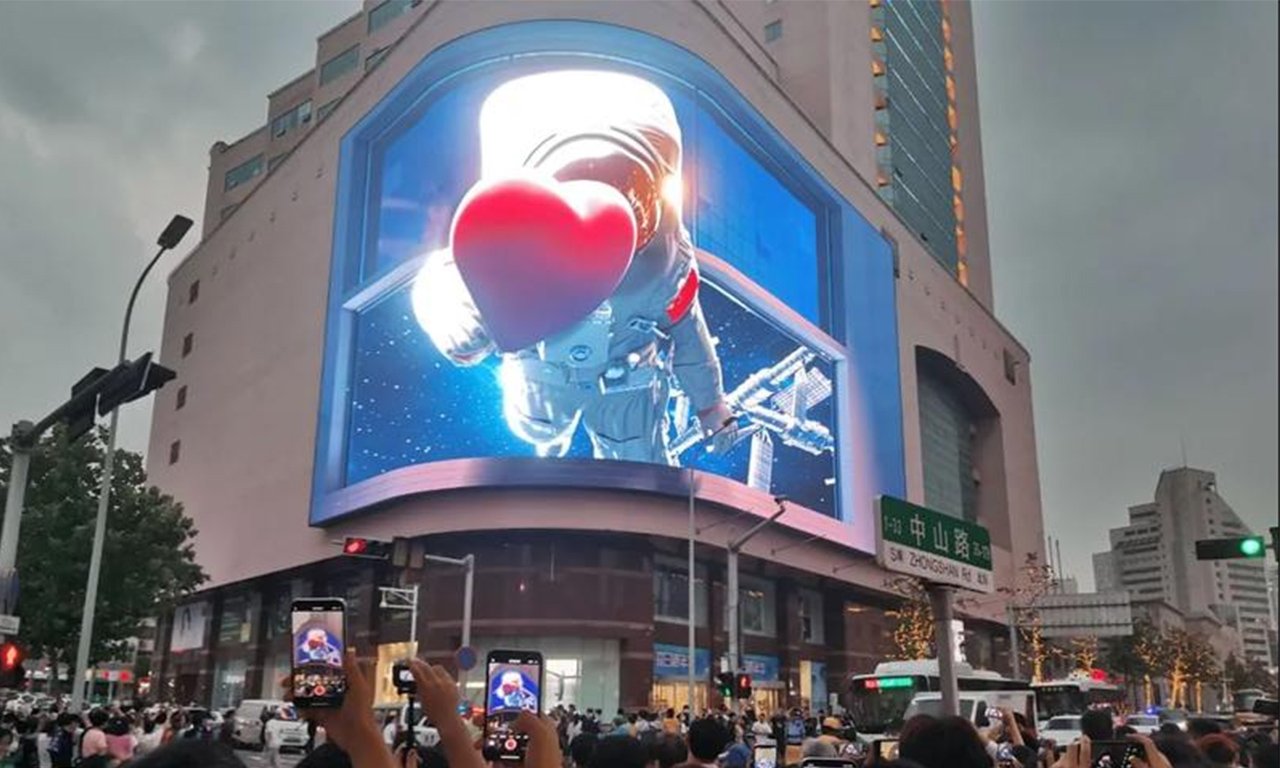
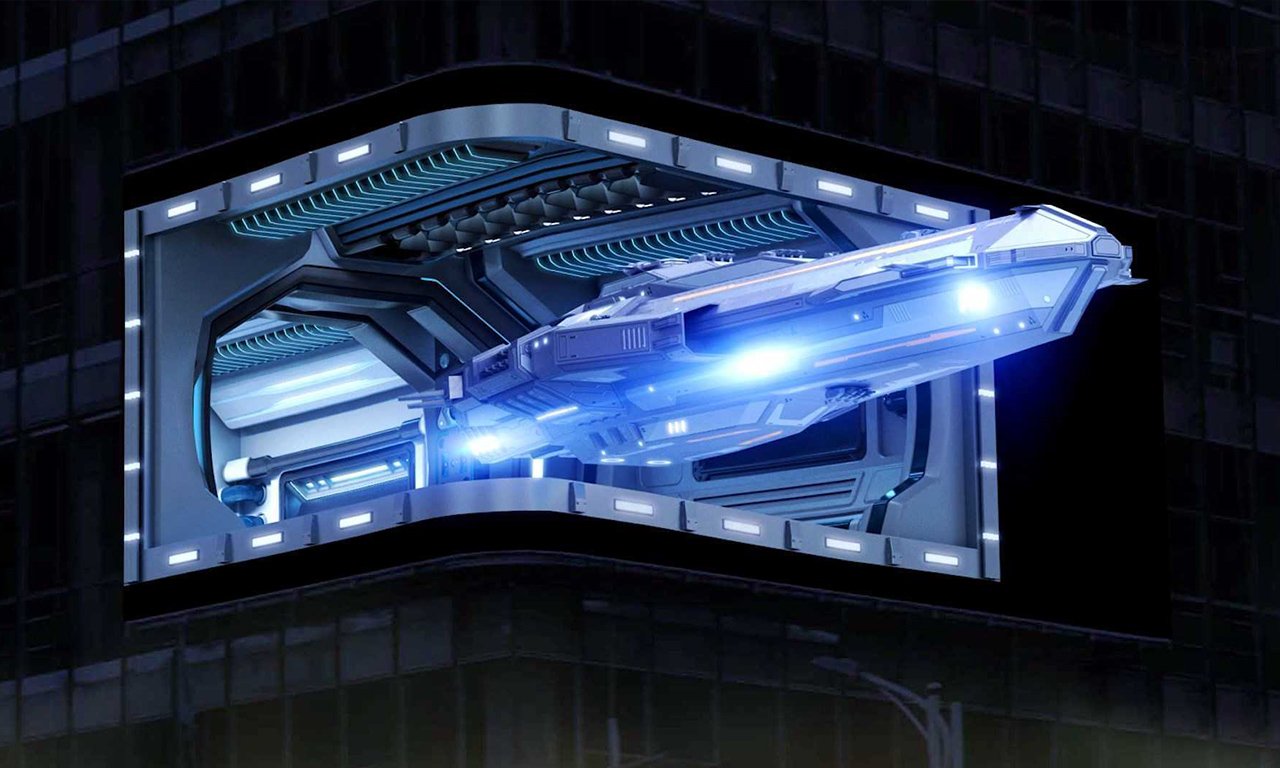
The illusion is created by matching a virtual camera to a real viewing position. For a naked eye 3D LED display, the creative team models the screen shape, sets the camera at the intended audience viewpoint and renders a scene that aligns with the building and display edges.
- Survey the site: record screen width, height, corner angle or curve, mounting height and audience positions.
- Build a matching scene: model the physical display and the apparent space inside it, including a virtual frame where appropriate.
- Render the animation: use perspective, shadows and objects crossing the virtual frame to suggest depth.
- Map the video: match the output pixel canvas to the LED wall and synchronize playback across its surfaces.
- Test on site: check the illusion from the main viewpoint and nearby positions, in daylight and after dark.
A typical anamorphic billboard does not create depth by alternating left-eye and right-eye images for an unaided audience. It also does not project a solid object into the air. Moving away from the intended viewpoint can weaken the effect or reveal a stretched image.
01. Does a naked eye 3D LED display need a 90-degree corner?
No. A 90-degree corner is a useful arrangement for a wraparound scene, but a flat screen can also show perspective-based 3D content. Curved and corner screens need content rendered for their actual geometry. Flexible modules are one construction option, not a universal requirement; purpose-built cabinets can also form a corner or curve. See the flexible LED display guide for curved-screen construction considerations.
3. Technical requirements for a 3D LED screen
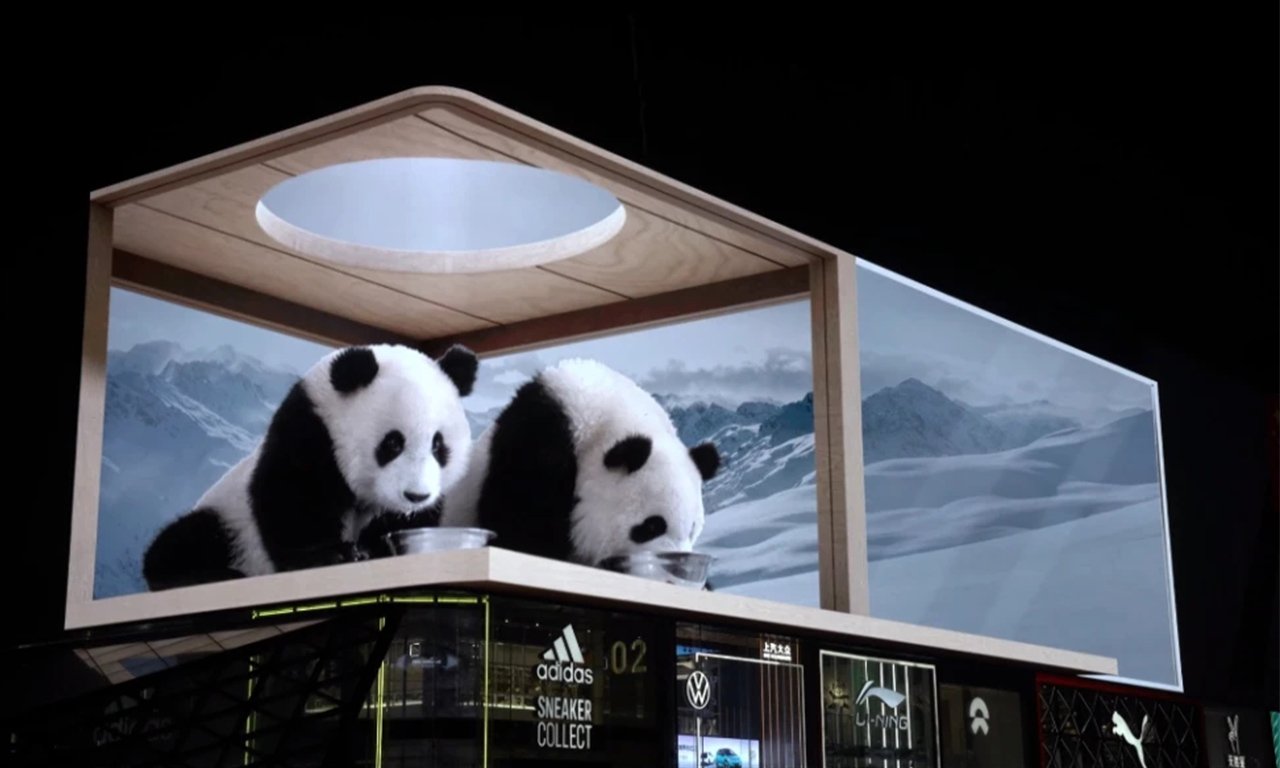
Specify the complete naked eye 3D LED display and content system together. Resolution, brightness or refresh rate cannot compensate for a video rendered for the wrong viewpoint.
| Requirement | What to confirm | Why it matters |
|---|---|---|
| Screen geometry | Dimensions, corner angle, curve radius, seam layout and mounting height | The animation must align with the installed display. |
| Pixel pitch and native resolution | Pitch in mm, total pixel width and height, closest normal viewer | Controls detail and the content delivery canvas; a 4K input does not prove a native 4K screen. |
| Brightness and color | Calibrated output in cd/m², daylight visibility, night dimming and color uniformity | Preserves the scene across lighting conditions and connected faces. |
| Refresh and video frame rate | LED refresh in Hz, video frames per second, driver configuration and camera test | They describe different processes. A large refresh number alone does not ensure smooth or camera-clean playback. |
| Playback and processing | Pixel capacity, supported format and frame rate, output mapping and synchronization | Avoids scaling errors, dropped frames and tearing across the corner. |
| Outdoor protection | Front/rear IP ratings, operating temperature, drainage, ventilation and corrosion exposure | The whole installation must suit the site, including connectors and service access. |
| Structure and service | Site-specific engineering, power distribution, access route, spares and calibration files | Makes installation and ongoing maintenance practical. |
01. A naked eye 3D LED display product example: EA3D-VR
EagerLED’s EA3D-VR outdoor 3D LED display page lists a customizable 90-degree curved cabinet arrangement, front and rear service, and IP66 cabinet protection. Its parameter table lists brightness options of 5,000, 5,500 and 6,000 cd/m², a 3,840 Hz refresh frequency, and a separate frame-frequency specification of at least 60 Hz.
These are product-page specifications checked on September 7, 2026, not requirements for every 3D billboard or independent test results. Confirm the selected model, operating settings and applicable protection report in the quotation. The separation between refresh frequency and frame frequency also explains why describing every naked-eye 3D screen as “up to 120 Hz” is misleading.
For a broader procurement reference, use the LED screen buying guide and specification checklist. Request a demonstration with the proposed content, actual brightness and intended camera settings.
4. Why are naked-eye 3D LED billboards popular?
A naked eye 3D LED display offers a distinctive way to present a product or scene in public space. Its value comes from the combination of creative content, a visible location and convincing execution.
- No wearable equipment: passersby can see the illusion without glasses or a headset.
- Product storytelling: an object can appear to rotate, approach the audience or move beyond a virtual frame.
- Architectural integration: a building corner can become part of the creative composition.
- Shareable footage: a strong sequence can give viewers a reason to record and share it, although reach is not guaranteed.
- Reusable display hardware: the wall can also run compatible conventional advertising content between 3D sequences.
These advantages do not establish a guaranteed increase in sales, foot traffic or advertising return. Set campaign objectives in advance and measure relevant outcomes, such as qualified inquiries, attributable visits or campaign recall. Views of a recorded clip and visits to the physical location are different measures.
5. Best locations, applications and limitations
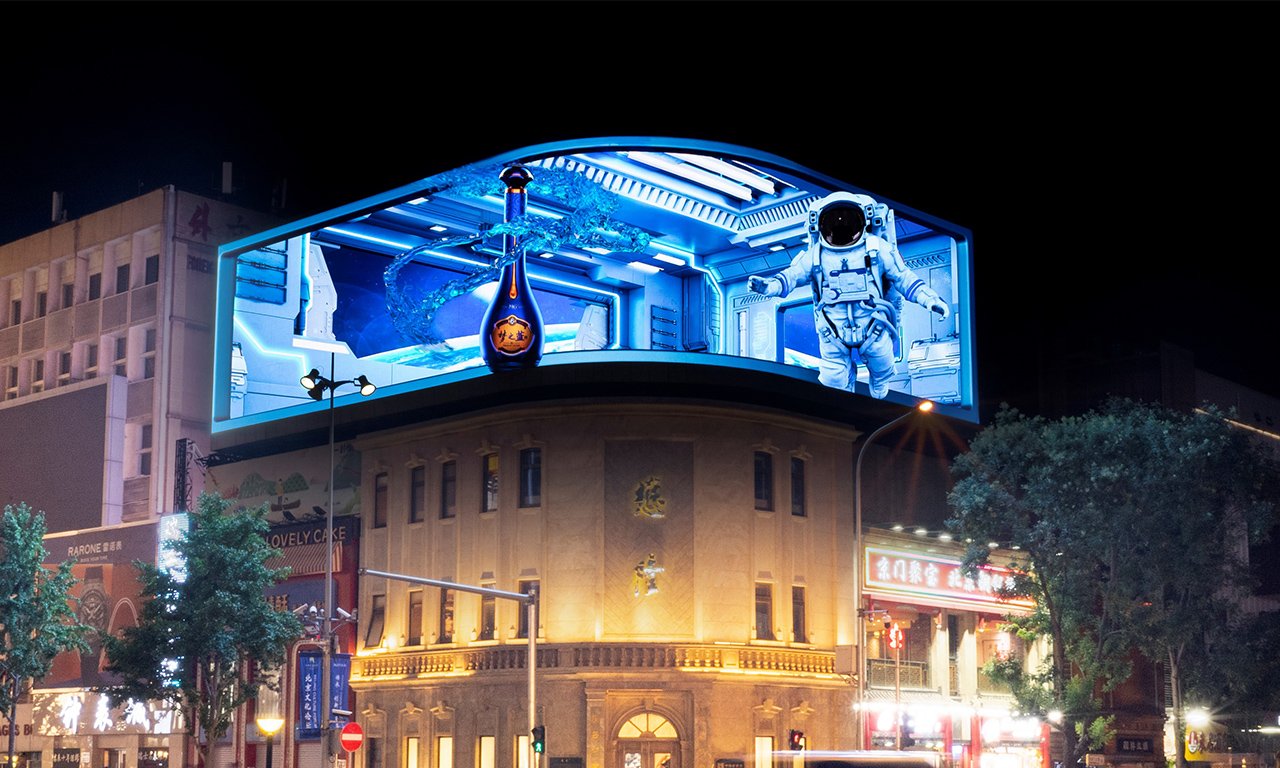
A suitable naked eye 3D LED display site has a clear sightline and a usable audience area near the planned viewpoint. Commercial plazas, shopping-center facades, pedestrian retail streets and exhibition spaces can support the format when their viewing geometry works. An indoor installation needs hardware selected for its own environment and viewing distance.
Assess where people actually stand and walk, not just the advertised viewing angle of the LED panel. A wide hardware viewing angle does not mean the perspective illusion remains correct everywhere. Trees, signs, traffic and nearby structures can obstruct the main view.
- Content cost: a sequence built for one screen may need reworking for another shape or location.
- Limited sweet spot: viewers far to the side may see distorted proportions.
- Operations: maintenance, power, cooling, color matching and scheduled content updates remain necessary.
- Site constraints: review local signage, brightness, structural and electrical requirements with the relevant professionals.
- Interaction: an animated scene is not automatically interactive; audience-triggered effects require a separately specified system.
Conventional 2D advertising may be more practical when viewers are spread over a broad area, content changes very frequently or the project has no budget for custom animation.
6. What affects cost, and what should a project brief include?
A meaningful naked eye 3D LED display price needs a defined scope. Separate the screen hardware from content production, installation and operation. A hardware-only price per square meter does not represent the full project cost.
- Display package: screen area, pixel pitch, shaped cabinets, controller, cables, spares and calibration.
- Installation: structure, access equipment, electrical work, transport, permits and commissioning.
- Creative production: geometry survey, animation, rendering, mapping, revisions and content usage rights.
- Operating costs: electricity, maintenance, content refreshes and media placement fees where the screen is rented.
Before requesting a proposal, prepare these six items:
- Site photos and drawings showing the intended viewing area.
- Proposed screen dimensions, mounting height and corner or curve geometry.
- Nearest and main viewing positions, ambient light and operating hours.
- The intended creative sequence, source assets and who will produce the animation.
- Installation, service-access, power and delivery requirements.
- An acceptance plan covering the 3D effect, seams, color, playback and camera footage.
Discuss your 3D LED display project with EagerLED using this brief. Ask the proposal to identify the exact hardware, content-production responsibilities, exclusions and acceptance criteria.
7. Content production and acceptance for a naked eye 3D LED display
Content is part of the system specification, not an asset to add after the cabinets have been ordered. A naked eye 3D LED display needs a creative brief that states the primary viewing zone, expected dwell time, screen geometry, resolution, playback format and visual action. Keep the main message legible before and after the apparent 3D moment. Fine details that look impressive on a studio monitor may disappear at the actual street distance.
01. Build content against measured geometry
Give the animator a dimensioned drawing of every display face and seam, plus photographs taken from the intended viewpoint. The team should agree on a virtual camera before final rendering. For a corner naked eye 3D LED display, the output is mapped to one continuous canvas and then assigned to the processor outputs. A change to the physical corner angle, cabinet count or crop after sign-off can break alignment, so preserve the approved geometry files and camera coordinates.
02. Test the complete playback chain
Request a low-resolution proof first, then a final native-resolution render. Verify the processor’s maximum pixel load, input format, frame-rate support and synchronized outputs. Inspect motion at the corner seam, dark gradients, bright highlights and product edges. Test daylight, dusk and night settings; excessive brightness can wash out shadow cues. A naked eye 3D LED display should also run ordinary 2D content cleanly if the media schedule requires it.
| Test | How to check it | Pass criterion to agree in advance |
|---|---|---|
| Viewing zone | Observe from the primary point and two side positions | Depth illusion and key message remain understandable in the agreed audience zone. |
| Screen mapping | Play grid and edge-alignment test files across every face | No unintended crop, stretched object or timing break at the seam. |
| Image quality | Inspect uniform grays, skin tones and bright product colors | Color and brightness match between cabinets at agreed settings. |
| Camera capture | Record with the intended promotional camera settings | No unacceptable banding, flicker or rolling artifacts in sample footage. |
| Operations | Reboot playback and simulate a content change | Correct file loads, outputs remain synchronized and staff can follow the handover guide. |
Document the pass criteria in the commissioning plan. Video proof alone cannot confirm screen flatness, service access, weather sealing or electrical safety. Those need separate on-site checks by the responsible specialists.
8. Common naked eye 3D LED display mistakes
Buying by screen size alone. A larger naked eye 3D LED display can still produce a weak effect if the primary audience sees it from the wrong angle. Map the viewing corridor, obstructions and time spent in sight of the screen before finalizing area or pitch.
Confusing panel viewing angle with 3D viewing zone. The LED can remain bright from the side while the anamorphic object looks stretched. Ask for renders from the center and edges of the real audience area. If people approach from many directions, consider several creative viewpoints or a simpler 2D sequence between 3D moments.
Treating refresh rate as a complete camera specification. Driver behavior, scan pattern, frame rate and camera shutter all affect footage. Run a camera test with the specified display configuration. For a naked eye 3D LED display intended to drive social sharing, a visually clean recording matters as much as the live impression.
Leaving content ownership and revisions undefined. Identify who supplies source models, who may reuse the animation, how many revisions are included, and who updates the files if the screen geometry changes. This prevents a finished naked eye 3D LED display from sitting idle while teams dispute deliverables.
Assuming audience response. Set a baseline for foot traffic or campaign inquiries, document the display schedule, and use a measurable call to action where appropriate. Evaluate creative performance separately from uptime and screen quality. A naked eye 3D LED display may attract attention, but each location and campaign needs its own evidence.
9. Frequently asked questions
01. Can a naked eye 3D LED display be installed indoors?
Yes. Use indoor-rated cabinets and set pixel pitch, brightness and content scale for the shorter viewing distance. Measure the main audience position and available mounting depth before choosing the screen.
02. How long should a 3D billboard animation run?
Match the loop to how long viewers can safely see the screen. In a brief pedestrian sightline, make the main visual readable quickly and avoid relying on a long story arc. Confirm local content and traffic rules for roadside locations.
03. Can existing 2D video be converted into naked-eye 3D?
It can be used as source material, but a convincing naked eye 3D LED display usually needs scene reconstruction, virtual camera work and rendering for the specific screen. Simple stretching or cropping rarely preserves believable depth.
04. What files should the content studio deliver?
Request the final native-resolution playback file, a lower-resolution review copy, project source files where contracted, mapping notes, camera and geometry references, and clear usage rights. Keep a known-good backup of the approved loop.
05. How should buyers compare two naked-eye 3D screen quotations?
Ask each bidder to price the same screen area, pixel pitch, controller, structure, power distribution, installation, content scope, spares, warranty and commissioning tests. A square-meter hardware figure alone is not a complete project comparison.
10. Conclusion
A naked eye 3D LED display works when screen geometry, perspective-rendered content and the real audience viewpoint are designed together. Its popularity comes from an immediately understandable visual illusion and the chance to tell a product story at architectural scale, but results depend on location, execution and measurement.
For a successful naked eye 3D LED display, survey the site first, confirm the native screen and playback specifications, commission custom content for that geometry, and accept the finished system from the actual viewing zone. Keep the quotation and handover explicit about creative ownership, maintenance and operating costs. This approach makes the display useful beyond a single striking video.