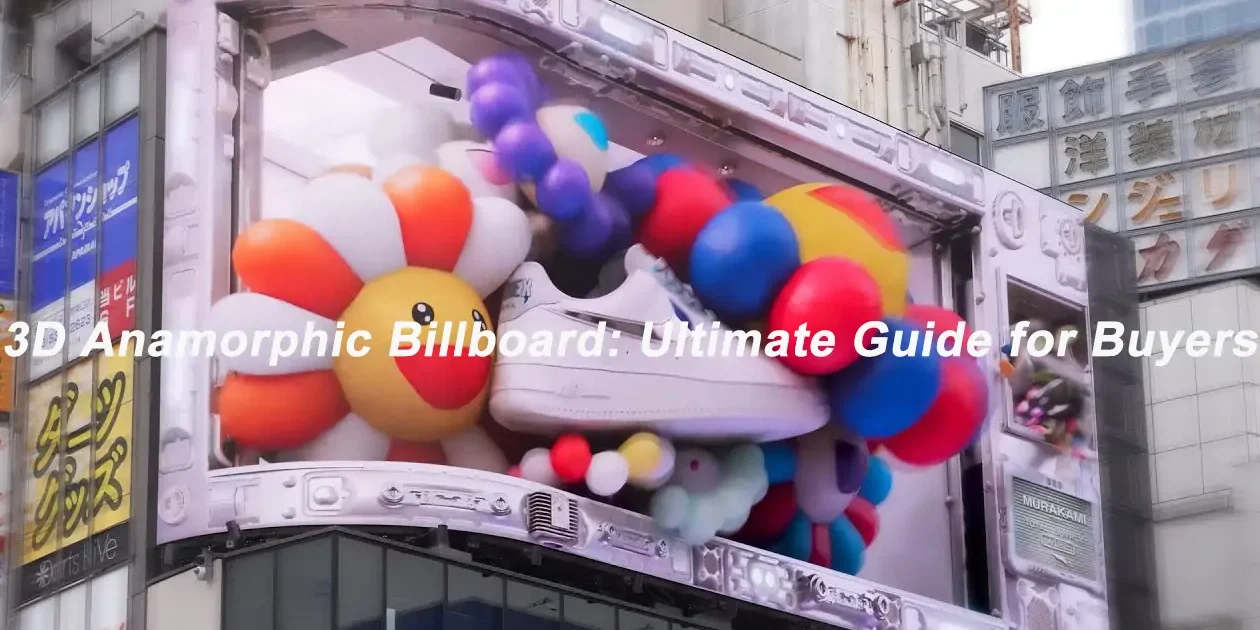
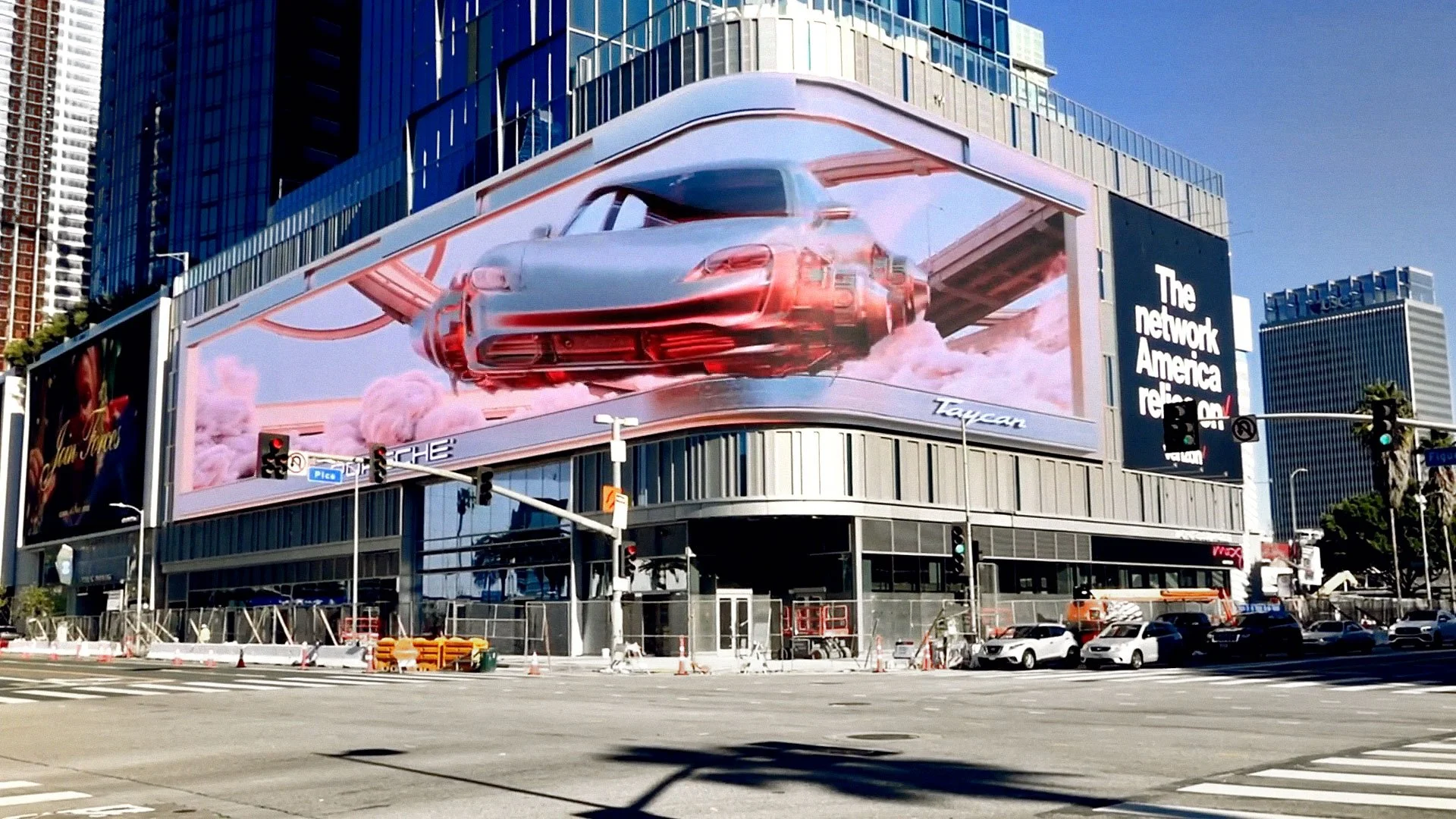
A 3D anamorphic billboard uses an LED screen and perspective-mapped animation to make objects appear to extend beyond the display or sit inside a deep virtual space. Viewers need no glasses. The effect depends on the relationship between the content, screen geometry, and intended viewing position; buying a curved screen alone does not create it.
For buyers, the practical questions are how to choose the screen, what a complete installation costs, and whether people at the location will actually see the illusion. This guide explains specifications, cost calculations, site selection, supplier checks, and production requirements for a 3D anamorphic billboard. It also separates buying a display from booking advertising space, so you can request a quotation that matches your project.
1. What is a 3D anamorphic billboard?
A 3D anamorphic billboard is a digital out-of-home display showing an image deliberately transformed for a particular viewpoint. Perspective, shading, occlusion, and a simulated frame make a two-dimensional surface appear three-dimensional. It is often called a naked-eye 3D billboard, forced-perspective billboard, or anamorphic LED display.
The screen emits a normal video image. The animation supplies the apparent depth. Unlike a hologram, the object does not occupy the air in front of the building. Unlike a stereoscopic display, a conventional 3D anamorphic billboard does not deliver separate left-eye and right-eye images. This distinction explains why the illusion changes as a viewer moves.
01. How does the 3D illusion work?
The content artist recreates the installed screen in a virtual scene and places a camera at the planned audience viewpoint. A virtual room, box, or window establishes depth. When an animated object crosses that apparent boundary, it seems to leave the display. The rendered image is mapped to the real screen’s pixel layout.
A convincing 3D anamorphic billboard therefore needs accurate measurements: screen width and height, corner angle or curve radius, installation elevation, and viewing distance. If these differ from the production model, edges and shadows no longer align. A video that looks distorted on a laptop may look correct on the intended screen.
02. Can flat screens create anamorphic effects?
Yes. A flat screen can show a perspective illusion when content is designed for its geometry and viewpoint. Corner and curved screens provide additional surfaces for a virtual box, but they are not mandatory. Nor does a corner guarantee an equally strong effect from both streets. Compare simulations from real pedestrian positions before choosing the shape.
For a fuller explanation of depth cues and display types, see how a 3D LED screen works. For procurement, the key principle is simple: evaluate the display and the content as one system.
2. The hardware stack: choosing a 3D anamorphic billboard
A complete 3D anamorphic billboard includes LED modules and cabinets, a supporting structure, power distribution, control equipment, playback hardware, cabling, and service access. Outdoor projects also need an installation design suited to heat, rain, wind, and the building interface. Assign responsibility for each component before comparing quotations.
01. Pixel pitch, resolution, and viewing distance
Pixel pitch is the distance between adjacent pixel centers, measured in millimeters. Smaller pitch creates more pixels in the same area, but the useful choice depends on viewing distance and the smallest detail the audience must recognize. There is no universal minimum viewing distance that guarantees an effective 3D anamorphic billboard.
Calculate native resolution from physical dimensions: pixels across = screen width in millimeters ÷ pixel pitch in millimeters. An illustrative 12-meter-wide by 6-meter-high P6 surface has 2,000 × 1,000 pixels. Actual dimensions must follow module and cabinet increments. For two faces, calculate each separately and obtain the combined playback map.
More pixels increase processing and content demands. Ask the supplier to demonstrate the proposed pitch with logos, text, dark gradients, and the intended animation at realistic distances. A specification labeled “4K” is insufficient unless it identifies the actual pixel canvas and how the content reaches it.
02. Brightness, filming quality, and outdoor protection
| Item | What to specify | How to verify |
|---|---|---|
| Pixel pitch and canvas | Pitch, face dimensions, native pixel map, and viewing zone | Approve drawings and inspect representative content at the intended distance. |
| Brightness and dimming | Calibrated luminance, automatic control, and nighttime settings | Test in site lighting; verify that dark details remain readable after dimming. |
| Refresh and playback | LED refresh, content frame rate, controller capacity, and synchronization | Film the final configuration with target phones and camera shutter settings. |
| Weather protection | Front and rear enclosure ratings, drainage, connectors, and sealing | Check model-specific reports and the complete installed assembly. |
| Corner continuity | Module alignment, seam spacing, color matching, and geometry | Run grids and moving objects across the joint from agreed viewing points. |
| Maintenance access | Front or rear servicing, replacement route, and spare inventory | Demonstrate a module replacement without disturbing adjacent cabinets. |
Request brightness suitable for the actual sunlight exposure rather than treating one nit value as a universal requirement. The operator also needs dimming that preserves contrast and complies with the site’s operating conditions. LED refresh rate and video frame rate describe different things: a high refresh specification does not turn a low-frame-rate animation into smoother motion.
Camera banding depends on scan behavior, brightness settings, shutter speed, and synchronization as well as refresh rate. A 3D anamorphic billboard intended for social video should pass a practical filming test. The IEC 60529 IP Code classifies enclosure protection; an IP rating alone does not establish corrosion resistance, thermal performance, or structural adequacy.
3. What a 3D anamorphic billboard costs
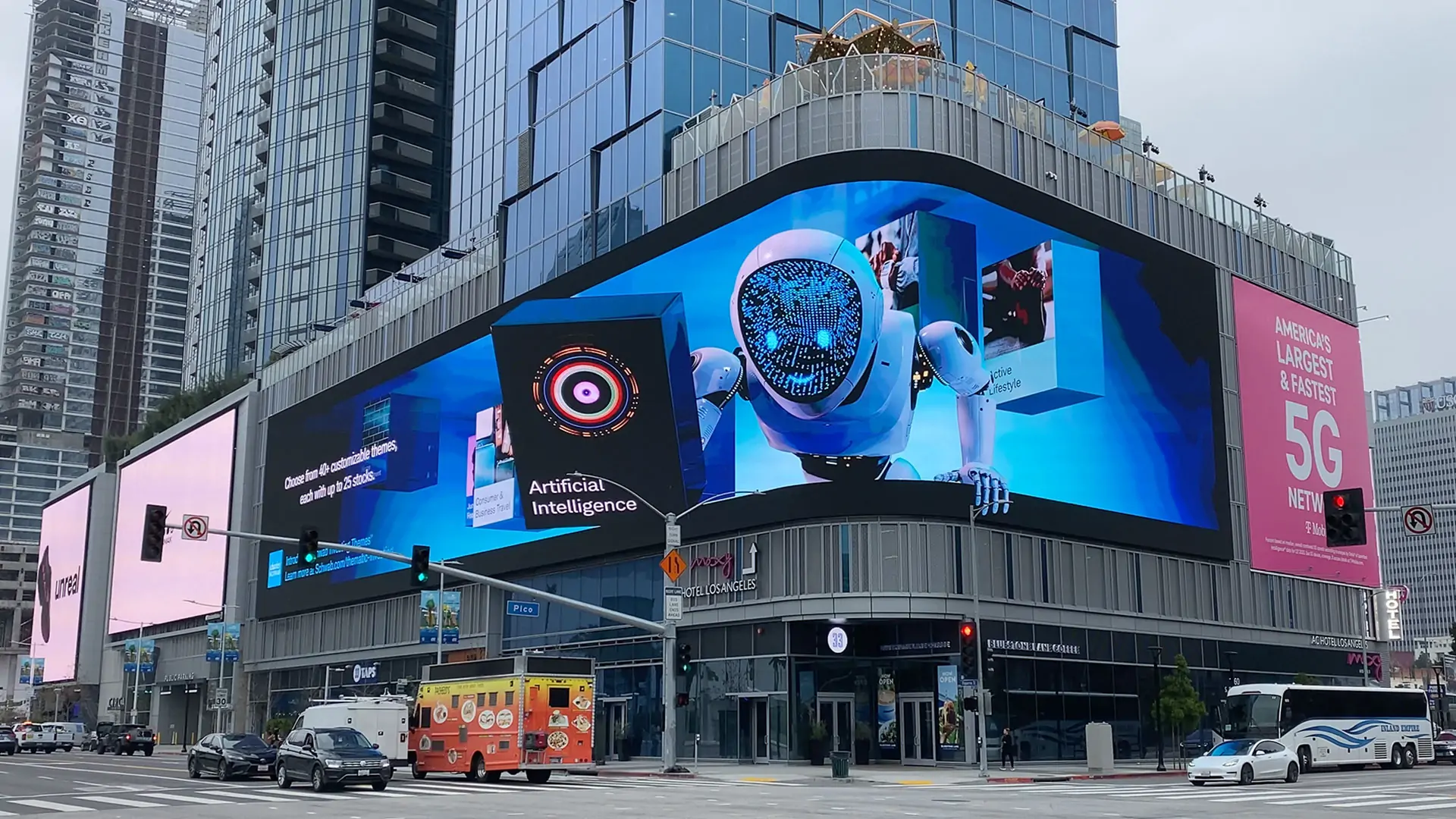
The cost of a 3D anamorphic billboard has three distinct parts: the installed display, creative production, and ongoing operation. Advertising on someone else’s screen adds media booking fees instead of requiring you to purchase the installation. A screen price per square meter cannot answer both questions.
01. Compare complete project budgets
Obtain itemized quotations using the same screen dimensions, pitch, installation location, and content brief. The following table is a budgeting framework, not a market price list. Building access and structural work can change the total substantially, so a remote estimate should remain conditional until the site has been assessed.
| Cost category | Required scope | Common omission |
|---|---|---|
| LED hardware | Cabinets, modules, power supplies, receiving cards, and spares | Corner modules and matching replacement stock |
| Control and playback | Processor, player, signal distribution, software, and configuration | Licenses, redundancy, and capacity for the full canvas |
| Structure and installation | Survey, engineering, fabrication, mounting, lifting, and electrical work | Building reinforcement, access equipment, and reinstatement |
| Logistics and approvals | Shipping terms, insurance, import charges, and local approvals | Storage, customs handling, and site scheduling costs |
| Anamorphic content | Concept, assets, animation, mapping, revisions, and on-screen tests | Source-file rights and adaptation to another screen |
| Operation | Electricity, connectivity, cleaning, repairs, and content updates | Service labor, travel, and replacement calibration |
| Media booking | Location, campaign dates, slot duration, frequency, and proof of play | Production fees and additional versions for different sites |
02. Estimate electricity with explicit assumptions
Use annual energy (kWh) = area (m²) × average operating power (W/m²) ÷ 1,000 × hours per day × operating days. Multiply energy by your electricity tariff. Use measured average consumption for the planned brightness and content; maximum rated power is needed for electrical design but usually represents a different operating condition.
For illustration only, a 60 m² display averaging 250 W/m² for 12 hours daily over 365 days consumes 65,700 kWh. At an assumed US$0.12/kWh, the energy charge is US$7,884 annually. These are arithmetic assumptions, not EagerLED product specifications or a local tariff quotation. Cooling, auxiliary equipment, demand charges, and taxes may add cost.
03. Price content and media separately
A 3D anamorphic billboard animation quote should specify duration, scene complexity, revision rounds, rendering, testing, usage rights, and deliverables. A simple product reveal differs from a photorealistic character sequence. Reusing a template may reduce production work, but it still requires permission and mapping to the actual screen.
For campaign placement, ask the media owner how many plays the package includes and when they occur. “A 30-second ad” describes duration, not campaign reach or total cost. Compare the cost per agreed campaign deliverable and assess a 3D anamorphic billboard over its intended operating period, including maintenance and creative refresh.
4. Picking a location for a 3D anamorphic billboard
A suitable site gives viewers a clear, safe place to see the intended perspective. High traffic alone does not establish that a 3D anamorphic billboard will work. Screen elevation, approach direction, trees, street furniture, reflections, and the time people spend facing the display all affect the result.
01. Define the viewing zone before screen geometry
Survey the main pedestrian approaches and photograph the screen position from realistic eye heights. Mark the preferred viewpoint and several secondary positions. Ask the content team to simulate all of them. The goal is a convincing central illusion and understandable branding elsewhere, rather than a spectacular render that works from one inaccessible camera position.
Corner screens can help establish a virtual enclosure; curves can soften a physical joint. Neither shape guarantees a wider useful viewing zone. For a 3D anamorphic billboard, the viewing zone is determined by the entire composition and installation, not the cabinet’s advertised optical viewing angle alone.
Record daylight exposure and evening conditions. Check whether buildings or seasonal foliage block the display. Confirm space for maintenance and whether the structure can be installed without conflicting with entrances or other building services. Obtain the necessary local sign, structural, electrical, and operating approvals before fixing the launch date.
02. Evaluate attention and commercial performance
Count people who can actually see the message, not every person passing through a district. Compare observed dwell time with the animation’s reveal and brand moment. If people move through the useful zone quickly, the message must remain understandable even when they see only a fragment of the sequence.
For a 3D anamorphic billboard beside a road, establish permitted content behavior and operating conditions with the relevant authorities. Do not assume full-motion advertising is permitted. Pedestrian campaigns can use a short, legible destination or call to action, but avoid forcing viewers to read dense text while moving.
Define success before launch: delivered plays, qualified inquiries, store visits, or a documented brand study. Keep paid distribution, organic social views, and physical audience estimates separate. A viral video is evidence of online attention, not proof that the billboard generated profitable incremental sales.
5. How to vet a 3D anamorphic billboard supplier
Evaluate a 3D anamorphic billboard supplier on its proposed system, engineering support, and service commitments. Ask for comparable projects with similar climate, access conditions, geometry, and operating hours. A showroom demonstration does not establish how the complete installation will behave on your building.
01. Verify documents and responsibilities
Request model-specific specifications, test documentation, wiring diagrams, cabinet drawings, and installation requirements. Identify who signs off the supporting structure and electrical design locally. A cabinet report is not a substitute for engineering the attachment to the building, and a generic certificate may not cover the model being quoted.
For relevant European markets, the European Commission explains manufacturers’ CE-marking responsibilities, including conformity assessment, technical documentation, and an EU declaration of conformity. Check applicable requirements for the actual product and destination; do not interpret CE marking as a blanket independent quality award.
Ask how LED batches, color consistency, power supplies, receiving cards, and replacement modules are controlled. The LED screen supplier factory checklist provides additional due-diligence questions. For any 3D anamorphic billboard, agree measurable acceptance conditions instead of relying on phrases such as “seamless” or “broadcast quality.”
02. Put acceptance and after-sales support in writing
The acceptance plan should include uniform gray and color patterns, dark-scene gradients, moving seam tests, playback stability, brightness control, and recovery after a power interruption. Check the actual supplied configuration. Photograph test results from agreed locations and record any outstanding issues before final acceptance.
Specify the dead-pixel remedy, response process, warranty exclusions, spare inventory, and who pays for labor, travel, lifting equipment, and shipping. Define how replacement modules will be color-matched. Also request configuration backups, labeled cabling, operator training, and a procedure for restoring playback after a controller replacement.
When requesting an EagerLED proposal, provide the city, indoor or outdoor environment, face dimensions, corner geometry, nearest audience distance, photographs, and service-access constraints. A product such as the EA1000F2 outdoor advertising LED screen is a hardware reference; its suitability for your geometry and installation must be confirmed in the project design.
6. Creating 3D anamorphic billboard content that works
Production begins with the real display. Give the artist the approved pixel map, dimensions, elevation, corner angle, photographs, and viewer coordinates. A 3D anamorphic billboard content team should agree these inputs with the hardware integrator before detailed modeling or final rendering begins.
01. Follow a measurable production workflow
Start with a brief that defines the product, audience, message, and campaign objective. Then approve a simple storyboard showing the depth illusion and brand moment. Build the virtual screen at the correct scale and test a rough animation from the main and secondary viewpoints before investing in detailed textures or simulation.
Next, map the scene to the display canvas and check safe areas for text and logos. Confirm file format, codec, frame rate, resolution, audio policy, and playback restrictions with the operator. Different screens may require separate output files, even when they share a creative concept.
Run the animation on the installed screen before final sign-off. Inspect the corner, highlights, dark details, and movement from real audience positions. Record phone footage under day and night settings. For a 3D anamorphic billboard, this test connects the creative approval to what viewers will actually experience.
02. Learn from examples without copying campaigns
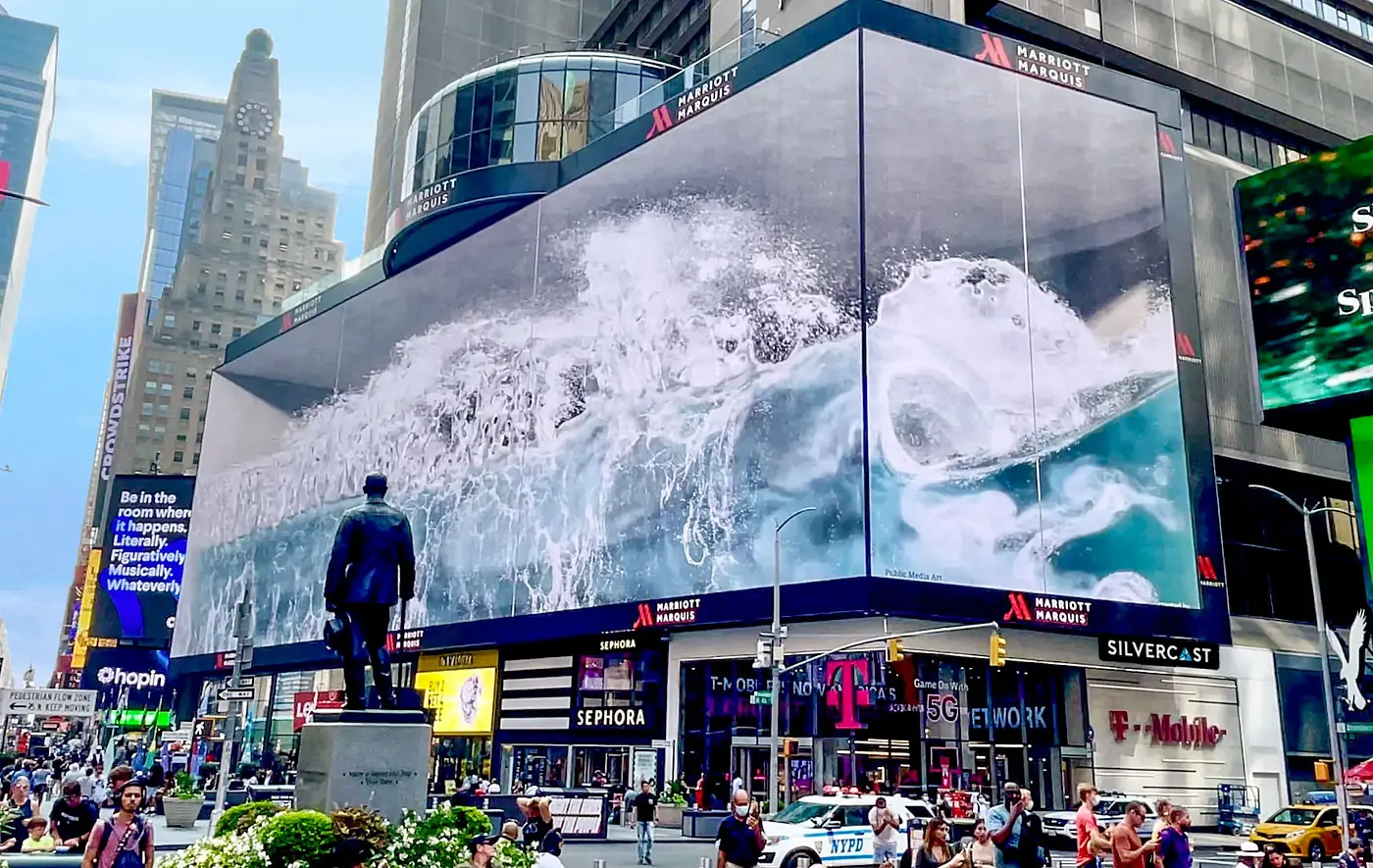
Familiar examples illustrate different techniques. The Seoul COEX wave uses an apparent enclosure to make moving water seem physically contained. Tokyo’s Shinjuku cat uses a recognizable character and a virtual ledge to suggest depth. Product reveals use a box or window boundary so an object can appear to cross into the viewer’s space.
These are design references, not a ranked list of the best 2026 campaigns or a promise of similar results. Study the frame, perspective, pacing, and readability in each example. For additional regional context, explore 3D billboard locations and examples in China. Evaluate real street footage as well as polished promotional clips.
A successful 3D anamorphic billboard makes its main subject immediately understandable. Avoid filling the entire sequence with effects that obscure the advertiser. Keep the brand legible when the clip is viewed without sound, filmed at an angle, or encountered halfway through a loop.
03. Choose production resources and refresh plans
Blender, Cinema 4D, and other 3D tools can support anamorphic production; the software name does not guarantee accurate mapping. Select a studio or internal team by relevant work, geometry checks, revision management, and delivery discipline. Retain an accountable producer who coordinates the artist, screen supplier, and media operator.
Free downloads and templates should be treated as starting assets, not ready-to-play content. Verify commercial rights, render resolution, and compatibility with your screen. Agree ownership of source files, future adaptation fees, and update responsibilities. Refresh a 3D anamorphic billboard when campaign goals, products, or audience response justify it, rather than following an arbitrary calendar.
7. What buyers get wrong about 3D anamorphic billboards
The most costly mistakes come from disconnected decisions. A display is ordered before the viewing zone is measured; animation is commissioned before the pixel map is final; or a launch date is promised before site work is approved. Give one project lead responsibility for connecting these dependencies.
Another mistake is assuming every “3D billboard” video shows a physical installation. Some clips are computer-generated composites placed into street footage. Request unedited footage from more than one angle and confirm the actual location when using a campaign as a reference for your own 3D anamorphic billboard.
Do not assume a larger screen solves weak geometry. Enlarging the installation can increase cost, load, power demand, and processing requirements without improving the audience’s perspective. Test the proposed composition first. Similarly, an interactive feature needs a separate brief for inputs, latency, moderation, and reliable fallback playback.
Plan commissioning as a project stage. The 3D anamorphic billboard should launch only after the structure, electrical work, control system, brightness schedule, and creative output have passed their agreed checks. Manufacturing lead time is only one part of the schedule; shipping, access, approvals, and content revisions also matter.
Finally, budget for ordinary operation. Name the person who monitors faults, approves content, controls access to the player, and maintains backups. Establish a fallback image and a shutdown procedure. Reliable operation and consistent imagery preserve the quality of a 3D anamorphic billboard long after the first campaign has finished.
8. 3D anamorphic billboard FAQs
01. How much does a 3D anamorphic billboard cost?
There is no universal installed price. Size, pitch, geometry, structure, access, location, and content scope determine the quotation. Separate hardware, installation, creative production, and operating costs. If you only want to advertise, request media placement and production prices instead of a screen purchase quote.
02. Can an existing LED screen become a 3D anamorphic billboard?
Often, yes, if its pixel layout, image quality, playback system, and viewing position support the proposed content. A flat screen can create perspective effects. Survey the installation and commission a mapped test before replacing hardware or promising a particular illusion.
03. How far away should viewers stand?
Use the viewing position defined by the content design and site survey. There is no fixed distance for every screen. Screen size, elevation, pitch, and perspective all matter. Test several nearby positions so the message stays readable outside the strongest illusion zone.
04. What resolution should 3D anamorphic billboard content use?
Use the operator-approved native canvas or specified delivery format, including all screen faces and any unused areas. Obtain the pixel map before rendering. A generic 1080p or 4K file may be the wrong shape, resolution, or mapping for the actual display.
05. Do 3D anamorphic billboards work in sunlight?
Yes, with suitable luminance, contrast, thermal design, and content. Direct sunlight and reflections can reduce shadow detail, so verify performance at the site. Nighttime settings are equally important: excessive brightness can wash out the image and conflict with local operating conditions.
06. How long does installation take?
The schedule depends on design approvals, manufacturing, shipping, structural work, electrical installation, and content testing. Ask for a milestone plan with dependencies and responsibilities. A prepared indoor site and a custom outdoor building installation should not be assigned the same generic timeline.
07. Can I use a free 3D anamorphic billboard template?
Only if its license allows the intended commercial use and the output is adapted to your screen. Check geometry, viewing position, resolution, and branding rights. A template that looks convincing in a demonstration may fail when played on a differently shaped installation.
9. Conclusion: plan the complete 3D anamorphic billboard
A 3D anamorphic billboard works when the site, screen, content, and operating plan support the same viewing experience. Start with audience positions, calculate the native canvas, compare complete quotations, and test the mapped animation on the installed hardware. Those decisions matter more than an impressive specification in isolation.
Before requesting a final proposal, assemble photographs, dimensions, viewing distances, access requirements, and a clear content brief. Include maintenance and creative updates in the budget. Contact EagerLED with your project details to discuss a display configuration and the information needed for an itemized quotation.