A stadium LED display is a modular screen used for video, scores, timing, sponsor messages or venue information. Choosing one requires more than selecting a pixel pitch: the buyer must define who sees each screen, how cameras capture it, how it connects to match operations and how technicians maintain it. This guide provides a procurement and acceptance framework for perimeter boards, main video boards and related venue displays.
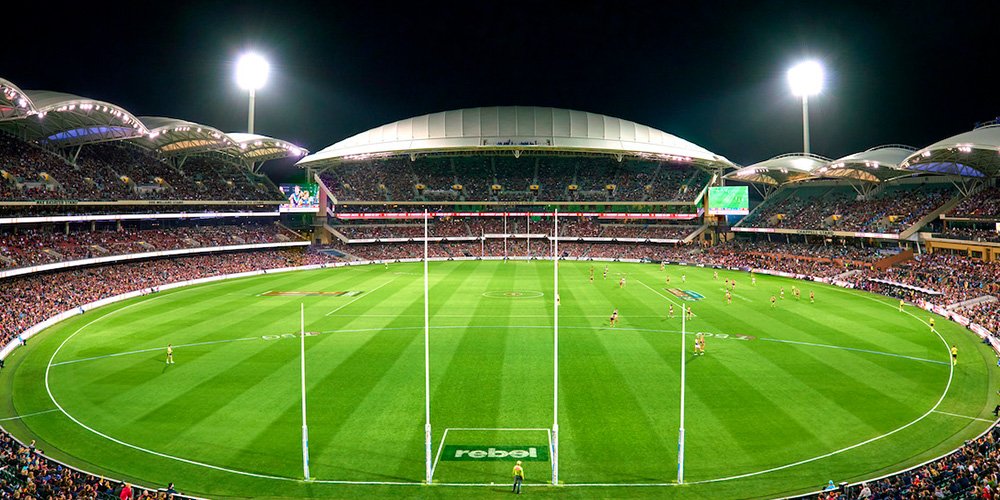
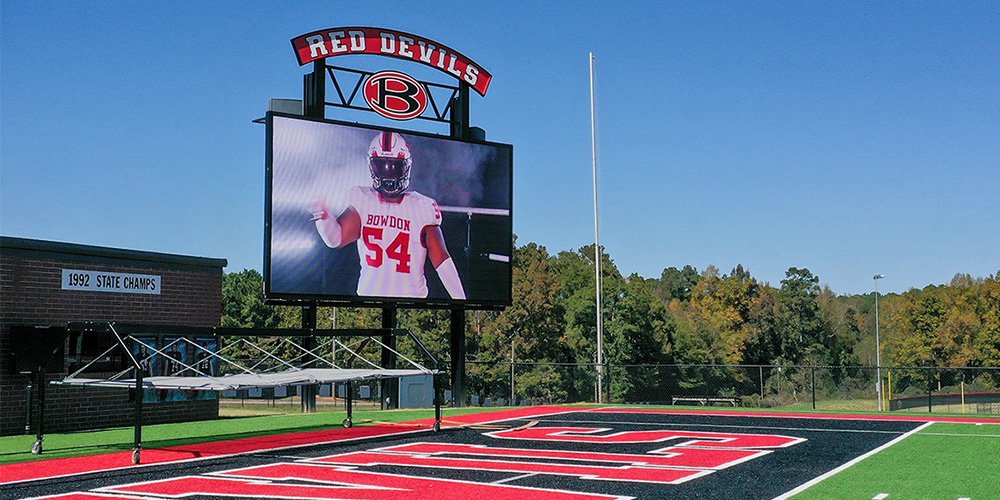
A stadium LED display budget depends on screen dimensions, pixel pitch, control equipment and installation scope. Use this guide to compare supplier proposals on the same basis and prepare a venue-specific quotation request. Product specifications are identified as manufacturer-published values, while budget and power calculations are labeled assumptions. Stadium photographs illustrate display positions; they do not establish that EagerLED supplied the photographed venue.
1. What Is a Stadium LED Display?
A stadium LED display forms an image from LED modules assembled into cabinets. A controller maps source content to those cabinets, while power distribution and a support structure complete the installation. A venue may use several independent canvases with different geometry and operating responsibilities.
01. Definition and Core Components
The procurement list should identify modules, cabinets, power supplies, receiving hardware, processing, signal distribution and mounting components. Include the scoring-data interface and content system where required. Check the boundary between the screen supplier, integrator, electrical contractor and venue operator; an omitted interface can prevent an otherwise functioning wall from showing the correct information.
Draw the source-to-screen path for every stadium LED display. Record input formats, native pixel dimensions, signal routes and the intended fallback if an input fails. Ask who retains configuration files and who may alter them during an event. Hardware capability and the operational workflow should be accepted together.
02. What Is the Big Screen in a Stadium Called?
Buyers commonly call the large screen a video board or jumbotron. “Stadium LED display” also includes perimeter advertising boards, ribbon boards and video scoreboards. Use the position and function in a quotation request: a four-face center-hung board is a different project from a long pitch-side advertising strip.
| Term | Position | Primary procurement question |
|---|---|---|
| Main video board or jumbotron | End stand or above an arena floor | Can designated seats read video, scores and essential text? |
| Video scoreboard | Position chosen for score visibility | How are official score and timing data received and verified? |
| Perimeter display | Along the field boundary | How are player areas, cameras and service access accommodated? |
| Ribbon board | Seating-tier fascia | How are long narrow content zones mapped and synchronized? |
| Facade display | Exterior wall or entrance | What are the exposure, access and site-approval requirements? |
2. Main Features of a Stadium LED Display
Evaluate the stadium LED display under the conditions in which the audience and camera crews will use it. A specification is a starting point; the acceptance test should demonstrate the required performance at the actual configuration.
01. High Refresh Rate and Broadcast Performance
LED refresh frequency, source frame rate and camera shutter timing describe different parts of the imaging chain. A headline refresh value does not guarantee a clean broadcast picture. Test the required camera models, frame rates and shutters with the selected panels, processor settings and operating brightness, including slow-motion modes when needed.
Brompton’s official ShutterSync explanation describes why LED refresh and camera exposure timing must work together. It supports requiring a camera test; it does not establish compatibility between that feature and a proposed EagerLED system. Record the tested configuration and limitations in the stadium LED display acceptance file.
02. High Brightness with Automatic Dimming
Set brightness around sunlight exposure, the viewing background and evening operation. Require an agreed dimming schedule or sensor-based control, plus an operator override appropriate to the venue. Evaluate dark content and sponsor colors at night settings. Excess light can make a screen uncomfortable even when daytime visibility is good.
03. Wide and Uniform Viewing Angles
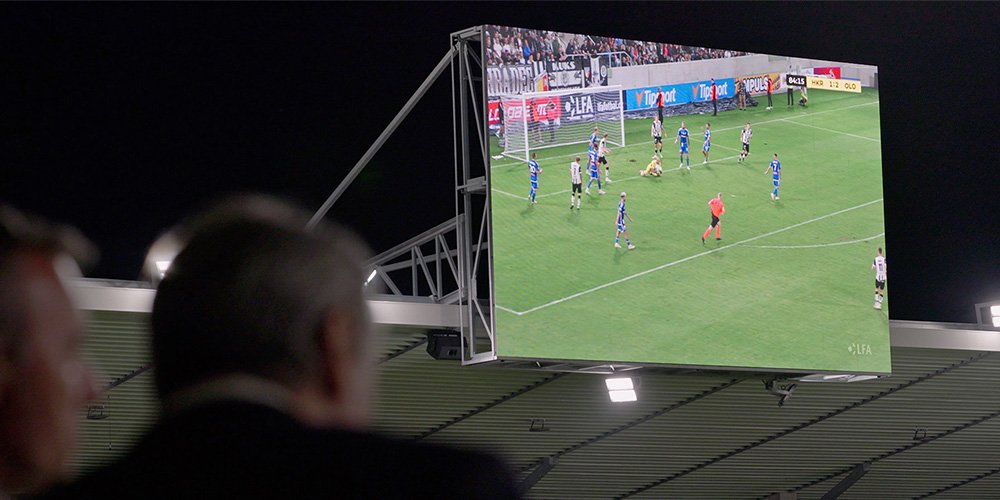
A quoted viewing angle does not translate directly into a percentage of usable seats. Seat coverage depends on screen orientation, height, distance, obstructions, letter size and the criterion used to define an acceptable image. A 140-degree specification cannot by itself prove 90–95 percent coverage.
For the stadium LED display survey, map representative seats in the near, far, side and upper sections. Include accessible seating and positions behind structural obstructions. Show the actual score layout and sponsor creative, then record which seats meet the agreed readability criterion. Use that evidence to adjust placement or content size.
04. Impact Resistance and Weather Protection
For a pitch-side stadium LED display, request the protection design, supporting documents and installation limitations relevant to player contact and the venue. Soft masks and covers are design features, not a guarantee against injury. Have the responsible venue specialists approve positioning, clearances and support arrangements.
Confirm the exact front and rear ingress ratings, connection protection, drainage and permitted cleaning procedure. Do not turn a cabinet IP rating into a claim that the assembled installation tolerates every weather or washdown condition. Ask for the applicable test evidence for the quoted configuration.
05. Modular, Service-Friendly Cabinets
Define the service direction before locating the stadium LED display. Check access to modules, power supplies, receiving cards and connectors. Demonstrate a component replacement with the proposed tools and working space. Cabinet weight alone does not determine the crew, access equipment or time needed for a safe repair.
3. Why Sports Venues Need a Stadium LED Display
A stadium LED display can provide several useful services, but financial and audience outcomes depend on the event program and operating team. State each intended benefit as a requirement that can be measured rather than a guaranteed result.
01. Sponsorship and Advertising Revenue
Define sellable slots, approved formats and reporting responsibilities before purchasing a stadium LED display for advertising. Playback logs can show that a file ran; they do not prove audience attention. Separate assumptions about inventory occupancy and sponsor rates from the hardware budget. Model a lower-sales scenario as well as the planned case.
02. Fan Engagement and Atmosphere
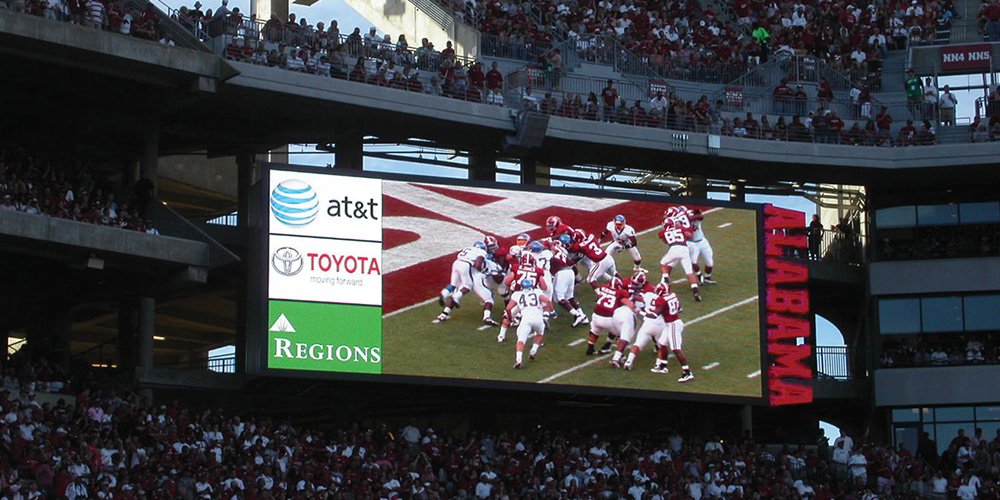
Plan the run of show: introductions, approved replays, intermission content and community messages. Test text and graphics from the actual seating areas. Name the operator responsible for each cue and keep essential information readable when promotional content occupies part of the canvas.
03. Refereeing Support and Official Decisions
The public stadium LED display should show only the information approved for spectators. Do not assume a public video board can replace a competition’s officiating system or dedicated review equipment. Agree score, clock and decision-display procedures with the event operator, including how incorrect data is corrected.
04. Multi-Event Flexibility
A concert, athletics meeting and football match can need different canvas layouts and inputs. Save approved presets and test them before the event. Define the responsible team for content conversion, live switching and handover when an external production company uses the stadium LED display.
4. Types of Stadium LED Display and Where They Are Used
Position changes the design brief. Choose a stadium LED display family around its role, then determine pitch, geometry, service direction and structure through the site assessment.
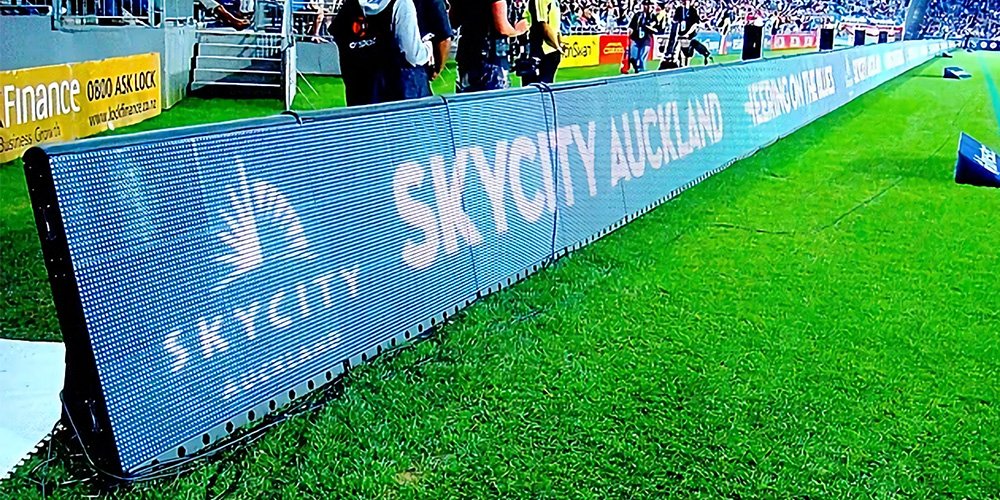
01. Perimeter LED Displays
Perimeter boards carry narrow advertising content along a playing area. Check camera-facing orientation, discontinuities, cable routes and access behind the cabinets. Define how a damaged section is isolated and when replacement work is permitted. Do not plan repairs in an active player area without the event operator’s procedure.
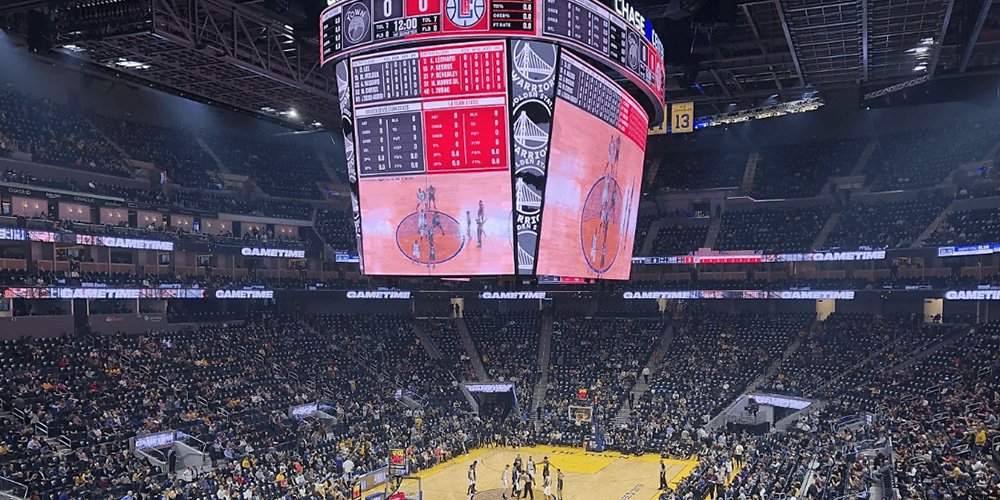
02. Center-Hung Video Boards (Jumbotrons)
A center-hung stadium LED display presents multiple faces above an arena. Its complete suspended mass includes structure, cables and accessories. Require a site-specific engineering and access plan, confirm what each seating section sees, and test the scoreboard layout on every face before acceptance.
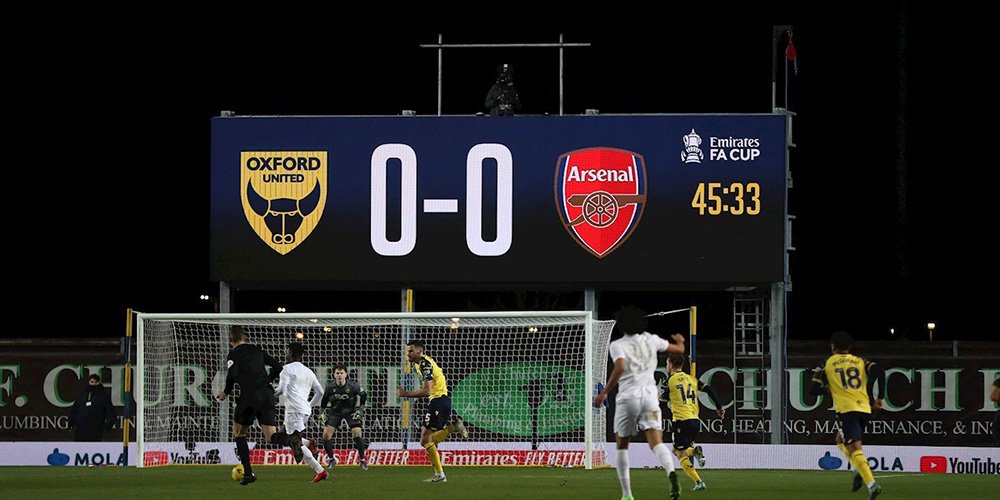
03. End-Wall Video Walls and Scoreboards
An end-wall stadium LED display may combine replays with score information. Keep critical text large enough for the designated far seats, and consider oblique viewers at the opposite corners. The input source resolution does not establish the wall’s native resolution or readable character size.
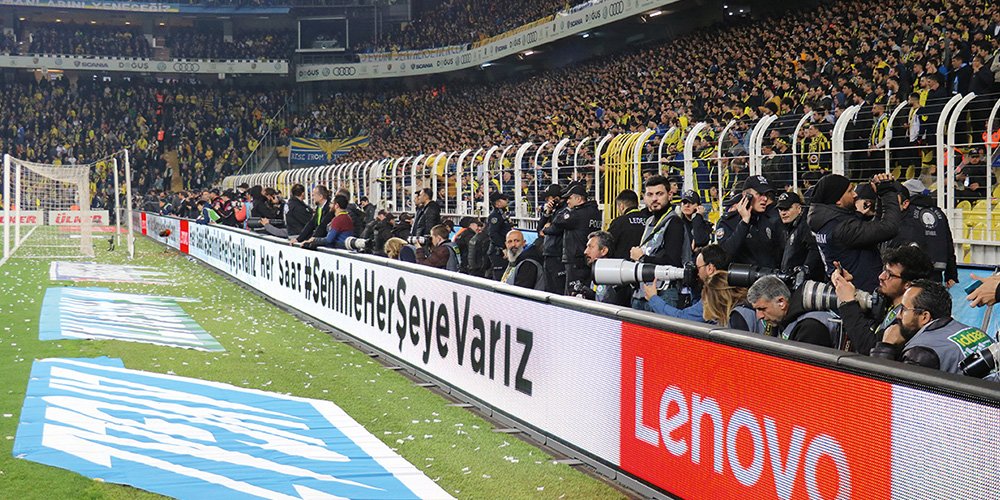
04. Ribbon Boards and Fascia Displays
Ribbon boards use unusually wide, shallow canvases. Give designers a pixel map showing corners, gaps and separately controlled zones. Test text movement and timing from seated positions. A standard widescreen advertisement stretched across the full ribbon will rarely preserve the intended proportions.
05. Facade and Entrance Displays
An external stadium LED display can carry event information and wayfinding. Evaluate daylight, surrounding properties, entrance congestion and service access. Confirm the applicable local approval process with the project team before ordering. Product weather ratings do not resolve structural, electrical or placement requirements.
5. How to Choose the Right Stadium LED Display
01. Match Pixel Pitch to Viewing Distance
Measure the nearest regular audience position and identify the smallest important content. Shortlist pitches, then test representative layouts. There is no universal distance multiplier that guarantees readability for every score graphic or spectator. At the same cabinet dimensions, a coarser pitch changes pixel count, not necessarily cabinet quantity.
As an illustrative geometry calculation, a 9.6 × 4.8 m canvas at exactly 5 mm pitch contains 1,920 × 960 pixels. At exactly 10 mm pitch, it contains 960 × 480 pixels. Halving pitch quadruples pixel count for the same area. Use the supplier’s actual module counts for the final stadium LED display map.
02. Set Brightness, Refresh Rate and Color Depth
Agree the operating settings and test content before comparing specifications. Examine the stadium LED display in daylight and at the intended night setting; test gradients, logos, video and camera capture. Avoid accepting a demonstration that uses different drivers, receiving hardware or processing from the quoted system.
03. Confirm Protection, Structure and Safety
Request model-specific documentation for the destination and application. A company logo or a general certificate list does not prove the supplied assembly meets every project requirement. Check the covered product, scope, issuer and relevant records with the responsible specialists. Treat missing evidence as an unresolved purchasing item.
04. Plan Installation and Service Access
Mark maintenance zones, delivery paths, lifting positions and protected cable routes on the drawings. Account for event-day restrictions and neighboring equipment. The stadium LED display proposal should state which party provides structure, electrical work, access equipment, assembly and final testing.
05. Choose the Control System and Software
List live inputs, score and clock interfaces, sponsor scheduling and user permissions. Test source loss, power restoration and any contracted redundancy under controlled conditions. Hand over documented presets, configuration backups and an approved recovery procedure. Confirm compatibility for the exact hardware and software versions.
06. Compare Total Cost of Ownership
Compare purchase, installation, energy, content operations, spares, inspection and service access over a defined period. Do not assume equipment is a fixed percentage of lifetime expenditure. For a stadium LED display used seasonally, operating hours and service arrangements may matter more than a generic annual-use assumption.
| Requirement | Test or document | Record at handover |
|---|---|---|
| Seat readability | Agreed content from mapped seating locations | Seat locations, photographs and unresolved obstructions |
| Broadcast image | Required camera modes at day and night settings | Camera settings, display settings and recordings |
| Score integration | Approved test data, correction and source-loss procedure | Interface versions and operator instructions |
| Weather protection | Configuration-specific documents and installation inspection | Ratings, connection details and cleaning limitations |
| Serviceability | Demonstrated component removal and replacement | Tools, access method and spare identifiers |
| Recovery | Controlled restart and any contracted failover | Configuration backup and responsible support contacts |
6. Stadium LED Display Price: Building a Project Budget
A stadium LED display price should refer to a dated bill of materials with explicit exclusions. Generic price ranges cannot account for venue geometry, broadcast integration, local labor or structural work. Obtain a project quotation rather than treating an online number as a current installed market price.
01. What Drives the Price
Screen area, pitch, cabinet design, protection, control capacity and required spare parts affect the equipment scope. Structure, access, distribution and commissioning affect the installation. Separate taxes, freight and destination work according to the quoted delivery terms. Record every unpriced requirement rather than entering zero.
02. Budget Scope by Display Type
| Display family | Equipment to identify | Site cost to investigate |
|---|---|---|
| Perimeter | Cabinets, supports, covers and control zones | Field routes, storage, event setup and safe access |
| Center-hung | Faces, secondary screens and processing | Complete rigging design, roof interface and maintenance access |
| End-wall | Canvas, control and scoring integration | Structure, foundations or attachment, lifting and service routes |
| Ribbon | Segments, corner mapping and signal distribution | Fascia attachment, access and long cable routes |
| Facade | Environmental configuration and content system | Building interface, approvals, access and electrical work |
03. A Worked Project Budget
Assume a hypothetical 60 m² stadium LED display with an arbitrary hardware allowance of USD 1,000/m². Hardware totals USD 60,000. If separately assumed control, structure, installation and freight allowances total USD 25,000, the defined subtotal is USD 85,000. These amounts illustrate arithmetic only; they are not EagerLED prices. Taxes, civil works or other exclusions must be added if not covered.
For a separate energy example, assume 60 m² at 200 W/m² average for 1,000 hours annually. That equals 12,000 kWh. At an assumed USD 0.15/kWh, display electricity is USD 1,800 per year, excluding auxiliary equipment and tariff-specific charges. Use measured representative consumption for the operating model and qualified electrical design for supply sizing.
04. How to Compare Stadium LED Display Quotes
Normalize dimensions, native resolution, operating settings, controls and service obligations. Ask for a written list of included and excluded work, quotation validity, warranty process and spare availability. Compare the complete stadium LED display package over the same period. Use the LED advertising screen guide for general placement and advertising workflow considerations.
7. EagerLED Stadium LED Display Solutions
Compare the proposed EagerLED system with the venue brief and require supporting documentation for the ordered configuration. Company-wide production figures, general certification statements and photographs do not substitute for a model-specific specification and service agreement.
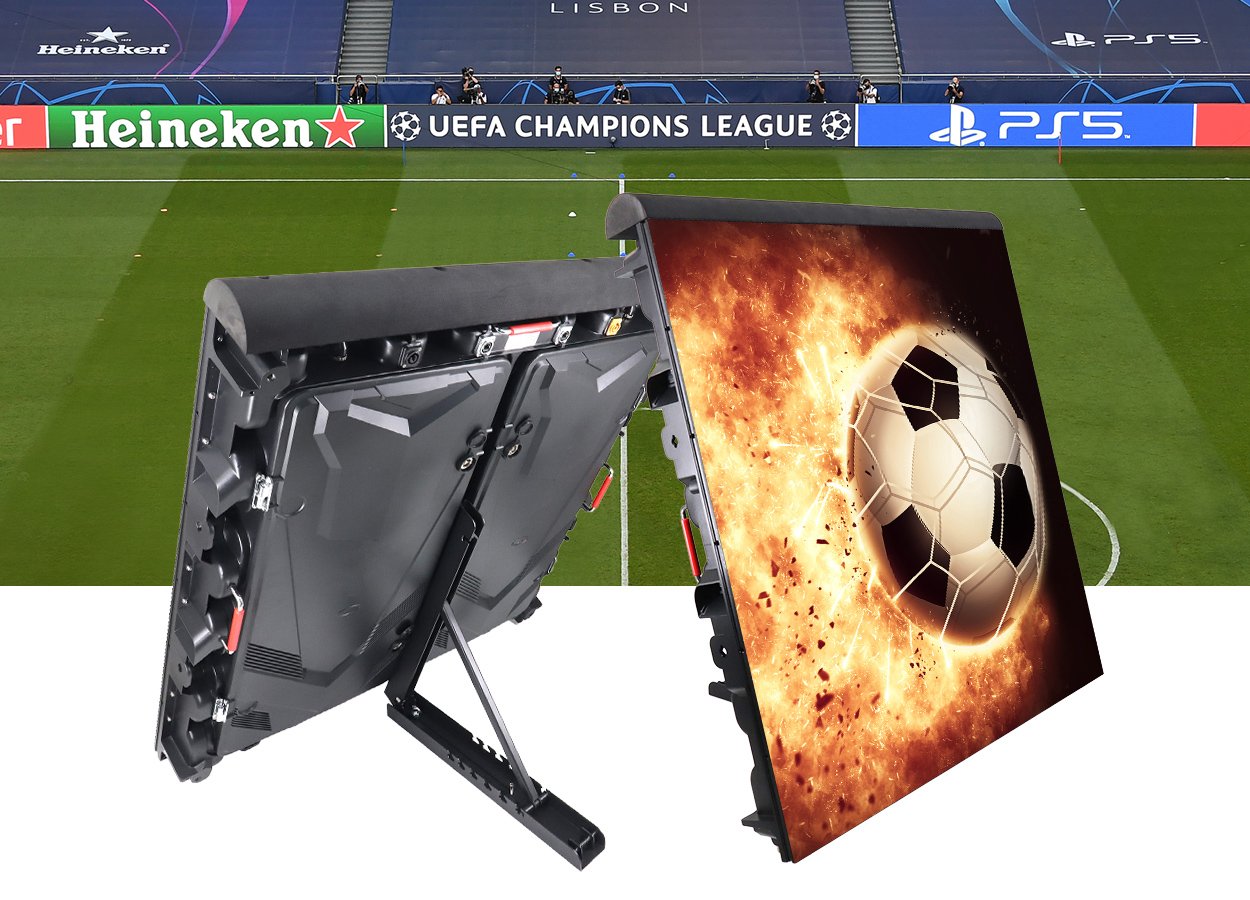
01. EA960SP4 Outdoor Perimeter Stadium LED Display
The EA960SP4 product page describes rear service, an adjustable support bracket and protective covers. Its table distinguishes two P5 LED packages. The comparison below preserves that distinction; these are manufacturer-published figures, not independent measurements or guarantees of camera performance.
| Published field | P5 SMD1921 | P5 SMD2727 |
|---|---|---|
| Cabinet dimensions | 960 × 960 mm | 960 × 960 mm |
| Brightness | 5,500 cd/m² | 6,000 cd/m² |
| Average / maximum power | 185 / 550 W/m² | 220 / 650 W/m² |
| Refresh frequency | At least 3,840 Hz | At least 3,840 Hz |
| Front / rear protection | IP65 / IP54 | IP65 / IP54 |
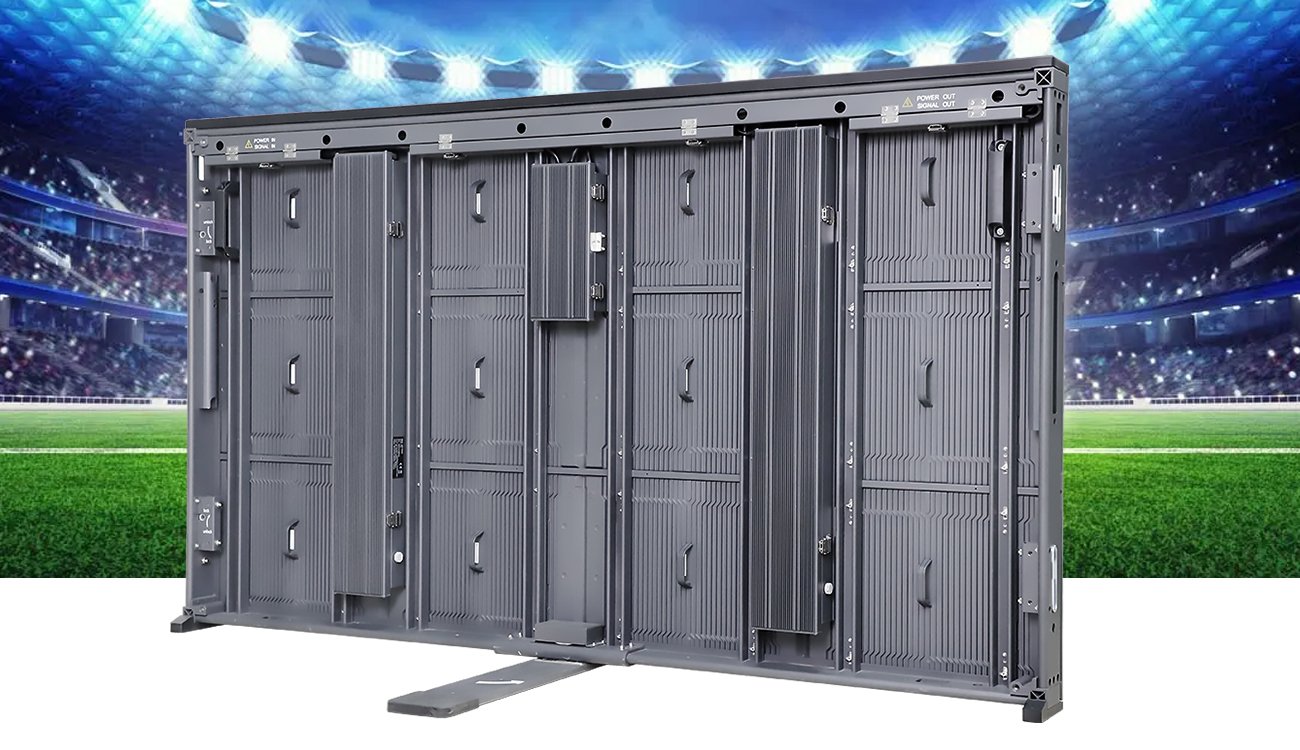
Confirm the LED package and test conditions in the quotation. Average power varies with content and operating settings. The retained cabinet illustrations show existing article media; the EA1600SP image below depicts a different cabinet family and must not be read as an EA960SP4 specification.
02. Related Guides and Products
Use EagerLED’s pixel-pitch guide for resolution terminology and the stadium screen size and sightline guide for early planning. This page focuses on procurement scope, operational integration and acceptance. Send a venue brief through the contact page for a configuration-specific proposal.
8. Stadium LED Display Installation, Maintenance and Service Life
01. Installation Methods
Ground-supported, wall-mounted and suspended stadium LED display installations need different engineering and access arrangements. Confirm the complete assembly and local conditions with the responsible professionals. Before delivery, approve cable routes, connection protection, drainage, service zones and the installation sequence around venue operations.
02. Preventive Maintenance Schedule
Use the supplied maintenance instructions to set intervals; exposure and event intensity can change them. The checklist below is a planning framework, not a universal service schedule. Keep records of defects, replacements and settings so the stadium LED display can be restored consistently.
| Trigger | Action | Record |
|---|---|---|
| Before an event | Check content, clock, dimming and visible damage | Readiness checklist and unresolved defects |
| After unusual weather or impact | Follow the inspection and isolation procedure | Observed damage and authorization to resume use |
| At supplier-defined intervals | Inspect connections, ventilation, seals and structure through qualified personnel | Inspection findings and corrective work |
| After component replacement | Verify mapping, settings and image consistency | Part identifiers, configuration and test result |
| Before changing event format | Test inputs, content zones and recovery presets | Approved event configuration |
03. Common Issues and How to Avoid Them
For camera banding, investigate the camera and display timing together. For image mismatch, check calibration and replacement identity. For recurring shutdowns, have the authorized service team diagnose the cause instead of repeatedly restarting the system. Component life, repairability and whole-system service life are different measures; no fixed decade-long result is promised here.
9. Stadium LED Display FAQ
01. What is the big screen in a stadium called?
Video board and jumbotron are common terms. Specify whether the stadium LED display is center-hung, end-wall, perimeter or ribbon so suppliers quote the correct system.
02. What is the difference between a jumbotron and a stadium LED display?
A jumbotron usually refers to a large video board. Stadium LED display is a broader category that includes scoreboards, perimeter advertising and ribbon displays with different shapes and operating roles.
03. How much does a stadium LED display cost?
Obtain a dated quotation for the actual area, configuration and installation scope. The worked example in this guide is hypothetical. It is not a current market range or an installed price commitment.
04. What pixel pitch is best for a stadium LED display?
Select candidates around viewing positions and required content, then test them. Confirm native resolution using module counts. A distance rule alone does not prove that small score text will be readable.
05. What brightness and refresh rate does a stadium LED display need?
Set requirements around daylight, night operation and the broadcaster's camera modes. A published refresh value is useful for screening proposals, but acceptance should include the actual camera and operating settings.
06. Are stadium LED displays waterproof?
Protection depends on the exact cabinet, front and rear ratings, connectors and installation details. Ask for the relevant evidence and maintenance instructions. Do not assume an outdoor rating allows immersion or unrestricted pressure washing.
07. How long does a stadium LED display last?
Useful service life depends on exposure, operating conditions, repairability and spare availability. Request the supplier's stated criteria and warranty terms. An LED component lifetime figure does not guarantee the same lifetime for the complete system.
08. How are stadium LED displays installed and maintained?
They may be ground-supported, fixed to a structure or suspended. The design must include access and replacement procedures. Require a handover demonstration, appropriate documentation and a venue-specific maintenance plan.
09. Why does a stadium LED display flicker on television?
Camera exposure and panel timing can interact to create banding or uneven capture. Test the full imaging chain, including dimmed operation and slow motion. A higher refresh number alone does not establish that every camera mode will work.
10. Can a stadium LED display be used for concerts and non-sport events?
Yes, when its inputs, content mapping and operating workflow support the event. Agree production responsibilities, test presets and confirm the required live video performance before the audience arrives.