Budget conference side screens as a two-wall system: active cabinets, the agreed image layout, signal routing, two support arrangements and destination costs. A price per square meter cannot show whether both screens can display the required content or whether the quotation includes everything needed at the venue.
This purchasing guide is for AV integrators supplying conference venues in Southeast Asia. It compares two illustrative layouts built from 500 × 500 mm cabinets. The quantities are transparent planning calculations, not a completed project or a published equipment price.
- State both wall dimensions and whether the content is mirrored or independent.
- Approve the slide and camera layout on each native canvas.
- Separate active cabinets, spare stock and support hardware.
- Use the same destination, delivery terms and installation scope for every quote.
On this page
Start with two cabinet grids
The EA500C6 rental display uses 500 × 500 mm die-cast aluminum cabinets. Its current product page lists a 6.5 kg indoor cabinet and indoor pitch options from P1.56 to P3.91. These family references establish a planning basis; the quotation must identify the exact pitch, revision and native cabinet resolution.
| Planning quantity | Layout A: two 3 × 2 m walls | Layout B: two 4 × 2.5 m walls |
|---|---|---|
| Grid per wall | 6 columns × 4 rows | 8 columns × 5 rows |
| Active cabinets per wall | 24 | 40 |
| Active cabinets, both walls | 48 | 80 |
| Active area, both walls | 12 m² | 20 m² |
| Cabinet-only mass per wall, at 6.5 kg | 156 kg | 260 kg |
| Cabinet-only mass, both walls | 312 kg | 520 kg |
Layout B adds 32 active cabinets and 8 m², a 66.7% increase in active area over A. It does not prove a 66.7% increase in the complete purchase price. Processing, support, freight and other items may change in different steps.
These masses exclude bars, frames, cables, cases and every other accessory. They are not rigging loads or a support design. Request the complete load schedule and venue-approved support arrangement separately. No spare cabinets are included in the active counts.
Budget for the image your audience will see
Layout A is 3:2 and B is 8:5; neither is exactly 16:9. If a 16:9 slide is fitted to the full width of A, its image height is 3 × 9 ÷ 16 = 1.6875 m. That leaves 0.3125 m unused vertically, or 0.15625 m above and below if centered. For B, the fitted image is 2.25 m high, leaving 0.25 m in total. A fill mode would instead crop the source unless the content is redesigned.
Do not buy extra LED area assuming it all becomes readable slide area. Ask the designer to show the smallest essential text, speaker image and sponsor graphics in the agreed composition. Check the nearest, farthest and oblique seats. A finer pitch improves available detail but cannot correct an obstructed sightline or an unreadably small source slide.
Ask for the native pixel map from the exact cabinet model. Processor loading, scaling and output allocation must use that map, not a rounded calculation from a nominal pitch label. Include a rehearsal with the actual slides and any cameras in the quoted acceptance scope.
Separate shared equipment from per-wall costs
| Quote line | State explicitly | Why a two-wall quote changes |
|---|---|---|
| LED cabinets | Model, pitch, quantity and calibration scope | Both active grids must match the approved layout |
| Content routing | Same image, independent images or selectable modes | Independent canvases may need additional output or source capability |
| Processing and distribution | Exact equipment, pixel map, ports, cable lengths and included backup | A controller name alone does not prove both walls are covered |
| Support and trim | Approved system for each location, complete accessories | Two separated structures are not one wider structure |
| Power | Maximum design load, distribution and venue connection scope | Each position needs a suitable documented feed |
| Commissioning | Mapping, image matching, source rehearsal and handover | Both walls must be accepted together |
Mirrored content means both side screens show the same composition. Independent content means the system must provide the required different canvases or sources. Neither requirement automatically dictates one processor or two. Ask the supplier to draw the exact topology and demonstrate both walls operating in the requested mode.
State whether the main stage wall already exists. Confirm who supplies source outputs and how changes between presentations, live cameras and standby graphics reach the side screens. Equipment that appears shared on a quotation may belong to another contractor and may not be available for this system.
Include access, spares and transport
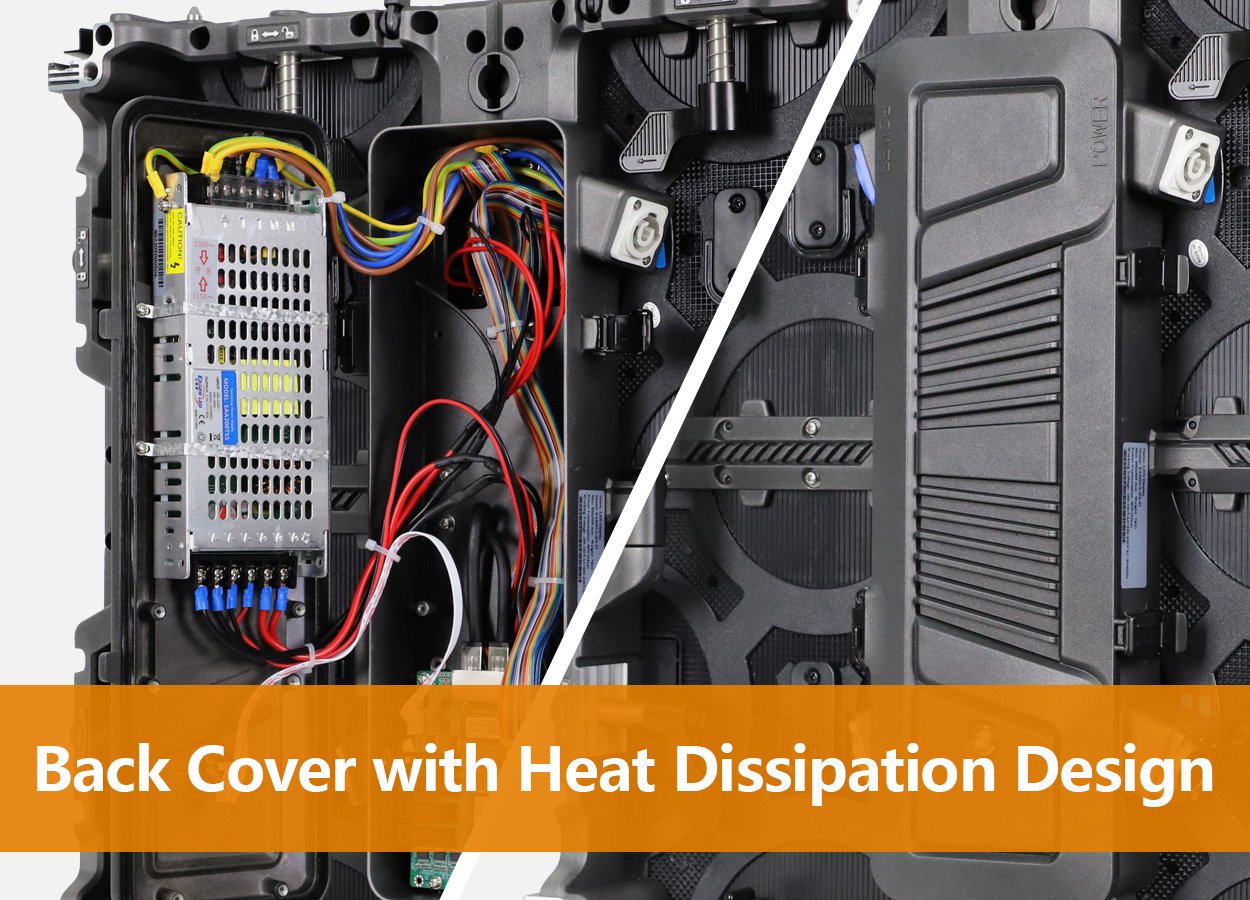
The EA500C6 product page describes an openable rear cover for the power and control area. Draw the working clearance behind each wall, including scenic masking and cable routes. A cabinet may be removable in a workshop but difficult to reach behind a conference stage. Ask how a technician can isolate and replace the planned service items without moving unsafe or loaded structures.
Quote spare cabinets and components separately from active area. Match their pitch, connectors, electronics, configuration and calibration requirements. Decide what travels to the event and what can remain at the service base. A shared spare kit may be practical for two nearby walls, but it must still support the required recovery time; no universal spare percentage is assumed here.
Request a case packing list with actual packed dimensions, gross weights and cabinet counts. Round case quantities according to the offered packing arrangement. Do not divide cabinet count by an assumed case capacity or use cabinet-only mass as shipping weight. Include the route from loading bay to stage, storage during the conference and return transport.
Compare landed and installed scope
For delivery to Singapore, Malaysia, Thailand or another Southeast Asian market, name the exact destination and use the same delivery basis in every request. Record currency, quotation date and validity. Ask who handles freight, insurance, import clearance, applicable taxes and last-mile transport, and identify exclusions rather than assuming a low hardware price includes them.
Keep three subtotals: supplied display equipment; delivery and destination charges; venue installation, commissioning and support. Mark unknown amounts as pending. Add locally confirmed charges only when their scope and basis are known. Do not use a generic tax percentage as a substitute for advice on the actual shipment.
This is a purchase-budget exercise for reusable rental cabinets. A local event rental package is a different comparison: state the hire period, build and strike, operator hours, delivery, damage terms and backup scope. The stage rental LED display guide explains broader operating and fleet decisions.
Conference side-screen budget FAQ
How many 500×500 mm cabinets do two conference side screens need?
Multiply columns by rows for each screen, then add the two counts. Two 3 × 2 m walls use 6 × 4 cabinets each, or 48 active cabinets in total. Spares are additional. Confirm that these dimensions fit the audience, content and approved support plan.
Does doubling the screen count double the total project price?
Not necessarily. Active cabinet area may double, while some processing can be shared if capacity and routing permit. Each wall still needs its own appropriate support, power distribution and cable runs. Compare an itemized two-wall system rather than doubling a single-wall package.
Can a 3 × 2 m LED wall show a 16:9 slide without cropping?
Yes, with a fitted image and unused space above and below. A 3 m wide 16:9 image is 1.6875 m high, leaving 0.3125 m of the 2 m screen height unused in total. Stretching or cropping changes the presentation. Approve the actual layout before buying.
Can EagerLED provide a fixed Southeast Asia side-screen price from cabinet count alone?
Cabinet count defines one part of the quote. The exact indoor model, pitch, control topology, support, spares, cases, shipping destination, delivery terms and local installation scope are also needed. Request a dated itemized quotation; this guide does not publish an unverified price range.
Request a comparable two-wall quotation
Send both active dimensions, venue plan, nearest and farthest seats, sample slides, mirrored or independent content requirement, support method and delivery city. Request itemized cabinets, control, support, cables, spares, cases, transport and commissioning, with exclusions identified.
Prepared by EagerLED for AV integrators. Product references reviewed on 16 October 2026. Layouts and quantities are hypothetical; no project price, structural approval or camera-performance guarantee is implied.