

Specify curved glass LED film from the developed surface, the permitted bending direction and a confirmed module map. The straight width seen on an elevation is not the length of a curved pane. A flexible product description does not establish a minimum bend radius or approval for every coating, compound curve or glass assembly.
This checklist is for architectural specifiers planning curved storefront glazing in the United States or Canada. It uses the EA-iFilm2 indoor film product as a dimensional reference and provides a conditional arc-length example. The calculations describe geometry, not a released installation design or a completed EagerLED project.
In this guide
Measure curved glass LED film along the surface
Identify whether the storefront uses a continuously curved pane or a series of flat panes arranged around a corner. They need different module and cable details. For a truly circular surface, record its radius, the included angle and the usable height. For a noncircular surface, obtain a measured developed profile rather than forcing the shape into a circular calculation.
The developed arc length is radius multiplied by angle in radians. The straight chord between the same endpoints is twice the radius multiplied by the sine of half the included angle. The arc is longer than its chord. Neither figure includes deductions for seals, mullions, edge equipment, joints or installation allowances.
Consider a circular quarter-turn with a 2.0 m radius. The included angle is 90 degrees, or π/2 radians. Its surface arc is approximately 3.142 m, while the chord is approximately 2.828 m. Measuring only the chord understates the curved path by approximately 314 mm in this example.
| Measurement | Calculation | Result |
|---|---|---|
| Developed surface arc | 2.0 × π/2 | 3.142 m approximately |
| Straight endpoint chord | 2 × 2.0 × sin 45° | 2.828 m approximately |
| Difference | Arc minus chord | 314 mm approximately |
| Three nominal 1 m module lengths | 3 × 1.0 | 3.000 m before joints and allowances |
Three 1 m lengths fit within the mathematical arc before allowances; three do not fit within the chord. That contrast explains why a flat elevation can produce a wrong takeoff. It does not prove that the selected module may bend around a 2.0 m radius, that its long direction may follow the curve or that the remaining 142 mm may be filled by cutting. Obtain those answers separately.
Choose a module format before drawing the image
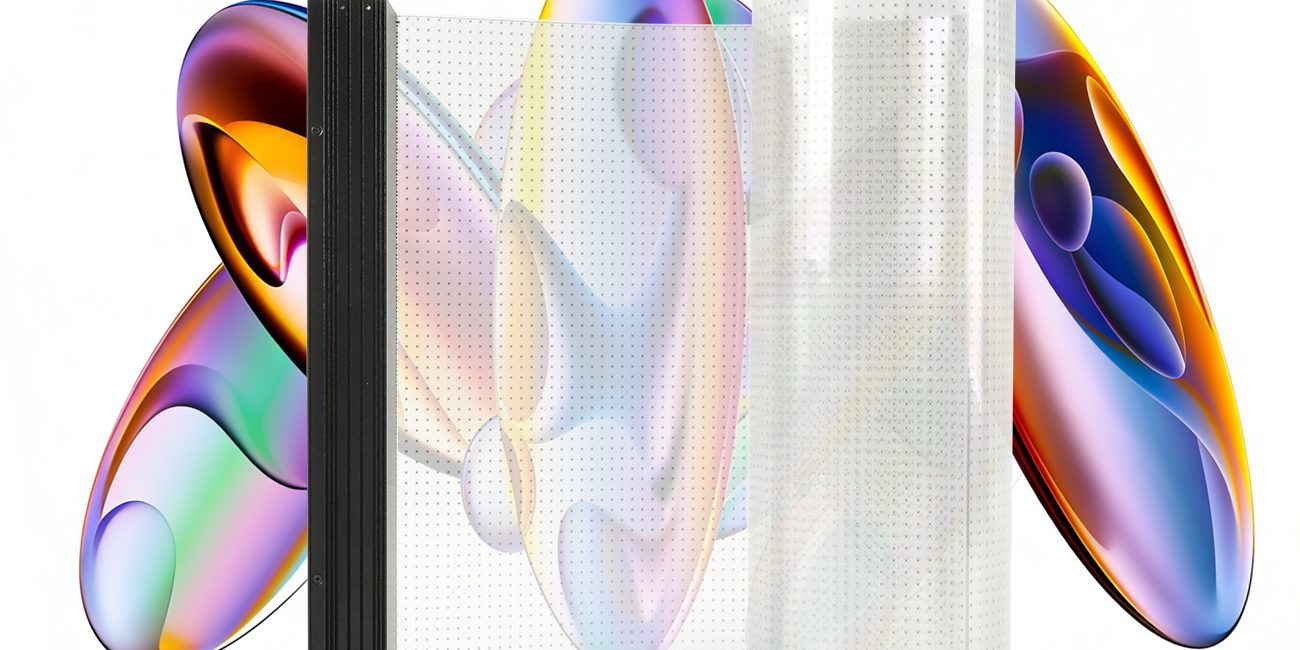
The EA-iFilm2 product page, reviewed on October 22, 2026, describes flexible, self-adhesive indoor LED film. Its parameter table lists different module heights and pixel matrices across the available pitches. Select the actual option before completing the curved glass LED film map.
| Option | Module dimensions | Module matrix | Listed transparency |
|---|---|---|---|
| P4 | 1000 × 240 mm | 250 × 60 pixels | 90% |
| P5 | 1000 × 240 mm | 200 × 48 pixels | 91% |
| P6.25 | 1000 × 400 mm | 160 × 64 pixels | 92% |
For example, a nominal 1.2 m active height uses five 240 mm module rows or three 400 mm rows, before allowances. With three modules across, the corresponding P4 canvas is 750 × 300 pixels; P5 is 600 × 240; P6.25 is 480 × 192. These are conditional full-module maps, not confirmation that this arrangement suits the curved glass.
The active envelope in all three examples is nominally 3.0 × 1.2 m. Changing pitch alters the image grid even when the envelope stays the same. Give the designer the confirmed native matrix and the direction of the curve. A familiar video input format is not the film’s native pixel count.

Require the bending limits in the specification
Ask for the permitted bend axis, minimum radius, installation direction and any restrictions around LEDs, conductors, connections and edges. State whether the surface is concave or convex from the installation side. A module that follows a cylinder is not automatically suitable for a dome, twisted surface or sharp fold.
Keep module boundaries on the drawing. Do not bend curved glass LED film across an opening joint or assume it can bridge two panes that move independently. At a faceted storefront, show the transition between flat panes and obtain the approved connection detail. A small apparent corner on the elevation may still be a prohibited local bend.
The page’s approximate 2 mm thickness is useful as a product reference, but it is not a complete edge or connector dimension. Request the installed assembly depth, connection envelopes and cable-routing detail for the exact revision. Include equipment concealed above or beside the glass.

Review a curved sample from actual viewing positions
Approve a representative curved glass LED film sample with the relevant glazing and display teams. Record the glass identity, attachment side, curvature, module revision and content version. Include the smallest essential campaign text and a graphic crossing a module boundary.
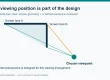
View the sample from the pedestrian approaches, not only square to its midpoint. The outer portions of the curve face different directions, so the apparent width and legibility change along the storefront. Check reflections, obstructions and the reverse view from inside. The product’s listed viewing angle does not guarantee that every word remains useful throughout that range.
Compare screen-off, daytime and evening conditions. The selected table columns list 2000 cd/m² brightness, but that does not establish suitability behind every sunlit window. Agree output settings for the actual message and environment. Likewise, listed transparency is not the measured optical transmission of the completed glass-and-film assembly.
Draw attachment and replacement around the curve
Confirm compatibility with the actual glass surface and any coatings or existing films. Use the approved preparation and attachment method. Show how a technician can reach the curved area, disconnect the affected section and remove it without loading adjacent glass or damaging nearby modules.

For curved glass LED film, request a replacement map that preserves module identities and the controller configuration. Keep spares matched to the approved revision. Ask how a replacement section is aligned and how the image is checked after the repair, including any boundary visible from an oblique approach.
The glass curtain-wall supplier checklist covers the broader attachment evidence and responsibility schedule. Use it alongside the developed geometry here. If the required curve or attachment cannot be supported, compare another approved display arrangement before committing to the glazing design.
Frequently asked questions
Can I order film from a photograph of the curved storefront?
A photograph helps explain the site, but it does not provide a reliable developed length or radius. Supply measured geometry, pane boundaries, usable height and obstructions before releasing a module quantity.
Should artwork be stretched to compensate for the curve?
Do not apply an arbitrary correction. Provide the confirmed pixel map and intended viewing positions to the content team, then approve representative artwork on the actual arrangement. One correction cannot guarantee the same apparent shape from every approach.
Does higher transparency always make text easier to read?
No. The background visible through the glazing also affects contrast. Compare the selected module option with the real interior background, message and daytime conditions rather than choosing from one percentage alone.
Is the remaining unfilled strip necessarily a problem?
Not always. An intentional border can be acceptable if it is shown on the approved elevation and content map. Keep the quoted active area distinct from the total pane area and agree the visual treatment with the project team.
What should the final drawing distinguish?
For curved glass LED film, show the glass boundary, developed active area, module boundaries, joints, connections and equipment locations separately. Record the bend direction and permitted geometry beside the product revision so later substitutions can be checked.
Request a geometry-specific film proposal
Send the country, measured curved profile, pane schedule, attachment surface, viewing positions and representative content. Ask for curved glass LED film specifications covering the exact module map, supported bending limits, attachment detail and replacement route. Discuss the curved storefront and module layout