

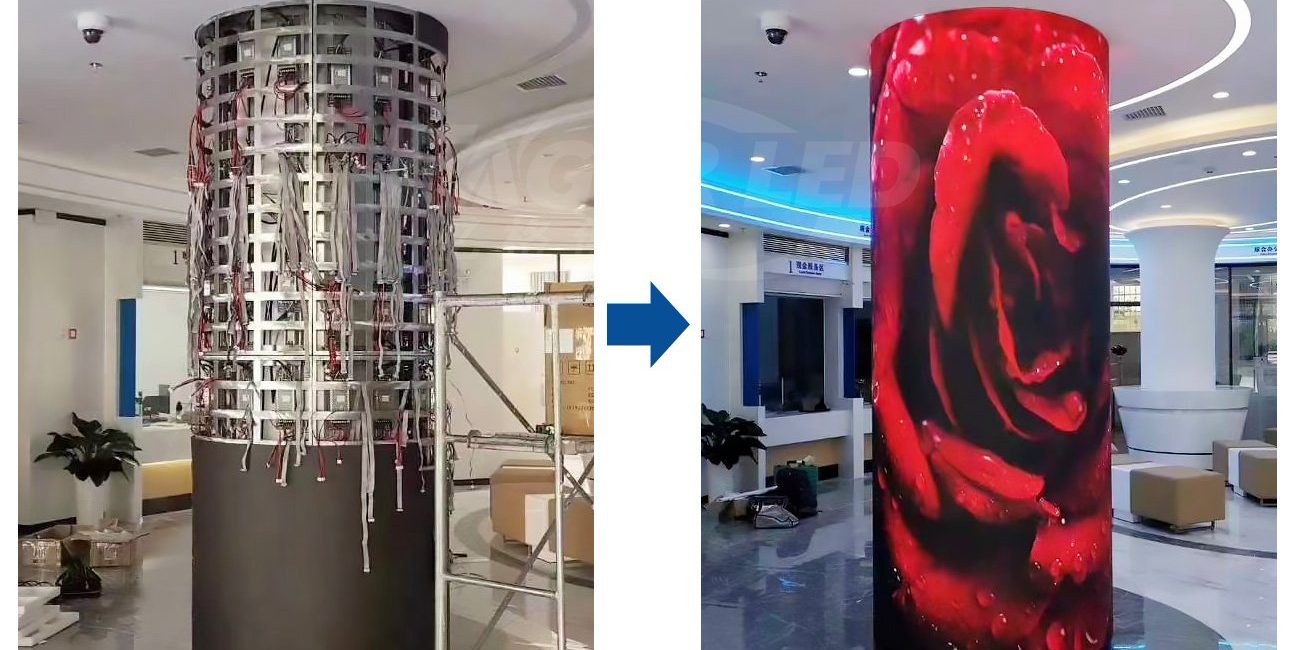
The cost of a flexible LED lobby column comes from the finished module layout and the complete installation scope. A price per soft module or square metre does not include every part needed to make the column work. Establish the finished diameter, active height, pixel map and service design before comparing proposals.
This worksheet is for display fabricators and lobby project teams in Brazil purchasing an indoor cylindrical display. It separates the supplier’s equipment package from local fabrication and installation, and provides a calculated bill of quantities without inventing a market price.
- Finished LED-surface diameter and active height.
- Full wrap or partial wrap, including the closing seam.
- Exact module size, pitch and approved curvature.
- Responsibility for frame, electronics, delivery and local installation.
In this column budget guide
Budget the finished LED surface, not the bare column
A display built around a structural column adds a frame and component space outside the existing surface. If the circular section has a uniform radial build-up t, the planning relationship is finished diameter = bare diameter + 2t. A service enclosure or an irregular column can require a more detailed section.
For a cylindrical display, nominal active area is circumference × active height, with circumference equal to π × finished diameter. Increasing the finished diameter increases the quoted display area even if the building column remains unchanged. Include the approved frame, ventilation and maintenance space in the drawing used for pricing.
Do not force the display to match an arbitrary circumference by stretching modules or closing an unapproved gap. The EA-Flex indoor system offers several module formats. The selected format, bend direction and permitted radius must fit the actual structure. A published bend angle alone does not approve the radius of a completed column.
Worked bill of quantities: a grid-led column concept
Explicit assumptions: one indoor full wrap, 16 modules around and 16 rows high, using nominal 320 × 160 mm modules with the 320 mm dimension following the circumference. The calculation ignores joint allowances and assumes the manufacturer approves that orientation and curve. It is a concept to quote and check, not a fabrication drawing.
| Planning item | Calculation | Nominal result |
|---|---|---|
| Active circumference | 16 × 0.320 m | 5.120 m |
| Active height | 16 × 0.160 m | 2.560 m |
| Implied LED-surface diameter | 5.120 m ÷ π | Approximately 1.630 m |
| Active modules | 16 × 16 | 256 modules |
| Active display area | 5.120 m × 2.560 m | 13.1072 m² |
For this concept, the display-surface subtotal is 256 × the quoted price per active module, or 13.1072 × a like-for-like quoted price per square metre. Identify whether those two rates include the same electronics, protection and assembly. Spare modules are additional inventory; they are not added to the active display area.
The implied diameter also checks architectural fit. Around a 1.500 m bare column, the nominal difference gives about (1.630 − 1.500) ÷ 2 = 0.065 m radial build-up. That arithmetic does not establish enough room for the selected frame, wiring, power supplies or component removal. If the required build-up is greater, revise the diameter and grid before accepting this module count.
Compare P2 and P2.5 on the same physical layout
EagerLED’s published 320 × 160 mm flexible-module examples list P2 at 160 × 80 pixels and P2.5 at 128 × 64 pixels. Confirm the ordered model and revision in the quotation. Keeping the 16-by-16 layout gives the following native canvases:
| Configuration | Native canvas | Total pixels |
|---|---|---|
| 320 × 160 mm P2; 256 active modules | (16 × 160) × (16 × 80) = 2,560 × 1,280 | 3,276,800 |
| 320 × 160 mm P2.5; 256 active modules | (16 × 128) × (16 × 64) = 2,048 × 1,024 | 2,097,152 |
The P2 layout contains 56.25% more pixels, while nominal module count and area remain the same. This is a processing-load comparison, not a price multiplier. Ask for separate module and controller proposals, including output mapping and any backup requirement, for the chosen canvas.
Choose between them by showing the actual lobby artwork at the closest normal viewing distance. A visitor sees one portion of the cylinder at a time, so repeat complete messages in visible zones and keep important text away from the closure seam. Include that content template and commissioning work in the budget.
Turn the module quote into a completed-column budget
Ask each bidder to fill the same scope schedule. Mark every item as supplied, locally provided, excluded or awaiting a quotation. A missing cost is an open budget line, not a zero.
| Scope line | Evidence or quantity to request | Responsibility to agree |
|---|---|---|
| Display surface and spares | Exact module model; active count; separate compatible spare count | Supplier and buyer-approved configuration |
| Custom support and finish | Approved section, circumference, seam, retention and finish | Supplier fabrication or Brazilian integrator |
| Power and receiving system | Power supplies, receiving cards, cables and component locations | Complete equipment package or explicit local scope |
| Processing and content | Native canvas; output map; player; control workflow; artwork template | Hardware supplier and content/commissioning team |
| Delivery | Packing list, dimensions, gross weight and named delivery point | Freight and destination costs separately confirmed |
| Site installation | Access equipment, electrical work, anchoring, assembly and testing | Local installer against the same site drawing |
| Handover and service | Configuration files, calibrated spares, training and replacement procedure | Named support and maintenance responsibilities |
For a Brazilian project, ask the local integrator and logistics provider to price the actual delivery location and site scope. Do not treat a factory equipment price as a completed lobby installation. Obtain current destination-specific delivery and applicable import-cost information; this guide provides no tax rate or clearance guarantee.
Resolve component access before the frame is priced
Front-removable modules help only when the technician can reach the removal point and the components behind it. Require a section showing cable slack, receiving cards, power supplies, ventilation and the removal route. A cheap shallow frame can become an expensive redesign if a power supply cannot be extracted.

Before approving production, ask for a representative curved sample with a joint and closure detail. Test agreed white, grayscale and lobby content, then demonstrate replacement of a module and the hardest-to-access electronic component. Record the results and retain the approved drawing, pixel map and configuration files.
For broader module selection and bend limits, read the flexible LED module specification guide. The worksheet here adds an explicit quantity and scope basis for comparing finished-column budgets.
Flexible LED column cost FAQ
Why is a flexible LED module quote lower than a complete column quote?
A module quote can cover only the display surface. A finished column also needs its engineered frame, power supplies, receiving electronics, processor, cabling, transport, installation, mapping, calibration and service access. Compare the included scope and assign responsibility for every excluded item.
Which diameter should be used to budget a cylindrical LED screen?
Use the finished LED surface diameter, not just the bare building column. A section drawing must account for the frame, electronics, ventilation and service arrangement. The approved circumference and module layout determine the active area and quantity.
Does a P2 column cost 56.25% more than a P2.5 column?
No price ratio follows from pixel count alone. In the stated 320 by 160 mm module example, the P2 layout has 56.25% more pixels than P2.5 at the same nominal area. Obtain actual module, processing and commissioning quotations for both configurations.
Can the example module grid be fitted around any existing column?
No. The grid implies a nominal circumference and diameter, before seam and frame allowances. The exact modules must be approved for the bend direction and radius. An existing column, service clearance or architectural envelope can require a different grid or a partial wrap.
Request a column layout and itemized proposal
Send the Brazilian installation city, bare column measurements, proposed finished envelope, active height, full or partial wrap, nearest viewers and available service space. Attach plan, elevation and section drawings, plus the lobby content sample.
Request separate display-surface, frame, processing, spares and delivery prices. Ask the local installer to quote site work against the same approved layout.
Prepared by EagerLED for display fabricators. Product references reviewed on 14 October 2026. Calculations describe stated planning assumptions; confirm module revisions, geometry, delivery scope and quotations before ordering. The manufacturer images are visual references, not identified Brazilian project evidence.