ICN2037 / ICN2037BP at a glance
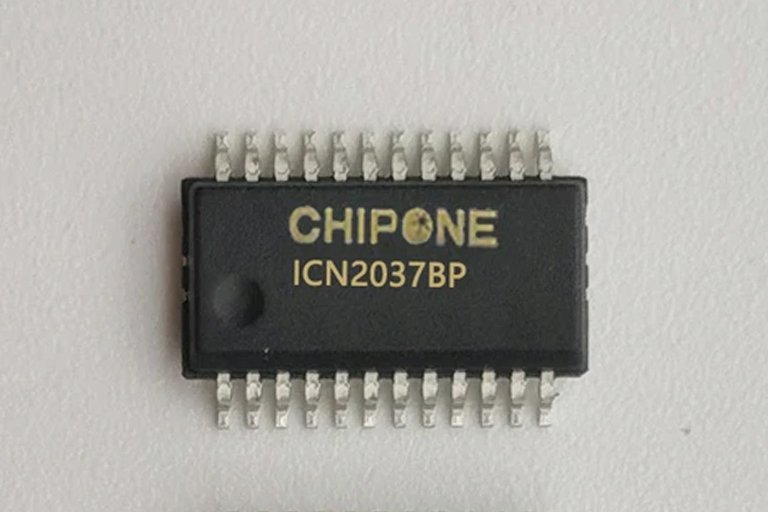
The ICN2037 is a 16-channel constant current LED sink driver with an integrated dual latch, designed for LED display modules. Each of its 16 outputs sinks 3-45 mA at VDD = 5 V (3-30 mA at VDD = 3.3 V), and the channel current is set by one external resistor (R-EXT). Current error stays below ±3.0% between channels and below ±2.5% between ICs. The device comes in a 24-pin SSOP24-P-150-0.635 (Pb-free) package, operates from 3.3 V to 5 V with a 6.0 V maximum supply rating, works from -40 °C to +85 °C, and passes 8 kV HBM ESD testing. The English datasheet (V2.0, November 2017) covering the ICN2037AP and ICN2037BP ordering codes can be downloaded on this page.
Download the Chipone ICN2037 / ICN2037BP datasheet (English, V2.0)
1. Description
ICN2037 is a driver IC specially designed for LED displays, using 16 channels of constant current sink output. ICN2037 integrates “Noise Free TM” technology, which has excellent anti-interference characteristics, so that the constant current and low gray effects are not affected by the PCB board.
Different external resistors can be used to adjust the output stage current and accurately control the LED brightness. At the same time, through precise current control technology, the inter-chip error can be lower than ±2.5%, and the inter-channel error can be lower than ±3.0%.
ICN2037 integrates double buffer registers. While displaying 16-bit data in the register, it can also continue to store 16-bit serial data. Compared with general-purpose constant current source chips, the refresh rate can be increased by more than 50%.
2. Characteristic
- 16 channels of constant current sink output
- Output current range: 3-45 mA at VDD = 5 V; 3-30 mA at VDD = 3.3 V
- Current accuracy: between channels below ±3.0%; chip-to-chip below ±2.5%
- Fast output current response (minimum): 40 ns at VDD = 5 V
- I/O Schmitt trigger input
- Maximum data transfer frequency: 30 MHz
- Chip operating voltage: VDD = 3.3-5 V (6.0 V maximum)
- Working temperature range: -40 to +85 °C
- Pre-charge circuit for ghosting reduction
- LED protection
- Enhanced circuit for caterpillar cancelling on damaged lamp beads
- Low-gray scale enhancement for consistent low-gray performance
- Integrated dual latch: refresh rate more than 50% higher than general-purpose constant current drivers
- ESD HBM pass 8 kV
3. ICN2037 key specifications
| Device type | 16-channel constant current LED sink driver with integrated dual latch |
| Output channels | 16 (OUT0-OUT15) |
| Output current per channel | 3-45 mA x 16 at VDD = 5 V; 3-30 mA x 16 at VDD = 3.3 V (DC characteristics table: 0.5-45 mA per channel) |
| Current accuracy | Between channels < ±3.0%; between ICs < ±2.5% |
| Output current setting | One external resistor (R-EXT): IOUT = (V R-EXT / REXT) x 15, with V R-EXT = 1.232 V |
| Output enable response | OE (min) 40 ns at VDD = 5 V |
| Serial data transfer frequency | 30 MHz (feature summary); 35 MHz maximum in the AC characteristics table |
| Supply voltage VDD | 3.3 V (min) / 5 V (typ.) / 6.0 V (max) |
| Operating temperature | -40 °C to +85 °C |
| Storage temperature | -55 °C to +150 °C |
| Package | SSOP24-P-150-0.635, Pb-free, 130 mg |
| Ordering codes | ICN2037AP, ICN2037BP |
| ESD rating | HBM pass 8 kV |
| I/O structure | Schmitt trigger input |
| Special functions | Pre-charge for ghosting reduction; LED protection; enhanced circuit for caterpillar cancelling; low-gray scale enhancement; integrated dual latch for higher refresh rate |
4. ICN2037 pin configuration (SSOP24)
The ICN2037 is supplied in a 24-pin SSOP24 package (SSOP24-P-150-0.635, 150 mil body, 0.635 mm pitch). The pin assignment below is taken from the datasheet pin configuration table.
| Pin | Name | Function |
| 1 | GND | Power ground |
| 2 | SIN | Serial data input for driver control |
| 3 | CLK | Clock input terminal; data shifts on the rising edge |
| 4 | LE | Edge-triggered latch input |
| 5-20 | OUT0-OUT15 | Constant current outputs |
| 21 | OE | Output enable terminal |
| 22 | SOUT | Serial data output to the following IC |
| 23 | R-EXT | Constant current value setting; connect an external resistor to GND |
| 24 | VDD | Power supply voltage |
5. Setting the ICN2037 output current with R-EXT
The datasheet gives the relationship between the output current and the external resistor as IOUT = (V R-EXT / REXT) x 15, where V R-EXT = 1.232 V. Resistor values below are calculated with that formula and match the two test points the datasheet publishes: 15 mA typical at 1.23 kΩ and 30 mA typical at 615 Ω.
| REXT | Typical output current | Notes |
| 411 Ω | ≈45 mA | Top of the setting range; 45 mA is also the absolute maximum output current rating |
| 615 Ω | ≈30 mA | Datasheet test point (IO2, typical) |
| 924 Ω | ≈20 mA | Common setting for indoor modules |
| 1.23 kΩ | ≈15 mA | Datasheet test point (IO1, typical) |
| 2.47 kΩ | ≈7.5 mA | Low-brightness indoor settings |
| 6.16 kΩ | ≈3 mA | Bottom of the 3-45 mA setting range at VDD = 5 V |
Use a 1% resistor and verify the resulting channel current on your own board: the DC characteristics table specifies a constant current output range of 0.5-45 mA per channel, and the absolute maximum output current must not be exceeded.
6. ICN2037 / ICN2037BP compared with other Chipone 16-channel drivers
Several Chipone 16-channel drivers share the same 16-output, serial-in/serial-out architecture but differ in accuracy, current range and on-chip correction circuits. The table below uses the specifications published for each part; always confirm against the manufacturer revision you are ordering.
| Driver | Outputs | Output current (VDD = 5 V) | Channel-to-channel error | Chip-to-chip error | Data transfer frequency | Notable features |
| ICN2037 / ICN2037BP | 16 constant current sink | 3-45 mA | < ±3.0% | < ±2.5% | 30 MHz | Dual latch, pre-charge ghosting reduction, caterpillar cancelling, low-gray enhancement, 8 kV HBM ESD, SSOP24 |
| ICND2038S | 16 constant current sink | 0.5-45 mA | ±0.7% typ / ±2.0% max | ±1.1% typ / ±2.0% max | 25 MHz | 4-bit current gain (25-100%), register configuration, ghost elimination, bidirectional clamp protection, SSOP24/QFN24 |
| ICND2153 / ICN2153 | 16 PWM constant current | 0.5-25 mA | ±1.0% typ / ±2.0% max | ±1.0% typ / ±2.0% max | 25 MHz | 8-bit current gain (12.5-200%), 1-32 scan, LED open-circuit detection, fixed 8x refresh |
Which one to choose: use the ICN2037 / ICN2037BP when you need a wide 3-45 mA sink current and a dual latch for higher refresh; choose the ICND2038S when channel-to-channel matching and register-based ghost elimination matter more; choose the ICND2153 / ICN2153 when you need PWM outputs with scan support and LED open-circuit detection. Datasheet downloads for each part are available on their pages and in our download centre.
7. Maximum ratings and timing limits
Maximum ratings and timing limits define the boundary conditions of a reliable ICN2037 design. Both tables below are taken from datasheet V2.0.
| Maximum rating | Value |
| Supply voltage VDD | 0-7.0 V |
| Output current IO | 45 mA |
| Input voltage VIN | -0.4 V to VDD + 0.4 V |
| Output voltage VOUT | 11 V |
| Clock frequency FCLK | 30 MHz |
| GND terminal current IGND | +1000 mA |
| Power dissipation PD (on PCB, 25 °C) | 3.19 W |
| Thermal resistance Rth(j-a) | 39.15 °C/W |
| Timing parameter | Symbol | Value |
| Clock pulse width | twCLK | Minimum 20 ns |
| Latch pulse width | twLE | Minimum 20 ns |
| Output enable pulse width | twOE | Minimum 40 ns (REXT = 890 Ω) |
| Hold and setup time | tHOLD / tSETUP | 5 ns (typ.) |
| Maximum clock rise and fall time | tr / tf | Maximum 500 ns |
| Propagation delay OE to OUT | tpLH3 / tpHL3 | 32 ns typ / 45 ns typ |
| Output rise and fall time | tor / tof | 30 ns typ / 45 ns typ |
8. Common display artefacts and the on-chip functions that address them
Most display defects that customers report on ICN2037-based modules are the four artefacts the datasheet lists dedicated on-chip circuits for. Checking the driver against this table is a fast way to separate a driver-IC issue from a module, cable or receiving-card issue.
| Display issue | On-chip function in the ICN2037 |
| Ghosting or hidden lighting when channels switch | Pre-charge for ghosting reduction |
| Caterpillar effect caused by a damaged LED | Enhanced circuit for caterpillar cancelling |
| Low-gray blocks, colour cast or a dark first row | Low-gray scale enhancement |
| Repeated LED bead damage on one channel | LED protection |
| Refresh rate limited by data transfer time | Integrated dual latch: the next frame can be loaded while the current frame is displayed |
If a fault follows the driver position when you swap modules, work through our LED display parts tutorial and the articles in the LED control system section.
9. FAQ: ICN2037 / ICN2037BP
What is the ICN2037?
The ICN2037 is a 16-channel constant current LED sink driver with an integrated dual latch. It sinks 3-45 mA per channel at VDD = 5 V, sets the current with one external R-EXT resistor, and is used to drive LED display modules. It is supplied in a 24-pin SSOP24 package and operates from -40 °C to +85 °C.
What is the difference between the ICN2037 and the ICN2037BP?
Both are the same 16-channel dual-latch driver in the SSOP24-P-150-0.635 (Pb-free) package, with a listed weight of 130 mg. The datasheet ordering information lists two orderable codes, ICN2037AP and ICN2037BP, so they share the electrical specification tables. Order the code your BOM or supplier specifies and confirm the marking and revision with the manufacturer before volume purchasing.
How do I set the output current of the ICN2037?
Connect an external resistor between pin 23 (R-EXT) and GND. The datasheet relationship is IOUT = (V R-EXT / REXT) x 15 with V R-EXT = 1.232 V, so a 1.23 kΩ resistor gives about 15 mA per channel and a 615 Ω resistor gives about 30 mA. The constant current output range is 0.5-45 mA per channel; never exceed the 45 mA absolute maximum output current rating.
What package and pin count does the ICN2037 use?
The ICN2037 is a 24-pin SSOP24 device, package code SSOP24-P-150-0.635 (150 mil body, 0.635 mm pitch). Pins 5-20 are outputs OUT0-OUT15, pin 23 is R-EXT and pin 24 is VDD.
What are the maximum output current and supply voltage of the ICN2037?
The absolute maximum output current is 45 mA per channel and the absolute maximum supply voltage is 7.0 V. In the DC characteristics table the recommended supply is 3.3 V minimum, 5 V typical and 6.0 V maximum. The output voltage rating is 11 V and the GND terminal current rating is 1000 mA.
Where can I download the ICN2037 datasheet?
The English Chipone ICN2037 datasheet (V2.0, November 2017) is available on this page in the download table above, and directly as ICN2037_datasheet_EN_2017_V2.0.pdf. We also list related driver datasheets in the download centre.
10. Datasheet version, source notes and related resources
Datasheet version and source notes
The specification tables and the current-setting formula on this page are taken from the Chipone ICN2037 datasheet V2.0 (November 2017) that is linked in the download table above. Two points in that revision are worth checking before you finalise a design:
- The feature summary lists a 3.3-5 V supply and a 30 MHz maximum data transfer frequency, while the DC and AC tables give a 6.0 V maximum supply voltage and a 35 MHz maximum transfer frequency. Design to the tables and confirm against the latest manufacturer revision.
- The pin configuration table describes the OE pin as active high, while the timing note on the same document describes the outputs as following the data when OE is low. Confirm the intended polarity with the latest datasheet before production.
Our download list names the file “Chipone ICN2037 / ICND2037”. The linked PDF is titled ICN2037 and its ordering information lists ICN2037AP and ICN2037BP, so use ICN2037 / ICN2037BP when ordering or cross-referencing the part.
Related EagerLED resources
- ICND2038S datasheet and specifications
- ICND2153 / ICN2153 datasheet and specifications
- LED display parts tutorial
- LED display module panel and indoor LED display module selection guides
- LED display download centre
Sourcing ICN2037 drivers, receiving cards or complete LED display modules? Contact EagerLED with your module type and current settings and our engineers will confirm availability.