

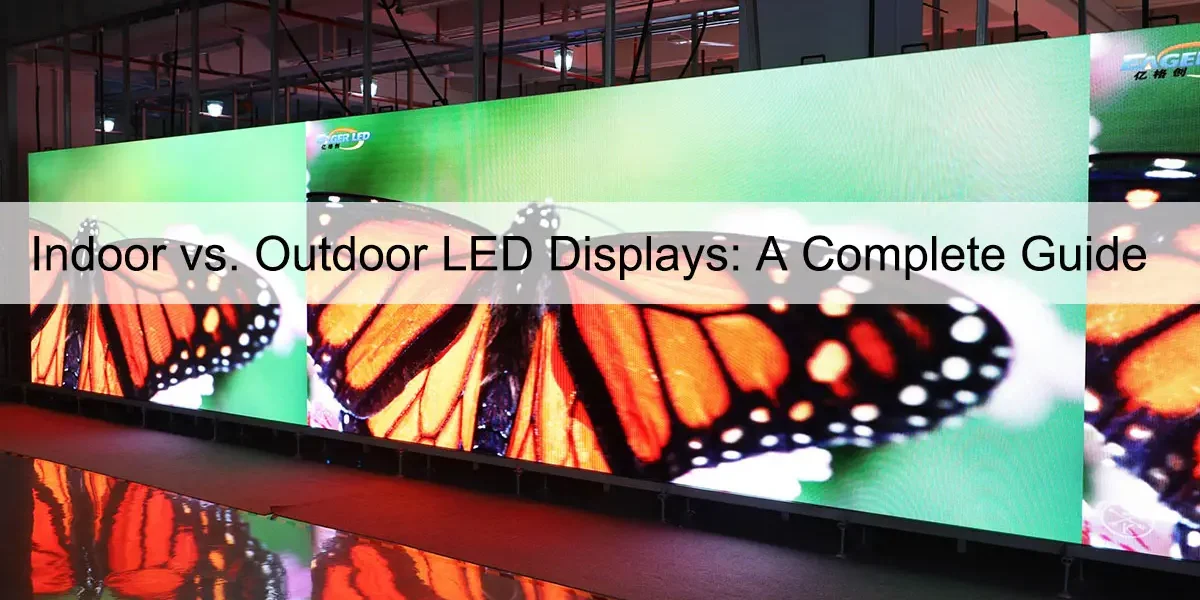
Indoor LED displays are built for controlled spaces and close viewing, so they usually use finer pixel pitches and lower brightness. Outdoor LED displays must remain readable in daylight and withstand rain, dust, humidity, and temperature changes, so they need higher brightness, an appropriate IP-rated enclosure, and stronger structural and thermal design. An outdoor screen is not simply a brighter indoor screen.
This comparison explains the practical differences that affect image quality, reliability, installation, maintenance, and price. The specification figures below are planning references and current EagerLED model examples, not universal limits for every LED screen.
Key takeaways
- Choose pixel pitch from the closest real viewing distance, not from the indoor or outdoor label alone.
- Choose brightness from ambient light and screen orientation; direct sun requires much more output than a controlled room.
- Check the exact front and rear IP ratings. “Waterproof” without a tested rating is not a usable specification.
- Compare total installed cost, including structure, power distribution, cooling, access, labor, and spare parts.
On this page: quick comparison | key differences | applications | price factors | how to choose | FAQ
Indoor vs Outdoor LED Screen: Quick Comparison
| Factor | Indoor LED display | Outdoor LED display |
|---|---|---|
| Environment | Controlled rooms with limited rain, dust, and temperature exposure | Sun, rain, dust, humidity, wind, and wider temperature changes |
| Brightness | Lower output for comfortable close viewing; EA1920iP5 example: 600-800 cd/m2 | Higher output for daylight visibility; EA1000F2 example: 5,000 or 6,500 cd/m2 |
| Pixel pitch | Often finer for nearby viewers; EA1920iP5 example: P1.25-P2.5 | Often wider for longer viewing distances; EA1000F2 example: P2.97-P10.42 |
| Protection | Usually a lower enclosure rating; EA1920iP5 example: IP31 | Weather-resistant enclosure selected for the site; EA1000F2 example: IP65 |
| Cabinet and structure | Slimmer and lighter options are common | Sealing, drainage, corrosion resistance, wind loading, and stronger support matter |
| Thermal design | Room HVAC and lower brightness usually reduce the thermal load | Solar heat, high brightness, sealed cabinets, and outdoor temperature must be calculated |
| Maintenance | Front service is common where wall depth is limited | Front or rear access must work with weather seals, safe access, and drainage |
| Typical total cost | Usually lower at comparable size and resolution | Usually higher because protection, brightness, structure, installation, and power requirements increase |
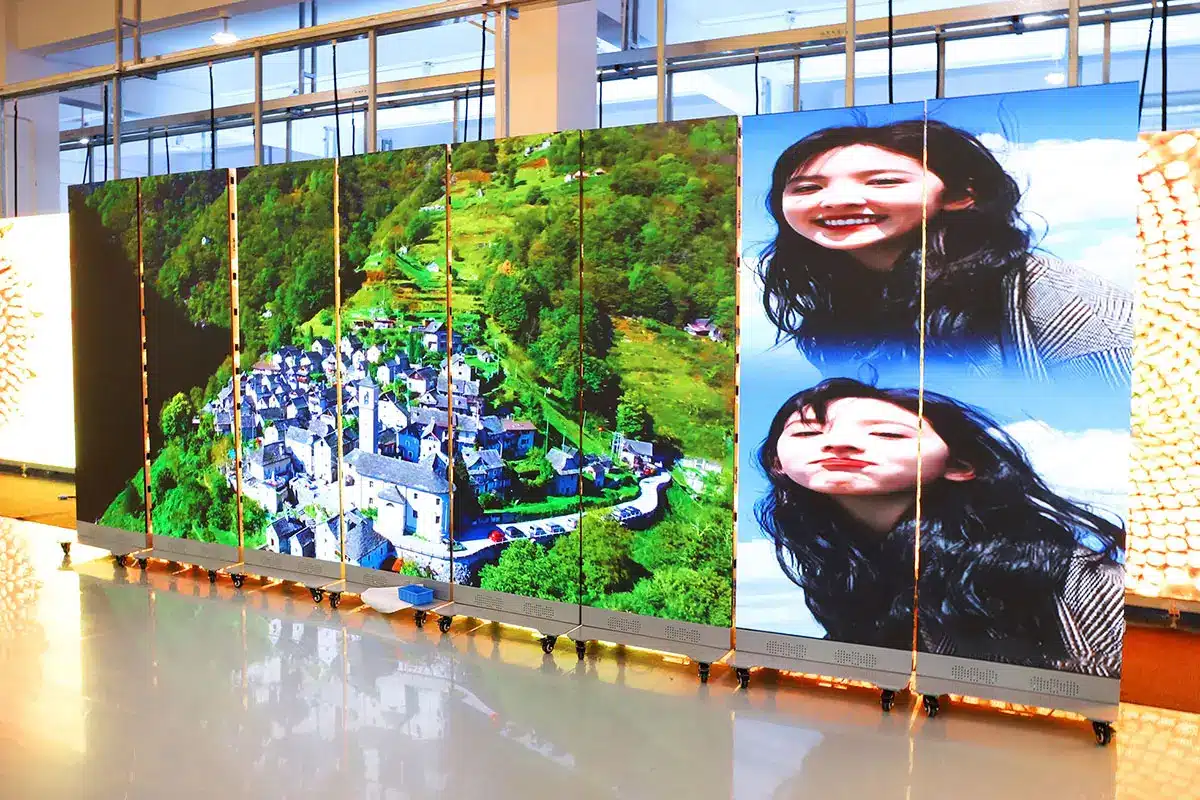
Model example: EagerLED’s EA1920iP5 indoor poster screen lists P1.25-P2.5, 600-800 cd/m2, IP31, and a refresh rate of at least 3,840 Hz. The EA1000F2 outdoor advertising screen lists P2.97-P10.42, 5,000 or 6,500 cd/m2, IP65, and a refresh rate of at least 3,840 Hz. These values show how designs diverge; always confirm the selected configuration’s data sheet.
Eight Key Differences Between Indoor and Outdoor LED Displays
1. Brightness and ambient light
Brightness is measured in candelas per square meter (cd/m2), also called nits. Indoor screens operate in controlled light, so excessive brightness can be uncomfortable at close range and can reduce perceived black levels. Outdoor screens need enough output to compete with daylight, especially when the display faces direct sun.
Do not specify brightness from the installation label alone. Record whether the screen faces east, west, or full midday sun; whether it sits under a canopy; and whether it will operate mainly in daytime or at night. Automatic brightness control can reduce power use and avoid an outdoor display appearing harsh after dark.
2. IP rating and weather protection
The International Electrotechnical Commission (IEC) says ingress protection ratings “grade the resistance of an enclosure against the intrusion of dust or liquids.” Under IEC 60529, the first numeral describes protection against solid objects and the second describes protection against liquids.
An IP rating applies to the tested enclosure and conditions, not to a vague promise that a complete installation is “waterproof.” Ask for the rating of the front and rear surfaces, the test basis, cable-entry treatment, module and door seals, drainage path, and the condition required to maintain the rating after service. Covered outdoor locations can still experience wind-driven rain, condensation, salt air, and humidity.
3. Pixel pitch, resolution, and viewing distance
Pixel pitch is the center-to-center distance between adjacent LED pixels, measured in millimeters. A smaller pitch places more pixels in the same area and supports closer viewing, but it also increases LED count and usually increases cost. Indoor installations often use finer pitches because audiences stand closer. Outdoor billboards and venue screens can often use a wider pitch because viewers are farther away.
Daktronics notes that “each display will have a minimum and a maximum viewing distance that may vary based on application and intended use” in its LED Learning Center. Measure the closest, typical, and farthest viewer positions, then confirm the pitch with sample content. For a practical starting chart, see EagerLED’s LED display pixel pitch guide.
4. Cabinet, sealing, and structural design
Indoor cabinets can prioritize a slim profile, low weight, quiet operation, and clean wall integration. Outdoor cabinets need sealing, drainage, corrosion-resistant materials, protected connectors, and a structure engineered for the site. A wall-mounted outdoor billboard, a rooftop screen, and a touring outdoor stage screen do not have the same wind, access, or safety requirements.
The cabinet also determines service access and installation depth. Review the differences between die-cast aluminum, sheet-metal, front-service, and rear-service designs in this LED display cabinet guide.
5. Heat dissipation and operating temperature
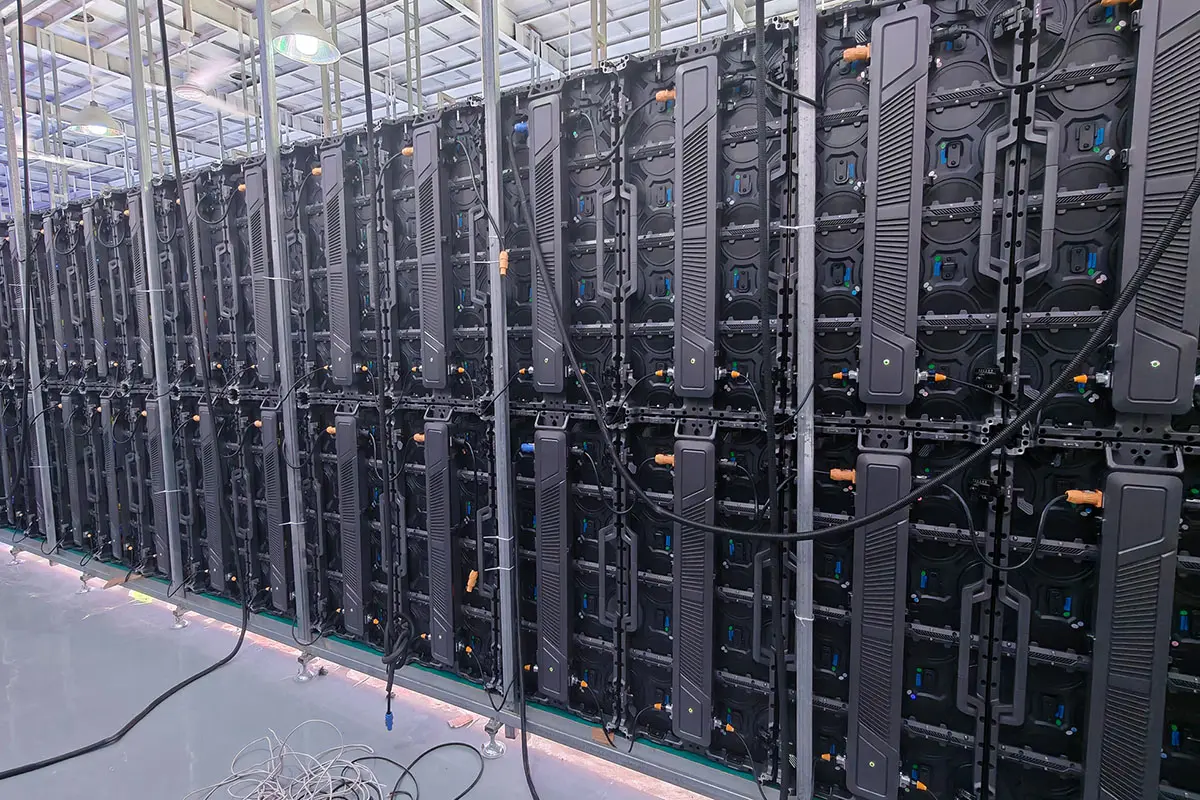
Outdoor electronics face solar heating and wider temperature swings while also operating at higher brightness. The thermal design must account for cabinet color, airflow, direct sun, local maximum temperature, dust filters, and whether the enclosure is naturally ventilated or actively cooled. Heat dissipation should be assessed for the complete cabinet and installation, not only the LED module.
Indoor screens still need ventilation. A fine-pitch wall installed tightly against a surface can trap heat, while a studio or meeting room may have strict noise limits that affect fan selection.
6. Power consumption and electrical design
Outdoor screens generally need more power because they operate at higher brightness and may require fans, air conditioning, or other environmental controls. Compare both maximum and average power per square meter. The maximum figure is important for cable, breaker, and distribution design; the average figure is more useful for estimating operating cost.
Final electrical design must follow the selected model, total screen area, local voltage, grounding, surge protection, and applicable local codes. Do not multiply a generic watts-per-square-meter figure by area and treat it as a finished electrical plan.
7. Maintenance and service access
Indoor screens are often installed against finished walls, so magnetic front-service modules and front-access power or receiving cards can save space. Outdoor screens may use front or rear service, but technicians also need safe physical access, weather-seal inspection, drainage checks, and a plan for replacing modules without compromising protection.
Before ordering, confirm the removal path for every service part, the required clearance, spare-module quantity, calibration procedure, and whether a lift or rear catwalk will be needed.
8. Content, camera use, and visual performance
Indoor screens often show detailed text, dashboards, products, or camera content at close range. This increases the importance of fine pitch, low-brightness grayscale, color accuracy, contrast, and a high refresh rate. Outdoor screens are commonly optimized for large text, bold images, traffic speed, longer viewing distance, and daylight contrast.
If the screen will appear on camera, specify camera type, frame rate, shutter settings, and intended recording format. Refresh rate alone does not guarantee a flicker-free result; the controller, scan mode, grayscale performance, and camera settings must work together.
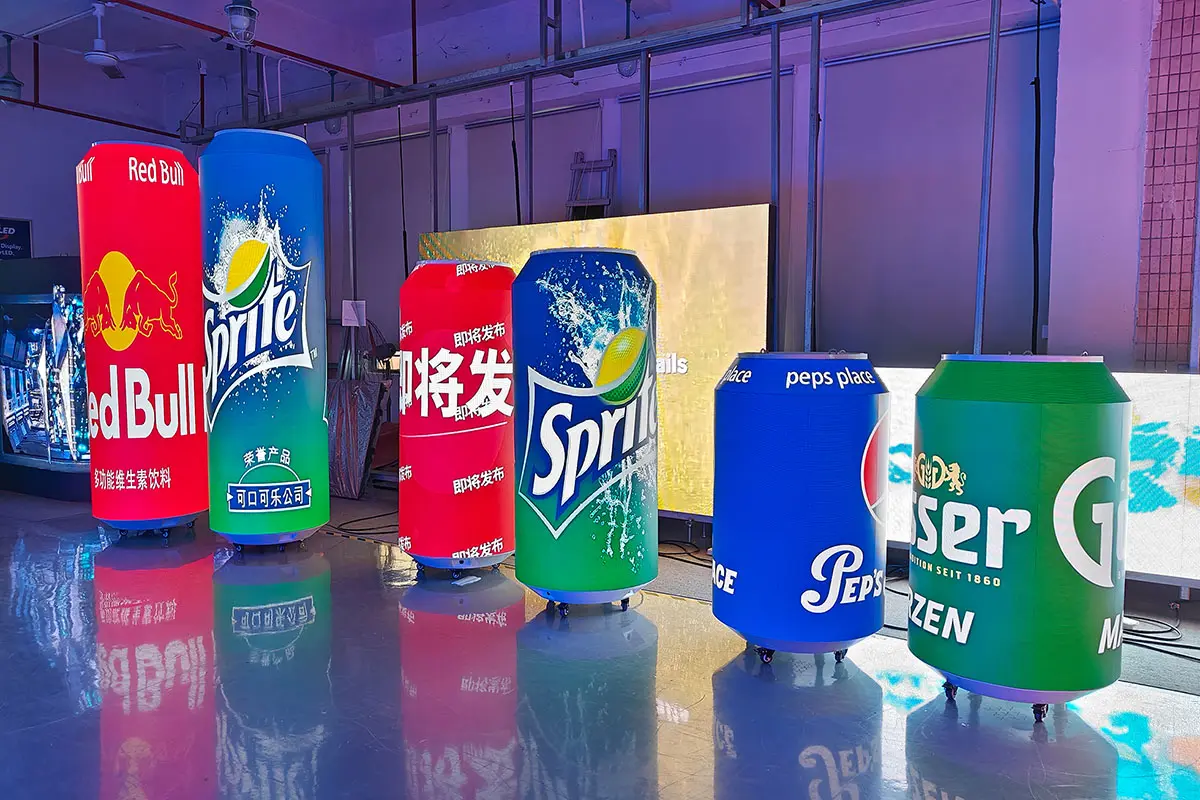
Where Indoor and Outdoor LED Displays Work Best
Use an indoor LED display where viewers are close and lighting is controlled; use an outdoor LED display where daylight visibility and environmental protection are essential. Semi-outdoor locations such as entrances, open concourses, and covered stages need a site-specific assessment because a roof does not eliminate humidity, wind-driven rain, dust, or temperature changes.
Typical indoor applications
- Retail stores and shopping malls: fine-pitch product video, promotions, wayfinding, and digital menus viewed at short range.
- Corporate rooms and control centers: detailed dashboards, presentations, and multi-window information where text clarity matters.
- Broadcast studios and event venues: camera-facing content that needs high refresh rate, stable grayscale, and controlled brightness.
- Airports, stations, exhibitions, and museums: schedules, guidance, brand media, and interactive visual experiences.
Explore purpose-built indoor LED screen options after confirming viewing distance, room light, wall depth, noise limits, and service access.
Typical outdoor applications
- Roadside billboards and building facades: high-impact advertising designed for daylight and longer viewing distances.
- Stadiums and public venues: live video, scores, announcements, and sponsor content across large audience areas.
- Public squares and transport hubs: information, emergency messages, advertising, and event content exposed to changing weather.
- Outdoor rental events: modular screens that combine weather protection with fast assembly, rigging, and transport requirements.
For more specialized designs, compare EagerLED’s stadium LED screen solutions and rental LED displays.
Outdoor rental example: This EagerLED project video documents 240 EA500C3 outdoor rental LED display cabinets supplied for a customer project in Congo. It shows a real modular outdoor configuration rather than a generic category illustration.
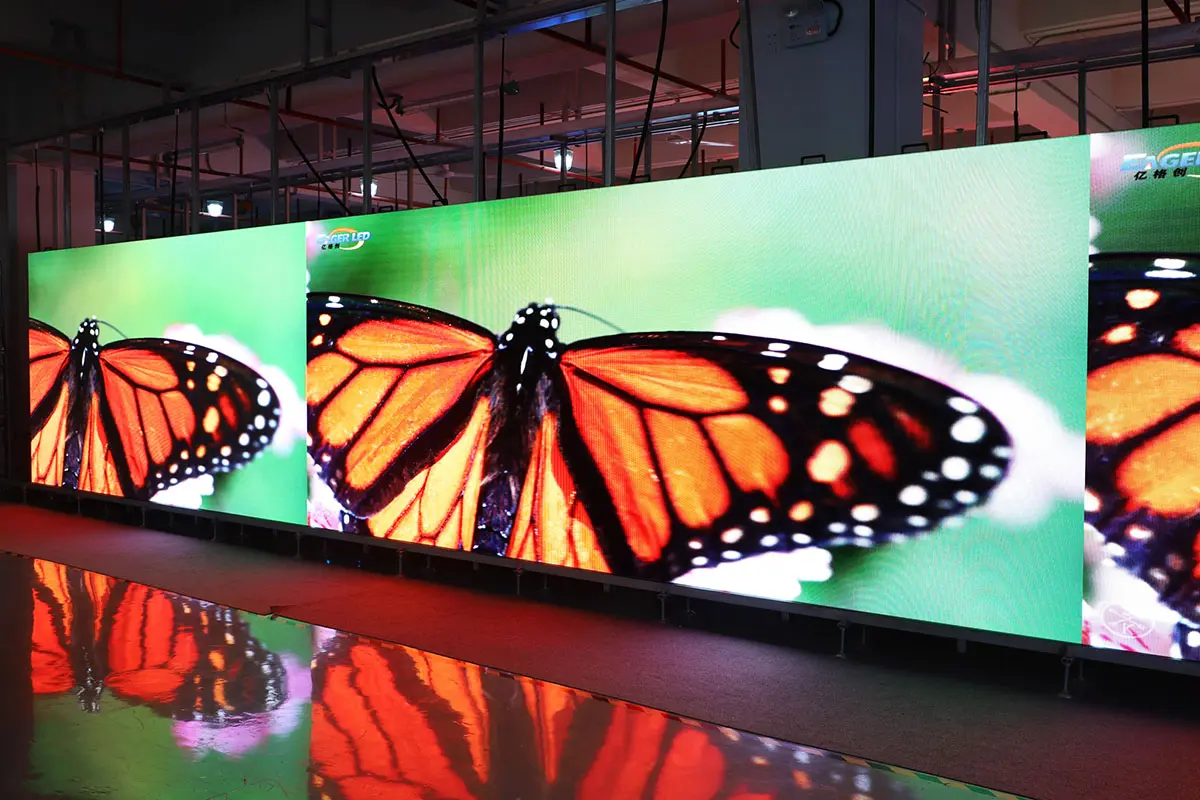
Indoor vs Outdoor LED Screen Price
At the same size and comparable resolution, an outdoor LED screen usually costs more than an indoor screen. The difference comes from higher-output LEDs, weather-rated modules and cabinets, sealing, corrosion protection, stronger supporting steel, more demanding installation, larger electrical capacity, and outdoor service access. There is no reliable universal price multiplier because pixel pitch, screen area, project location, structure, and configuration can outweigh the indoor or outdoor label.
Ask suppliers to separate these line items so quotations are comparable:
- LED cabinets, modules, receiving cards, and controller;
- supporting structure, trim, lifting, and installation labor;
- power distribution, cabling, grounding, and surge protection;
- cooling, ventilation, weatherproofing, and access equipment;
- spare modules, shipping, commissioning, training, and warranty coverage.
A lower hardware quote can produce a higher total project cost if it requires more steel, rear access, custom power work, or frequent maintenance.
How to Choose the Right LED Display
- Classify the real environment. State whether the screen is fully indoor, semi-outdoor, under a canopy, or fully exposed. Include rain, humidity, dust, salt, temperature, and sun direction.
- Measure viewing distances. Record the closest, typical, and farthest viewers before choosing pixel pitch.
- Define content and camera needs. Small text, spreadsheets, broadcast cameras, brand colors, and fast motion require different performance than a roadside advertisement.
- Set brightness from ambient light. Include daytime and nighttime operation and ask how automatic brightness control is implemented.
- Verify the complete IP rating. Check front and rear ratings, cable entries, seals, drainage, and maintenance conditions.
- Plan structure, power, cooling, and access. Confirm wind load, mounting surface, electrical supply, heat rejection, noise limits, and the technician’s service path.
- Compare total installed cost. Use the same screen area, resolution target, controller scope, structure, installation, spares, and warranty assumptions for every bid.
Installation example: The video below shows rapid assembly of a rental LED display back frame. Permanent indoor and outdoor installations still require a site-specific structural, electrical, data, access, and safety plan that follows local requirements.
Specification rule: Use the indoor/outdoor category to narrow the design, then approve the project from the exact model data sheet, site survey, structural design, and electrical plan.
Common Selection Mistakes
- Using an indoor screen in a covered outdoor area. A roof does not eliminate humidity, condensation, wind-driven rain, dust, or temperature changes.
- Choosing the smallest pixel pitch available. Finer pitch may add cost without visible benefit at the actual viewing distance.
- Specifying only peak brightness. Daylight readability, night dimming, contrast, grayscale, and heat all matter.
- Treating IP65 as a complete project specification. The rated surface, cable system, structure, seals, and service procedure must all be clear.
- Comparing cabinet prices instead of installed cost. Structure, power, cooling, labor, access, shipping, and spares can change the result.
Frequently Asked Questions
What is the main difference between indoor and outdoor LED screens?
Indoor LED screens prioritize close-viewing image detail, lower brightness, and slim installation in controlled spaces. Outdoor LED screens prioritize daylight visibility, environmental protection, structural strength, drainage, and thermal management.
Can an indoor LED screen be used outdoors under a roof?
Not unless the exact system is designed and rated for that environment. A canopy may reduce direct rain, but it does not remove humidity, condensation, dust, wind-driven water, temperature changes, or corrosion risk.
Can an outdoor LED screen be used indoors?
It can operate indoors if power, structure, ventilation, and local requirements are satisfied, but it may be unnecessarily bright, heavy, noisy, coarse in pixel pitch, and expensive. A purpose-built indoor model is usually the better fit.
Which is more expensive, an indoor or outdoor LED display?
Outdoor LED displays usually cost more at comparable size and resolution because they need higher brightness, weather protection, stronger structures, and more demanding power, cooling, installation, and maintenance provisions. Exact pricing requires a model-specific and site-specific quotation.
What IP rating should an outdoor LED screen have?
There is no single rating that fits every site. IP65 is common in outdoor LED product specifications, but buyers must verify which surfaces are rated, the test conditions, cable entries, drainage, installation orientation, and how the rating is maintained after service.
How do I choose pixel pitch for an indoor or outdoor LED screen?
Start with the closest viewing distance and the smallest important content, then confirm the result with the actual screen size and sample content. Indoor screens often use finer pitches because viewers are closer; outdoor screens often use wider pitches because viewers are farther away.
Sources and Methodology
This guide was updated on August 31, 2026. The category comparison combines the IEC’s explanation of IP ratings, Daktronics’ public LED learning material, and current EagerLED model specifications. Product figures are examples, not minimum or maximum requirements for every project.
- International Electrotechnical Commission: Ingress Protection (IP) ratings
- Daktronics: LED Learning Center
- EagerLED EA1920iP5 indoor screen specifications
- EagerLED EA1000F2 outdoor screen specifications
Need a model-specific recommendation? Send the installation location, screen dimensions, closest viewing distance, daylight exposure, mounting method, and required service access in the form below.