

Choose a hot-climate roadside LED display by the brightness it can sustain within an approved operating environment, not by maximum nits alone. Give suppliers the site exposure and mounting detail, request configuration-specific thermal evidence, and agree how the screen dims, alarms and recovers. An outdoor or IP65 label does not settle temperature suitability.
This guide is for outdoor project engineers comparing permanent roadside signs in hot locations. It turns the site brief into a supplier response and acceptance record. The EA960F4 below is a verified product reference with stated limits, not a recommendation for every desert, tropical or enclosed installation.
- Required daytime readability and appropriate night output.
- The applicable temperature range and its reference point.
- Solar exposure, mounting and the complete cooling arrangement.
- Monitoring, fault response and a serviceable installation.
On this page
Describe the heat exposure at the actual site
Send the installation coordinates or site address privately with the RFQ, plus orientation, photographs, mounting height and surrounding structures. Record when the front and rear receive direct sun, whether hot surfaces or cladding surround the cabinets, and whether the proposed structure restricts the manufacturer’s cooling arrangement.
Use dated site measurements or a documented engineering design basis for temperature and exposure. Identify the measuring point and method. A weather-station air reading, a sun-heated cabinet surface and an internal component reading are different quantities; do not compare them as though every published temperature limit refers to the same point.
| Site input | Record in the brief | Supplier response to require |
|---|---|---|
| Temperature basis | Location, reference point, date or design-data source | Applicable product limit and stated test conditions |
| Sun and surroundings | Orientation, exposure periods and nearby cladding | Required mounting and heat-removal detail |
| Advertising operation | Daily hours, content and target brightness schedule | Supported sustained operation for that configuration |
| Dust and access | Exposure, inspection route and maintenance constraints | Cooling-care method and practical service plan |
Read brightness and temperature as one model schedule
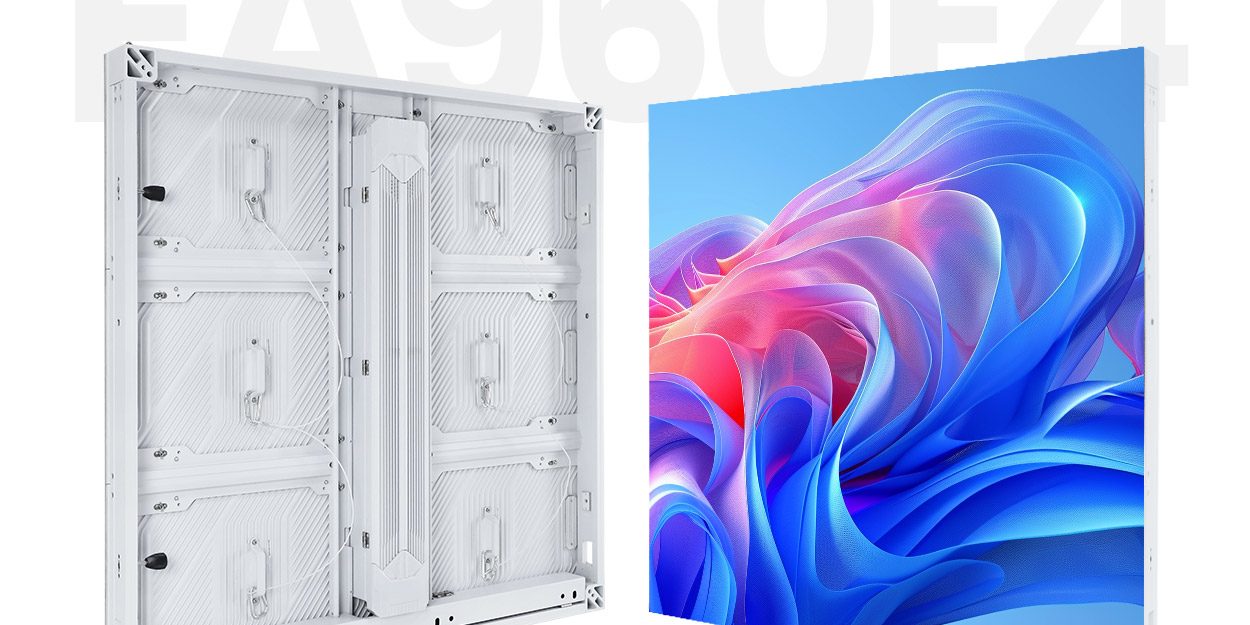
The EA960F4 outdoor advertising display provides a useful specification reference. Its current page lists the following family-level details. Require the selected pitch, cabinet revision and complete offered configuration in the quotation; do not assume every option shares every headline value.
| Published EA960F4 reference | Value or construction | Hot-site purchasing check |
|---|---|---|
| Brightness across listed variants | 6000–6500 cd/m² | Which value applies, and under which temperature and image conditions? |
| Operating range | -20 to +50 °C | What reference point and test conditions define the limit? |
| Standard cabinet | 960 × 960 × 80 mm aluminum | How will the proposed support and cladding preserve its thermal arrangement? |
| Cooling construction | Aluminum module bases, vortex fans and a cabinet-door heat path | What installation conditions, inspection and replacement access are required? |
| Published protection | IP65 | Which tested assembly and installed sealing detail does this cover? |
For a simple exception check, suppose a project explicitly requires operation at 55 °C at the same reference point and conditions used by a proposed 50 °C rating. The requirement exceeds that limit by 5 °C. More brightness or a stronger ingress-protection claim does not close the gap. Request a manufacturer-supported configuration or redesign the applicable conditions with the project team; do not approve the exception silently.
That is an illustrative comparison, not a temperature measurement from an EagerLED installation. Where the reference points differ or are undefined, resolve them before doing the comparison.
Require a thermal acceptance record
Ask the supplier to identify how its supporting evidence represents your installation. A cabinet operated on an open workshop floor is not automatically equivalent to one mounted inside closely spaced decorative cladding. The report should identify the equipment, conditions, settings and measuring points so the engineering team can judge its relevance.

| Acceptance-record field | What to retain | What remains unresolved without it |
|---|---|---|
| Equipment identity | Model, pitch, cabinet and electronics revision | Whether evidence matches the proposed supply |
| Installed arrangement | Cabinet orientation, support, cladding and cooling detail | Whether the test represents the finished sign |
| Operating conditions | Defined temperature points, exposure and test duration | Whether conditions represent the agreed duty |
| Image and output | Content pattern, brightness settings and measured output | Whether headline brightness was sustained in the stated condition |
| Electrical operation | Recorded supply conditions and defined power measurement | Whether design load and operating consumption are being confused |
| Behaviour and recovery | Observed limits, alarms and supported recovery sequence | What the operator should do outside normal operation |
Agree the test duration, permitted readings and pass conditions with the manufacturer and responsible engineer before testing. Do not present an arbitrary soak duration as a universal standard. Mark missing evidence as pending, and distinguish an approved exception from a requirement that the proposed system actually meets.
Commission the intended brightness behaviour
Verify the actual advertising content from safe, approved viewing positions. Choose text and graphics for the native canvas and viewing task. Do not conduct readability checks while driving or stand in an uncontrolled roadside work area. The responsible project team should address local sign, electrical and structural requirements separately.
Demonstrate the agreed day and night settings. Where an ambient-light sensor is included, verify its location, compatibility and fallback behaviour. Where temperature monitoring, alarms or automatic output reduction are offered, record the exact equipment and logic. These are purchasing questions, not features to assume from a cabinet photograph.
Retain the operating settings, representative content, measurements and timestamps. If brightness is reduced for thermal protection, record the resulting image and the supported return to normal operation. Do not defeat a protection function to keep a campaign running. Obtain the manufacturer’s approved fault and restart procedure.
Keep cooling and service access usable
Show how technicians can inspect and replace the cooling components and power equipment in the final structure. A front-removable module does not establish access to every fan, door, cable and power connection. The service route must work with cladding, platforms and neighbouring cabinets in place.
Set inspection and cleaning intervals from the supplied instructions and actual site conditions. Retain access to any specified filters, fans and heat-transfer surfaces. Record conditions after unusual dust or weather exposure and have qualified personnel assess faults before restarting. Do not create a universal monthly cleaning promise for every climate.
The outdoor LED screen guide covers broader brightness, enclosure and budgeting choices. Use the thermal record here to resolve the particular site exposure, sustained output and operating response before placing the order.
Hot-climate roadside LED display FAQ
Is maximum brightness enough to choose a roadside LED display for a hot climate?
No. Confirm readable content at the real sightlines and the conditions under which the offered system can sustain its operating brightness. Assess temperature limits, mounting, solar exposure, cooling and night dimming together.
Does an IP65 cabinet prove high-temperature suitability?
No. Enclosure ingress protection does not establish the permitted temperature, solar load or continuous brightness. Obtain the exact model’s operating limits and project-specific thermal evidence separately.
Can the EA960F4 be specified for every hot roadside site?
No. Its current product page lists a -20 to +50 degrees Celsius operating range and configuration-dependent brightness of 6000 to 6500 cd/m². Confirm the meaning and conditions of those limits and the actual site. If the required operating conditions exceed the approved configuration, request a supported alternative.
What should happen if the screen gets too hot?
Specify the response with the manufacturer and operator before purchase. Confirm available monitoring, alarm points, any supported brightness reduction or shutdown, and the approved recovery procedure. Do not assume these functions are included or override protection to maintain an advertising schedule.
Request a site-specific outdoor display proposal
Send the installation city, active dimensions, viewing distances, orientation, site temperature basis, mounting and cladding drawings, daily operating hours and sample content. Request the exact model schedule, installation conditions, thermal evidence, day/night control scope and service plan. Flag any requirement beyond published limits for a written response.
Prepared by EagerLED for outdoor project engineers. Product references reviewed on 15 October 2026. The temperature comparison is hypothetical; no completed hot-climate test, project performance or universal approval is claimed. Confirm the exact supplied configuration and project-specific operating limits.