LED display manufacturers and suppliers to compare in Russia include XLED, GTLight, OPZ MEI, Svetodiody Rossii, LEDsi, LED Ekrany, MEDIA-LED, P10.RU, Future Vision, and Alternative Sphere. Their roles differ: some manufacture screens, while others supply components or integrate complete installations. Compare production scope, pixel pitch, local service, Russian-language operation, and total installed cost before shortlisting.
Publisher: EagerLED · Content updated:
EagerLED is a China-based LED display manufacturer and exporter publishing this guide for buyers, integrators, and project managers. We also sell display equipment, so this commercial relationship is disclosed. The profiles summarise published company information; this is an editorial shortlist, not a sales ranking or an independent factory audit.
1. LED Display Manufacturers in Russia: Comparison Table
Use this table to narrow the enquiry list before requesting prices. The suggested enquiry focus is an editorial assessment of published product and service information, not a guarantee of current stock or performance. LED display manufacturers in Russia should confirm their production scope separately from their sales-office location.
| Company | Published role or location | Enquiry focus | Key verification |
|---|---|---|---|
| XLED | Dealer and integrator; Moscow contact | Advertising screens and media facades | Original factory and component list |
| GTLight | Manufacturer; Novokuznetsk production | Indoor, outdoor, road and sports displays | Exact model, factory scope and warranty |
| OPZ MEI | Moscow manufacturer and engineering provider | Institutional, stage and information displays | Product documentation and software scope |
| Svetodiody Rossii | Display production and installation provider | Transport, road information and video screens | Data interfaces and site service coverage |
| LEDsi | Russian screen manufacturer | Manufactured screens and networked deployments | Current product identity and control platform |
| LED Ekrany | Screen and advertising-equipment provider | Commercial indoor and outdoor installations | Equipment origin and turnkey exclusions |
| MEDIA-LED | Manufacturer and installer; Rostov-on-Don base | Retail, stage and southern outdoor projects | Environmental design and service logistics |
| P10.RU | Screen and component supplier | Modules, controllers and assembly hardware | Electrical and configuration compatibility |
| Future Vision | Manufacturer; Yekaterinburg production sites | Media facades and custom installations | Structural drawings and model-specific limits |
| Alternative Sphere / altsfer | Engineering and turnkey display provider | Displays, media facades and steelwork | Contracting entity and responsibility boundaries |
A manufacturer may still buy LED packages, driver ICs, power supplies, or control hardware from other businesses. Local assembly and local component production are different capabilities. Equally, a competent integrator may provide stronger installation support than a distant factory. Compare local screen suppliers by evidence relevant to your site.
2. Ten Russian LED Display Manufacturers and Suppliers
01. XLED: LED Display Supplier and Project Integrator
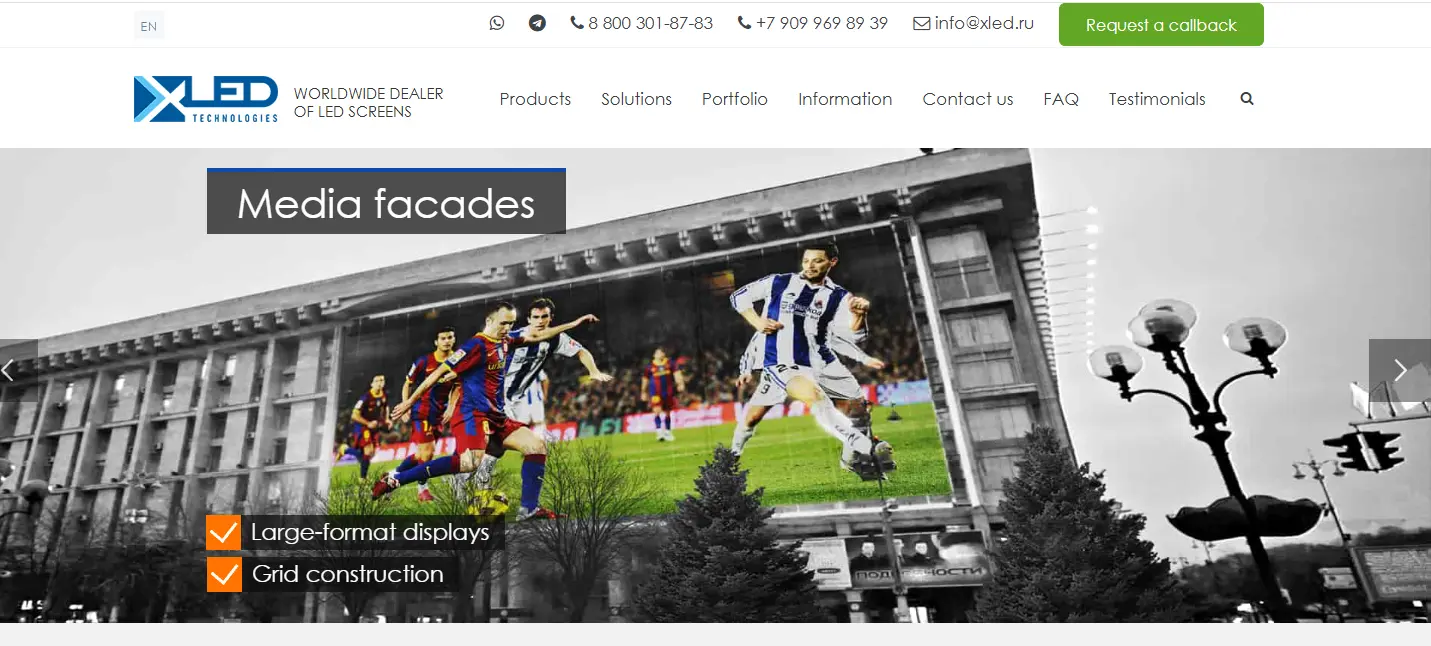
XLED describes a workflow that sources proposals from several manufacturers and then handles delivery, installation, commissioning, and staff training. Its public catalogue includes indoor and outdoor screens, media facades, transparent displays, sports systems, and creative formats. That makes the dealer/integrator description more precise than assuming it manufactures every screen itself.
For buyers comparing LED display manufacturers in Russia, XLED illustrates why the original equipment manufacturer matters. Request the factory name, module model, receiving-card configuration, and responsibility for replacement parts. Its published Moscow Metro media-facade example provides a project reference, but a large past installation does not establish suitability for your specific pitch, brightness, or climate requirement.
02. GTLight: Russian LED Display Manufacturing
GTLight identifies Novokuznetsk in the Kemerovo region as its main Russian production location. Its published range covers indoor and outdoor screens, media facades, road displays, sports displays, and related hardware. Buyers should distinguish this production location from the company’s Moscow sales presence.
Among Russian display companies, GTLight is a relevant enquiry candidate when the project combines display hardware with structural or application-specific engineering. Ask which operations are performed in-house and obtain the proposed cabinet drawings. Its website gives different warranty periods for different equipment, so the contract must specify the actual term, covered components, labour, and transport responsibilities. Avoid converting a headline warranty into a promise for every product.
03. OPZ MEI: Manufacturing and Engineering Support
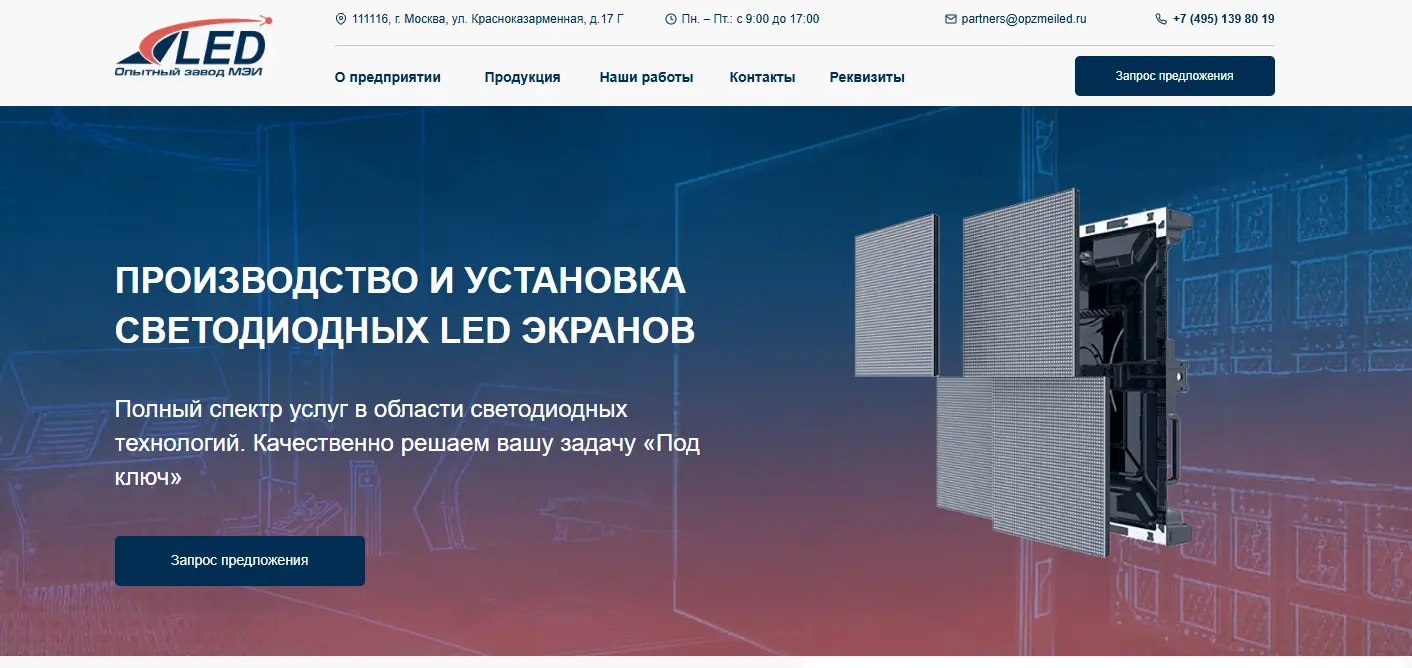
OPZ MEI presents itself as a Russian LED-screen producer operating on the basis of the Moscow Power Engineering Institute. Its published information describes development, production, installation, and support, together with its own software. The catalogue includes indoor screens, outdoor screens, signage, information boards, and stage applications.
Buyers considering screen suppliers for institutional projects should request documentation tied to the exact offered model and contracting entity. If local-origin or software-register evidence is relevant to your purchasing process, obtain the current record and have the procurement team verify it. A company’s general statement about registration should not be treated as proof that every configuration qualifies.
04. Svetodiody Rossii: Screens and Transport Information
Svetodiody Rossii publishes display-production, design, and installation services alongside solutions for airports, transport, road information, sports, and general video-screen applications. Its service contacts are organised by region and function, which gives buyers a useful starting point for discussing local support.
Russian display companies serving transport projects must address the information workflow as well as the screen. Ask how live data reaches the display, what happens if the network fails, and how operators receive fault notifications. For road or public-information use, document character readability, brightness control, recovery after a power interruption, and maintenance access. These are enquiry requirements, not claims that every model includes the same functions.
05. LEDsi: Screen Production and System Evaluation
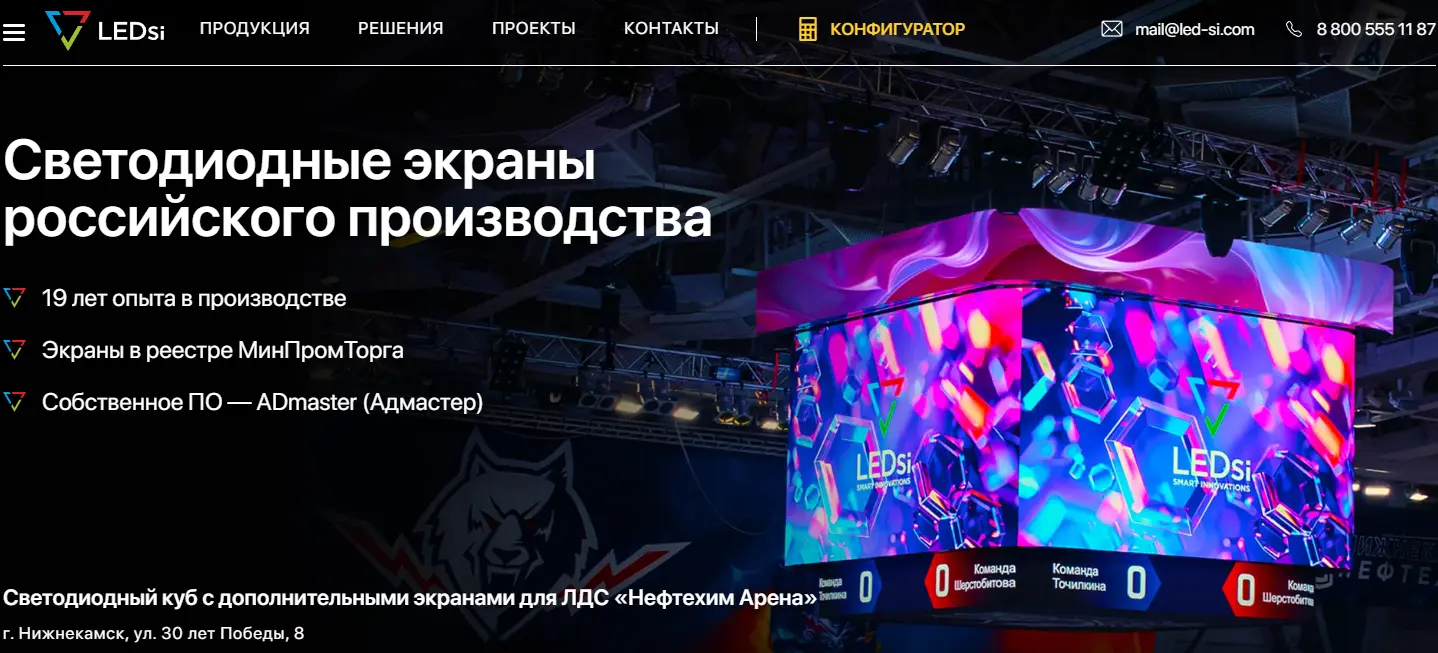
LEDsi publishes information about Russian LED-screen production under the LEDsi Smart Innovations name. Current production material is available under its newer web presence, while older references may still use the led-russia name. Confirm the current legal seller, technical documentation, and model catalogue when requesting an offer.
When comparing screen suppliers for a network of screens, evaluate the complete operating system. Request a demonstration of scheduling, user permissions, monitoring, and recovery after connection loss. Clarify which functions are included, which require subscriptions, and who owns the configuration files. A good hardware proposal can still become expensive if software licences, remote access, and future migration are unclear.
06. LED Ekrany: Commercial Display Procurement
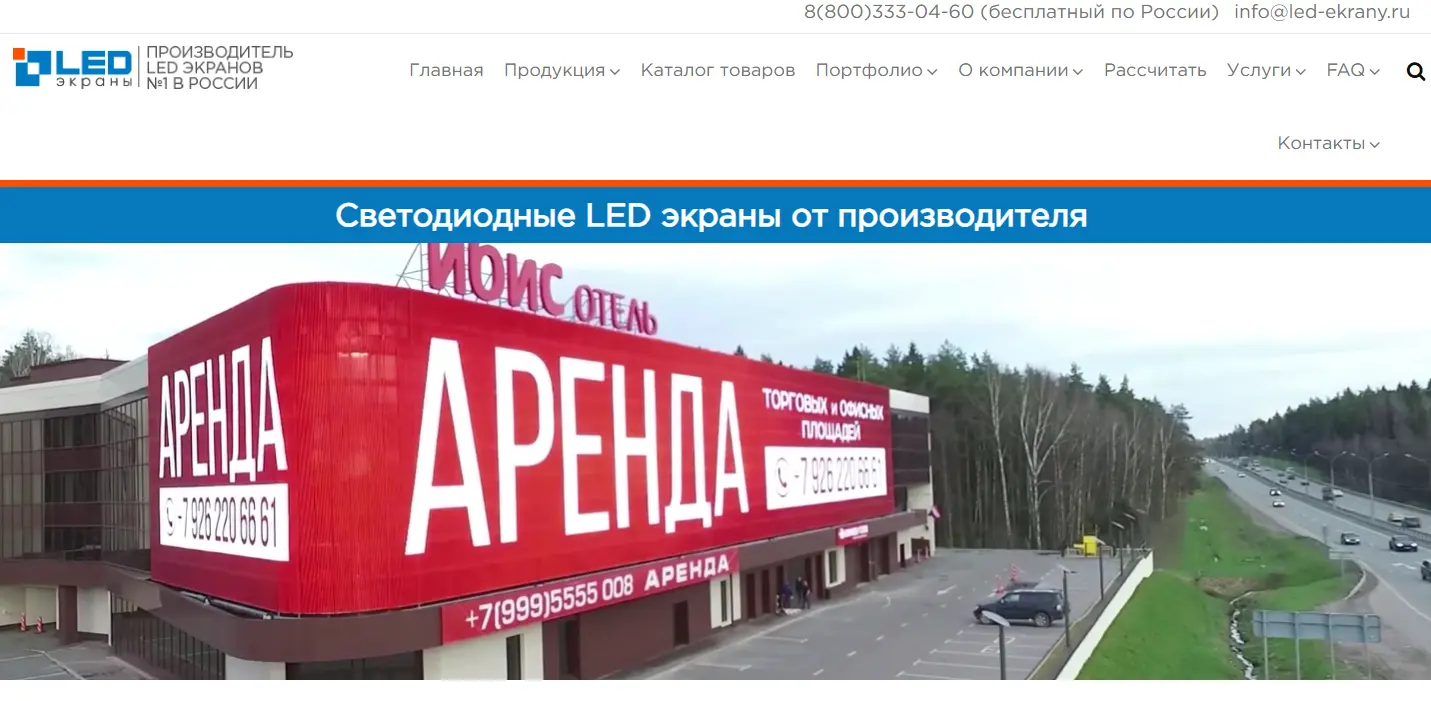
LED Ekrany markets LED screens and advertising equipment, including indoor display applications. Treat it as a commercial screen and project-supply candidate while asking the business to establish the manufacturing and installation scope of the actual proposal. Catalogue breadth alone does not prove that all components are made in-house.
For local screen suppliers, the useful comparison is a matched bill of materials. Ask for the same active display size, pixel resolution, service direction, brightness, controller, and spare-parts package from every bidder. Separate delivery of cabinets from a fully commissioned installation. This prevents an apparently cheaper quotation from excluding the structure, cabling, lifting equipment, operator training, or final calibration.
07. MEDIA-LED: Production and Installation in Rostov-on-Don
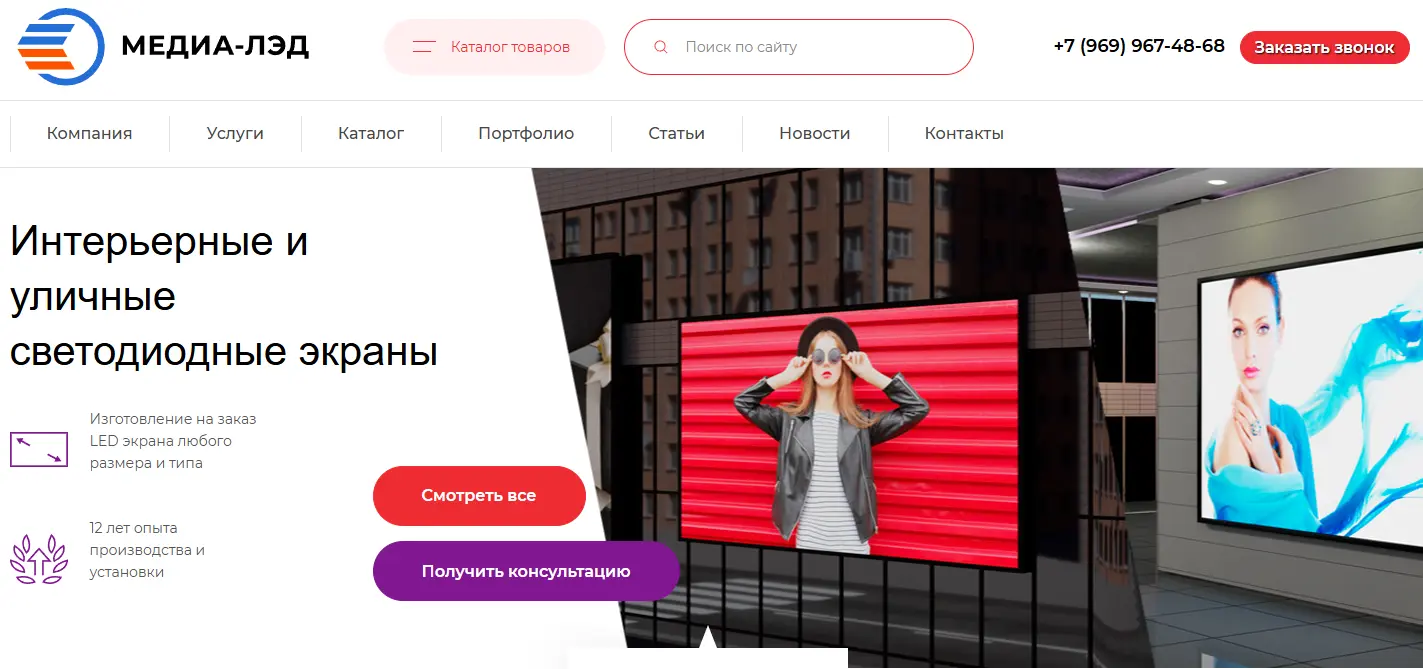
MEDIA-LED states that its production base and service centre are in Rostov-on-Don. Its published range includes outdoor, indoor, stage, rental, transparent, and modular screens. The company also describes installations in southern regions with heat, humidity, wind, and coastal exposure.
This location corrects older descriptions that associated the company primarily with Saint Petersburg. When evaluating Russian display companies for a southern or coastal site, request evidence for corrosion protection, enclosure sealing, drainage, and thermal design. Ask whether service engineers and replacement modules are available within the required response time. Environmental experience is a useful discussion point, but model-specific ratings and installation details must still be documented.
08. P10.RU: Components and LED Screen Assembly Supply
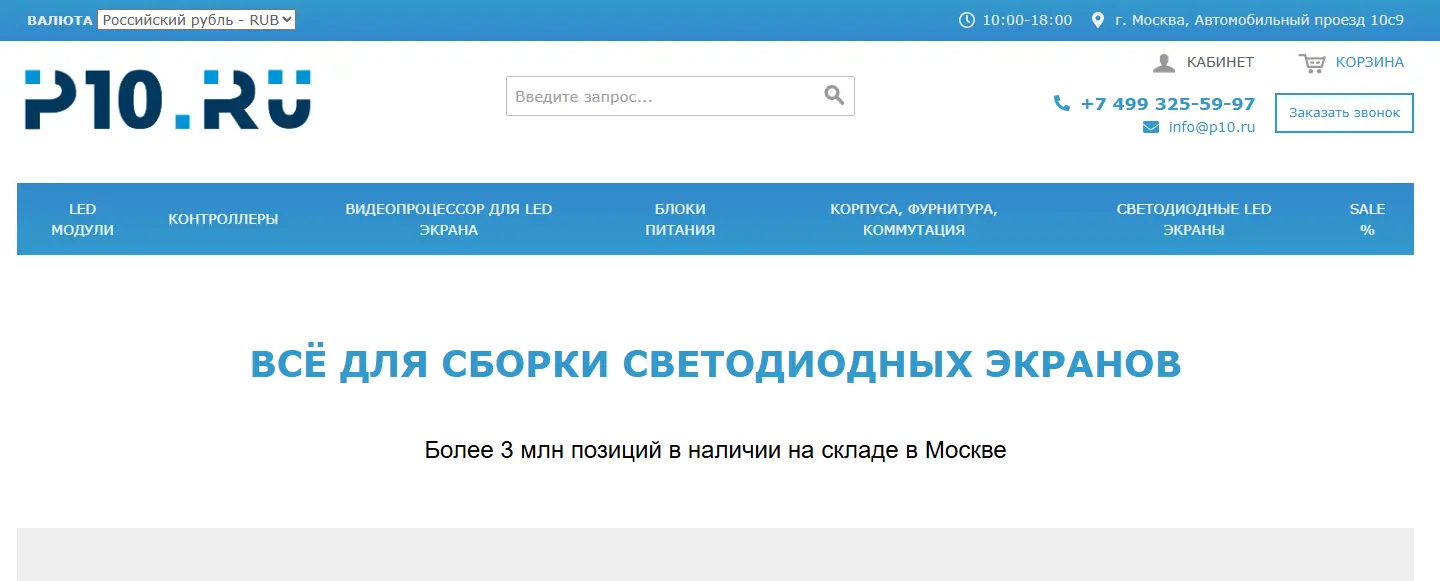
P10.RU’s catalogue is centred on screen assembly and related equipment. It lists control systems, video processors, power supplies, cabinets, fittings, connections, and complete screen categories. This makes it relevant to integrators, repair teams, and buyers sourcing replacement components.
local screen suppliers selling parts should confirm compatibility in writing. A replacement module must match more than pixel pitch: dimensions, connector layout, voltage, scan configuration, driver IC, and colour characteristics can all matter. Supply photographs and the original configuration files where available. For a complete screen purchase, establish who performs assembly, testing, commissioning, and warranty diagnosis rather than assuming those services accompany component prices.
09. Future Vision: Media Facades and Custom Screens
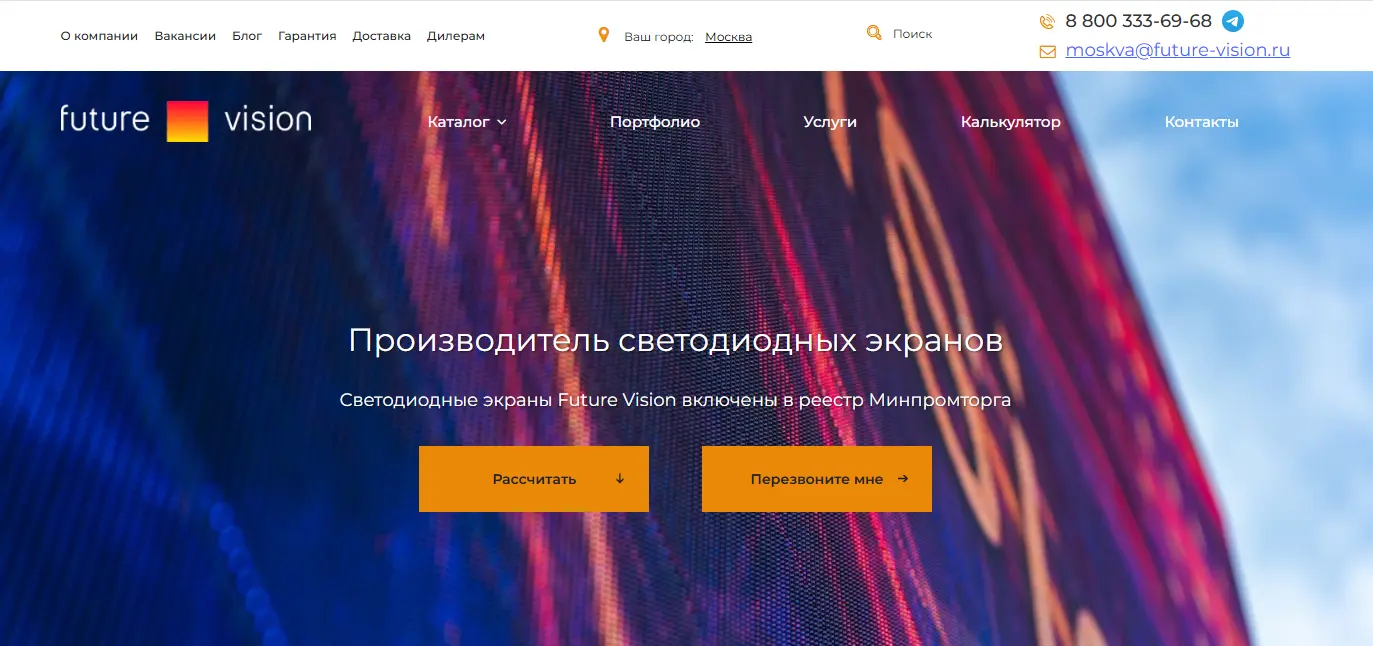
Future Vision describes itself as a manufacturer and supplier of LED screens and media facades, with two production sites in Yekaterinburg. Its public material covers project design, fabrication, delivery, installation, and service. Media facades are a particularly relevant area for an enquiry.
For screen suppliers proposing a facade, compare the complete architectural solution: transparency, daylight access, mounting, wind loading, cable routing, and safe repair access. Published temperature or brightness figures must be checked against the exact model in the quotation. Ask for a sample or reference installation with comparable viewing distance. A mesh facade that works for large graphics may not reproduce small text as clearly as a solid display.
10. Alternative Sphere: Engineering, Screens, and Structures
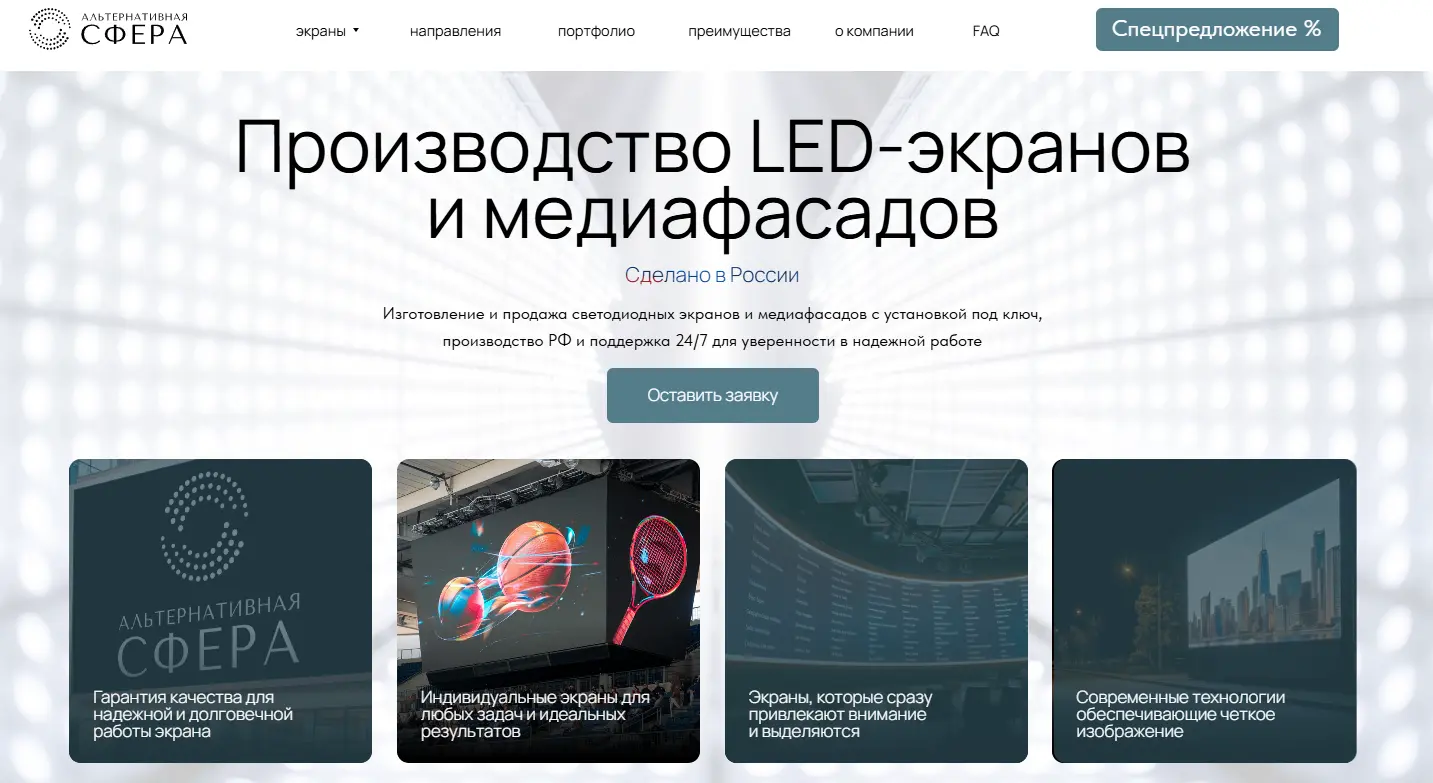
The altsfer website previously associated with the ZUZIN entry now identifies the business as Alternative Sphere and names an LLC as its legal entity. It describes turnkey LED screens, media facades, metal structures, engineering, commissioning, and service. The current identity should be used when discussing new contracts.
Buyers comparing local screen suppliers should ask which party signs off the structure, electrical installation, and screen commissioning. Obtain one responsibility matrix covering design assumptions, site preparation, mounting tolerances, access equipment, and ongoing maintenance. An integrated engineering proposal can simplify coordination, but the written scope must make clear which tasks belong to the supplier, building owner, and other contractors.
3. How to Choose LED Screen Suppliers in Russia
01. Match the supplier to the application
Shortlist screen suppliers against a written project brief. Include active screen width and height, closest and typical viewing distances, content examples, operating hours, installation photographs, and the target handover date. For an indoor wall, prioritise readable text, low-brightness image quality, fan noise, and front service access. For outdoor advertising, prioritise daylight visibility, weather protection, structural design, and remote monitoring.
local screen suppliers should explain why their proposed pixel pitch fits the viewing conditions. Use EagerLED’s indoor LED screen options and indoor versus outdoor display guide to prepare a consistent brief. Product categories help organise the enquiry; a site-specific design remains essential.
02. Verify Russian-language operation and support
A Russian-language LED display supplier should demonstrate more than translated marketing. Ask to see the actual operator interface, Cyrillic text rendering, font support, training material, and fault messages. Confirm the language and time zone of technical support. For scheduled advertising, test local time settings, offline playback, and restart behaviour. Russian display companies should identify who can restore the system if the original operator leaves.
03. Check production and service evidence
Request a factory or workshop demonstration, a sample bill of materials, and references for comparable installations. screen suppliers should separate their own manufacturing processes from bought-in components. local screen suppliers should identify their upstream factory and replacement-parts route. Check the service address and ask how a failed module reaches a technician. A named repair process is more useful than an unsupported promise of nationwide service.
04. Send one specification to every shortlisted supplier
For a Russian-language LED display wholesale enquiry, use the same request for quotation (RFQ) so differences in price reflect the equipment and service offered:
- Site and use: installation city, indoor/outdoor location, screen dimensions, viewing distances, content examples, and operating hours.
- Hardware: module and cabinet models, pixel pitch, final resolution, calibrated brightness, processor, receiving cards, and power supplies.
- Outdoor conditions: front/rear ingress ratings, operating and cold-start temperatures, dimming, drainage, and maintenance access.
- Russian-language operation: Cyrillic content test, interface demonstration, training, manuals, and named support contacts.
- Commercial scope: quantity, spare parts, logistics, installation, acceptance criteria, warranty, and service response arrangements.
Request an EagerLED configuration and quotation using this brief. Confirm delivery availability, installation responsibilities, and language support for your project directly with the sales team.
4. Technical Specifications for Russian LED Display Projects
Use the following checklist when comparing Russian display companies. These are specification questions, not universal minimums: the correct values depend on the site, content, camera use, and electrical design.
| Parameter | What to request | Why it matters |
|---|---|---|
| Pixel pitch and resolution | Pitch in mm; active dimensions; pixel matrix | Determines detail and controller load |
| Brightness | Calibrated cd/m², dimming range and sensor | Balances daylight visibility and night operation |
| Ingress protection | Front and rear ratings; test evidence; installed enclosure scope | Module protection may differ from the whole cabinet |
| Temperature | Operating, storage and cold-start limits | Winter restart can differ from continuous operation |
| Refresh and camera behaviour | Refresh, scan ratio and camera demonstration | A high headline number alone does not prevent banding |
| Electrical demand | Maximum and typical W/m² with test conditions | Supports circuit sizing and running-cost estimates |
| Maintenance | Front/rear access, clearance and module replacement procedure | Determines downtime and access cost |
| Control system | Exact processor, cards, firmware and backup files | Reduces compatibility and recovery problems |
| Mechanical design | Weight, fixing points, drawings and engineering responsibility | Connects screen selection to a buildable installation |
01. Calculate pixels before choosing a controller
Pixel pitch is the distance between neighbouring pixel centres. For a proposed active width of 6,000 mm at 3 mm pitch, horizontal resolution is 6,000 ÷ 3 = 2,000 pixels. At 3,000 mm height, the display is 2,000 × 1,000 pixels, or two million pixels. This is an illustrative calculation; actual cabinet and module dimensions determine the buildable size.
screen suppliers should supply the final pixel map and controller loading plan. Port capacity, frame rate, bit depth, and wiring topology can affect usable capacity. Do not describe a screen as “4K” solely because its processor accepts a 4K input. The LED video wall guide provides additional context for planning a complete system.
02. Specify IP65 and 8,000 nits correctly
If your enquiry requires an IP65 media-facade LED display with 8,000-nit brightness, state both requirements explicitly. One nit equals one candela per square metre. Ask whether brightness is measured after calibration, at what colour temperature, and with what power draw. local screen suppliers should explain how automatic dimming changes operation after dark.
The IEC 60529 enclosure-protection standard defines IP classifications. IP65 addresses dust and water-jet protection under specified tests; it does not establish frost resistance, corrosion resistance, or structural safety. Russian display companies should identify front and rear protection separately and explain how connectors, ventilation, and service doors are protected after installation. A mesh screen also needs a suitable pixel layout and transparency level for its intended content.
03. Evaluate climate, energy, and camera performance
Ask screen suppliers for the operating and cold-start temperature ranges of the complete assembly, including power supplies and controllers. Discuss condensation during temperature changes, drainage, snow exposure, and access for winter maintenance. A single component’s temperature rating does not describe the complete system.
For energy-efficient mesh advertising screens, compare measured consumption at equal brightness and representative content. Include heating, cooling, and standby loads. For stages and recorded events, local screen suppliers should demonstrate the proposed screen with the intended cameras and shutter settings. Refresh rate, scan behaviour, synchronisation, and exposure interact; a specification sheet cannot replace a camera test.
5. Pricing, Wholesale Orders, and Total Ownership Cost
01. Compare installed scope rather than panel price
There is no single meaningful price for all screen suppliers. Pitch, area, cabinet construction, LED package, control hardware, site access, and service scope change the cost. Request separately itemised hardware, structure, electrical work, transport, lifting, commissioning, training, and spare parts. Clarify the quotation currency, tax treatment, validity period, and payment milestones with the seller.
Russian display companies and import-based suppliers can both offer competitive projects, but compare equivalent deliverables. A lower price per square metre may exclude the controller or mounting structure. Check whether a quoted size is active image area or overall structure size, and whether the supplier has included the necessary finishing panels and cable routes.
02. Make wholesale orders repeatable
local screen suppliers handling wholesale orders should specify minimum order quantities, batch consistency, serial-number tracking, packing, and inspection criteria. Ask for replacement modules from the same production batch where practical, plus calibration data and compatible power supplies. Agree how later batches will be matched. “Same pitch” is not sufficient evidence that future panels will look or function identically.
For cross-border procurement, establish who handles logistics, import documentation, and the confirmation of applicable product requirements before placing an order. Avoid assuming that a local reseller’s paperwork automatically covers a different factory-direct configuration.
03. Estimate electricity and downtime
Use average measured demand for an operating-cost estimate and maximum rated demand for electrical planning. As an illustration, a 20 m² screen averaging 250 W/m² for 12 hours daily uses 20 × 0.25 × 12 = 60 kWh per day before auxiliary loads. Multiply by the actual electricity tariff; this example is not a supplier specification or local price forecast.
screen suppliers should help document these assumptions. Add planned service visits, access equipment, replacement parts, software fees, and expected operating hours to the ownership model. A screen with straightforward front access can reduce repair effort where a rear maintenance corridor is impossible.
6. Installation, Acceptance, and After-Sales Support
Before manufacturing begins, agree a drawing package and acceptance checklist. screen suppliers should confirm active dimensions, cabinet layout, cable connections, service clearances, and the approved component list. Record substitutions through a written change process. Site preparation and electrical work should be reviewed by the responsible qualified specialists.
At factory acceptance, inspect full-white, primary-colour, grey-ramp, and dark-content patterns. Check dead pixels, colour differences, visible seams, brightness uniformity, and playback at the intended settings. Run the agreed operating test and document faults and remedies. Specify acceptable tolerances in the purchase agreement rather than deciding them after delivery.
At site acceptance, test source switching, content scheduling, brightness control, restart after power loss, and recovery from a disconnected signal path. local screen suppliers should deliver the final wiring diagram, configuration backups, firmware versions, passwords through an agreed secure handover, and a spare-parts inventory. Train more than one operator where continuity matters.
For event applications, compare rental LED display systems for repeated assembly and transport requirements. For venues, review stadium LED displays and perimeter boards against the actual sporting and broadcast use. Ask who owns rigging and structural approvals within the project team.
Finally, distinguish response time from repair time. Russian display companies should specify how quickly support acknowledges a fault, when a technician can attend, and how long replacement parts normally take. Define warranty exclusions and who pays freight, access equipment, and labour. Keep a service log so recurring faults can be diagnosed consistently.
7. FAQ: LED Display Manufacturers in Russia
01. Which LED display manufacturers in Russia should I compare?
The ten companies profiled here are XLED, GTLight, OPZ MEI, Svetodiody Rossii, LEDsi, LED Ekrany, MEDIA-LED, P10.RU, Future Vision, and Alternative Sphere. Shortlist those whose documented manufacturing, supply, installation, and service scope matches your project. The list does not establish a universal best supplier.
02. Are all Russian LED display manufacturers full-cycle factories?
No. The market includes manufacturers, assemblers, dealers, and integrators. A company may perform structural fabrication locally while buying electronic components elsewhere. Ask which operations it performs and request the original hardware manufacturer and bill of materials for the quoted configuration.
03. How do I find Russian-language LED display support?
Ask LED screen suppliers in Russia to demonstrate Cyrillic content, the operator interface, scheduling, and fault reporting. Confirm Russian-language documentation, training, and the support contact in the contract. The ability to display Russian text does not automatically mean the maintenance software or service team operates in Russian.
04. Is IP65 protection enough for an outdoor screen in Russia?
No. IP65 is an ingress-protection classification, not a complete climate specification. LED display manufacturers in Russia should also document operating and cold-start limits, condensation management, connectors, thermal design, and the installed front and rear protection. Structural and access requirements remain separate checks.
05. Do outdoor media facades always need 8,000 nits?
No. Required brightness depends on orientation, ambient light, viewing conditions, and operating schedule. If 8,000 nits is a project requirement, ask for calibrated measurement conditions and automatic dimming. LED screen suppliers in Russia should provide a model-specific proposal rather than treating maximum brightness as the only measure of quality.
06. What should a wholesale LED display quotation include?
Require module and cabinet models, quantities, control hardware, power supplies, spare parts, calibration information, packing, delivery scope, and warranty terms. Russian LED display manufacturers should also explain batch matching and future parts availability. Compare total installed and operating costs alongside the initial equipment price.
8. Conclusion: Build a Documented Supplier Shortlist
The most suitable screen suppliers are those that can document the proposed system and support it at your location. Use the comparison table to identify candidates, the technical checklist to align quotations, and an agreed acceptance procedure to verify delivery. Preserve the distinction between a manufacturer’s capability and a supplier’s responsibility for the complete project.
Prepare one enquiry with dimensions, viewing distances, site photographs, climate conditions, content examples, and operating hours. Request a matched specification from three local screen suppliers, then compare installed cost, service access, and ownership expenses. For an alternative hardware proposal, use EagerLED’s relevant product pages above and request configuration details against the same brief. EagerLED publishes this guide and supplies LED display equipment; the shortlist is intended to support informed comparison.