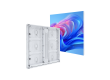



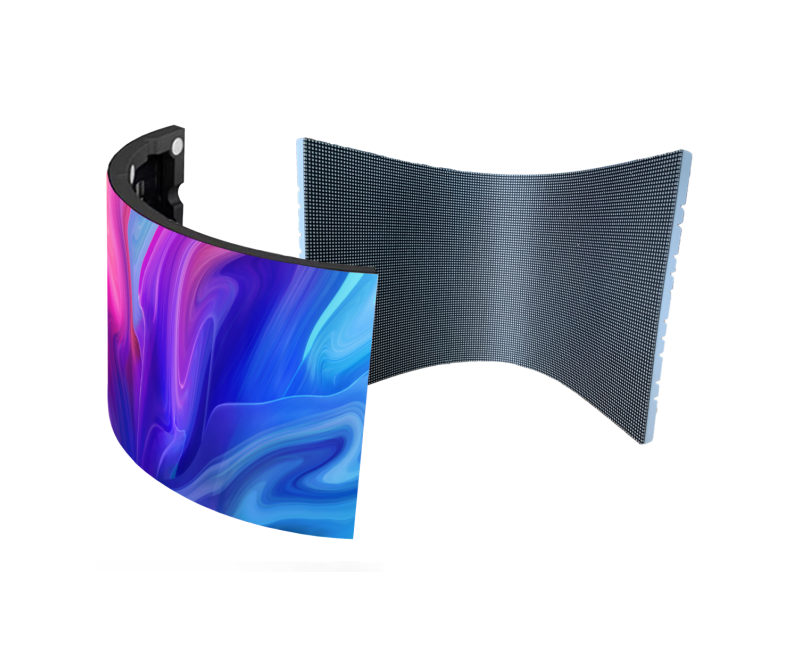
A soft LED module, also called a flexible LED module, is an LED display module built on a flexible printed circuit board (FPC) with a soft backing. Unlike a rigid LED module, it can follow a controlled curve and attach to a shaped metal structure. This makes it suitable for cylindrical columns, concave or convex walls, waves and other indoor display surfaces that flat cabinets cannot cover smoothly.
The main advantages are design flexibility, smooth curved splicing, low module weight, magnetic front access, modular repair and compatibility with fine-pitch indoor display systems. The trade-off is that the module still needs an accurately built support structure, careful cable routing and operation within the manufacturer’s stated bend and environmental limits.
Key takeaways
- Soft and flexible LED modules describe the same product category.
- The module bends because it uses an FPC and soft structural materials, not because the LEDs themselves bend.
- Flexible modules are best for shaped indoor displays; rigid cabinets remain the simpler choice for conventional flat walls and many outdoor installations.
- EagerLED’s EA-Flex range includes multiple module sizes and pixel pitches, with magnetic front service and a stated curvature of up to 45 degrees.
- The support frame, bend direction, pixel pitch, viewing distance, environment and service access should be confirmed before ordering.
Table of contents
- What is a soft LED module?
- How does a flexible LED module work?
- Seven advantages of soft LED modules
- Soft LED module vs. rigid LED module
- Where are soft LED modules used?
- How to choose a soft LED module
- Limitations and installation mistakes
- Frequently asked questions
What is a soft LED module?
A soft LED module is the display tile used to build a flexible LED display. Its LEDs and driver components are mounted on a flexible printed circuit board rather than the rigid board used in a conventional module. A soft mask and flexible rear structure protect the components while allowing the tile to follow its designed bend direction.
The module is only one part of the finished display. A complete installation also needs a shaped metal support structure, power supplies, receiving cards, data and power cables, a video controller, installation hardware and calibrated content. The module can conform to the structure, but it is not self-supporting.
Flexible printed boards are an established electronics category. IPC identifies IPC-2223 as its sectional design standard for flexible printed boards. For an LED project, however, the usable bend limit must come from the module manufacturer and model datasheet, not from a generic FPC rule.
Source: IPC Design Standards
How does a flexible LED module work?
The construction solves two problems at the same time: it lets the display surface curve, and it keeps each tile replaceable.
- The flexible PCB carries the circuit. Copper traces, LEDs and driver components are arranged so the board can bend along the intended axis.
- The soft structure controls the shape. The backing and mask support the components while allowing controlled deformation.
- Magnets attach the module to a metal frame. The frame determines the final radius and geometry; the module follows that surface.
- Flexible cables carry power and data. Cable paths need enough clearance and should not be pinched or forced across the bend.
- Software maps content to the final canvas. Cylinders and irregular surfaces often need custom resolution mapping so content does not appear stretched or interrupted at a seam.
EagerLED states that its EA-Flex modules use magnetic front service and can be installed or replaced from the viewing side with the appropriate tool. The same product page lists a curvature of up to 45 degrees; confirm how that figure is measured for the exact module and frame before production.
Source: EagerLED EA-Flex indoor soft flexible LED display
Seven advantages of soft LED modules
1. They create smooth curved display surfaces
Rigid cabinets can approximate a curve by joining flat sections at angles, but the joins may produce a faceted appearance. A soft LED module follows a continuous shaped frame, which is better suited to concave walls, convex columns, waves and other flowing surfaces.
2. They expand architectural design options
A flexible module lets designers integrate digital content into a structure instead of placing a flat rectangle in front of it. Typical forms include cylindrical column wraps, curved retail walls, stage waves, rings and selected irregular shapes. Feasibility still depends on the minimum radius, module dimensions and frame geometry.
3. They reduce load at the module level
Soft modules do not use the heavy individual cabinet housing found in many conventional LED products. This makes the module itself easier to handle and useful where installation depth or structure load matters. Calculate the complete installed load, including the frame, power supplies, cables and service hardware, rather than comparing bare modules alone.
4. Magnetic mounting can speed installation
Embedded magnets hold the modules against a ferromagnetic mounting surface. Installers can position and replace individual tiles without accessing every fastener from behind. The benefit depends on frame accuracy and magnet alignment; a poorly fabricated frame can still cause uneven seams.
5. Front service simplifies module replacement
A failed tile can be removed from the viewing side with a service tool, reducing the rear clearance required for maintenance. This is valuable for column wraps and curved walls where rear access is limited. Power supplies and receiving cards must also be placed where technicians can reach them.
6. Fine-pitch options support close indoor viewing
EagerLED’s current EA-Flex specifications list a broad range of pixel pitches across several module formats. For example, the 240 x 120 mm series lists P0.9 through P4 options. Smaller pixel pitches can provide finer image detail at closer distances, but they also increase pixel density, processing load and typically project cost.
7. They can deliver camera-friendly performance
For the 240 x 120 mm EA-Flex series, EagerLED lists a refresh frequency of at least 3,840 Hz, 14-bit gray scale and a 140-degree viewing angle. These specifications can support stages, showrooms and camera-facing environments, but the complete system’s performance also depends on driver settings, controller configuration, scan mode, camera shutter and calibration.
Soft LED module vs. rigid LED module
| Decision factor | Soft LED module | Rigid LED module |
|---|---|---|
| Best surface | Concave, convex, cylindrical or wave-shaped | Flat or gently segmented surfaces |
| Circuit substrate | Flexible printed circuit board | Rigid printed circuit board |
| Support | Requires a precise shaped metal structure | Usually installed in a rigid cabinet or panel system |
| Typical access | Magnetic front service | Front or rear service, depending on cabinet |
| Design freedom | High within the specified bend limit | Lower, but predictable for standard walls |
| Installation risk | Frame tolerance, cable routing and radius need close control | Mechanically simpler for standard grids |
| Outdoor suitability | Model-specific; the reviewed EA-Flex modules list IP31 | Many dedicated outdoor cabinets offer higher protection ratings |
| Best choice when | The display must follow a non-flat indoor surface | The project is a conventional flat wall, rental screen or exposed outdoor display |
Choose a flexible module because the geometry requires it, not because it is automatically superior. A rigid cabinet is usually the more straightforward solution for a flat rectangular screen.
Where are soft LED modules used?
Retail columns and curved feature walls
Wrapping an existing column turns a structural obstruction into a digital surface. The design team should measure the finished circumference, identify the viewing directions and decide where to place the vertical content seam before specifying the module grid.
Stages, exhibitions and entertainment venues
Wave walls, curved scenic elements and circular displays can create a more continuous background than angled flat cabinets. For camera use, verify refresh rate, scan mode and on-camera testing with the final controller configuration.
Corporate lobbies and showrooms
Curved displays can follow interior architecture while maintaining a shallow visual profile. Plan front service access and ventilation before the wall finish is completed.
Museums and immersive spaces
Concave LED surfaces can surround the viewer and support panoramic content. The content canvas, viewing distance and focal point should be designed together with the physical structure.
Broadcast and virtual-production environments
Flexible modules can help remove hard corners in a camera background. They do not by themselves guarantee virtual-production performance; color consistency, scan behavior, refresh rate, synchronization and camera tests remain essential.
How to choose a soft LED module
Step 1: Define the geometry
Record whether the surface is concave, convex, cylindrical, wave-shaped or freeform. Supply the finished radius or diameter, total width and height, and the direction in which each module must bend. A drawing or 3D model is more reliable than a verbal description.
Step 2: Establish the viewing conditions
Document the nearest normal viewing distance, expected content, camera use and ambient light. Select pixel pitch from these conditions and validate the result with a sample when the audience will stand close to the screen.
Step 3: Check the exact module format
EagerLED currently presents 240 x 120 mm, 320 x 160 mm, 256 x 128 mm, 250 x 250 mm and 300 x 168.75 mm EA-Flex parameter groups. The module dimensions must tile cleanly across the proposed frame; otherwise the final edge or seam may require a design change.
Step 4: Confirm environment and protection
The reviewed EA-Flex tables identify the modules as IP31 indoor products. Do not treat that rating as suitable for direct rain, outdoor dust exposure or wash-down areas. Ask engineering to confirm humidity, temperature, ventilation and protection requirements for the actual site.
Step 5: Design service access and cabling
Mark the locations of receiving cards, power supplies, hubs and cable routes. Confirm that a technician can remove a module and reach service components without dismantling the surrounding architecture.
Step 6: Request a project-specific validation
Before mass production, confirm the bend direction and limit, module count, spare-module quantity, frame tolerance, power loading, controller capacity and final pixel map. For a non-standard shape, test a small section of the real frame with the selected module.
Limitations and installation mistakes
Do not exceed the stated bend limit
Forcing an FPC beyond its intended geometry can damage traces, solder joints or components. Follow the datasheet for the exact model. Avoid folding, creasing or twisting a module, even if the backing feels soft.
Do not expect the module to correct a poor frame
Magnets hold the tile to the structure; they do not make an inaccurate structure flat or evenly curved. Variations in radius or mounting height can create visible seam, alignment and brightness differences.
Do not trap or sharply bend cables
Leave controlled clearance for power and data connections. Route cables along the intended curve and keep connectors free from sustained mechanical stress.
Do not ignore heat and maintenance access
The module surface may be thin, but the system still produces heat and contains serviceable electronics. Include ventilation and reachable component zones in the architectural design.
Do not use an indoor rating outdoors
The current EA-Flex specifications reviewed for this article list IP31. Choose a purpose-designed outdoor system when the display will face rain, airborne dust or other exposed conditions.
Frequently asked questions
What is a soft LED module?
A soft LED module is an LED display tile built with a flexible printed circuit board and soft structural materials. It attaches to a shaped support frame to create curved or irregular indoor LED displays.
Is a soft LED module the same as a flexible LED module?
Yes. In the LED display industry, soft LED module and flexible LED module commonly refer to the same product category. Always compare the exact datasheet because bend limits, dimensions, pixel pitch and environmental ratings vary by model.
Can a soft LED module make a 360-degree cylinder?
It can be used to build a cylindrical display when the module dimensions, bend direction and stated curvature match the cylinder diameter. The steel structure, vertical seam, cable route and content resolution must be engineered for the complete 360-degree surface.
Can flexible LED modules be used outdoors?
Only when the selected product is specifically rated for the outdoor environment. The EagerLED EA-Flex modules reviewed here are listed as IP31 indoor products, so they should not be exposed directly to rain or outdoor dust.
How is a flexible LED screen maintained?
EA-Flex modules use magnetic front service. A technician removes the relevant module from the viewing side with the appropriate tool, then accesses or replaces the affected component. The frame must include reachable power, receiving-card and cable locations.
What should I send a manufacturer for an accurate proposal?
Provide a drawing with the display width, height, radius or diameter, surface direction, nearest viewing distance, indoor or outdoor conditions, mounting surface, service access, content input and installation deadline. Photographs and a 3D model help reduce assumptions for irregular shapes.
Plan your flexible LED display
The best module is determined by the geometry and viewing conditions, not by a single headline specification. Send EagerLED your dimensions, radius, viewing distance and site conditions to receive a module recommendation, pixel map and frame proposal for the project.