

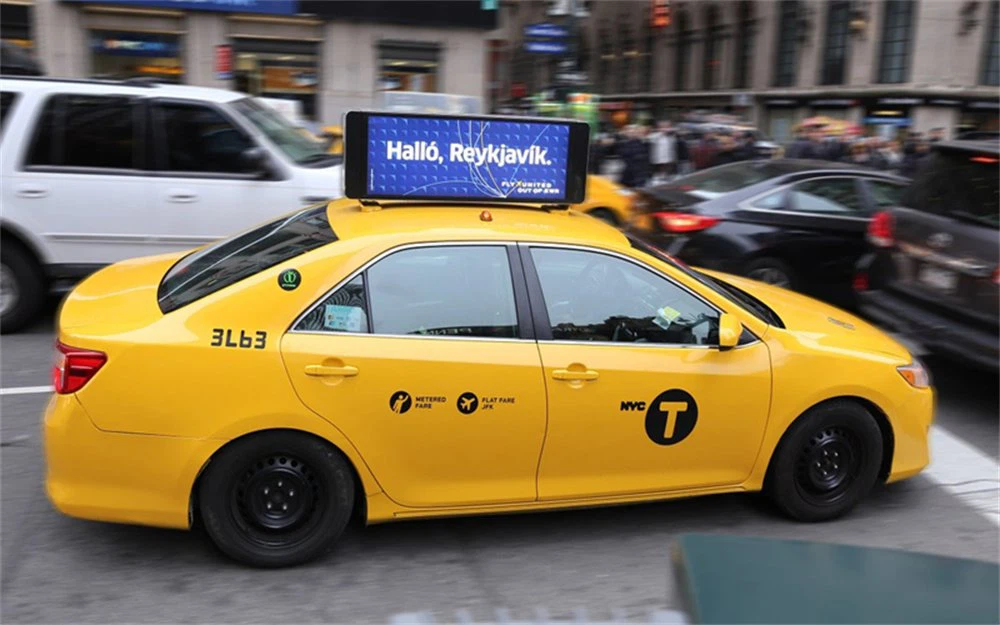
A taxi top LED display is a double-sided digital sign mounted on a vehicle roof, powered by the vehicle’s electrical system and updated over a mobile network. It turns a taxi fleet into a moving advertising network.
The hardware is only one part of that network. Power integration, 4G cluster control, local approvals and the operating budget decide whether a project works.
Key takeaways
- Many double-sided units use a face of about 960 × 320 mm per side; P2.5 gives 384 × 128 pixels on that face.
- Published listings show brightness of about 4,500–5,500 nits and wide-range 9–24 V DC input.
- A unit averaging 130 W draws about 11 A on a 12 V system; peak current can approach 35 A.
- Fleets are managed by 4G cluster control: local playback, cloud scheduling, remote monitoring and GPS-tagged proof of play.
- Rules differ by city: New York requires fixture approval, London capped screens at 1,000 cabs, and Los Angeles raised legal objections.
- Third-party reference prices range from about US$1,550 per unit to US$3,950 plus mounting for a complete kit.
This guide is for fleet media operators, taxi companies, advertising agencies and LED distributors planning a taxi top project. It covers typical specifications, the control architecture, how regulators in major cities have handled rooftop screens, and the cost items that belong in a complete budget.
1. What Is a Taxi Top LED Display?
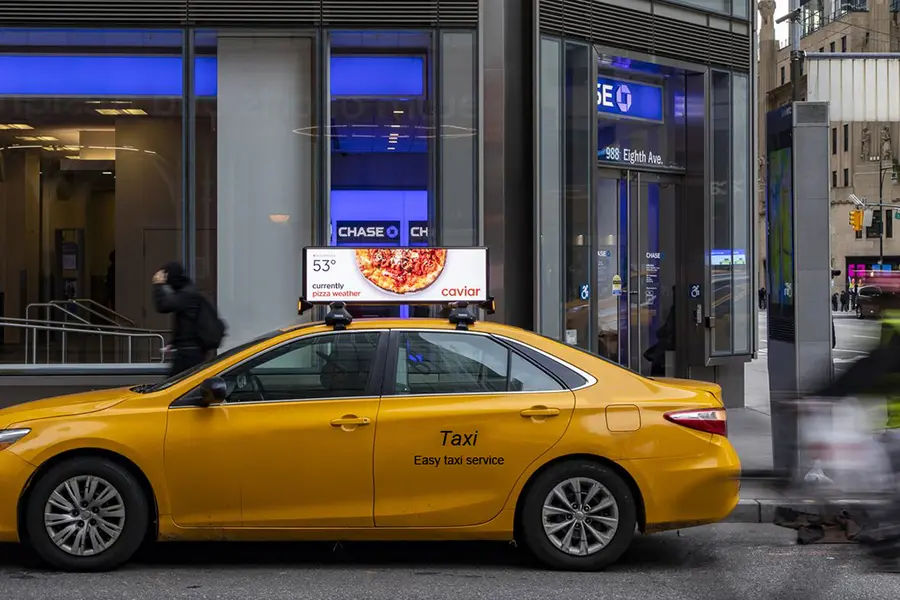
A taxi top LED display, also called a taxi roof LED screen or digital taxi topper, replaces the printed advertising box on a taxi roof with two outward-facing LED faces.
Each face is a small outdoor LED display with its own modules. A shared receiving card or multimedia player inside the housing drives both sides.
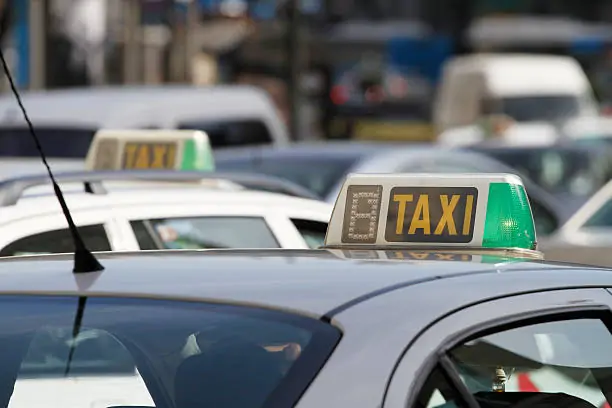
Compared with a static topper, a digital unit can:
- rotate several advertisers on one vehicle;
- change content by time of day;
- report where and when each advertisement was shown.
Those advantages come with requirements that a printed box does not have: a power connection, a data connection, thermal management, and in many cities a separate approval for illuminated or moving images.
| Feature | Static taxi topper | Taxi top LED display |
|---|---|---|
| Advertisers per vehicle | Usually one per print run | Several in a rotating playlist |
| Content changes | New print and manual replacement | Remote publishing over 4G or Wi-Fi |
| Night visibility | Depends on backlighting | Self-illuminated, needs dimming control |
| Proof of display | Photos or driver logs | Playback logs, optionally GPS-tagged |
| Vehicle integration | Mechanical mounting only | Mounting, power wiring and data connection |
| Approvals | Advertising fixture rules | Fixture rules plus any digital-sign rules |
2. Typical Taxi Top LED Display Specifications
There is no single standard size, but many double-sided units use a visible face of about 960 × 320 mm per side, built from small outdoor modules.
The table below shows how common pixel pitches translate into resolution on that face size. The pixel counts are calculated from the dimensions; confirm the actual module layout with the supplier.
| Pixel pitch | Face size (per side) | Resolution per side | Typical use |
|---|---|---|---|
| P2.5 | 960 × 320 mm | 384 × 128 pixels | Dense urban streets, small text, video |
| P3.33 | 960 × 320 mm | 288 × 96 pixels | Balanced detail and cost |
| P4 | 960 × 320 mm | 240 × 80 pixels | Simple graphics and short messages |
| P5 | 960 × 320 mm | 192 × 64 pixels | Logos, large text, highest brightness per cost |
Published product listings give a useful reference for the other parameters. For example, one Chinese supplier lists double-sided 960 × 320 mm taxi signs in P2.5, P3.33 and P5 with:
- 9–24 V DC input;
- brightness of at least 4,500–5,500 nits, depending on pitch;
- average consumption of roughly 120–150 W;
- maximum consumption of 420–450 W per unit.
Treat such figures as a starting point for comparison, not as a guaranteed specification.
| Parameter | Reference range | What to confirm |
|---|---|---|
| Brightness | About 4,500–5,500 nits on published listings | Measured brightness at the calibrated white point, plus the dimming range for night |
| Input voltage | Wide-range DC, often 9–24 V | Compatibility with the exact vehicle system and its voltage dips |
| Power consumption | Average roughly 90–150 W; maximum 270–450 W per unit on published listings | Consumption with your actual content, not only full white |
| Ingress protection | Outdoor rating such as IP65 or IP66 | Which parts the rating covers, including cable entries and the service lid |
| Operating temperature | Commonly around −20 °C to +60 °C | Behavior after hours of sun on a dark roof and after a cold start |
| Refresh rate | 1,920 Hz or higher; 3,840 Hz for camera-friendly playback | How the screen looks in phone photos and video |
| Connectivity | 4G, Wi-Fi, GPS, USB service port | Supported network bands in your country |
| Housing | Aluminum or composite, streamlined shape | Total weight with rack, roof load limit, wind noise and car-wash behavior |
For a broader explanation of protection ratings, see our guide to LED display IP ratings.
01. Mechanical Design Is Part of the Specification
A taxi roof is a moving, vibrating, wet environment. Ask the supplier:
- how the modules are secured inside the housing;
- how the housing resists repeated shocks;
- whether the design has been vibration-tested.
New York City’s Taxi and Limousine Commission, for example, requires rooftop advertising fixtures to be tested and certified by a licensed Professional Engineer against the military environmental standard MIL-STD-810F before approval. Even where no such rule exists, a comparable test record is a sensible requirement.
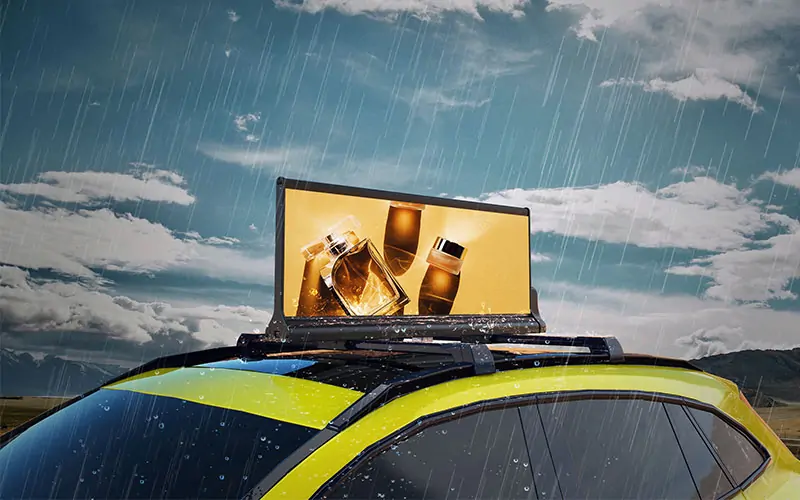
Also confirm the mounting method. Some kits clamp to factory roof rails or door frames without drilling, while others use a dedicated rack.
The installed weight, the vehicle manufacturer’s roof load limit and the effect on the vehicle’s height should be checked by a qualified vehicle installer for each model in the fleet.
3. Choosing Pixel Pitch and Brightness
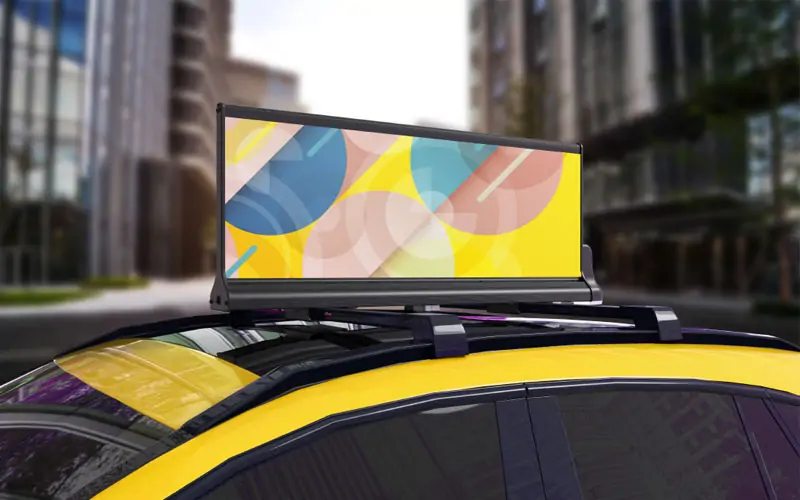
Viewers usually see a taxi top display from a few meters to a few tens of meters away, often while both the viewer and the vehicle are moving. That favors bold, simple content over fine detail.
The general rule from our LED display pixel pitch guide still applies: smaller pitch gives a sharper image at short distances, while larger pitch costs less and can deliver more brightness per watt.
- Choose P2.5 or finer when the fleet operates mainly in dense city centers, when pedestrians are close to the vehicle, or when advertisers want short video clips and product images.
- Choose P3.33 or P4 as a balanced option for mixed urban and arterial routes.
- Choose P5 when content is mostly logos and large text, or when budget and power consumption are the main constraints.
Resolution affects creative work directly. A 384 × 128 face can show a logo, a short headline and a call to action. A 192 × 64 face can show only a few large words. Agree the content template with advertisers before choosing the pitch.
01. Brightness Must Follow the Time of Day
Daylight readability needs high brightness, but the same output at night is uncomfortable for drivers and pedestrians and may break local rules.
Specify an ambient-light sensor and an automatic dimming curve, and test that the screen steps down smoothly at dusk. Our outdoor LED screen guide explains why nits should be set as day and night targets rather than a single maximum.
4. Vehicle Power: 12 V and 24 V Systems
Power integration is where many taxi top projects run into trouble. Passenger cars usually have a 12 V system, while some commercial vehicles use 24 V. Electric and hybrid taxis have their own low-voltage arrangements.
The display should be connected through a suitable DC/DC converter by a qualified automotive electrician, with correct fusing and cable sizing.
The current draw is higher than many buyers expect:
- A unit averaging 130 W on a 12 V system draws about 11 A.
- If the same unit can reach 420 W on full-white content, the peak current approaches 35 A at 12 V.
- At 24 V, the same peak is about 17.5 A.
Size wiring and protection for the peak, and design content that keeps the average low.
| Design point | Why it matters |
|---|---|
| Ignition-linked switching | Prevents the display from draining the battery when the engine is off |
| Under-voltage shutdown | Turns the display off before the battery falls too low to start the vehicle |
| Soft start and surge protection | Protects electronics during engine cranking and load dumps |
| Current limiting | Caps consumption on bright content and reduces heat |
| Thermal protection | Reduces brightness or shuts down safely when the housing overheats |
For general background on calculating consumption, see our guide to LED display power consumption.
5. 4G Cluster Control and Proof of Play
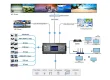
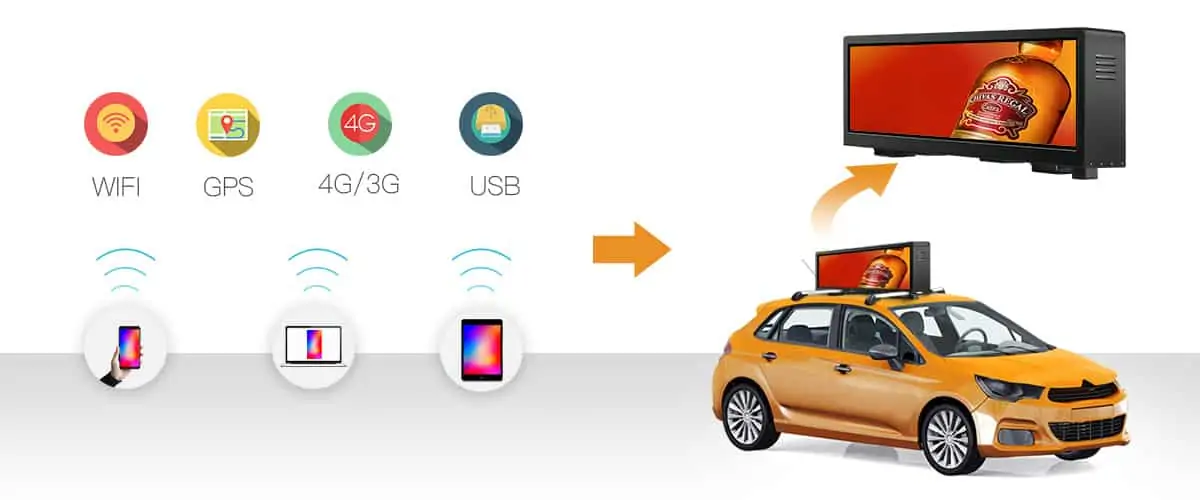
A taxi fleet cannot be managed screen by screen. “Cluster control” means managing hundreds or thousands of displays as groups from one cloud platform. A typical architecture has four layers:
- On-vehicle player. An asynchronous multimedia player or control card stores content locally and drives both faces. Local storage lets the display keep playing when the mobile signal drops. Players of this kind are discussed in our NovaStar TB30 vs TB50 comparison.
- Connectivity. A 4G module (or 5G where available) carries content and status data. Wi-Fi is useful for large updates at the depot. GPS provides location for scheduling and reporting.
- Cloud content management. The operator groups vehicles, uploads playlists, schedules campaigns and pushes updates to the whole fleet or selected groups.
- Monitoring and reporting. The platform shows which units are online, flags faults and records playback logs for advertisers.
01. Features to Require from the Platform
| Feature | What it enables | Question for the supplier |
|---|---|---|
| Group publishing | Different campaigns for different fleets, cities or vehicle types | How many groups and devices can one account manage? |
| Scheduling | Daypart campaigns, such as breakfast or evening offers | Does the schedule follow local time on the device if the network is lost? |
| Geofencing | Location-specific content, or switching off in restricted zones | How often is the position checked, and what happens without GPS? |
| Proof of play | Playback reports with time and location for advertisers | Can logs be exported, and how long are they stored? |
| Remote monitoring | Online status, temperature, voltage and fault alerts | Which alerts are available, and who receives them? |
| Remote firmware updates | Fixes without bringing vehicles to the depot | Is there a tested rollback if an update fails? |
| User permissions | Separate roles for operators, sales staff and advertisers | Can access be limited per group or campaign? |
02. Plan Mobile Data and Proof of Play
Plan mobile data before choosing SIM contracts. Estimate the size of each playlist, how often it changes, how many vehicles receive it, and how much status data each unit reports.
Using depot Wi-Fi for large video updates and 4G for small changes and monitoring keeps data costs predictable. Confirm that the 4G module supports the network bands used in your country.
Proof of play deserves particular attention because it is what advertisers pay for. GPS-tagged playback logs let an operator show that a campaign ran in the agreed area and time.
They do not measure audience size by themselves; audience estimates require a separate, transparent method agreed with advertisers.
6. Taxi Top LED Display Regulations and Approvals
Rules for rooftop digital advertising differ widely between countries and cities, and they change. They may involve the taxi licensing authority, the road traffic authority, outdoor advertising rules and vehicle safety regulations at the same time.
The examples below show how varied the approaches are. They are not legal advice; confirm the current rules with the authorities that license your vehicles.
01. New York City
The Taxi and Limousine Commission rooftop advertising rules require approval of each rooftop advertising fixture design before it is installed. Under those rules:
- the fixture must be certified by a licensed Professional Engineer under MIL-STD-810F;
- it must be two-sided, with each side wider than it is tall;
- advertising may appear only on the sides of the vehicle, not the front or back;
- medallion owners need an annual advertising permit;
- operating an unauthorized fixture, or one without a permit, can lead to fines.
In 2021, Adweek reported that rooftop advertising on rideshare vehicles was not permitted in New York City, while a digital program was planned for yellow cabs.
02. London
Transport for London decided to allow digital advertising screens on the roofs of licensed taxis, but capped the number at 1,000 cabs to protect the appearance of London’s taxis and streets.
Taxis fitted with screens needed a vehicle licence costing £170, £68 more than the standard fee, according to local reporting.
03. Los Angeles
In 2019, Los Angeles City Council’s Transportation Committee discussed a pilot for digital rooftop displays on taxis. During that discussion, the City Attorney’s representative said the devices were not consistent with State law and that their use violated the city’s prohibition on mobile advertising on vehicles, according to the committee report.
This shows that a technically ready product can still be blocked by local law.
04. Questions to Answer Before Ordering
| Topic | Question | Usually answered by |
|---|---|---|
| Legality | Are moving or illuminated advertisements allowed on licensed taxis or private vehicles? | Taxi regulator, city or road authority |
| Fixture approval | Does the fixture design need type approval or engineering certification? | Taxi regulator, vehicle inspection body |
| Display rules | Are there limits on brightness, animation, video, sound or which sides may show advertising? | Taxi regulator, advertising authority |
| Content rules | Which categories of advertising are restricted, and who approves content? | Advertising standards body, regulator |
| Permits and fees | Is there a per-vehicle permit, higher licence fee or fleet cap? | Taxi regulator |
| Vehicle safety | Does the installation affect vehicle homologation, height limits or inspections? | Vehicle inspection body, vehicle manufacturer |
| Insurance | Is the display covered, and does it change the vehicle policy? | Insurer |
7. Taxi Top LED Display Cost: What Belongs in the Budget
The price of the display unit is only part of the cost. Published figures give a sense of scale:
- One Chinese supplier lists a double-sided P3.33 taxi sign at about US$1,550–1,650 per unit, depending on quantity.
- A US company selling complete rooftop kits lists P2.5 units at US$3,950 plus US$350 for the mounting kit, with finer pitches costing more.
These are third-party reference prices, not EagerLED quotations. Actual prices depend on pitch, housing, control system, order quantity and delivery terms.
Build the budget per vehicle and then for the whole fleet:
| Cost item | One-time or recurring | Notes |
|---|---|---|
| Display unit (both faces, housing, player) | One-time | Compare quotes on the same pitch, brightness and control system |
| Mounting rack or clamp kit | One-time | Often specific to each vehicle model |
| Power integration (converter, fuses, cabling) | One-time | Include professional installation labor |
| Shipping, import duties and taxes | One-time | Depends on Incoterms and destination |
| Approvals, engineering certification, permits | One-time and recurring | Some cities charge per vehicle every year |
| SIM cards and mobile data | Recurring | Use depot Wi-Fi for large updates to control cost |
| Cloud CMS subscription | Recurring | Check whether pricing is per device or per account |
| Insurance | Recurring | Display hardware and any change in vehicle cover |
| Spare units and modules | One-time and recurring | Keep spares so vehicles return to service quickly |
| Maintenance and removal | Recurring | Cleaning, seal checks, repairs and transfer when vehicles are replaced |
| Driver or fleet revenue share | Recurring | Agree before installation who earns what from each vehicle |
01. Estimate Revenue Conservatively
Revenue depends on four variables:
- the number of advertising slots per loop;
- the share of slots actually sold;
- the price per slot;
- the share paid to vehicle owners.
Vendor claims of very short payback periods usually assume high occupancy. Taxi drivers speaking at the 2019 Los Angeles hearing said screens could add up to US$300 per month to their income, but that was a claim, not a verified figure.
Build your model with a realistic sales rate for your market and test it with a pilot fleet before scaling.
8. Sample and Acceptance Tests
Order samples before committing a fleet. Mount them on the vehicle models you operate and run them in real traffic for several weeks. The following checks expose most problems early:
- Brightness and dimming: measure daytime brightness and confirm the automatic night setting.
- Water ingress: spray test, heavy rain and an automatic car wash, then open the housing and inspect.
- Heat: park the vehicle in full sun, then start the display and monitor temperature and brightness.
- Cold start and voltage dips: confirm the display survives engine cranking and shuts down correctly at low battery voltage.
- Vibration: after road running, check module alignment, connectors and fasteners.
- Network loss: drive through poor coverage and confirm offline playback, reconnection and log upload.
- Proof of play: compare exported logs with the actual route and schedule.
- Service: time how long it takes to replace a module or a complete unit.
Record the approved sample configuration and test results so later production batches can be checked against them. Keep a documented spare-parts list and a handover record for the delivered system.
01. How EagerLED Can Support a Taxi Top Project
EagerLED manufactures outdoor LED modules and display systems in Shenzhen. A taxi top LED display solution can be configured with options such as:
- 4G/5G, Wi-Fi and GPS connectivity;
- local storage for offline playback;
- a cloud CMS with fleet grouping and GPS-tagged proof-of-play logs;
- an ambient-light sensor and thermal controls;
- under-voltage shutdown.
Certificates should be requested for the exact model and target market. Approval in each city remains the responsibility of the operator, so share the requirements of your regulator early and we can confirm which technical documents are available for the proposed configuration.
9. Frequently Asked Questions
01. How many advertisers can one taxi top LED display carry?
That depends on the loop length and slot duration. A loop with several short slots can rotate multiple advertisers on the same vehicle. Keep the loop short enough that each advertiser appears frequently along a typical route.
02. Will a taxi top display drain the vehicle battery?
It should not if it is wired correctly. Use ignition-linked switching and an under-voltage shutdown so the display turns off before the battery falls too low to start the vehicle.
03. Can the two sides show different content?
Many systems can show synchronized or separate content on each face. Confirm this with the supplier, because it depends on the player and screen configuration.
04. Does a taxi top LED display work without a mobile signal?
Yes, if the player stores content locally. It continues playing the last schedule and uploads its logs when the connection returns.
05. Which pixel pitch is best for a taxi top display?
P2.5 suits dense city centers and video content. P3.33 or P4 is a balanced option. P5 suits logos and large text where cost and power consumption matter most.
06. Are taxi top LED displays legal everywhere?
No. Some cities approve them with conditions, some cap the number of vehicles, and some restrict mobile digital advertising altogether. Check with your taxi regulator and advertising authority before ordering.
07. How long does it take to install one unit?
Installation time depends on the mounting method and wiring. Clamp-on kits are quicker than permanent racks. Plan a trial installation on each vehicle model to set realistic fleet timelines.
10. Plan Your Taxi Top LED Display Project
Before requesting quotations, prepare:
- the vehicle models and their electrical systems;
- the target cities and their approval requirements;
- the preferred pixel pitch;
- the number of vehicles;
- your content management needs.
Contact EagerLED with these details for a configuration proposal and an itemized quotation, or read our mobile billboard advertising guide to compare other vehicle-based formats.