Outdoor advertising LED displays turn building facades, shopping districts, transport approaches and roadside locations into flexible digital media. Their strongest feature is the ability to deliver legible moving content under changing daylight while updating campaigns remotely. Yet a convincing outdoor screen is more than a bright panel: image quality, weather protection, structural safety, energy use and service access all affect whether the installation works for years.
This guide explains the features of outdoor advertising LED displays from a buyer’s perspective. It shows how to match pixel pitch to viewing distance, specify brightness without excessive glare, interpret IP ratings correctly, compare running costs and plan maintenance. The examples are planning starting points; a site survey, product datasheet and local engineering review should determine the final specification.
If you are comparing outdoor advertising LED displays, start with the audience: where do people stand or drive, how long can they see the message, and what ambient light reaches the screen? Those answers make the remaining specifications meaningful. A display that looks impressive in a showroom can underperform at noon or become too intense after dark if its controls and location were not considered together.
Contents
1. What makes an outdoor advertising LED display different?
01 A direct-view image for public spaces
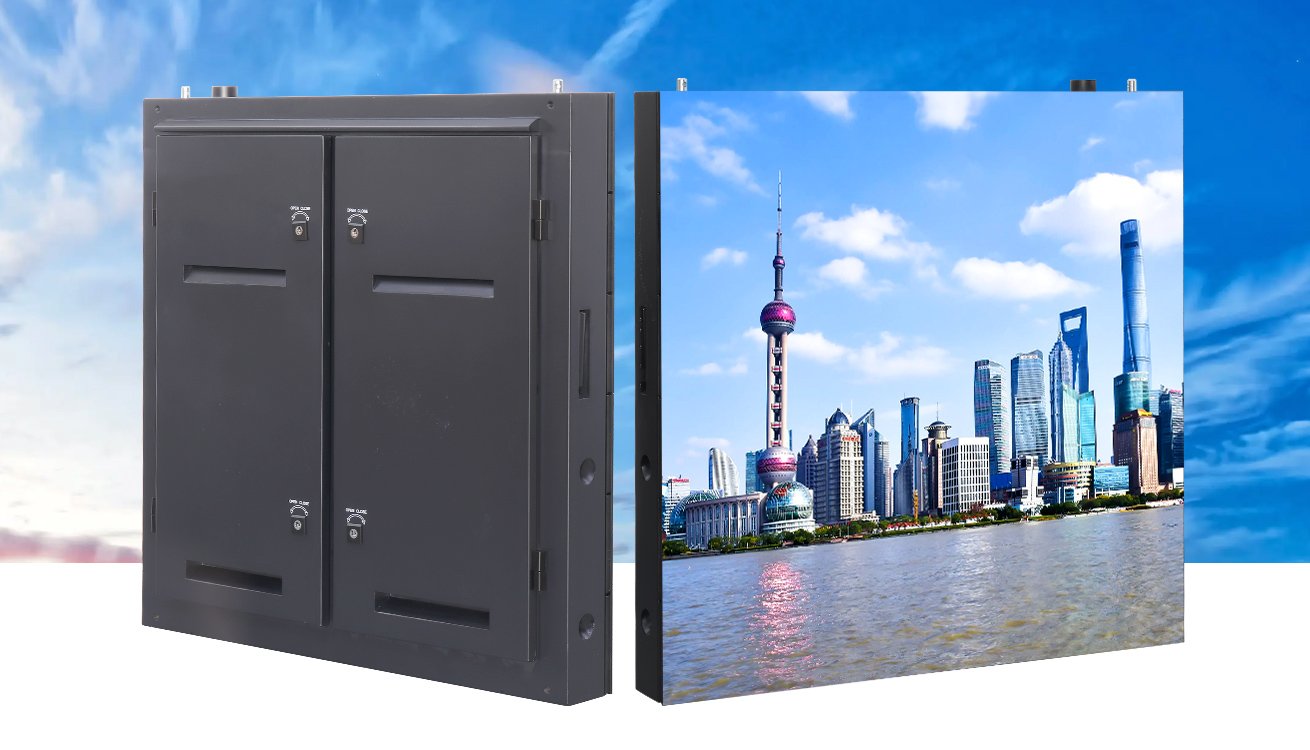
An outdoor advertising LED display is a modular, direct-view screen. Each cabinet contains LED modules, power supplies, receiving electronics and a protective structure. Cabinets join into a larger canvas, so the owner can choose dimensions and aspect ratio to suit a facade or freestanding sign. Unlike a printed billboard, the creative can change by time of day, campaign or location without replacing a physical face. Unlike a projection system, the image is emitted by the display itself.
The engineering challenge is that outdoor advertising LED displays must remain readable as sunlight, rain, temperature and viewing direction change. Outdoor advertising LED displays therefore require a coordinated system: appropriate LED package and pitch, sufficient but controlled luminance, weather-resistant enclosure, thermal design, secure mounting and a manageable content workflow. A headline brightness figure alone does not describe performance.
02 A useful specification starts with the site
Map the nearest and farthest viewers, their approach angle, average dwell time, ambient light, traffic context, mounting height and service route. A pedestrian plaza may reward finer detail; a distant roadside screen needs large type and simple creative. Check local sign rules, permitted brightness, operating hours and structural approvals before placing an order. These vary by jurisdiction and site, so the supplier should be given the actual drawings and exposure conditions.
For buyers reviewing outdoor advertising LED displays, request a proposal that identifies the exact cabinet model, LED configuration, screen dimensions, pixel resolution, peak and typical power, front and rear IP ratings, service method and control architecture. This prevents a generic quote from hiding important differences.
2. Image quality: pitch, resolution and content
01 Match pixel pitch to the closest real viewer
Pixel pitch is the center-to-center spacing between adjacent pixels, stated in millimeters. A smaller pitch creates more pixels per square meter, which can improve close-range detail but usually increases purchase cost and electronic complexity. A larger pitch may be entirely appropriate when viewers are farther away. The right choice is set by viewing geometry and content, not by the smallest available number.
For outdoor advertising LED displays, a frequently used screening heuristic is about one meter of viewing distance for each millimeter of pitch. This is only a close-view starting point, not a universal visual-acuity rule. Letter height, contrast, eyesight, motion and dwell time matter. Ask the supplier for a full-size sample and test the actual creative from the nearest intended position.
| Site example | Planning pitch range | Reason to test |
|---|---|---|
| Pedestrian retail frontage | P3–P5 | Short viewing distance and detailed branding |
| Urban street or transit approach | P4–P8 | Mixed pedestrian and vehicle distances |
| Large roadside billboard | P6–P10 or wider | Longer view and simpler copy |
02 Calculate useful screen resolution
Divide active width and height in millimeters by the proposed pitch. A 6,000 mm by 3,000 mm face at P6 has approximately 1,000 by 500 physical pixels. The same face at P10 has about 600 by 300. Pixel count determines how much fine detail the hardware can show, but a higher-resolution source file cannot recover detail that the LED grid lacks. Build artwork at the native display aspect ratio and preview it at realistic viewing distances.
Outdoor advertising LED displays benefit from short messages, large type, clear silhouettes and a strong visual hierarchy. Avoid fine disclaimers or dense text that a moving audience cannot read. Set safe margins around the frame, and test content at noon, dusk and night. A screen should be judged with real campaigns, not only high-saturation demo video.
03 Evaluate color, uniformity and refresh
Ask for measured brightness uniformity, grayscale behavior at reduced luminance and calibration procedure. Modules from different batches can show visible color seams; calibration and replacement inventory help maintain a coherent image. Refresh rate matters when the display will be filmed, but the advertised number alone does not guarantee clean camera footage. Camera shutter settings, scan design and dimming method also matter. Film a sample at expected brightness if camera use is important.
3. Brightness, contrast and viewing angle
01 Specify readable daylight performance
Outdoor advertising LED displays often need several thousand nits of peak luminance to remain legible in daylight, but there is no single correct target for every orientation. Direct afternoon sun, reflections, shade and background contrast change the requirement. Compare measured luminance at the operating mode you intend to use, not only a maximum laboratory setting. A matte surface, suitable LED package and well-designed louvers can improve perceived contrast as much as chasing a higher nit figure.
Automatic brightness control is essential in many installations. A calibrated ambient-light sensor and scheduled limits should raise output when needed and reduce it after sunset. Set a safe fallback if the sensor fails. Excess brightness wastes energy, accelerates stress and can create nuisance glare. Local permits may impose limits on luminance, transitions and operating hours; verify these before commissioning.
02 Check contrast where the public stands
For outdoor advertising LED displays, contrast describes how clearly bright and dark image areas separate. In full sun, light reflecting from the screen face can wash out dark content even if the LEDs are powerful. Request viewing tests in the intended direction and use photographs or measurement records taken under representative daylight. Content with large areas of white may look bright but draw more power and be harder to read than balanced, high-contrast creative.
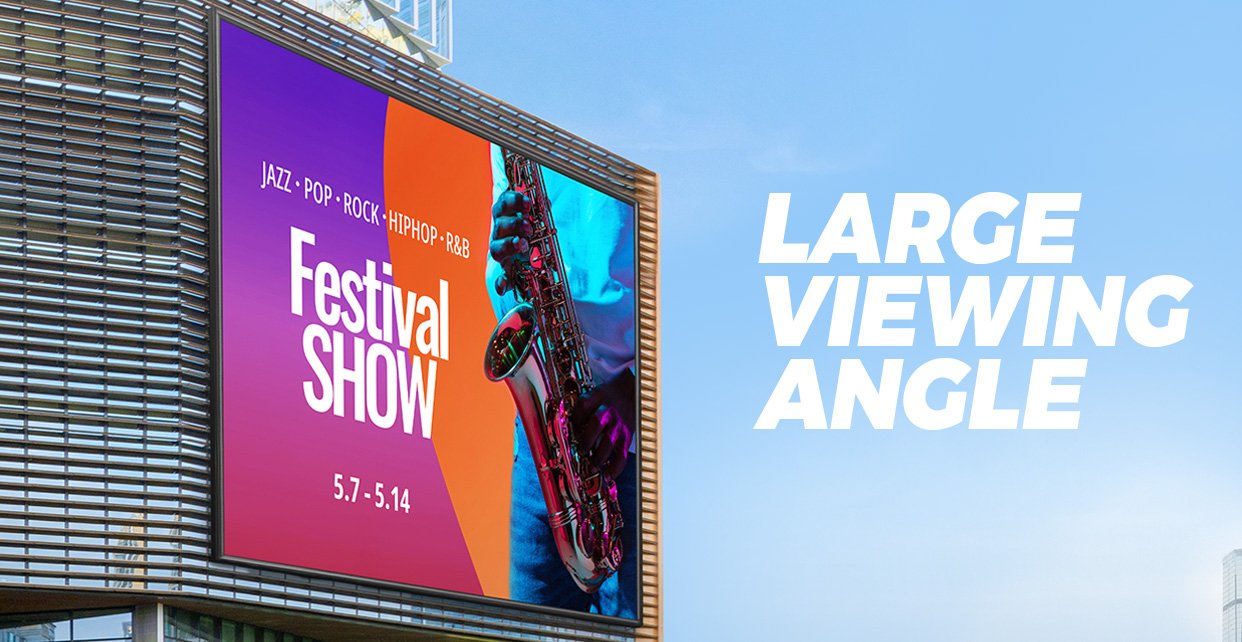
03 Measure useful viewing angle, not just a brochure maximum
The viewing angle of outdoor advertising LED displays should cover the actual pedestrian and vehicle approaches. A broad horizontal angle is valuable on a corner or busy square; a narrower beam can be acceptable for a direct roadside approach. Ask how brightness and color change at the outer viewing positions, because an advertised angle may describe visibility rather than acceptable image quality. Also assess vertical angle when the screen is mounted high above the audience.

4. Weather protection and service life
01 Read IP ratings correctly
The IP code in IEC 60529 describes protection provided by an enclosure against solid objects and water. The first digit addresses solid-particle ingress; the second addresses water ingress. An IP65 face is dust-tight and protected against water jets under the standard test conditions. IP68 has a different water-immersion test and is not a universal requirement for an installed outdoor billboard. In particular, immersion resistance does not replace drainage, sealing quality, corrosion protection or a suitable installation design.
Ask for the tested rating of the front face and the rear cabinet separately. Front and rear protection can differ because access doors, cable exits and ventilation paths differ. Confirm whether the certificate covers the complete cabinet configuration, including connectors and service openings, rather than an isolated module. For exposed sites, review wind-driven rain, dust, salt, freeze-thaw cycles and humidity with the supplier. Outdoor advertising LED displays should be assessed as assembled systems.
| Requirement | What to request | Why it matters |
|---|---|---|
| Ingress protection | Front and rear IP test reports for the proposed cabinet | A rating only applies to the tested enclosure |
| Temperature and humidity | Operating range and thermal test conditions | Electronics must work in local extremes |
| Corrosion protection | Cabinet finish, fasteners and coastal options | Salt and moisture can shorten service life |
| Drainage and cables | Gland details, drip loops and service-door seals | Water may enter through installation details |
02 Plan heat, rain and corrosion together
High-output outdoor advertising LED displays produce heat in their LEDs, drivers and power supplies. Confirm how the cabinet rejects heat at maximum ambient temperature and whether a stated IP rating changes when ventilation is added. The structure should prevent water pooling and allow service teams to inspect seals. Coastal or industrial locations may need different coatings, fasteners and maintenance intervals from an inland sheltered facade.
Avoid promising a fixed operating life from the LED diode rating alone. Power supplies, fans, seals and control equipment have their own failure modes. Ask for spare modules, power supplies and receiving cards from compatible batches, plus a documented replacement and recalibration procedure. This makes outdoor advertising LED displays easier to keep visually consistent over time.
5. Energy use and whole-life cost
01 Compare typical and maximum power
For outdoor advertising LED displays, maximum power is important for electrical design, while typical power is more useful for budgeting. Both should be stated per square meter for the same brightness and content assumptions. A full-white test pattern can draw far more power than ordinary mixed advertising creative. Request the test method, not only a single number. Multiply average kilowatts by operating hours and the applicable tariff to estimate energy cost.
For example, a 30 m² display averaging 0.30 kW/m² for 14 hours a day uses about 126 kWh per day before controllers, networking or cooling. At 0.45 kW/m² the same schedule uses 189 kWh. These are illustrative calculations, not a claim about a particular EagerLED model. Measured operation and local tariffs should replace assumptions in a project budget.
02 Use controls to reduce unnecessary output
Automatic dimming and a sensible operating schedule can reduce consumption while preserving readability. The U.S. Department of Energy notes that LEDs can be dimmed and controlled, although its published lighting findings are not a direct performance guarantee for video displays. Commission the sensor against real daylight, verify nighttime caps and check the power meter after installation. Avoid a control strategy that leaves the display at daytime brightness all night.
In outdoor advertising LED displays, power architecture also affects energy losses. Ask about power-supply efficiency at typical load, standby draw, cabinet distribution and whether failed supplies can be replaced without dismantling neighboring cabinets. Energy savings should be evaluated alongside color quality and reliability. A lower-power specification has little value if it produces unacceptable daylight contrast.
03 Budget beyond the purchase price
The lifetime cost of outdoor advertising LED displays includes cabinets, structural steel, permits, power service, control hardware, connectivity, installation, routine cleaning, spare parts, access equipment and potential downtime. Compare quotations on a common scope and service period. Front-access hardware may cost more initially but save repeated lift or rear-platform work at a wall site. Conversely, rear service can be straightforward where a protected walkway already exists.
| Cost item | Question to ask | Evidence |
|---|---|---|
| Electricity | What are measured typical and peak watts at stated brightness? | Test conditions and meter readings |
| Access | Can technicians reach modules and supplies safely? | Service drawings and replacement demonstration |
| Spares | Which parts and batches remain available? | Bill of materials and spare-parts plan |
| Downtime | How quickly can a failed section be isolated? | Warranty and support terms |

6. Structure, electrical safety and access
01 Treat the screen as a building component
The support structure for outdoor advertising LED displays must account for cabinet mass, wind exposure, mounting surface, maintenance loads and local code requirements. A screen on a roof or facade can transfer substantial forces into the building. Obtain structural calculations from a qualified local engineer and verify anchors, steelwork and existing substrate before fabrication. The advertising display supplier can provide load data, but the site engineer must confirm the final installation.
Consider appearance as well as safety. Cabinet depth, trim, exposed rear surfaces and cable routes influence how the finished sign fits the architecture. A clean integration is planned at drawing stage, not added after the screen arrives. If the building envelope is penetrated, coordinate weatherproofing and future access with the building owner.
02 Design for electrical and lightning risk
Provide a dedicated electrical design for the installed maximum load, including distribution, protective devices, grounding, surge protection and accessible isolation. Electrical rules differ by country and location. In the United States, electric signs may be evaluated under UL 48; ask which approvals and documentation apply to the destination market and the exact product configuration. Do not assume a general product certificate covers the completed site installation.
A stable control network also matters. Route power and signal cables to reduce damage and make troubleshooting practical. Document the controller mapping and spare data paths before the site is handed over. Outdoor advertising LED displays installed in public areas should have clear procedures for emergency shutdown and safe maintenance.
03 Choose front or rear maintenance early
Front service allows modules and some components to be removed from the viewer side, useful when a wall blocks rear access. Rear service can offer more working room where an enclosed walkway exists. Verify the exact parts reachable from each side: modules, power supplies, receiving cards and cabling. Test the removal procedure with a sample cabinet and confirm the working space, lift route and pedestrian controls required for service.
A purchase decision should include the labor needed for a routine module swap, not only the statement that the product is serviceable. The most reliable outdoor advertising LED displays are those for which technicians can find, reach and replace failed components promptly without putting people below at risk.
7. Control, content and operational reliability
01 Choose a content workflow the team can operate
Outdoor advertising LED displays may receive content from a local player, scheduled media system or networked controller. Define who can approve artwork, upload campaigns, schedule changes and recover a failed player. The control system should support the required file formats, native pixel dimensions, time zone, brightness schedule and remote health checks. If the display sells advertising slots, ask for proof-of-play records and a workflow that prevents one client’s creative from appearing in the wrong time slot.
For outdoor advertising LED displays, network connectivity is useful, but a screen should have a safe behavior when the connection fails. Decide whether it should continue the last approved playlist, show a neutral fallback or go dark. Document access credentials and give only appropriate staff permission to change schedules. These operating details influence revenue and public appearance as much as the display hardware.
02 Build resilience into the signal chain
Map every cabinet to the sending system and keep a copy of the final configuration. For important sites, consider redundant data paths, spare controllers and backup power for the control equipment if brief outages are common. Ask what happens when one receiving card or power supply fails: does a small area go dark, or does a larger section lose signal? A clear fault map and labeled cabling make repairs faster.
Commission outdoor advertising LED displays with a burn-in period, color and brightness calibration, day and night inspection, network-loss test, power-restart test and a maintenance handover. Record final settings and keep a baseline photograph of the screen at controlled brightness. This makes later changes easier to diagnose.
8. How to choose outdoor advertising LED displays by location
01 Retail facades and pedestrian squares
Close-view outdoor advertising LED displays need legible branding, a pitch selected from the nearest pedestrian position and good contrast across wide approach angles. Check whether the screen blocks windows, signage or access routes. Front service is often practical where there is no rear corridor, but the replacement procedure must fit local pedestrian-safety arrangements. Dimming should prevent the display from dominating neighboring storefronts at night.
02 Roadside and elevated billboards
Roadside outdoor advertising LED displays are usually seen at greater distance and for shorter periods. Favor large type, simple visuals and a pitch that delivers enough detail for that range. Wind loading, permitting, electrical capacity and safe service access deserve early engineering attention. Set brightness for daylight readability while respecting local nighttime and traffic rules. The screen’s location and creative matter more than an unnecessarily fine pixel grid.
03 Transport hubs and exposed coastal sites
For outdoor advertising LED displays, a transport approach may mix close and distant viewers, requiring a compromise between pitch, dimensions and message length. Check sightlines from each relevant path rather than assuming the centerline view represents the audience. Coastal exposure adds salt, moisture and wind considerations; request corrosion details, sealing test evidence and a suitable spare-parts plan. For any location, validate a representative sample in the real light conditions if the project scale warrants it.
| Location | Priority feature | Common oversight |
|---|---|---|
| Retail facade | Close-view detail and night dimming | No safe front-service plan |
| Roadside billboard | Long-distance legibility and structure | Overpaying for unnecessary fine pitch |
| Transport hub | Multiple viewing angles and content scheduling | Designing for only one sightline |
| Coastal site | Corrosion protection and sealing | Treating an IP number as a complete durability plan |
9. Procurement and acceptance checklist
01 Information to put in the request for quotation
Send the supplier screen width and height, mounting drawings, nearest and farthest viewing distances, photos in morning and afternoon light, site climate, power supply, access restrictions, operating hours and content examples. Request the exact outdoor advertising LED display model and cabinet configuration, measured luminance, pitch, resolution, front/rear IP evidence, maximum and typical power, warranty exclusions, spares and service drawings. Ask whether the proposed package includes processor, control software, sensors, surge protection, steelwork, commissioning and training.
02 Tests to witness before acceptance
For outdoor advertising LED displays, at the factory check cabinet alignment, dead pixels, color uniformity, brightness control, calibration records and representative content. At the site, verify grounding and electrical isolation, weather seals, data redundancy where specified, sensor response, night limits, remote scheduling, fault recovery and service access. Retain the final configuration file, as-built wiring diagram, test records and spare-parts inventory. These steps make outdoor advertising LED displays easier to operate and provide a clear reference if a warranty issue occurs.
The best proposal is the one that fits the audience and the site with evidence. EagerLED offers commercial LED display options and outdoor fixed-installation products; compare the datasheet for the proposed model against this checklist. For broader system planning, see the outdoor LED video wall guide.
10. Frequently asked questions
01 Practical answers
01. What is the main advantage of outdoor advertising LED displays?
They can show bright, changeable digital campaigns to audiences in public spaces. Their value depends on readable content, reliable operation and a location where the intended audience can actually see the screen.
02. What pixel pitch should an outdoor billboard use?
Choose pitch from the nearest meaningful viewing distance, screen size and content detail. A pedestrian facade may need a finer pitch than a distant roadside board. Test a sample with actual artwork before specifying a final value.
03. How bright should an outdoor LED screen be?
It should remain legible in the site's brightest expected conditions and dim automatically as ambient light falls. Ask for measured luminance and a commissioning plan; a higher maximum nit figure is not automatically better.
04. Does an outdoor advertising LED display need IP68?
No universal IP68 requirement applies. IEC 60529 ratings describe specific enclosure tests. Request front and rear IP evidence for the proposed cabinet and review drainage, cable entries and local exposure separately.
05. How much electricity does a digital billboard use?
Consumption depends on area, brightness, creative content and hours. Estimate energy as average power in kilowatts multiplied by operating hours, then add control and cooling loads where applicable. Require measured typical and peak power figures.
06. Is front or rear maintenance better?
Front service suits sites without rear access; rear service can be efficient with a safe walkway. Confirm that technicians can reach the specific components likely to fail and test a real replacement procedure.
07. Which approvals are needed?
Permits and electrical or structural approvals depend on the location. A qualified local engineer and installer should check the support, power, grounding and sign rules. Ask the supplier for the exact product certifications relevant to the destination market.
08. How can I keep image quality consistent?
Specify calibration, compatible spares and a documented replacement process. Inspect the screen at day and night brightness after commissioning and retain baseline measurements for future maintenance.
For a quotation on outdoor advertising LED displays, provide the installation dimensions, viewing distances, site photographs, exposure conditions and required operating schedule. The project team can then compare a specific cabinet and control package against these requirements.