

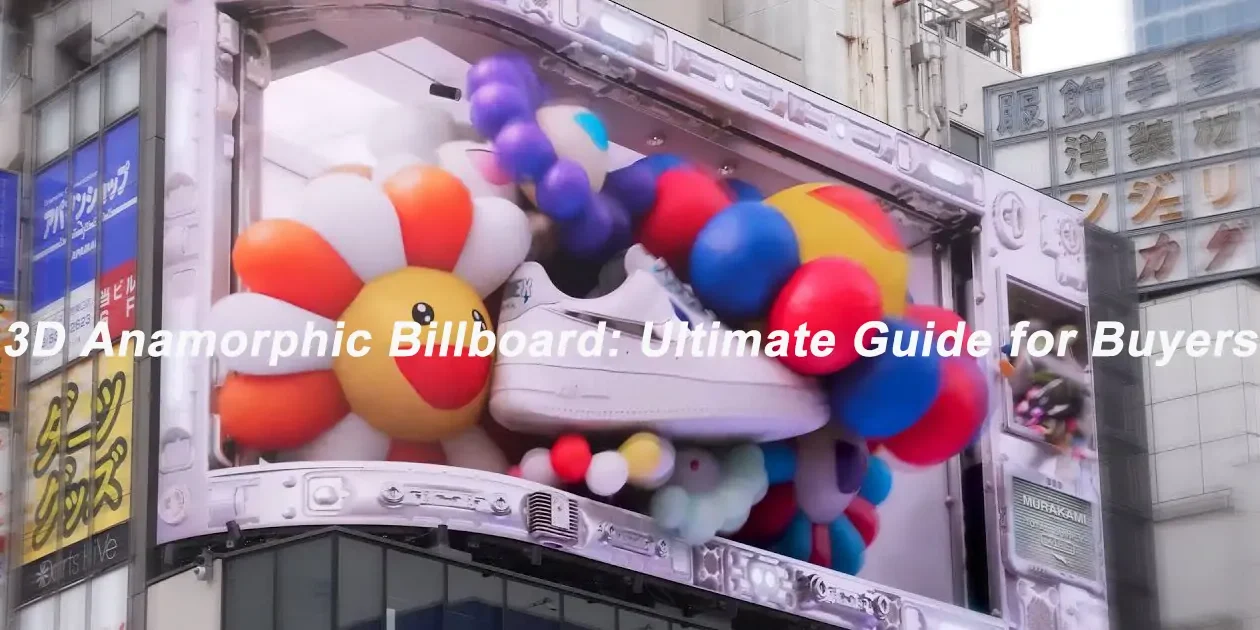
You’ve seen the video. A wave crashes out of a building in Seoul. A giant cat lounges across a Tokyo intersection, swatting at pedestrians who aren’t there. In the comments, someone always writes: “Why doesn’t my city have this?”
The hardware exists. The content tools are mature. Dozens of manufacturers can ship tomorrow. What stops most buyers isn’t the technology — it’s that procuring a 3D anamorphic billboard works nothing like buying a standard digital screen, and almost nobody figures that out until the invoice breaks their assumptions.
This guide covers the parts that trip people up: which hardware specs actually hold up once the screen is outdoors for two years, what you’ll really spend, how to pick a site that pays for itself, how to tell which suppliers will still answer the phone in year three, and the content mistakes that turn a six-figure installation into very expensive wallpaper.
1.What is a 3D anamorphic billboard?
2.The hardware stack: what you’re actually buying
3.What a 3D anamorphic billboard costs in 2026
4.Picking a location that earns back the investment
5.How to vet a supplier without getting burned
6.The creative side: making anamorphic content that lands
7.What buyers get wrong about 3D anamorphic billboards
8.FAQs
9.Conclusion
1. What is a 3D anamorphic billboard?
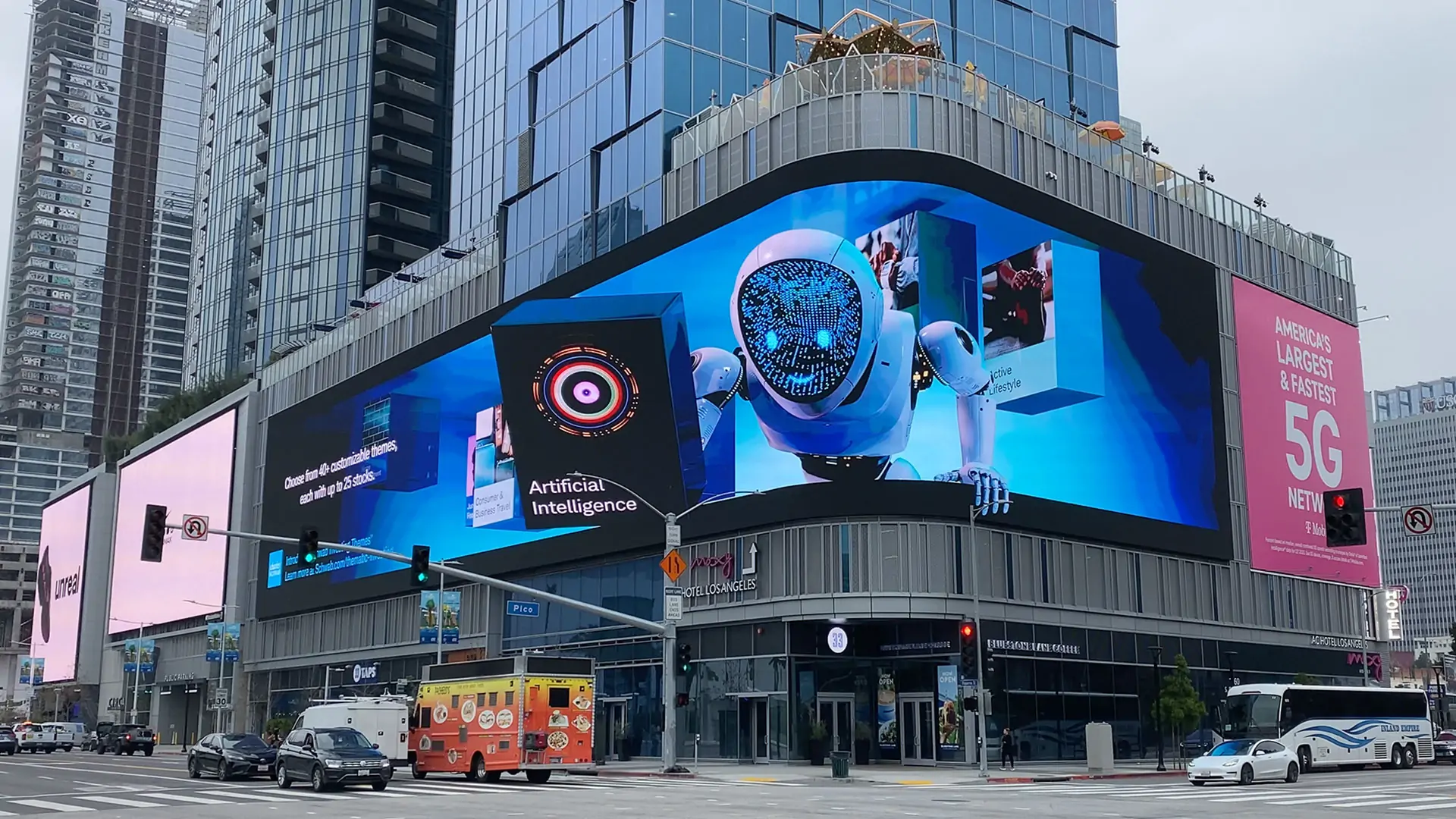
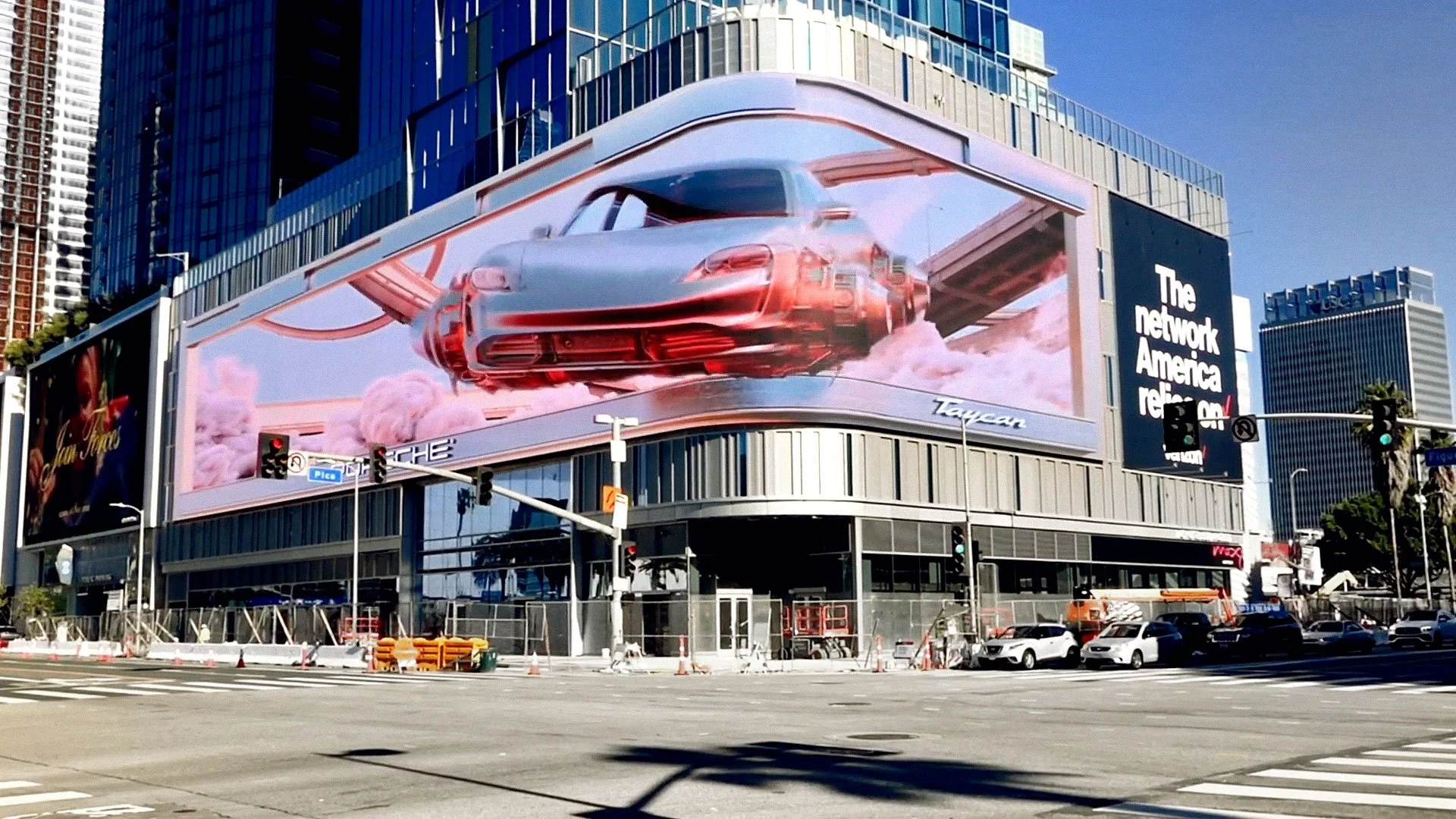
A 3D anamorphic billboard is a large LED display — almost always wrapping a building corner or installed on a curve — that shows content rendered with forced perspective techniques. From the intended viewing position, objects appear to float in front of the screen, punch through the surface, or occupy space the display doesn’t physically take up.
No glasses. No headset. No hologram. The effect comes from three pieces working together: a precisely shaped LED surface, a calibrated camera position during 3D rendering, and content where shadows, parallax, and occlusion all align for a single sweet spot viewer position.
Here’s the part that matters for procurement: you are buying a screen and a content pipeline, and they have to work as a system. Buying one without planning for the other is the most common procurement mistake in this category, and also the most expensive.
2. The hardware stack: what you're actually buying
When a manufacturer sends a quote for a 3D anamorphic LED display, the panels dominate the line items. But the panels are one piece of a stack that needs to function as a system.
2.1 What a complete installation actually includes
Behind the LED cabinets, you need a steel support structure engineered for wind load, seismic code, and the specific corner geometry. You need power distribution and conditioning, a media player or playback server, cooling if the display is enclosed, network gear for remote content management, and a monitoring system that alerts you when a cabinet goes dark.
The structural work alone can add 15 to 25 percent to your hardware cost, more if the host building needs reinforcement. Budget for it from day one, because it won’t appear in the panel quote.
2.2 Specs that matter and specs that don't
Manufacturers lead with pixel pitch. It’s a simple number, it sounds technical, and smaller always sounds better. Pixel pitch matters relative to viewing distance. A 10mm pitch display at 35 meters looks about the same as a 6mm pitch at the same distance, except the 6mm costs 40 percent more and draws more power. For outdoor corner displays where viewers stand 20 to 50 meters away, pixel pitches between 6mm and 12mm are the practical range. Fine pitch indoor installations at 2.5mm to 4mm make sense in retail and transit concourses where people walk within arm’s reach.
Other specs have a bigger impact on whether the display holds up over five years. Refresh rate gets overlooked constantly, and it matters more on a 3D billboard than on a standard one — these installations get filmed by every passerby with a phone. If your display shows scan lines or flicker on video, those viral moments look cheap. Aim for 3,840Hz minimum. Go to 7,680Hz if the installation might appear in professional broadcasts.
Brightness for outdoor needs to be 6,000 to 8,000 nits. A display rated at 5,000 nits looks bright on a showroom floor and washed out facing afternoon sun. Indoor displays in malls and airports work fine at 1,500 to 2,500 nits.
IP rating is where cheap quotes cut corners in ways that show up two years later. Outdoor front face: IP65 minimum. Rear: IP54 minimum. If a supplier proposes IP54 on the front face for outdoor use, that display is going to have problems.
3. What a 3D anamorphic billboard costs in 2026
Pricing on these installations isn’t transparent. Manufacturers rarely publish list prices, and two quotes for the same square meterage can differ by 40 percent. The numbers below are planning ranges, not offers. They’re built from the component level up, not pulled from a single manufacturer’s price sheet.
3.1 Three budget tiers
A small format indoor installation (15 to 25 square meters, retail or airport concourse, fine pitch 2.5mm to 4mm, single media player, moderate structural work) will typically land between $80,000 and $200,000 all-in. Content is extra.
A mid tier urban outdoor installation (40 to 70 square meters, outdoor rated cabinets at 6mm to 10mm pitch, structural steel, remote monitoring, power distribution) runs $300,000 to $700,000. Most brand owned installations sit in this range.
A premium landmark corner (80 to 150-plus square meters, high traffic city center site, custom structural engineering, redundant power, broadcast grade media servers) starts around $900,000 and can go past $2.5 million.
What pushes a project through each band isn’t really the LED cabinets themselves. It’s structural complexity, site access (crane rental, road closures, night work premiums), and permitting costs, all of which vary wildly by city.
3.2 Line items that hide outside the LED quote
Two quotes both showing “$5,000 per square meter” are not automatically comparable. One might exclude the steel structure, content licensing, installation labor, and the media player. The other includes them. Ask every supplier to break out at minimum: LED cabinets and receiving cards, sending units and media player, structural engineering and fabrication, installation labor and equipment, power distribution and conditioning, content management software licensing, and year one maintenance.
3.3 What a 30-second loop costs to produce
An original, studio produced 30 second 3D anamorphic loop from an established studio typically runs $15,000 to $60,000. Photorealistic character animation and complex particle work push toward the high end. Semi custom work built from existing templates lands at $4,000 to $12,000. Some studios now offer subscription models (refreshed content on a monthly or quarterly cadence) at roughly $1,500 to $3,500 per month.
The line item buyers most often forget: rendering time and revision rounds. A complex 3D scene corrected for a 50 meter viewing distance on an L shaped corner can require multiple test renders with on site calibration. Budget an extra 15 to 20 percent beyond the stated production fee for testing and tuning.
3.4 What it costs to keep running
Once the screen is live, the meter doesn’t stop. A 60-square-meter outdoor display burns roughly $6,000 to $14,000 per year in electricity depending on brightness, local rates, and duty cycle. Maintenance contracts typically run 8 to 12 percent of hardware cost annually. Content refresh — quarterly minimum for a brand owned display — adds another $10,000 to $40,000 per year depending on how you produce it.
4. Picking a location that earns back the investment
A mediocre screen in a great location will outperform the best screen in a dead zone. The physics of anamorphic content make location selection more consequential than it is for standard digital displays: the illusion works from a defined viewing cone, and if most of your audience walks outside that cone, they see a stretched, distorted image.
4.1 Corner wraps, curves, and why the shape matters
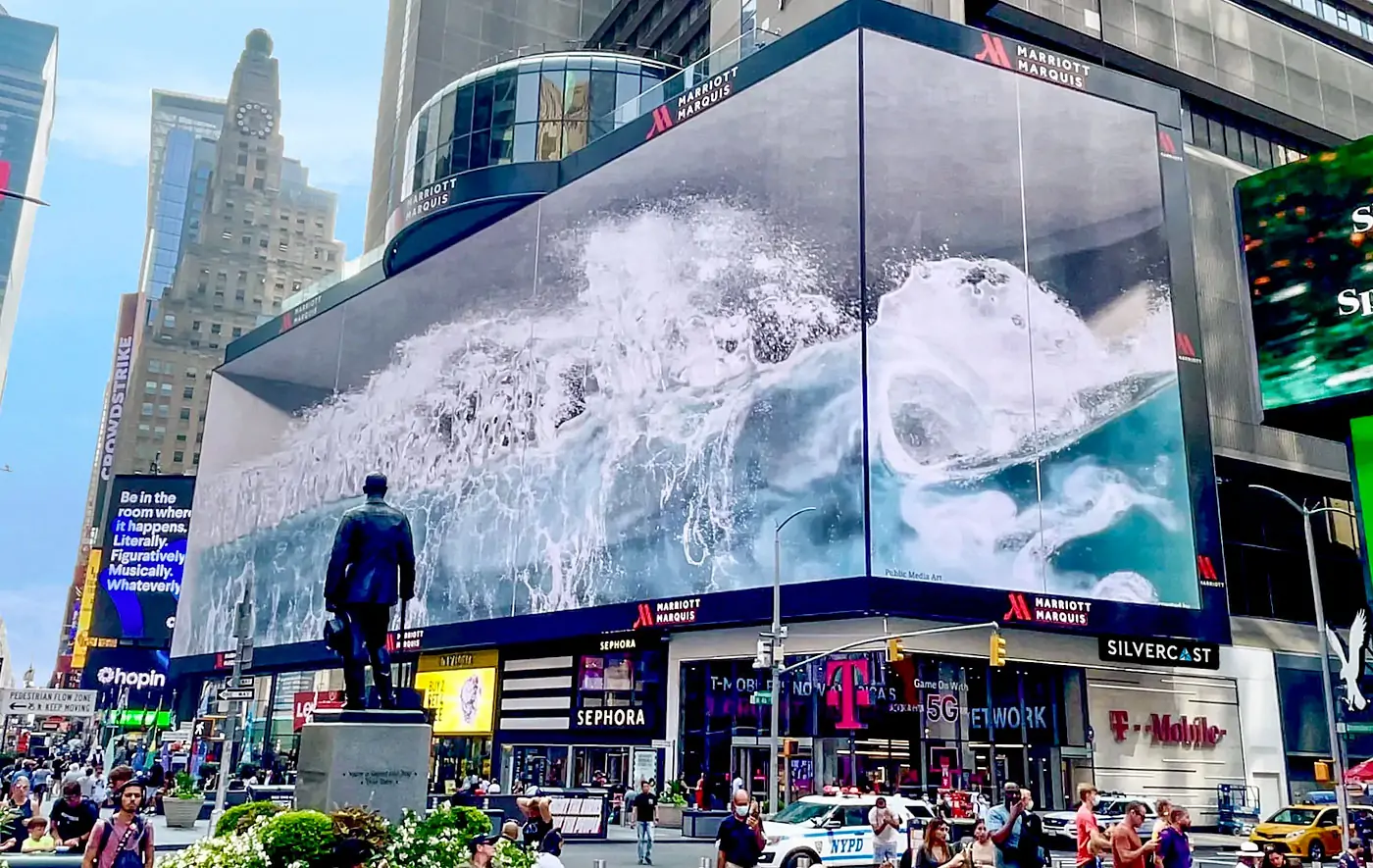
Corner wrap installations, where the LED surface covers both sides of a 90 degree building corner, produce the strongest illusion and the widest effective viewing angle. Content appears to exist in 3D space at the corner, and viewers approaching from either street get some version of the effect. The most famous installations (SM Town COEX in Seoul, the Shinjuku 3D Cat in Tokyo) are corner wraps for this reason.
Curved installations can work but need more precise content calibration, and the sweet spot is narrower. Flat single plane displays produce the weakest 3D effect. A flat screen showing 3D rendered content is a high end digital billboard, not a true anamorphic installation. Marketing it as “3D” sets expectations the content team won’t be able to meet.
4.2 How to read traffic numbers
The metric that pays the bills is effective dwell time impressions: people in the viewing cone, facing the screen, for long enough to process the content. Pedestrian count data from municipal sources or services like Geopath (in the US) or Route (in the UK) gives you a starting point, but you need to adjust it. What share of that foot traffic approaches from the intended viewing angle? What’s the average walking speed through the viewing zone? If your content’s core reveal takes five seconds and the average person clears the sweet spot in three, the content won’t land — doesn’t matter how good the render looks on a desktop monitor.
For vehicle oriented installations, shorter loops (8 to 12 seconds) with an instant visual hook are non negotiable. Drivers don’t get a slow build. They get a glance. The content has to work at that speed or it doesn’t work at all.
5. How to vet a supplier without getting burned
The LED display industry has a handful of tier 1 global brands with established support networks and verifiable installation histories: Absen, Unilumin, Leyard, Samsung. It also has hundreds of smaller manufacturers, concentrated in Shenzhen, where quality runs from “genuinely good value” to “panels that start failing at 18 months and a warranty that disappears.”
Who you pick as a supplier will affect your total cost of ownership more than which pixel pitch you pick. A mid tier panel from a company that answers the phone three years from now is worth considerably more than a premium panel from a company that doesn’t.
5.1 What certifications actually tell you
Every manufacturer can show you an ISO 9001 certificate. It means they have documented processes. It tells you almost nothing about panel quality. Certifications that carry more weight for outdoor 3D displays: ETL or CE listing for electrical safety, FCC for electromagnetic compliance, and (for European installations) EN12966 certification for variable message signs near traffic. If your site has significant wind exposure, ask whether the cabinets have been independently tested to local wind load code.
Request reference sites that have been operating for at least two years, not the one installed last quarter that still looks perfect. Call the reference. Ask what failed in year one. Something always fails in year one. The question that distinguishes good suppliers from the rest is whether they fixed it fast.
5.2 Questions to ask before signing
- Where are the LED chips sourced, and what binning tolerance do you guarantee? If the answer avoids the binning question, inconsistent brightness across cabinets will be visible from a block away.
- What’s the dead pixel threshold in the warranty? Industry norm is no more than 10 dead pixels per million in year one, with a defined remedy after that. If the warranty language doesn’t name a specific number, press for one.
- Who handles structural engineering and installation? Some manufacturers ship panels and consider their job finished. Others manage the full project. The gap between these two approaches is where projects go sideways.
- What’s your on site service response time for this city? A 72 hour response might be fine if the display sits near a maintenance depot. It’s a problem if you’re the only installation in the country.
- Will you manufacture compatible replacement modules in four to five years? LED technology moves fast. If a manufacturer discontinues a cabinet line after three years and you can’t get matching replacements, one damaged panel means a visibly mismatched screen or a full re skin.
- What’s excluded from the warranty? Power supplies, receiving cards, and labor are common exclusions. Know them before they surprise you, because they will.
6. The creative side: making anamorphic content that lands
People spend months picking hardware and then treat content as an afterthought. An expensive screen showing forgettable creative is a bad investment.
6.1 Why generic 3D renders fail on anamorphic screens
You cannot take a standard 3D animation, drop it on a corner display, and expect it to work. Anamorphic content is rendered from a single calibrated camera position that matches the intended viewing location. If the camera position in your 3D scene doesn’t match the geometry of the physical screen and the real world viewer position, shadows point wrong, parallax doesn’t line up, and nothing floats. It just looks like a regular video on a bent TV.
Studios that specialize in this (there are growing clusters in Seoul, Tokyo, Los Angeles, and London) typically require architectural drawings, a site survey with measured sightlines, and test render passes on the actual hardware before final delivery. This calibration process isn’t optional and it isn’t cheap. Budget for it separately from the creative fee.
6.2 In house vs studio: which makes sense
For a brand operating one installation, outsourcing to a studio almost always costs less than building an internal 3D team. A senior 3D artist with anamorphic experience runs $90,000 to $140,000 annually in a major market, plus software licenses, render infrastructure, and the reality that you still need a creative director to concept the work. For a media owner running five or more installations with monthly content rotations, the in house economics start to flip.
A practical middle ground: keep an art director or creative producer in house to manage briefs and brand consistency, and outsource the 3D production to a studio on retainer. You keep creative control without carrying a full production pipeline.
6.3 Content refresh cadence
For a brand owned display, quarterly refresh is the minimum to keep audiences from tuning out. Monthly is better if you’re using the screen as an earned media engine — new creative gives influencers and media outlets a reason to cover the installation again. Media owners selling ad slots typically rotate advertiser creative on campaign cycles of 4 to 12 weeks, with multiple advertisers in a scheduled loop across the day.
7. What buyers get wrong about 3D anamorphic billboards
I keep seeing the same assumption trip people up: treating the screen like it’s the whole investment. It’s closer to 40 percent. The rest is content, calibration, maintenance, and the operational discipline to keep the thing fresh. One retailer I know of dropped over $400,000 on a beautiful corner display and ran a stock Unreal Engine tech demo on it for eight months because nobody had allocated a content budget. The demo looked impressive. It sold nothing.
Another one that comes up often: buyers watch a campaign clip with 80 million views and build their business case around the assumption that their installation will earn similar organic reach. What’s invisible in that clip is the six figure influencer seeding and PR campaign behind it. The screen created the asset. The distribution strategy drove the virality. You need both.
Then there’s the timeline optimism. Manufacturer pitch decks commonly suggest 8 to 10 weeks from purchase order to launch. That timeline assumes structural engineering is finished, permits are issued, content is already produced, and nothing goes wrong with customs or weather. For first time buyers, a 16 to 24 week timeline is more realistic. Permitting alone — especially for outdoor corner installations in dense urban corridors — can burn a month before anyone touches a wrench. Treat anything shorter as luck, not a plan.
8. FAQs
1. How long does it take to install a 3D anamorphic billboard?
From signed PO to a working display, first time buyers should allow 16 to 24 weeks. That covers structural engineering sign off, permitting (usually the slowest part), LED cabinet manufacturing and shipping, steel fabrication, installation, content calibration, and commissioning. Indoor installations in prepared spaces with pre existing structural approvals can land closer to 10 to 14 weeks.
2. Can an existing LED billboard be converted to show 3D anamorphic content?
Depends on the screen. A standard flat LED display can show perspective content, but it will not produce the same spatial illusion as a corner wrap or curved installation. The effect is fundamentally tied to screen geometry. If your existing display happens to be on a corner or curve and meets the brightness and refresh specs, a content only upgrade is doable. If it’s flat, you are looking at a hardware change.
3. What's the minimum budget to get started?
For a small indoor corner display (15 to 20 square meters in a retail or event setting, with template based content), plan on roughly $80,000 to $120,000 all in for the first year: hardware, installation, and an initial content package. Outdoor installations at meaningful scale start closer to $300,000. If those numbers are out of reach, you are probably looking at a standard LED billboard rather than a 3D anamorphic setup — which might serve your goals fine, depending on what you’re trying to achieve.
4. Do 3D anamorphic billboards work in direct sunlight?
They do, with enough brightness behind them. Outdoor rated LED displays at 6,000 to 8,000 nits stay visible in direct sun. The anamorphic illusion is geometric (it comes from the relationship between content and screen shape, not from projected light), so ambient light doesn’t break it the way it would with a projection. One thing worth speccing carefully: anti reflective coatings. Glare at certain sun angles washes out shadow detail that the 3D effect depends on. It’s not a dealbreaker, but it’s the kind of thing you notice after the install and wish someone had mentioned.
5. How much electricity does one of these consume?
A 60 square meter outdoor display running at 6,000 to 7,000 nits typically draws 35 to 60 kilowatts, varying with how bright the content is (white dominant scenes pull more power than dark ones). At average US commercial rates, that’s roughly $8,000 to $16,000 per year. Indoor displays at lower brightness cost a lot less to run.
9. Summary
A 3D anamorphic billboard is not a screen purchase. It’s three things — hardware, content, and ongoing operations — and skimping on any one of them means the other two don’t pay back.
The buyers who get this right budget for content like it matters as much as the panels, pick locations based on foot traffic data rather than gut feel, and vet suppliers by calling reference sites instead of reading brochures. The format is still early, and in most cities nobody’s claimed the landmark corner yet. That won’t last.