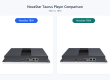


The NovaStar MX20 vs MX40 Pro decision is not simply “small controller versus large controller.” The MX20 is the better-value choice when a project fits its six Ethernet outputs, 3.9-million-pixel ceiling, and HD-class input workflow.
The MX40 Pro becomes the right tool when you need a 4K/HDR signal path, more than three layers, a very wide canvas, 12G-SDI, or the capacity and output flexibility required by large touring, broadcast, or virtual-production systems.
The mistake is choosing from the headline pixel count alone. Bit depth, frame rate, receiving-card model, per-port loading, and screen geometry can reduce the usable capacity.
Table of Contents
- Quick Verdict
- NovaStar MX20 vs MX40 Pro Specification Comparison
- Capacity Math: Check the Screen Before the Feature List
- Inputs and Image Processing
- Workflow, Redundancy, and Rack Practicalities
- Which Controller Fits Your Application?
- Common Selection Mistakes
- Final Decision Checklist
- Frequently Asked Questions
- Conclusion
1. Quick Verdict
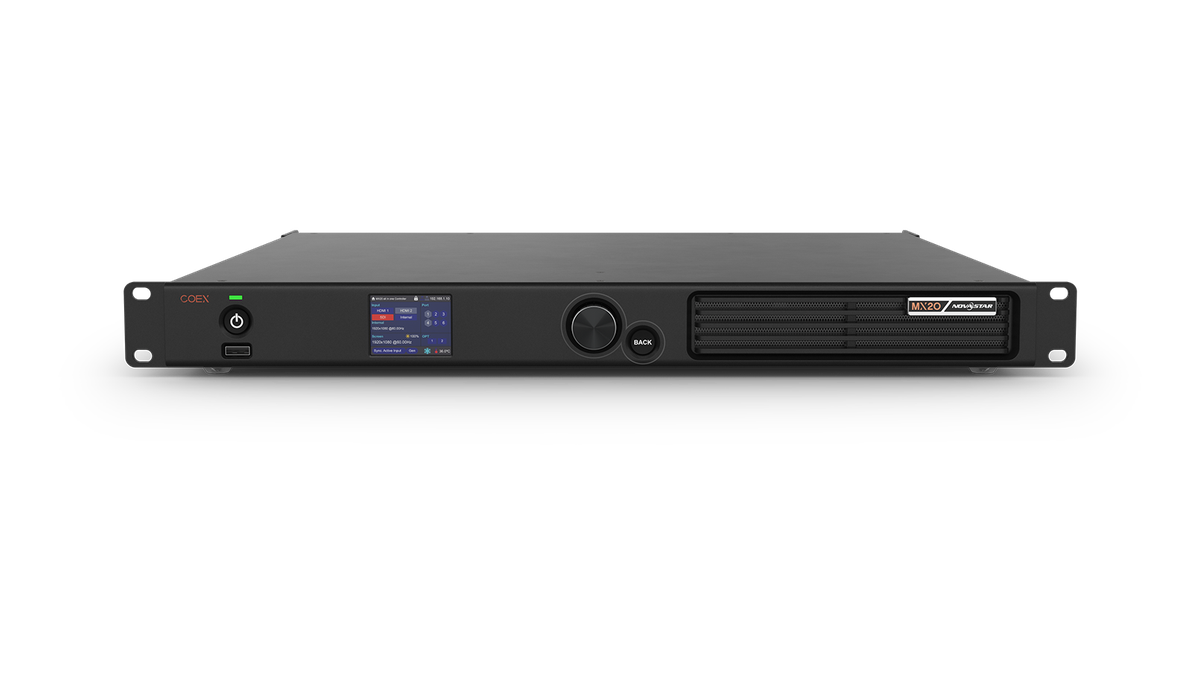
1.1 Choose the NovaStar MX20 if…
Choose the MX20 when all of the following are true:
- The LED canvas is comfortably below 3.9 million pixels after per-port calculations.
- Six Gigabit Ethernet outputs are enough for the cabinet map and backup plan.
- Your sources are HDMI 1.3 or 3G-SDI rather than native 4K HDMI, DisplayPort, or 12G-SDI.
- Three independent layers cover the required compositions.
- You want COEX features such as VMP control, Genlock, presets, frame-rate adaptation, full-grayscale calibration support, and sub-1 ms minimum processing latency without buying more controller than the project needs.
- A compact 1U chassis, lower power draw, and lower transport weight matter.
The MX20 is particularly strong for corporate stages, houses of worship, rental inventory for modest walls, broadcast confidence displays, and fixed installations with a known canvas and straightforward HD sources.
1.2 Choose the NovaStar MX40 Pro if…
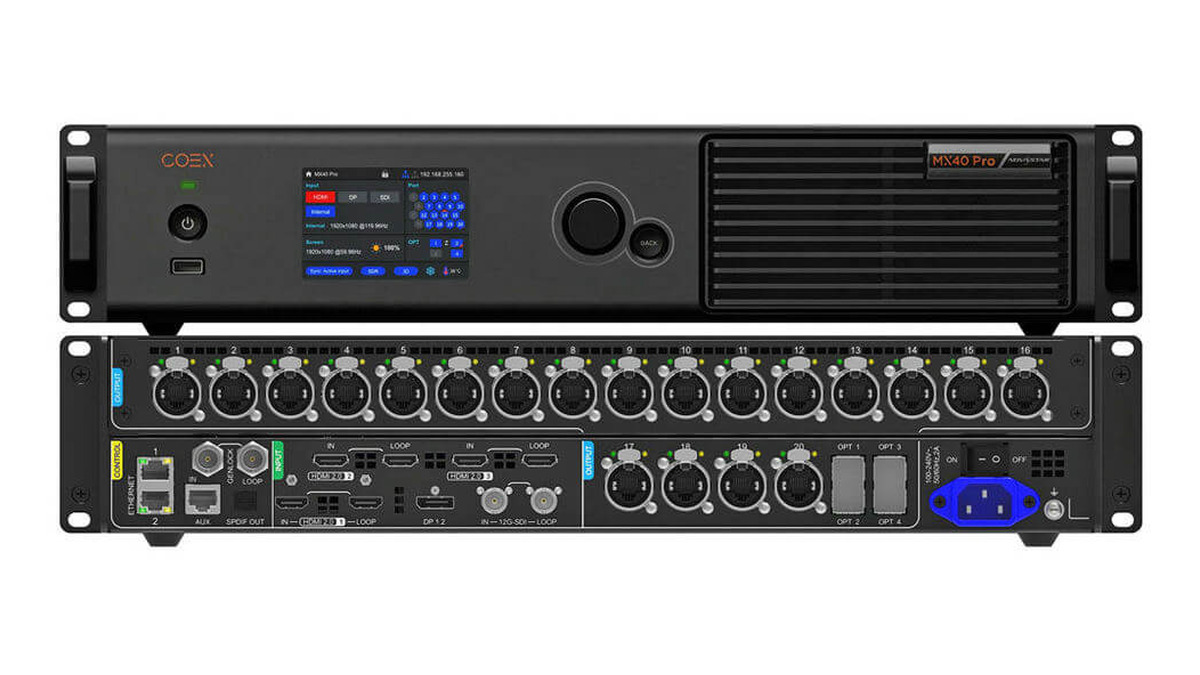
Choose the MX40 Pro when any of these requirements are non-negotiable:
- The canvas exceeds the MX20’s capacity, six-port count, or 4,096-pixel output width/height limit.
- You need HDMI 2.0, DP 1.2, or 12G-SDI inputs for a true 4K signal path.
- You need four independent 4K layers rather than three layers.
- HDR10, HLG, 3D LUTs, Color Curves, Color Replacement, Dynamic Booster, 3D, Shutter Fit, or frame multiplication is part of the production brief.
- The system needs 20 physical Gigabit Ethernet outputs or four 10G optical outputs with configurable 20-port/40-port optical modes.
- You are building an xR stage, broadcast studio, flagship touring package, or unusually wide creative display.
Bottom line: if the MX20 passes the capacity calculation and the production brief is HD/SDR, it is usually the more rational purchase. Buy the MX40 Pro for requirements the MX20 cannot satisfy, not merely for unused headroom.
2. NovaStar MX20 vs MX40 Pro Specification Comparison
The following table is based on NovaStar's official NovaStar MX20 specifications and NovaStar X40 Pro specifications.
| Specification | NovaStar MX20 | NovaStar MX40 Pro | Why it matters |
|---|---|---|---|
| Product position | All-in-one COEX controller | Flagship all-in-one COEX controller | Both combine processing and LED control in one chassis |
| Maximum device load | Up to 3.9 million pixels | Up to 9 million pixels | This is a ceiling, not a guarantee at every bit depth/frame rate |
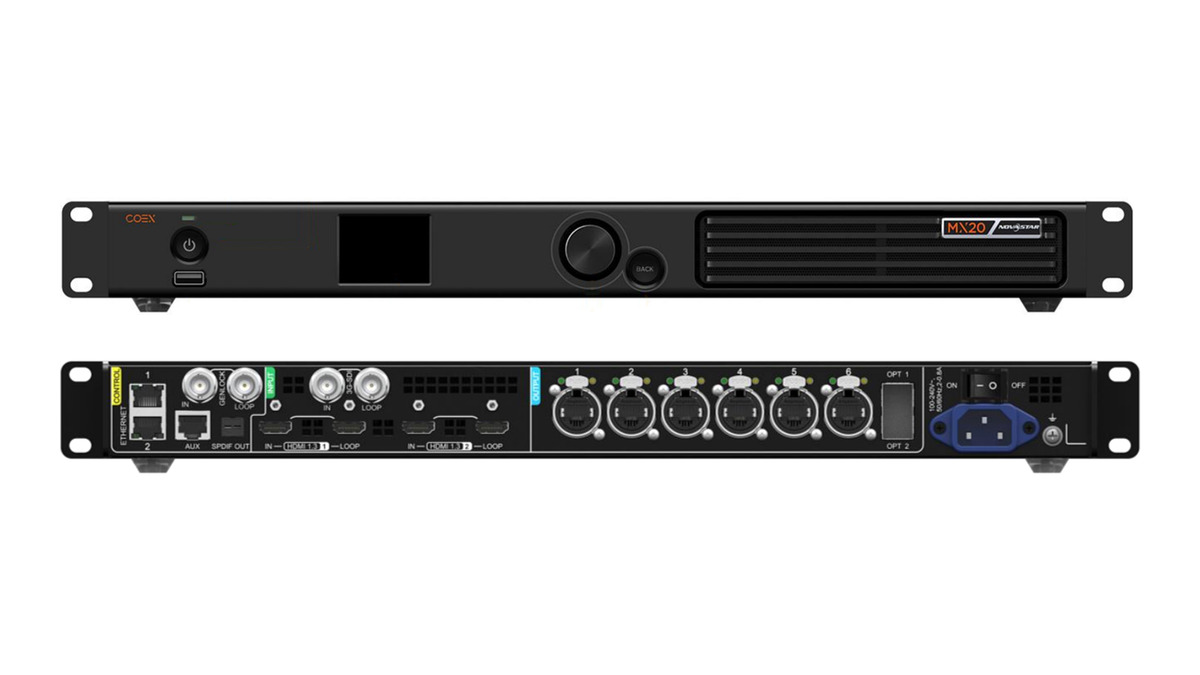
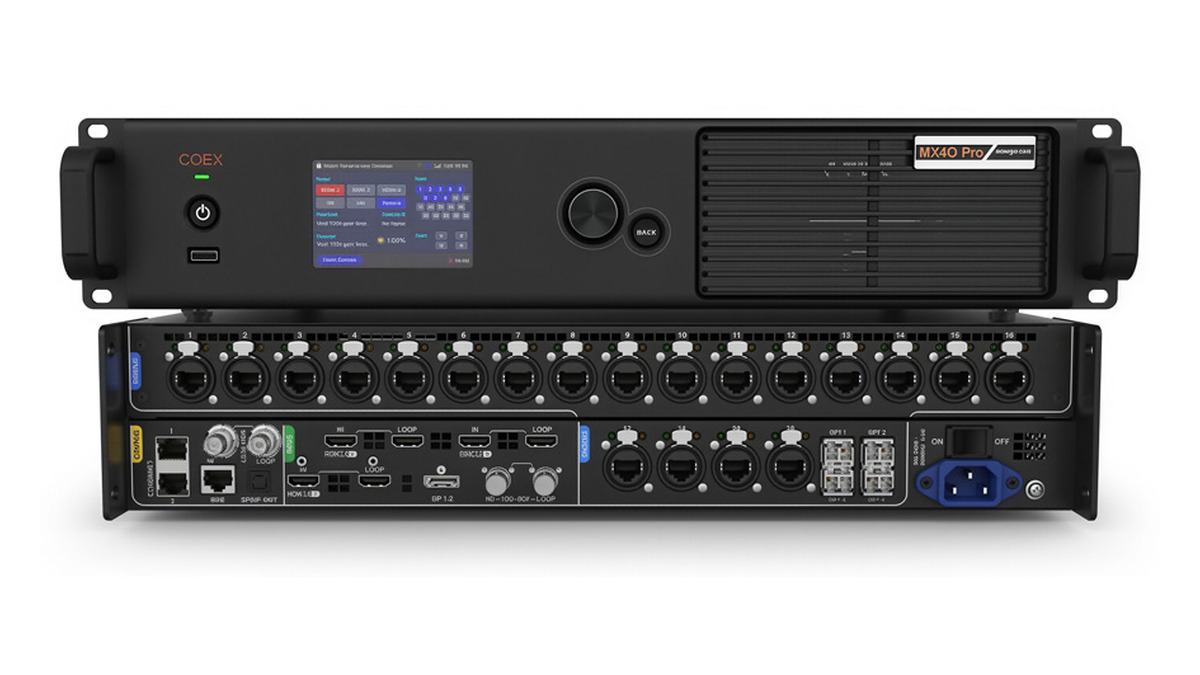
| Physical Ethernet outputs | 6 x Gigabit Ethernet | 20 x Gigabit Ethernet | More ports simplify large cabinet maps and distribution |
| Optical outputs | 2 x 10G | 4 x 10G; selectable 20-port or 40-port mode | Optical mode changes mapped output channels; it does not add physical RJ45 ports |
| Video inputs | 2 x HDMI 1.3 with loop; 1 x 3G-SDI with loop | 3 x HDMI 2.0 with loop; 1 x DP 1.2; 1 x 12G-SDI with loop | MX40 Pro accepts modern 4K production sources directly |
| Input bit depth | 8-bit and 10-bit | 8-bit, 10-bit, and 12-bit | Higher bit depth reduces banding but also affects port capacity |
| HDMI capability | Up to 1920 x 1200 at 60 Hz as the listed maximum; custom/forced canvases up to 3,840 px wide or 2,560 px high | Up to 4096 x 2160 at 60 Hz; forced ultra-wide inputs up to 8192 x 1080 at 60 Hz | Match the source format, not just the LED canvas |
| SDI capability | 3G-SDI, up to 1920 x 1080 at 60 Hz | 12G/6G/3G/HD-SDI, up to 4096 x 2160 at 60 Hz | MX40 Pro fits UHD broadcast chains without an external converter |
| Maximum output width/height | 4,096 pixels | 16,384 pixels | A narrow banner can exceed the MX20 limit despite a low total pixel count |
| Independent layers | 3 | 4 x 4K layers | Relevant for multi-source compositions inside the controller |
| HDR | Not listed | HDR10 and HLG | Required for managed HDR workflows |
| Advanced color tools | 14-channel correction; full-grayscale calibration support | Adds Color Replacement, Color Curves, 3D LUT, Dynamic Booster, HDR, and more | MX40 Pro is built for color-critical and camera-facing work |
| Camera/xR tools | Frame-rate adaptive operation; low latency | Adds Shutter Fit and frame multiplication up to 480 Hz | These tools target demanding camera capture workflows |
| Genlock | Input with loop-through | Input with loop-through | Both can synchronize to a production timing reference |
| Presets | Up to 128 | Up to 128 | Useful for repeatable show states and fast recalls |
| VMP / protocols | VMP; SNMP, Art-Net, central control | VMP; SNMP, Art-Net, central control | Core management workflow is shared |
| Minimum processing latency | 0-frame mode, less than 1 ms | 0-frame mode, less than 1 ms | Feature combinations and screen mapping still require validation |
| Chassis size | 482.6 x 49.9 x 384.0 mm | 482.6 x 94.2 x 467.0 mm | MX20 is approximately 1U; MX40 Pro is approximately 2U and deeper |
| Net weight | 4.5 kg | 7.5 kg | Important for fly packs and touring inventory |
| Maximum power consumption | 50 W | 95 W | Plan rack power and cooling accordingly |
| Typical noise at 25 degrees C | 36.2 dB(A) | 38.5 dB(A) | Relevant for quiet studios and control rooms |
| IP rating | IP20 | IP20 | Both require dry, protected indoor installation |
2.1 What is genuinely the same?
Both products belong to the COEX ecosystem and work with NovaStar’s VMP software. Both provide Genlock, 128 presets, irregular-screen loading without counting blank pixels, Ethernet-port hot backup, frame-rate adaptation, image scaling, 14-channel color correction, automated monitoring, and a minimum processing-latency mode of less than 1 ms.
That shared foundation is why the MX20 should not be dismissed as a basic sender. It offers much of the operational experience of the COEX platform. The MX40 Pro adds scale, source flexibility, and high-end image-processing tools.
2.2 Where does the MX40 Pro earn its premium?
The premium is justified when a project uses its additional capability: direct 4K inputs, 12-bit source handling, 20 Ethernet ports, wider canvases, four 4K layers, HDR, 3D LUT workflows, advanced camera tools, or extensive optical distribution. If none of those items appears in the system design, the MX20 may produce the same practical result with less rack space, power, weight, and cost.
3. Capacity Math: Check the Screen Before the Feature List
3.1 Start with total active pixels
Calculate the physical LED canvas first:
total active pixels = canvas width x canvas height
A 1920 x 1080 wall contains 2,073,600 pixels. A 3840 x 2160 wall contains 8,294,400 pixels. The first is below the MX20’s headline 3.9-million-pixel limit; the second requires the MX40 Pro based on total capacity alone.
Irregular canvases deserve special treatment. Both controllers support “no rectangle restriction,” so blank space around separated or shaped LED sections does not consume device capacity. Count the pixels in the cabinets that are actually loaded.
3.2 Then calculate per-port loading
The device total is only one constraint. NovaStar’s V1.5.1 tables specify these maximum values per Gigabit Ethernet port at 60 Hz:
| Output format at 60 Hz | A10s Pro/A8s Pro family | Other listed Armor-series receiving cards |
|---|---|---|
| 8-bit | 659,722 pixels per port | 659,722 pixels per port |
| 10-bit | 494,792 pixels per port | 329,861 pixels per port |
| 12-bit | 329,861 pixels per port | 329,861 pixels per port |
The MX20 does not accept a 12-bit video input, so the 12-bit row is mainly relevant to the MX40 Pro. At higher frame rates, per-port capacity falls further. At 120 Hz, for example, an A10s Pro/A8s Pro-family path is limited to 329,861 pixels per port at 8-bit and 247,396 at 10-bit.
This produces a counterintuitive result: a 1920 x 1080 wall distributed evenly over six MX20 ports needs about 345,600 pixels per port. It fits at 8-bit/60 Hz.
At 10-bit/60 Hz, it fits with A10s Pro/A8s Pro-family receiving cards, but it exceeds the 329,861-pixel per-port limit listed for other Armor-series cards. The display is under 3.9 million pixels, yet the detailed port calculation can still disqualify the design.
3.3 Do not ignore the overall device ceiling
Per-port arithmetic does not cancel the device limit. Twenty MX40 Pro ports at 659,722 pixels each would total more than 13 million pixels, but the controller remains capped at 9 million pixels. Conversely, 20 ports at 12-bit/60 Hz total only about 6.6 million pixels, so a full 3840 x 2160 canvas cannot be assumed to work at that format even though it is below the 9-million-pixel headline.
For commissioning headroom, avoid designing every output exactly at its mathematical maximum. Allow room for cabinet-map changes, redundancy, and narrow load areas. NovaStar notes that when a rectangular load area within a port is less than 128 pixels wide, capacity loss must be calculated as (128 - load width) x load height; multiple narrow areas accumulate additional loss.
3.4 Width can decide before pixel count does
The MX20’s maximum output width or height is 4,096 pixels, while the MX40 Pro supports up to 16,384 pixels. An ultra-wide ribbon measuring 8,000 x 240 pixels contains only 1.92 million pixels, but it exceeds the MX20’s output-dimension limit. This is a clear MX40 Pro application despite the modest total pixel count.
4. Inputs and Image Processing
4.1 MX20: an efficient HD/SDR signal path
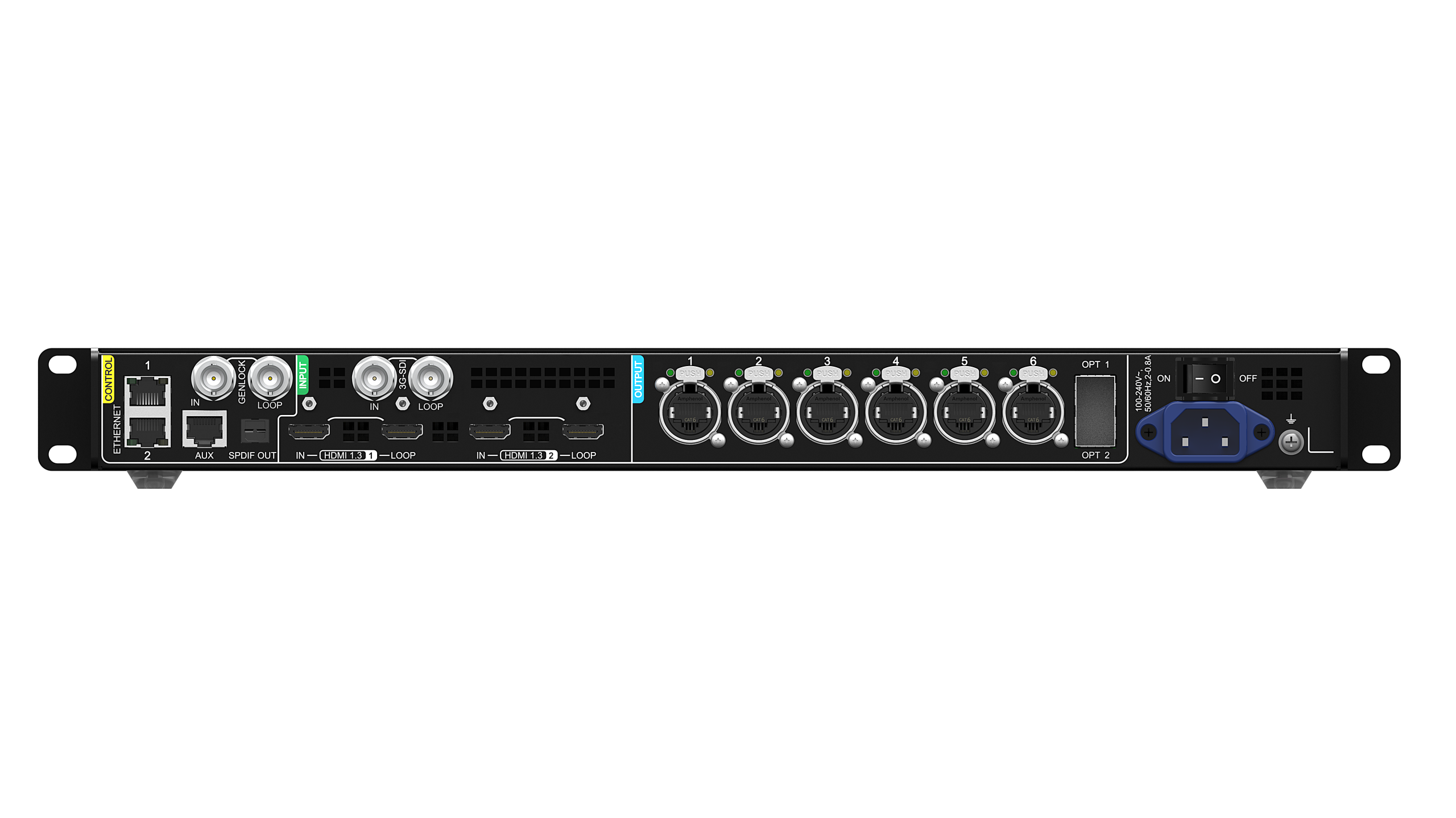
The MX20 accepts two HDMI 1.3 inputs and one 3G-SDI input, each with loop-through. NovaStar lists HDMI at up to 1920 x 1200 at 60 Hz under the connector’s maximum-resolution specification, with custom forced formats up to 3,840 pixels wide or 2,560 pixels high.
The detailed source table also lists 2560 x 1440 at 24/25/30 Hz, not 60 Hz. Its 3G-SDI path reaches 1920 x 1080 at 60 Hz.
That makes the MX20 a natural fit for HD switchers, media servers, presentation systems, and broadcast sources. If the production already ends in 1080p and does not require HDR, adding a flagship 4K controller may not improve the visible result.
4.2 MX40 Pro: 4K, HDR, and color-managed production
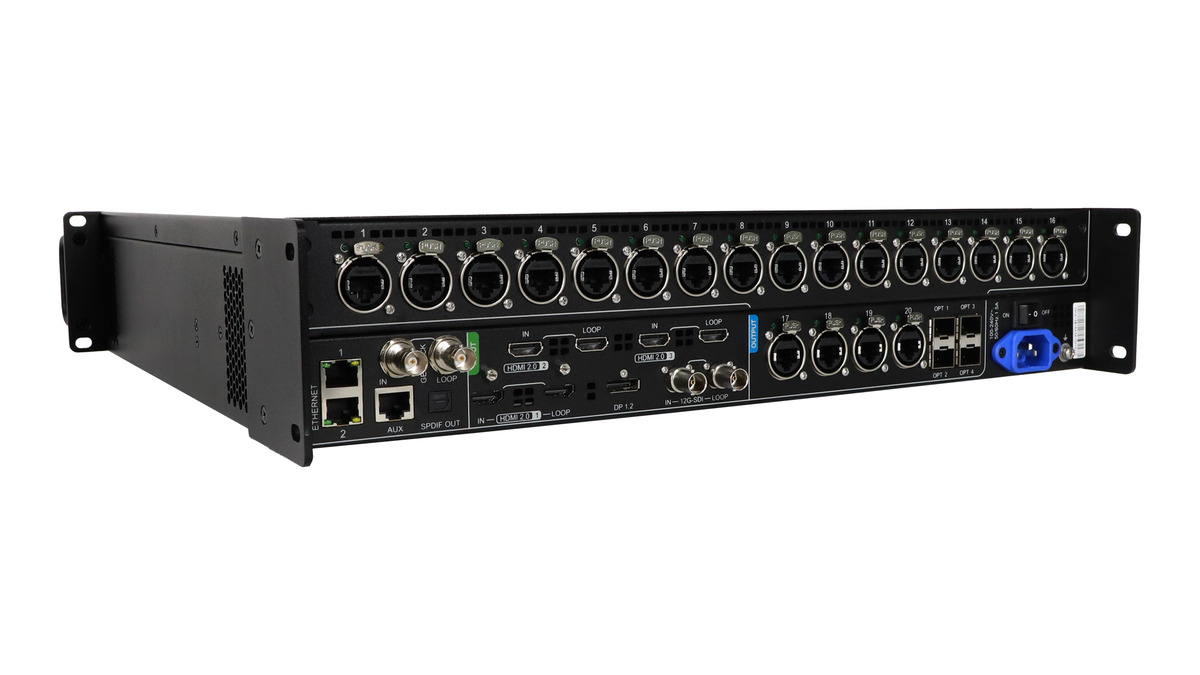
The MX40 Pro accepts three HDMI 2.0 sources, one DP 1.2 source, and one 12G-SDI source. HDMI and DP support up to 4096 x 2160 at 60 Hz, while forced ultra-wide HDMI formats can reach 8192 x 1080 at 60 Hz. The 12G-SDI input supports up to 4096 x 2160 at 60 Hz.
The higher-end processing is just as important as the connectors. The MX40 Pro adds:
- HDR10 and HLG for high-dynamic-range sources.
- 3D LUT import at 17-cube, 33-cube, or 65-cube precision.
- Color Curves and Color Replacement for source-specific adjustments.
- Dynamic Booster for frame-by-frame contrast/detail optimization with compatible receiving hardware and calibration equipment.
- Shutter Fit and frame multiplication for camera-facing and xR workflows.
- Four independent 4K layers for multi-source compositions.
These are production tools, not universal picture-enhancement buttons. NovaStar’s function-limitations table states that several features depend on specific receiving cards, driver ICs, cameras, colorimeters, NCP files, or mutually exclusive operating modes. Specify the complete signal-and-receiving chain before promising a feature to a client.
5. Workflow, Redundancy, and Rack Practicalities
5.1 Shared VMP operations reduce training differences
Both controllers use VMP for screen configuration, device management, and monitoring. Both also support SNMP, Art-Net, and central-control protocols, and both can cascade control connections over Ethernet without a separate switch for the supported topology.
For rental companies, this common workflow is valuable. Operators can move between MX20 and MX40 Pro systems without learning a completely different control environment. Standardized presets, receiving cards, firmware policy, and diagnostic procedures often matter more than adding one more headline feature.
5.2 Optical outputs need a topology plan
The MX20’s two 10G optical outputs carry the data for Ethernet ports 1-6, with the second optical port acting as a copy channel. The MX40 Pro has four 10G optical outputs and can use 20-port or 40-port optical modes. In 40-port mode, the optical outputs map channels 1-40, but the chassis still has only 20 physical RJ45 outputs.
Treat optical mode, physical Ethernet, and backup assignments as a designed topology. Do not count an optical copy or logical channel as an independent physical output without checking the manual and downstream fiber converter arrangement.
5.3 Rack and transport requirements are materially different
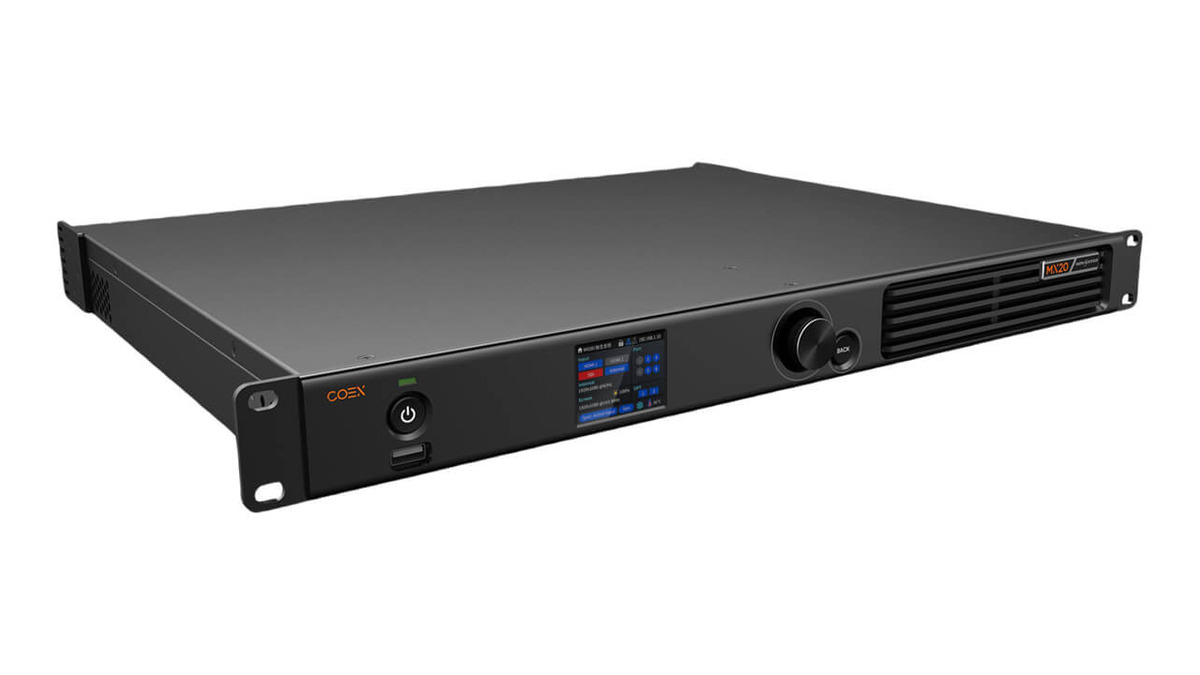
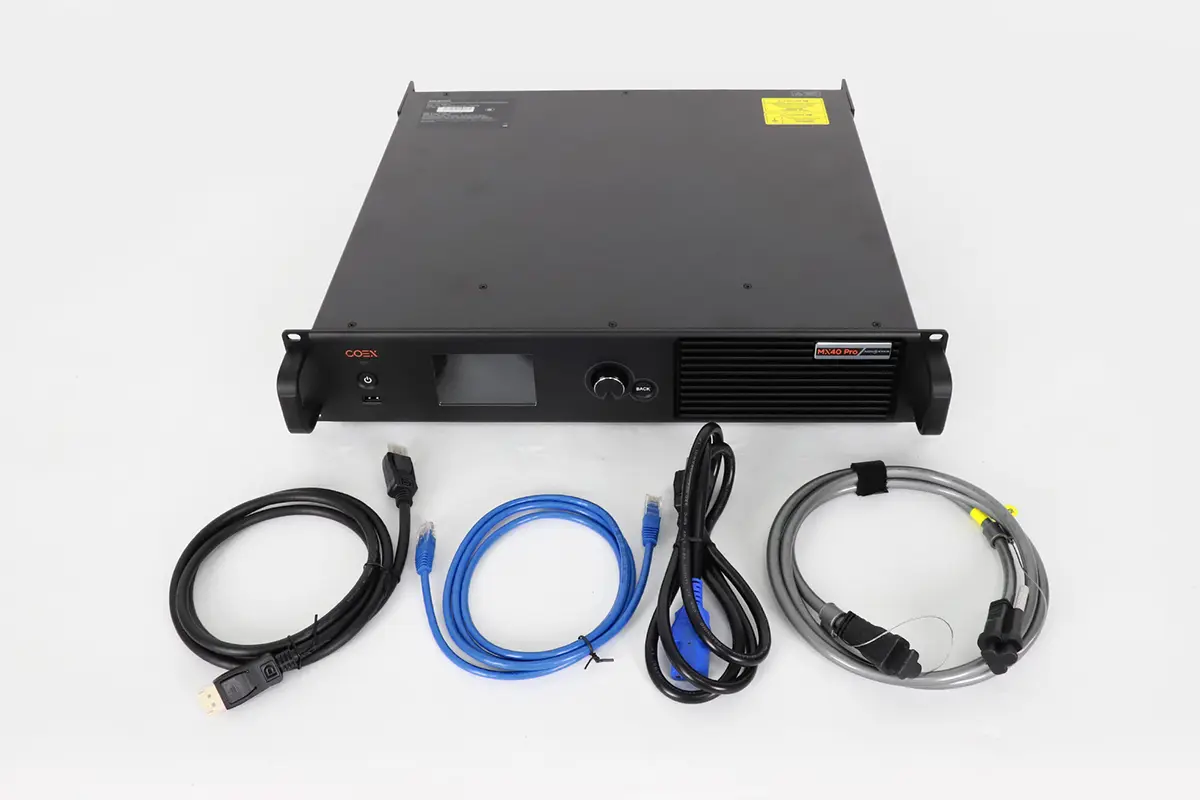
The MX20 is 49.9 mm high, 384 mm deep, weighs 4.5 kg, and consumes up to 50 W. The MX40 Pro is 94.2 mm high, 467 mm deep, weighs 7.5 kg, and consumes up to 95 W. The larger unit also has explicit flight-case requirements in the V1.5.1 document.
For a touring rack, check usable depth behind the front rails, cable bend radius, rear support, ventilation, and flight-case structure. For a quiet studio, note the published typical noise levels of 36.2 dB(A) for MX20 and 38.5 dB(A) for MX40 Pro at 25 degrees C.
6. Which Controller Fits Your Application?
6.1 Corporate events and houses of worship
For a 1920 x 1080 or similarly sized main wall fed from an HD switcher, the MX20 is often the right starting point. Verify per-port load at the chosen bit depth and receiving-card family, then confirm whether three layers are enough. Its 1U chassis and lower weight are helpful in compact racks.
Choose the MX40 Pro when the same venue needs native 4K inputs, more complex in-controller compositions, multiple large canvases, or an ultra-wide output above 4,096 pixels.
6.2 Broadcast studios
An HD studio working in 3G-SDI can use the MX20, especially for smaller walls and confidence displays. A UHD studio built around 12G-SDI, HDR, 3D LUTs, or a large camera-facing LED background should select the MX40 Pro. Direct 12G-SDI avoids adding a converter solely to enter the controller.
6.3 Virtual production and xR
The MX40 Pro is the clear choice for most serious xR stages because it provides Shutter Fit, frame multiplication, 4K inputs, greater loading capacity, wider output dimensions, and advanced color tools. Confirm the required receiving cards, driver ICs, NCP files, Genlock design, camera/colorimeter workflow, and feature compatibility before procurement.
The MX20 can still serve small camera-facing environments where the project needs Genlock, low latency, and frame-rate adaptation but does not require the MX40 Pro’s specialized xR features.
6.4 Touring and rental inventory
The decision depends on the jobs the rack must cover. The MX20 is efficient for a fleet of repeatable, modest canvases and can increase the number of deployable systems per budget. The MX40 Pro is the more flexible flagship when one rack must accept varied 4K sources, drive large or unusual canvases, and support demanding camera workflows.
For broader system planning, review EagerLED's commercial LED display solutions and outdoor LED display guide. These resources help connect controller capacity with cabinet type, installation environment, viewing distance, and service requirements.
7. Common Selection Mistakes
7.1 Buying from the 3.9M or 9M number alone
Headline capacity ignores per-port load, bit depth, frame rate, receiving-card family, and narrow-load-area losses. Calculate all of them.
7.2 Confusing input resolution with LED output dimensions
Input resolution describes the video signal entering the controller. Output width/height and active pixel count describe the LED canvas. A controller can scale a source, but both sides of the system must independently fit their limits.
7.3 Assuming every advanced feature works in every mode
On the MX40 Pro, low latency cannot be enabled simultaneously with Genlock, 3D, or frame multiplication. Other features require specific receiving cards and calibration hardware. Build a compatibility matrix for the exact show mode.
7.4 Treating optical ports as extra free capacity
Optical outputs transport mapped Ethernet-channel data. Their modes and copy relationships do not override the controller’s pixel ceiling or automatically create additional physical copper outputs.
7.5 Specifying without system headroom
A design at the mathematical limit has little tolerance for cabinet-map changes, backup ports, higher bit depth, or future content formats. Leave documented engineering margin and validate the final .scr/screen configuration in VMP before the equipment reaches site.
8. Final Decision Checklist
8.1 Five calculations to complete
Before requesting a quote, document:
- Active LED width, height, and total physical pixels.
- Required source formats, including connector, resolution, frame rate, bit depth, color sampling, and HDR/SDR status.
- Receiving-card models and the maximum pixels assigned to every output port.
- Maximum output width/height and any narrow cabinet regions under 128 pixels wide.
- Backup, fiber, and control topology, including which outputs are active or redundant.
8.2 Four workflow questions to answer
Then ask the production team:
- Are three layers enough, or are four 4K layers required?
- Do we need HDR, 3D LUT, Dynamic Booster, Shutter Fit, 3D, or frame multiplication?
- Which functions must run simultaneously, and does NovaStar permit that combination?
- Does the rack meet space, depth, cooling, power, noise, and transport requirements?
If the MX20 passes every calculation and workflow question, choose it with confidence. If it fails even one hard constraint, move to the MX40 Pro or redesign the system.
9. Frequently Asked Questions
9.1 Is the NovaStar MX40 Pro always better than the MX20?
It is more capable, but it is not always the better purchase. For a modest HD/SDR wall that fits six ports and three layers, the MX20 can provide the required COEX workflow with less rack space, power, weight, and cost. The MX40 Pro is better when its capacity, 4K connectivity, layers, or advanced processing are required.
9.2 Can the NovaStar MX20 handle a 4K LED wall?
A standard 3840 x 2160 LED canvas contains 8.29 million pixels, so it exceeds the MX20’s 3.9-million-pixel device capacity. The MX20 can accept certain custom or lower-frame-rate input formats beyond 1920 x 1200, but input capability does not increase its LED output capacity.
9.3 Can the MX40 Pro drive a full 4K canvas at 12-bit and 60 Hz?
Do not assume so from the 9-million-pixel headline. NovaStar lists 329,861 pixels per port at 12-bit/60 Hz. Across 20 ports, that is about 6.6 million pixels, below the 8.29 million pixels in a 3840 x 2160 canvas. Validate the final source format, receiving cards, mapping, and controller configuration.
9.4 Do both controllers support Genlock and low latency?
Yes. Both list Genlock input with loop-through and a minimum 0-frame processing mode of less than 1 ms. However, NovaStar states that low latency cannot operate with Genlock. The MX40 Pro also prevents low latency from operating simultaneously with 3D and frame multiplication.
9.5 Which NovaStar controller is better for virtual production?
The MX40 Pro is generally the stronger xR/virtual-production choice because it adds Shutter Fit, frame multiplication, 4K/HDR inputs, greater pixel capacity, 3D LUT support, and advanced color controls. The complete system must use compatible receiving cards, driver ICs, calibration tools, timing, and VMP/NCP configurations.
10. Conclusion
In the NovaStar MX20 vs MX40 Pro comparison, choose the MX20 when your LED canvas fits within 3.9 million pixels and needs no more than six Ethernet outputs, three layers, or HD/SDR inputs. It provides the core COEX and VMP workflow in a compact, efficient chassis.
Choose the MX40 Pro for larger canvases, 20 Ethernet outputs, native 4K inputs, HDR, four 4K layers, advanced color tools, or xR workflows. Before purchasing, verify total pixels, canvas dimensions, bit depth, frame rate, receiving cards, and per-port loading. Select the controller that meets every requirement with practical headroom.