

Most LED display cabinets use one of five structural materials: die-cast aluminum, fabricated aluminum, steel (often called an iron cabinet), magnesium alloy, or carbon-fiber composite. For rental LED screens, die-cast aluminum is usually the practical default because it balances manageable weight, repeatable precision, quick-lock compatibility, and durability. Steel suits cost-sensitive fixed installations where the support structure and corrosion protection are designed for the load. Fabricated aluminum reduces weight for many fixed projects, while magnesium alloy and carbon fiber are specialized choices when further weight reduction justifies higher cost and more complex repair planning.
Material alone does not determine waterproofing, flatness, or service life. Compare the finished cabinet’s weight per square meter, manufacturing tolerance, surface treatment, service route, locks, spare-part availability, and complete-enclosure IP test evidence.
On this page: material comparison | what material changes | five cabinet materials | real cabinet data | how to specify | FAQ
LED Display Cabinet Material Comparison
| Material / process | Finished weight | Precision | Relative cost | Typical use | Main watch-out |
|---|---|---|---|---|---|
| Die-cast aluminum | Light | High and repeatable | Medium to high | Rental, touring, fine-alignment systems | Tooling cost and model-specific repair parts |
| Fabricated aluminum | Light to medium | Medium to high | Medium | Indoor or outdoor fixed displays | Welding and machining consistency |
| Steel / iron cabinet | Heavy | Medium | Low | Permanent fixed and large outdoor screens | Shipping, structural load, and corrosion control |
| Magnesium alloy | Very light | High | High | Weight-critical rental or touring systems | Supplier availability, finish, and repair method |
| Carbon-fiber composite | Very light | Design dependent | Very high | Premium touring and specialized creative screens | Impact inspection, inserts, repair, and replacement cost |
These are practical tendencies, not guarantees. Wall thickness, ribs, locks, power-box design, rear covers, and manufacturing process can outweigh the raw material advantage.
What the Cabinet Material Actually Changes
Finished weight and structural load
Raw density explains only the starting point. The Royal Society of Chemistry lists pure magnesium at 1.74 g/cm3, aluminum at 2.70 g/cm3, and iron at 7.87 g/cm3. Actual cabinets use alloys, coatings, fasteners, electronics, and different wall geometries, so these figures should explain direction rather than predict finished weight.
Ask suppliers for both kilograms per cabinet and kilograms per square meter. A 500 x 1000 mm cabinet can weigh more per piece than a 500 x 500 mm cabinet yet still be lighter per square meter. For hanging screens, the structural calculation must include cabinets, modules, rigging bars, power boxes, cables, and an appropriate safety factor.
Flatness, seam control, and repeated assembly
Die casting can create repeatable locating features, lock seats, and cabinet geometry in one production process. That repeatability is valuable for rental systems that are assembled and dismantled frequently. Fabricated frames can also perform well, but welding, machining, and inspection consistency become more important.
Do not accept a material label as proof of screen flatness. Request the cabinet tolerance, inspect a multi-cabinet sample, and check seams under real content from normal viewing positions. Positioning pins and locks must keep alignment after repeated use, not only during the first factory assembly.
Heat, corrosion, and ingress protection
Aluminum and magnesium alloys can support efficient heat paths, but cabinet temperature depends on the complete design: power density, airflow, contact surfaces, rear-cover design, ambient temperature, brightness, and operating hours. Steel cabinets can also be reliable when thermal paths and ventilation are engineered correctly.
Likewise, an aluminum cabinet is not automatically waterproof. IEC 60529 classifies protection provided by the complete enclosure under the IP Code. Ask for the tested front and rear protection grades, sealing details, connector ratings, drainage design, and corrosion treatment for the finished assembly.
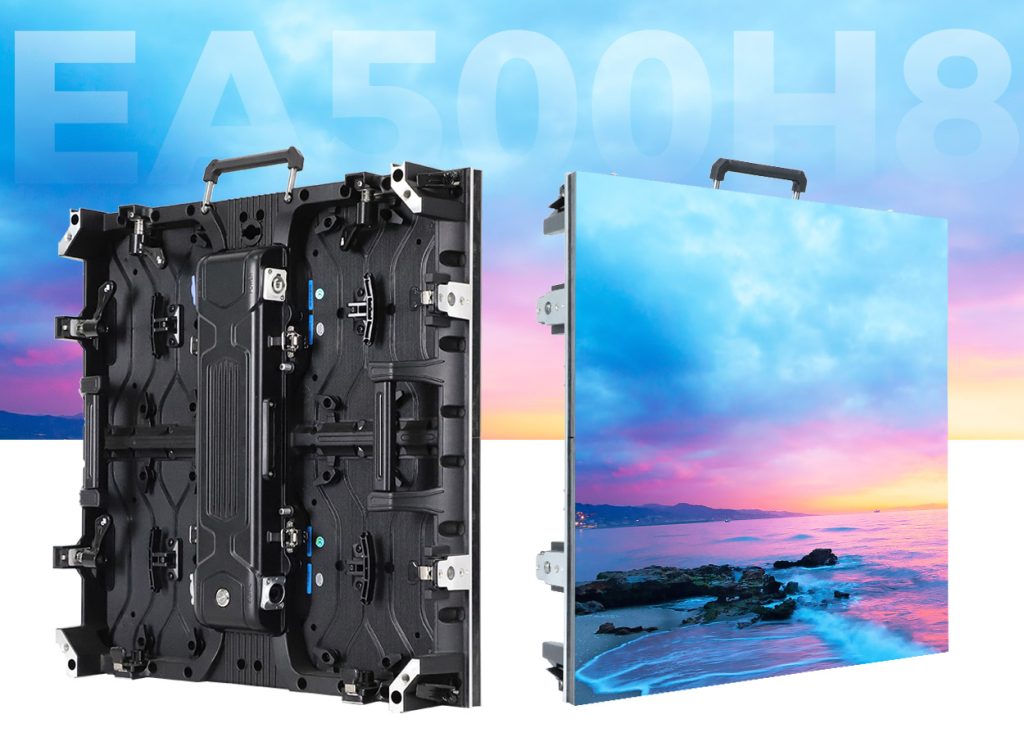
EA500H8 rental cabinet: current indoor and outdoor 500 x 500 mm configurations.
The 5 Main LED Display Cabinet Materials
1. Die-cast aluminum cabinets
Best for: rental stages, exhibitions, touring events, and projects that need repeatable alignment and fast assembly.
Die-cast aluminum is the most common premium rental-cabinet choice. It supports integrated quick locks, positioning pins, handles, corner protectors, curved locks, and detachable power boxes. The controlled molding process helps manufacturers repeat the same geometry across production batches, which supports clean seams and interchangeable units.
Check more than the alloy name. Confirm cabinet weight, lock cycle durability, corner protection, module compatibility, front or rear service access, spare power-box availability, and whether 500 x 500 mm and 500 x 1000 mm units can mix in the same system.
2. Fabricated aluminum cabinets
Best for: fixed indoor displays, wall-mounted screens, and outdoor installations that need less weight than steel.
Fabricated aluminum cabinets may use profiles, plates, machining, and welding instead of a single die-cast body. They can be customized without the same die tooling investment and are useful for project-specific dimensions. Quality depends heavily on material thickness, reinforcement, welding distortion control, machining, and final inspection.
Ask how flatness is checked after welding and finishing. Also confirm how dissimilar fasteners, coatings, and outdoor exposure are handled to reduce galvanic corrosion risk.
3. Steel cabinets, often called iron cabinets
Best for: permanent outdoor billboards and cost-sensitive fixed installations where transport frequency is low.
The LED industry often uses the term “iron cabinet” for a fabricated steel enclosure. Steel is mature, strong, widely available, and economical. It is much heavier than aluminum or magnesium at the raw-material level, so the support frame, lifting plan, shipping cost, and installation labor need more attention.
For outdoor use, specify surface preparation, coating system, drainage, fastener protection, and maintenance intervals. Low purchase price is not a saving if corrosion treatment, structural steel, or installation labor is under-scoped.
4. Magnesium-alloy cabinets
Best for: weight-critical rental and touring applications where logistics savings justify a higher cabinet price.
Magnesium’s lower raw density creates real lightweight potential, but the finished result still depends on the alloy, wall design, ribs, locks, covers, and attached electronics. Confirm the exact finished cabinet weight and normalize it by area before comparing it with aluminum alternatives.
Also verify surface treatment, part availability, approved repair procedure, supplier continuity, and whether mixed-material fasteners or inserts have been engineered for the operating environment.
5. Carbon-fiber composite cabinets
Best for: premium touring systems, large suspended screens, and specialized projects where every kilogram matters.
Carbon-fiber composite is not a metal. Its performance depends on fiber orientation, resin system, laminate design, inserts, edge protection, and manufacturing quality. It can provide excellent stiffness-to-weight performance, but purchase price, impact inspection, field repair, and replacement lead time are normally more demanding than for metal cabinets.
Request the load path, fastener-insert design, allowable damage criteria, inspection procedure, and repair documentation. A lightweight specification without a service plan is incomplete.
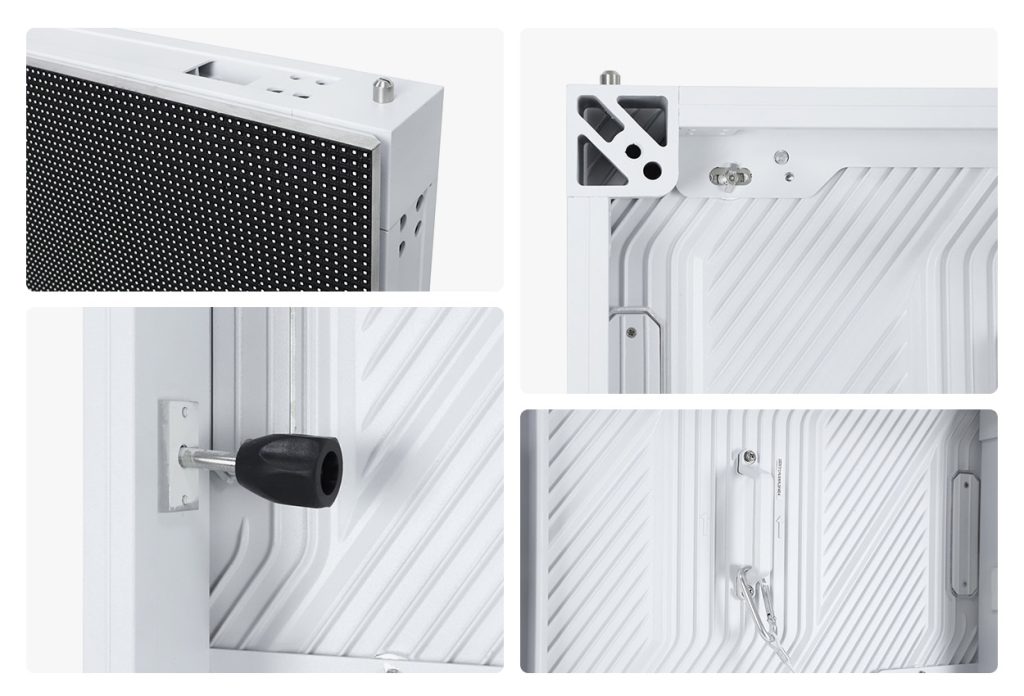
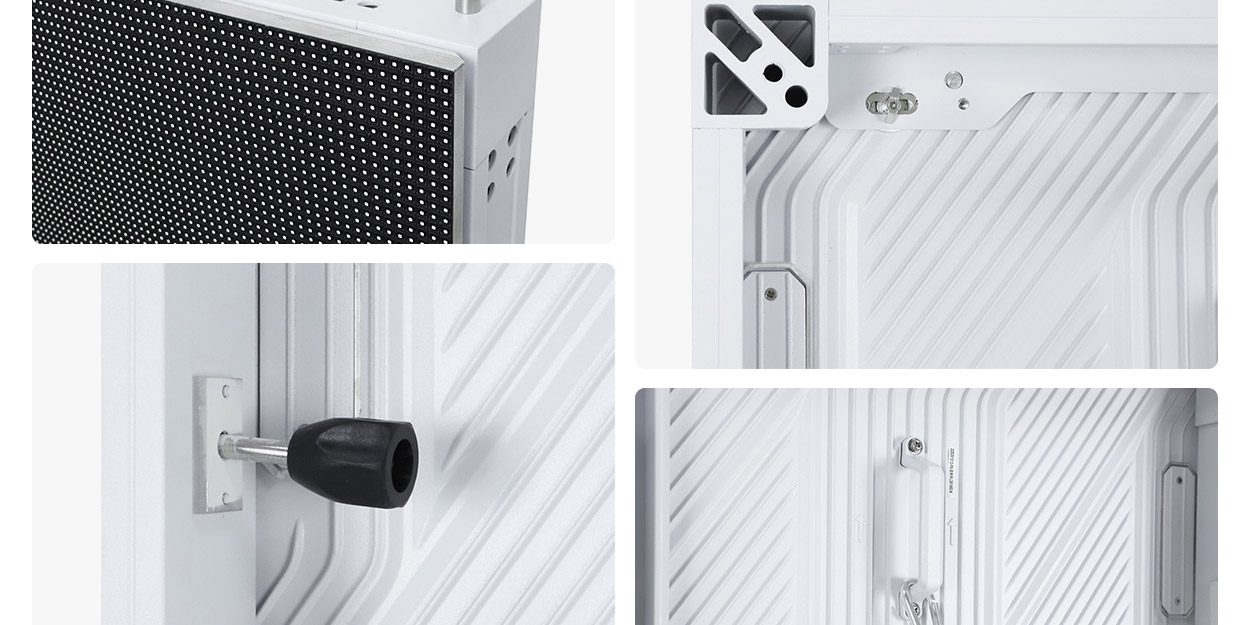
EA960F4 aluminum advertising cabinet with quick locks, positioning pins, and module safety tethers.
Real EagerLED Cabinet Data: Compare kg/m2, Not Only kg per Piece
To make the comparison practical, EagerLED normalized four current cabinet configurations by face area. The calculation is cabinet weight divided by cabinet width x height. It covers the listed cabinet only and excludes rigging, flight cases, external cabling, and supporting structure.
| Cabinet example | Size | Listed weight | Approx. kg/m2 | Published protection detail |
|---|---|---|---|---|
| EA500H8 indoor | 500 x 500 mm | 6.3 kg | 25.2 kg/m2 | IP31 |
| EA500H8 outdoor | 500 x 500 mm | 6.5 kg | 26.0 kg/m2 | IP65 front / IP54 rear |
| EA960F4 | 960 x 960 mm | 25.3 kg | Approx. 27.5 kg/m2 | IP65 |
| EA1000F2 | 1000 x 1000 mm | 28.4 kg | 28.4 kg/m2 | IP65 |
What this shows: piece weight alone can mislead. EA500H8 is easiest to handle per cabinet, while the larger fixed-installation cabinets cover far more display area per piece. Use kg/m2 to compare shipping and structural load, then use piece weight to evaluate handling and installation. A serious quotation should show both.
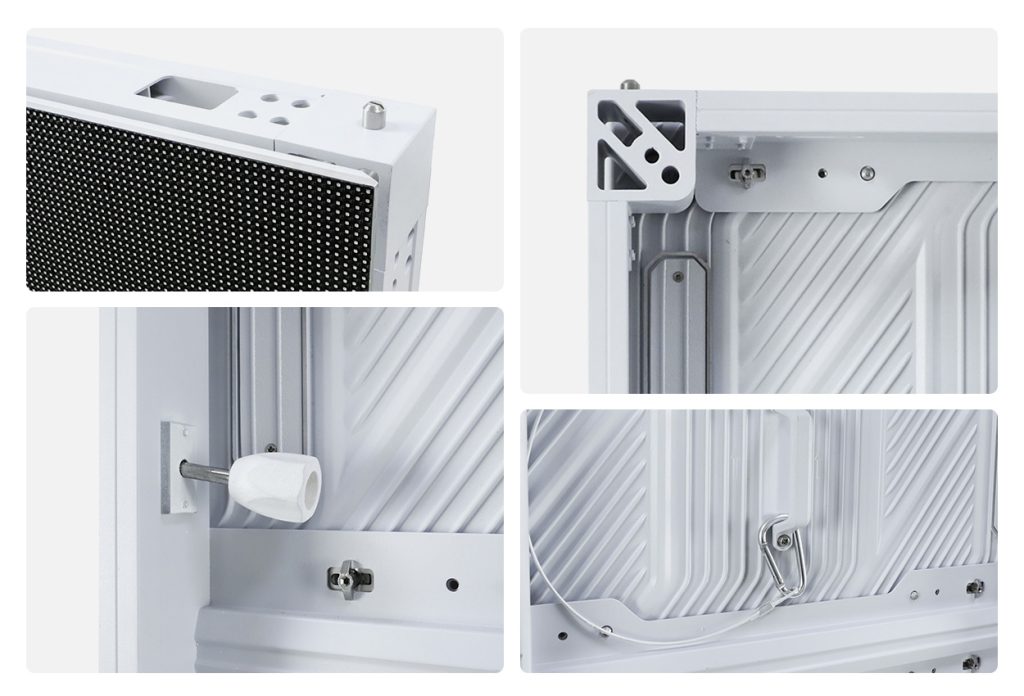
EA1000F2 1000 x 1000 mm aluminum cabinet: compare both piece weight and area-normalized weight.
How to Specify an LED Display Cabinet Material
- Define the application. Record indoor or outdoor use, fixed or rental operation, hanging or stacking, assembly frequency, viewing distance, operating hours, ambient conditions, and transport method.
- Set the service route. Confirm whether modules, power supplies, receiving cards, and cables must be removed from the front, rear, or both sides after installation.
- Compare normalized weight. Request cabinet dimensions, weight per piece, and kg/m2. Add rigging and supporting structure before approving a suspended system.
- Verify geometry and hardware. Review drawings, cabinet tolerance, module alignment, locks, locating pins, handles, corner protectors, and compatibility between cabinet sizes.
- Separate material from weatherproofing. Request front and rear IP ratings for the complete enclosure, connector ratings, sealing details, drainage, coatings, and corrosion test information appropriate to the project.
- Plan maintenance and spares. Confirm repair methods, spare cabinet availability, compatible production batches, replacement lead time, and whether specialized materials can be serviced locally.
- Inspect a multi-cabinet sample. Test seams, locks, service access, thermal behavior, noise, and image performance under realistic content and viewing conditions.
This page focuses on materials. For cabinet types, standard sizes, maintenance methods, quantity calculations, and a complete procurement checklist, see EagerLED’s LED Display Cabinet Buyer’s Guide.
Common Material-Selection Mistakes
- Comparing only kg per cabinet: different face areas make the number misleading. Normalize to kg/m2.
- Assuming aluminum means IP65: IP classification applies to the complete enclosure, not the material name.
- Choosing the lightest option without a repair plan: logistics savings can be lost through long replacement lead times or specialized repairs.
- Ignoring production consistency: a strong material cannot compensate for poor welding, machining, locks, or inspection.
- Using one cabinet specification for every environment: indoor and outdoor versions can have different weights, seals, brightness, and service layouts.
Frequently Asked Questions
Which LED display cabinet material is best?
There is no universal best material. Die-cast aluminum is usually the best balance for rental screens; fabricated aluminum suits many lighter fixed installations; protected steel is practical for permanent, cost-sensitive projects. Magnesium alloy and carbon fiber are specialized options when lower weight is valuable enough to justify higher cost and more complex sourcing.
Why is die-cast aluminum common in rental LED screens?
Rental screens need repeated assembly, accurate seams, quick locks, manageable handling weight, and replaceable units. Die casting supports repeatable cabinet geometry and integrated hardware. The final decision should still be based on measured cabinet weight, tolerance, lock durability, service access, and spare availability.
Is magnesium alloy lighter than aluminum?
At the pure-element level, the Royal Society of Chemistry lists magnesium at 1.74 g/cm3 and aluminum at 2.70 g/cm3. Finished cabinets use alloys and different geometries, so compare the supplier’s actual kg per cabinet and kg/m2 rather than applying the raw-density ratio directly.
Does an aluminum LED cabinet automatically have an IP65 rating?
No. IP ratings describe the protection provided by a complete enclosure under IEC 60529. Seams, rear covers, connectors, ventilation, gaskets, drainage, and assembly quality all affect the result. Confirm separate front and rear ratings and the test evidence for the exact cabinet version.
What data should every cabinet quotation include?
Request material and manufacturing process, cabinet dimensions, weight per piece and kg/m2, module and pixel-pitch compatibility, front/rear service access, front/rear IP ratings, flatness or tolerance, lock and connector details, surface treatment, operating limits, drawings, spare-parts plan, warranty, and replacement lead time.
Sources and Methodology
This comparison was reviewed on August 31, 2026. Raw material densities are cited from the Royal Society of Chemistry and are used only to explain direction. IP terminology is based on IEC 60529. EagerLED example weights, dimensions, and protection grades come from the current EA500H8, EA960F4, and EA1000F2 public specification pages. The kg/m2 figures are EagerLED calculations based on those published cabinet dimensions and weights; they exclude rigging, external cabling, flight cases, and supporting structure.
- Royal Society of Chemistry: Magnesium
- Royal Society of Chemistry: Aluminium
- Royal Society of Chemistry: Iron
- IEC 60529: Degrees of protection provided by enclosures
- EagerLED EA500H8: 500 x 500 mm rental cabinet specifications
- EagerLED EA960F4: 960 x 960 mm aluminum cabinet specifications
- EagerLED EA1000F2: 1000 x 1000 mm aluminum cabinet specifications
Need a cabinet recommendation for a real project? Share the screen size, pixel pitch, indoor/outdoor environment, installation method, service route, and delivery schedule. EagerLED can compare cabinet weight, structure, and maintenance requirements before quotation.