

Walk up close to a fine-pitch LED wall. Smooth, seamless, no visible dots? That’s COB. Can count individual pixels at arm’s length? SMD. Surface feels like glass? Someone spec’d GOB. None of these are inherently better. They solve different problems at different price points, and LED packaging technology — how LED chips are mounted, connected, and protected on a circuit board — determines which problem you’re solving. Pick wrong and you pay for it in repair costs, image quality, or both.
1.What is LED Packaging Technology?
2.Six Major LED Packaging Technologies
3.LED Packaging Technology Comparison At a Glance
4.How Packaging Technology Shapes What Viewers Actually See
5.How to Choose the Right LED Packaging Technology
6.LED Packaging Technology by Application
7.LED Packaging Technology FAQs
8.Conclusion
1. What is LED Packaging Technology?
LED packaging technology refers to how individual LED chips are assembled, electrically connected, and physically protected on a printed circuit board. The “package” is the interface between the semiconductor chip and the outside world. It provides electrical connection, thermal management, mechanical protection, and optical control over how light leaves the chip.
In the LED display industry, packaging technology is the single biggest determinant of pixel pitch capability, durability, repairability, and cost. As pixel pitches have shrunk from P10 to P0.4 over the past decade, packaging has evolved from through-hole DIP assemblies to surface-mount SMD to fully encapsulated COB panels. Each generation solved the problems created by the previous one while introducing new trade-offs of its own.
2. Six Major LED Packaging Technologies
2.1 DIP — Dual In-line Package
DIP LED packaging technology is the oldest packaging method still in use. Individual LED chips are mounted on metal lead frames, inserted through holes drilled in the PCB, and wave-soldered from the back. Each pixel is a discrete through-hole component, typically 5 mm or larger in diameter.
DIP displays are bright, rugged, and cheap. They are also bulky, power-hungry, and incapable of fine pixel pitches — P2.5 is about the practical floor, and even that requires extremely tight component spacing. Viewing angles are narrow, typically 60 to 90 degrees horizontally. You still see DIP in large outdoor billboards and perimeter displays where viewing distance is measured in tens of meters and nobody cares about pixel density. For anything indoors or closer than 20 meters, DIP is obsolete.
2.2 SMD — Surface-Mount Device
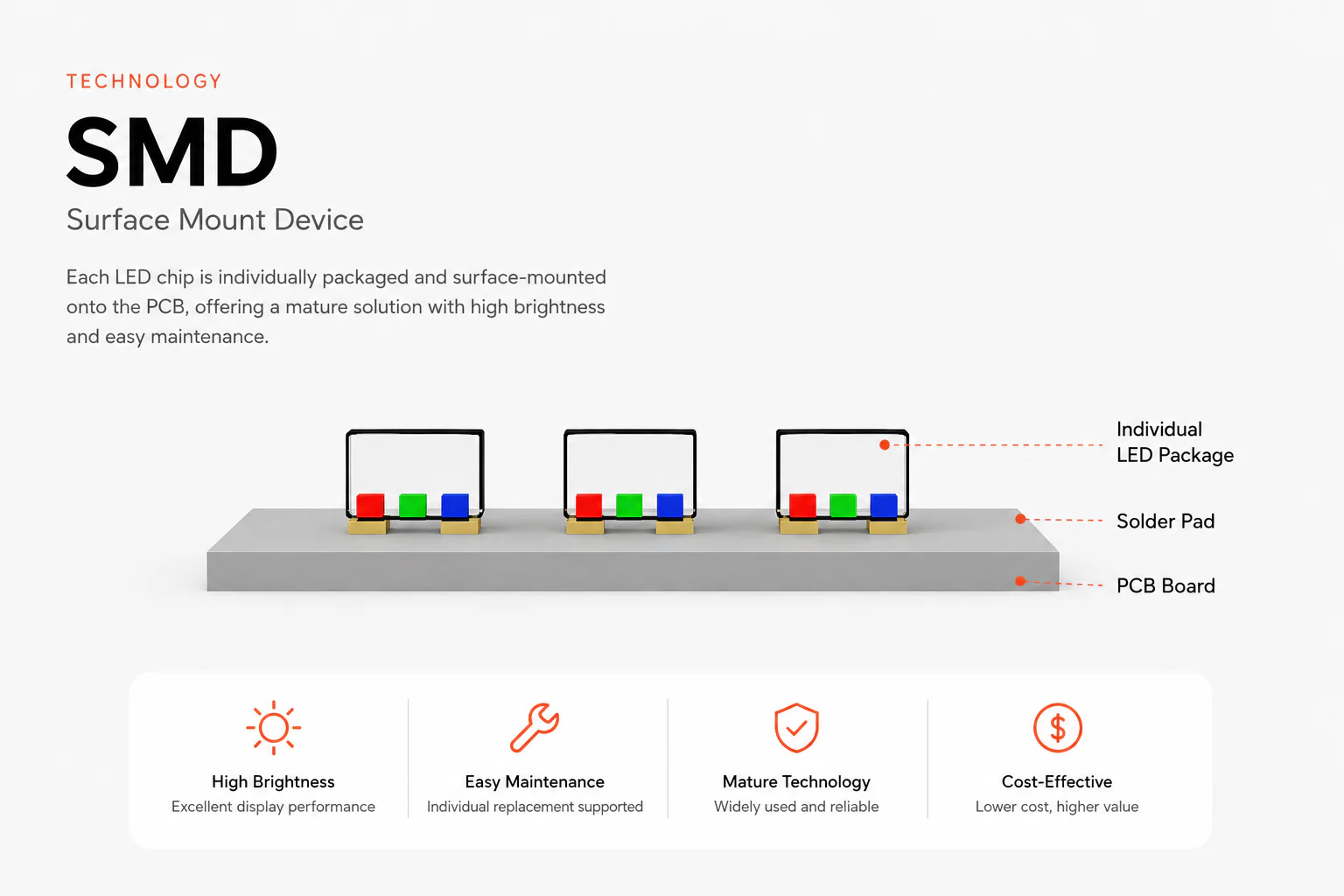
SMD is the industry workhorse. RGB LED chips are pre-packaged into small plastic “lamp beads” — typically 2 to 5 mm across — and soldered onto the PCB surface using automated pick-and-place machines. Each bead contains the red, green, and blue chips for one pixel.
SMD LED packaging technology covers the widest pixel pitch range of any technology: P1.0 through P10 and beyond. It’s cost-effective, bright (1,500 to 2,000 nits), and supports wide viewing angles of 120 to 160 degrees. Individual dead pixels can be replaced on-site in about 15 minutes with a $12 to $15 replacement bead. The supply chain is mature and competitive, which keeps pricing in check.
The downsides are physical. Solder joints are exposed and vulnerable to impact, moisture, and thermal cycling. At close viewing distances under 2 meters, individual pixels are visible as discrete points — the “screen door effect.” Static contrast ratios hover around 1,200 to 1,800:1, which is fine for general signage but inadequate for broadcast or control rooms. And as pixel pitch drops below P1.0, the SMD beads become mechanically fragile and increasingly expensive to manufacture.
2.3 IMD — Integrated Matrix Device
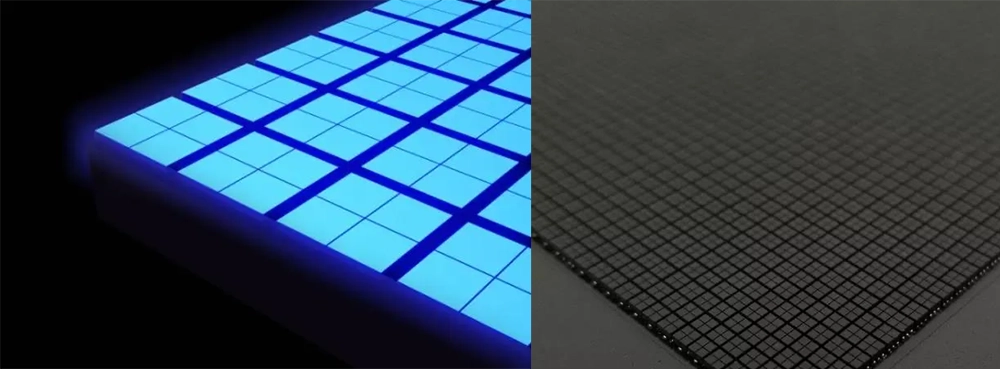
IMD is a transitional technology that bridges SMD and COB. Multiple pixels (typically 2×2, or “4-in-1”) are integrated into a single package, which is then surface-mounted like an SMD bead. The idea is to get some of COB’s pixel density and durability benefits while staying on standard SMT production lines.
IMD LED packaging technology achieves finer pitches than conventional SMD — down to about P0.6 — without requiring the complete manufacturing overhaul that COB demands. It also improves impact resistance compared to individual SMD beads since the larger package distributes mechanical stress across multiple pixels.
The limitation is color uniformity. Because multiple pixels share a single package, individual sub-pixels cannot be binned separately. If one red chip in a 4-in-1 package is slightly off, all four pixels in that package show the deviation. Below P0.6, the approach runs into the same physical scaling limits as SMD. IMD is best understood as a cost-optimized stepping stone: better than SMD for fine pitch, cheaper than COB, but not the long-term endpoint for either.
2.4 GOB — Glue On Board
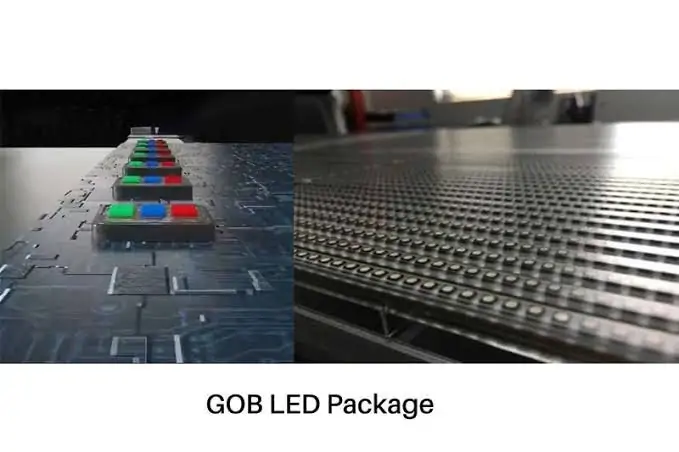
GOB is not a standalone packaging technology but a protective treatment applied on top of SMD. After the SMD module is fully assembled, a layer of transparent epoxy or polyurethane resin is poured over the entire surface, encapsulating every LED bead under a continuous protective shield.
The result is an SMD display with dramatically improved durability. Impact resistance increases roughly eightfold. Moisture and dust ingress protection reaches IP65 or better at the module surface, even if the cabinet itself is not sealed. The resin layer diffuses point-source light slightly, reducing moiré patterns and softening the pixel grid for a more comfortable close-up viewing experience. Surface cleaning becomes trivial — a damp cloth wipes the flat face clean.
The trade-offs are cost and repairability. GOB LED packaging technology adds 10 to 20 percent to the module cost over bare SMD. When an LED fails, the cured resin must be removed before the bead can be replaced, which is slow and risks damaging adjacent pixels. Over very long timeframes (five-plus years), some resin formulations can yellow slightly under UV exposure, though modern materials have improved significantly on this front.
2.5 COB — Chip On Board
COB eliminates the individual LED package entirely. Bare LED chips are bonded directly to the PCB substrate, wire-bonded for electrical connection, and then the entire board surface is encapsulated in a single monolithic resin layer. There are no individual lamp beads, no exposed solder joints, and no gaps between pixels.
The result is a display that looks fundamentally different from SMD. There is no screen door effect at any distance. The surface emits light as a continuous plane, with static contrast ratios of 5,000 to 8,000:1 and viewing angles approaching 180 degrees. The direct chip-to-board thermal path improves heat dissipation by roughly 30 percent compared to SMD, contributing to longer lifespan — typical ratings exceed 80,000 hours with annual failure rates under 0.5 percent.
COB LED packaging technology is the dominant technology for fine-pitch indoor applications between P0.4 and P1.5. Control rooms, broadcast studios, XR virtual production stages, luxury retail, and museum installations all gravitate toward COB because close-up image quality is non-negotiable in those environments.
The downsides are cost and repair logistics. COB modules cost roughly 2.5 times more per square meter than equivalent SMD at common pitches. When a pixel fails, you cannot replace an individual LED. The entire module must be swapped, which costs $300 or more and requires downtime. Peak brightness tops out around 800 to 1,200 nits, which limits COB’s suitability for direct-sunlight outdoor applications. And color batch consistency requires precise factory calibration — field adjustments are limited.
2.6 MIP — Micro LED in Package
MIP is the newest entrant and the one most likely to define the next five years of LED packaging technology. Micro LED chips are wafer-level tested, binned, and pre-encapsulated into standardized RGB units, which are then mounted using conventional SMT equipment. This combines the quality advantages of chip-level binning with the manufacturing efficiency of surface-mount assembly.
MIP LED packaging technology targets pixel pitches from P0.2 to P0.6 — territory where even COB struggles. Black ratio exceeds 99 percent, producing exceptional contrast. Individual pixel packages are modular and replaceable, solving COB’s repair problem. And because the technology is SMT-compatible, manufacturers can adopt it without the massive capital investment that COB lines require.
MIP is still scaling. Volumes are lower than SMD or COB, so per-unit costs remain high — roughly three times SMD at comparable resolutions. Precision alignment tolerances at sub-P0.4 pitches are unforgiving, and not every contract manufacturer has the equipment to hit them reliably yet. But major LED brands are investing heavily in MIP production lines, and costs are falling faster than COB costs did at the same stage of maturity. For ultra-fine-pitch applications where image quality, repairability, and manufacturing scalability all matter, MIP is the direction the industry is heading. If you are spec’ing a display below P0.6 today, MIP is effectively the only game in town that lets you replace individual pixels in the field.
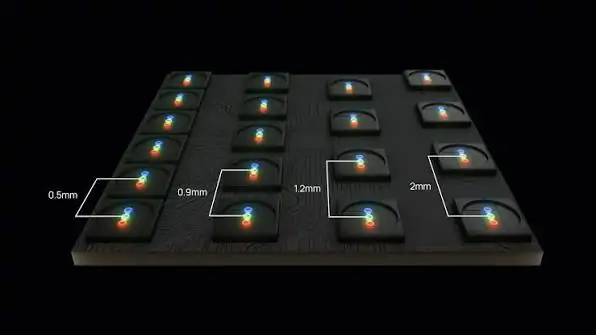
3. LED Packaging Technology Comparison At a Glance
| Technology | Pixel Pitch Range | Relative Cost | Durability | Repairability | Best Viewing Distance |
|---|---|---|---|---|---|
| DIP | P2.5–P20+ | 0.5× | Moderate | Easy (bead-level) | 20 m+ |
| SMD | P1.0–P10+ | 1.0× (baseline) | Low–Moderate | Easy (bead-level) | 3 m+ |
| IMD | P0.6–P1.5 | 1.3× | Moderate | Moderate (package-level) | 2 m+ |
| GOB | P1.2–P10+ | 1.2× (over SMD) | High | Difficult | 2 m+ |
| COB | P0.4–P1.5 | 2.5× | Very High | Module-level only | 0.5 m+ |
| MIP | P0.2–P0.6 | 3.0×+ | High | Modular (package-level) | 0.3 m+ |
4. How Packaging Technology Shapes What Viewers Actually See
LED packaging technology directly changes the visual experience in ways anyone standing in front of the display can notice.
Contrast and black levels. COB and MIP achieve static contrast ratios of 5,000:1 and higher because the continuous resin surface absorbs ambient light instead of reflecting it off individual bead surfaces. SMD contrast tops out around 1,800:1 — fine for bright retail where ambient light washes out blacks anyway, but visibly gray in dark-room conditions. For a broadcast studio or a control room running dark-mode dashboards, the difference is not subtle.
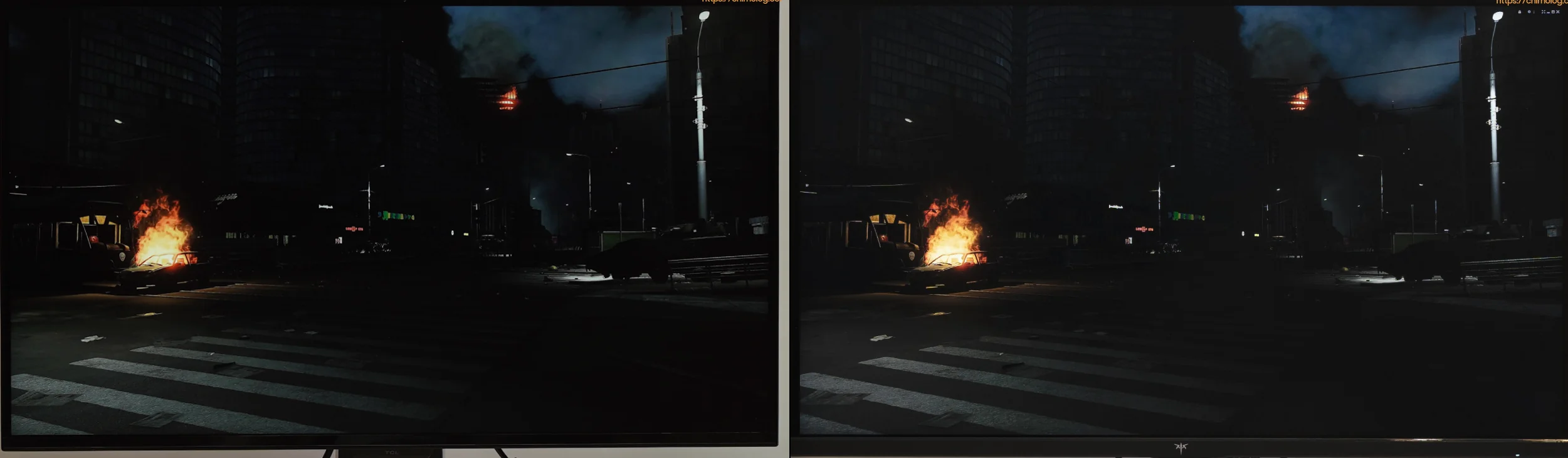
Viewing angle. SMD beads emit directionally, with brightness and color shifting past 140 to 160 degrees off-axis. COB and MIP emit as a continuous plane, holding color and brightness consistent to nearly 180 degrees. In a wide boardroom with foot traffic passing the screen from the side, COB holds image quality where SMD visibly drops off.
Screen door effect and moiré. At close range, SMD shows gaps between individual LED beads as a fine grid. COB eliminates this because there are no gaps between separately packaged pixels. GOB softens it with a diffusing resin layer. For any installation where a camera points at the screen — broadcast, virtual production, filmed events — COB or GOB is effectively mandatory to avoid moiré interference in the camera feed.
Perceived sharpness at distance. Beyond 4 meters, the human eye cannot resolve individual SMD pixels at P2.5 or finer. At that range, SMD and COB are visually indistinguishable. Paying for COB on a wall the audience views from 8 meters away is spending money on a difference nobody can see.
5. How to Choose the Right LED Packaging Technology
Choosing LED packaging technology is not about finding the “best” option. It is about matching the technology to the installation’s specific constraints. Four questions will get you there.
5.1 Question 1: How close will viewers be?
This is the first filter. Viewing distance determines minimum pixel pitch, and pixel pitch narrows your packaging options dramatically. If the closest viewer is 5 meters away, P2.5 SMD looks identical to P2.5 COB but costs significantly less. There is no reason to pay the COB premium at that distance. If the closest viewer is 1 meter away, SMD shows visible pixel grain and COB becomes worth the money.
Rule of thumb: for viewing distances under 2 meters, COB or MIP is the right conversation to be having. Between 2 and 4 meters, SMD or GOB covers most needs. Beyond 4 meters, SMD is almost always the correct answer unless the environment demands extra protection.
5.2 Question 2: What is the physical environment?
Indoor, climate-controlled, low-traffic spaces are forgiving. SMD works fine and you do not pay for protection you do not need. Outdoor installations with rain, dust, and temperature swings demand either a sealed cabinet around SMD modules or a native protective technology like GOB or COB. High-traffic public areas — subway stations, airports, retail floors — benefit from GOB’s impact resistance and cleanable surface. Coastal installations with salt spray push toward fully encapsulated COB.
5.3 Question 3: What is your maintenance strategy?
If you have on-site technicians who can swap individual LEDs, SMD’s repairability is a genuine operational advantage. A dead pixel takes 15 minutes and a $15 part. If your displays are installed across multiple sites with no local technical staff, COB’s lower failure rate and module-swap repair model may be more practical despite the higher per-incident cost. Rethink the maintenance math for your specific deployment model, not the industry average.
5.4 Question 4: What is the total cost of ownership window?
SMD has the lowest upfront cost but higher annual failure rates (2 to 3 percent) and faster lumen depreciation. COB costs more to buy but fails less often (0.5 percent annually) and holds its visual quality longer. Over a three-to-five-year ownership window in a 24/7 control room, COB’s total cost of ownership often beats SMD’s despite the higher purchase price. For a three-day rental or a seasonal retail display, SMD’s lower upfront cost wins every time.
5.5 Putting it together: a real example
A corporate lobby needs an LED wall. The closest viewer is 2 meters from the screen, so P1.5 or finer is the pixel pitch requirement. The lobby is indoors and climate-controlled, so no environmental hardening is needed — SMD or COB are both viable. The facility has no on-site AV technician, so any repair means calling an integrator and waiting. Total cost of ownership over five years matters more than the upfront purchase price.
Running the numbers: SMD P1.5 costs less to buy but at a 2 to 3 percent annual failure rate, the lobby will accumulate dead pixels that require service calls. COB P1.2 costs more upfront but the 0.5 percent failure rate means far fewer interventions over five years. The seamless image quality at 2 meters is a bonus. In this scenario, COB is the right answer — not because it is “better,” but because the specific combination of viewing distance, maintenance constraints, and ownership timeline makes the higher upfront cost the cheaper option over time. Change any variable — say the closest viewer is 4 meters away — and SMD becomes the smarter choice.
6. LED Packaging Technology by Application
| Application | Recommended Technology | Why |
|---|---|---|
| Outdoor billboard (50 m+ viewing) | DIP or SMD | Cost-effective at large pitches, high brightness |
| General indoor signage (3 m+ viewing) | SMD | Best cost-to-performance ratio |
| Rental and staging | SMD or GOB | SMD for cost, GOB for durability on tour |
| Conference room (2–4 m viewing) | SMD P1.5–P2.5 | Adequate at standard meeting distances |
| Boardroom (1–2 m viewing) | COB P0.9–P1.2 | No visible pixel grain up close |
| Broadcast studio | COB P0.9–P1.5 | High contrast, no moiré on camera |
| Control room / NOC (24/7) | COB P0.7–P1.2 | Reliability, low failure rate, seamless viewing |
| XR virtual production | COB or MIP | Anti-moiré, high refresh, camera-friendly |
| Luxury retail (close viewing) | COB P0.6–P1.2 | Premium image quality, dust-sealed |
| High-traffic public area | GOB | Impact and moisture protection, cleanable |
| Ultra-fine-pitch (< P0.6) | MIP | Only technology viable below P0.6 with repairability |
7. LED Packaging Technology FAQs
1. What is the most common LED packaging technology?
SMD covers roughly 70 to 80 percent of all LED display installations. It is mature, cost-effective, versatile, and backed by a deep supply chain.
2. Is COB always better than SMD?
No. COB wins on close-up image quality and reliability. SMD wins on brightness, upfront cost, and field repairability. Beyond 4 meters viewing distance, they look identical.
3. What is the difference between GOB and COB?
GOB is a protective resin coating applied over SMD modules. COB is a different manufacturing process where bare LED chips bond directly to the PCB with no individual lamp beads. GOB adds durability to SMD. COB eliminates SMD entirely.
4. How long do different LED packaging technologies last?
SMD: 50,000 to 60,000 hours, 2 to 3 percent annual failure rate. COB: 80,000-plus hours, roughly 0.5 percent annual failure rate. GOB matches SMD lifespan with fewer impact-related failures. Actual longevity depends more on environment and thermal management than packaging alone.
5. Can LED packaging technology be upgraded after purchase?
No. The packaging method is integral to manufacturing. An SMD display cannot become COB. GOB can technically be applied aftermarket to SMD modules but is rarely cost-effective versus buying factory GOB.
6. Is IMD still worth considering?
IMD is fading as COB and MIP mature. The cost gap between IMD and COB has narrowed at P0.9 to P1.2, making COB the better choice for most new installs. IMD persists mainly where manufacturers have existing IMD lines.
7. How does flip-chip COB differ from conventional COB?
Conventional COB wire-bonds each chip to the PCB. Flip-chip COB inverts the chip and bonds it directly via conductive bumps, improving heat dissipation, current tolerance, and brightness. Most premium COB displays use flip-chip today.
11. Conclusion
LED packaging technology is not a spec-sheet checkbox. Start with viewing distance — that determines pixel pitch, which narrows your packaging options. Environment, maintenance strategy, and ownership timeline narrow them further. By the time you reach the final decision, there are usually only one or two technologies left standing.
For most installs: SMD at 3 meters and beyond, COB for premium close-up indoor, GOB for harsh environments on a budget, MIP for anything below P0.6. The expensive mistake isn’t picking the wrong one. It’s picking without knowing what problem the technology was built to solve.