

Choosing between NovaStar’s two controller families is less about finding the “more powerful” box and more about matching architecture to the job. NovaStar H Series vs VX Series comes down to scale, I/O flexibility, redundancy, and how quickly your team needs to deploy. This guide compares the current H and VX Pro lineups with practical recommendations for rental stages, corporate lobbies, control rooms, broadcast sets, and large fine-pitch LED walls.
Table of Contents
1. NovaStar H Series vs VX Series: The Short Answer
2. NovaStar H Series vs VX Series: Product Roles
3. NovaStar H Series vs VX Series Comparison Table
4. NovaStar H Series vs VX Series: Performance
5. NovaStar H Series vs VX Series: Best Use Cases
6. NovaStar H Series vs VX Series: How to Choose
7. Common Buying Mistakes
8. Frequently Asked Questions
9. Conclusion
1. NovaStar H Series vs VX Series: The Short Answer
For most single-screen event and commercial projects, choose a VX Pro controller. It combines video processing, scaling, switching, and LED sending in a compact fixed-port unit. The VX400 Pro through VX2000 Pro cover 2.6 million to 13 million pixels, so selecting a model is straightforward.
Choose an H Series chassis when the system needs many sources, many outputs, unusually high pixel capacity, advanced multi-window layouts, centralized control, or serious redundancy. In the NovaStar H Series vs VX Series decision, H is the scalable system platform; VX is the fast, efficient appliance.
1.1 Choose H Series when complexity will grow
In NovaStar H Series vs VX Series, an H chassis makes sense when your specification includes several screens, mixed connector standards, control-room workflows, input and device hot backup, or future expansion. The modular card design lets integrators build the exact signal path required rather than replacing the controller when the project grows.
1.2 Choose VX Series when speed and simplicity matter
For NovaStar H Series vs VX Series, a VX Pro is usually the better operational choice for touring crews, rental companies, houses of worship, conference rooms, and standard LED walls. Its fixed I/O removes card-selection decisions, reduces rack space, and makes it easier to keep identical backup units ready.
2. NovaStar H Series vs VX Series: Product Roles
2.1 NovaStar H Series: a modular splicer and controller platform
To understand NovaStar H Series vs VX Series, start with NovaStar’s description of H Series as its flagship all-in-one video splicing processor for fine-pitch LED applications. The range includes H2, H5, H9, H15, and H20 chassis. Depending on chassis and output cards, official maximum loading capacity runs from 26 million pixels on H2 with RJ45 sending cards to 520 million pixels on H20 with enhanced optical output cards.
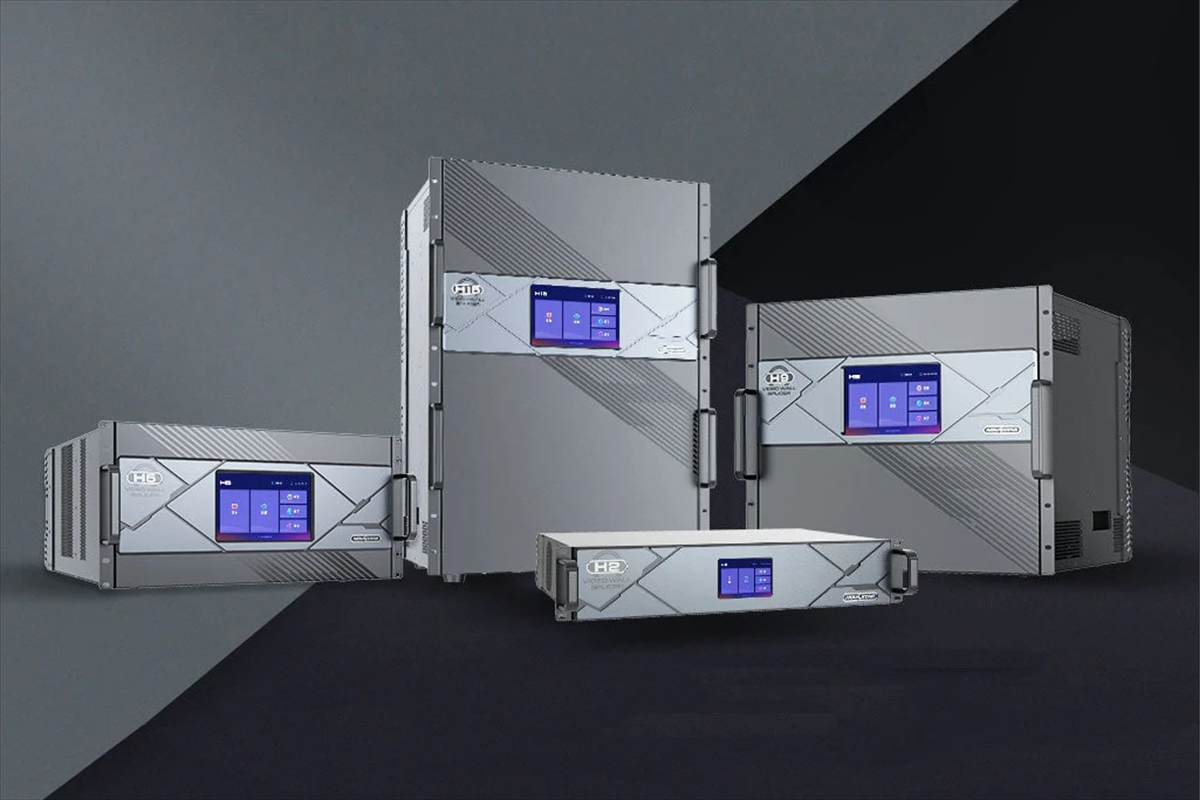
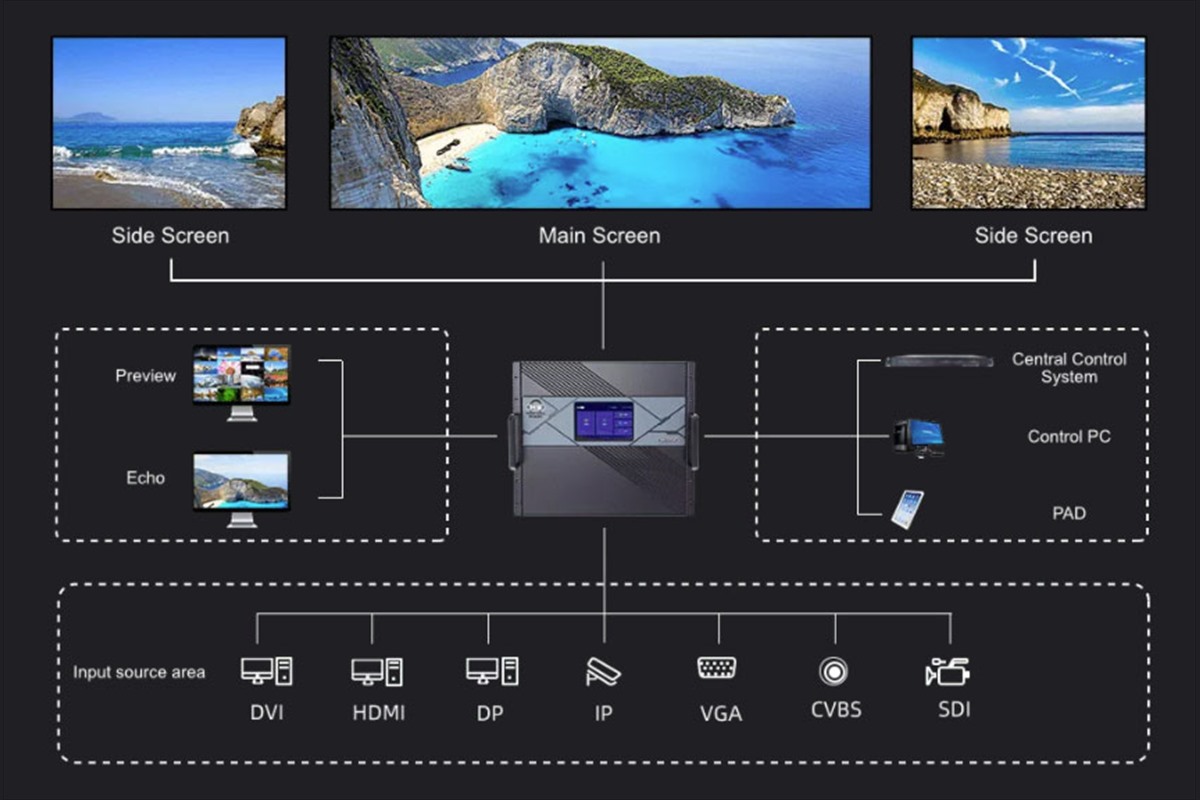
The important point is not only capacity. H Series accepts modular cards for HDMI, DisplayPort, DVI, SDI, IP, NDI, HDBaseT, optical transmission, preview, audio, and control connections. It can provide up to 16 layers per card, 8K end-to-end processing, 4K 120 Hz input support, multi-screen control, API and SNMP integration, and hot-backup options. That makes it suitable for systems that behave more like a video routing and display platform than a single LED controller.
2.2 NovaStar VX Series: a fixed-configuration all-in-one controller
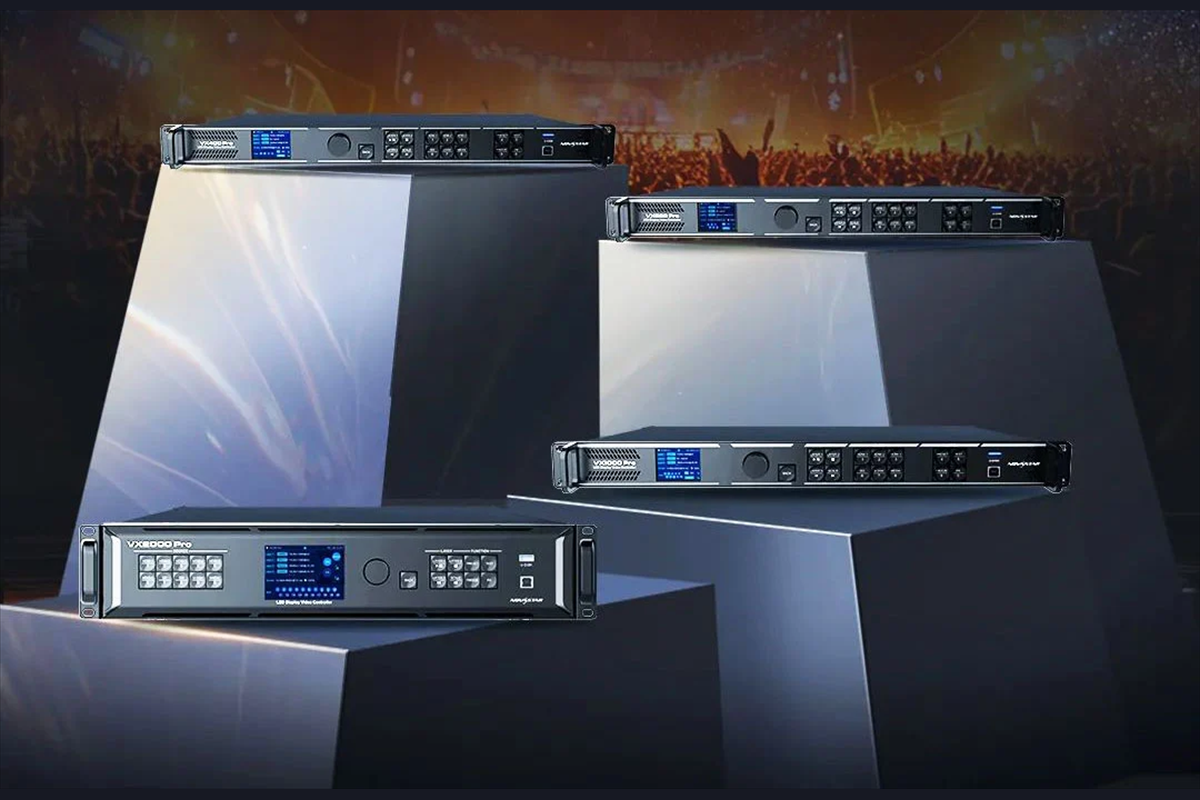
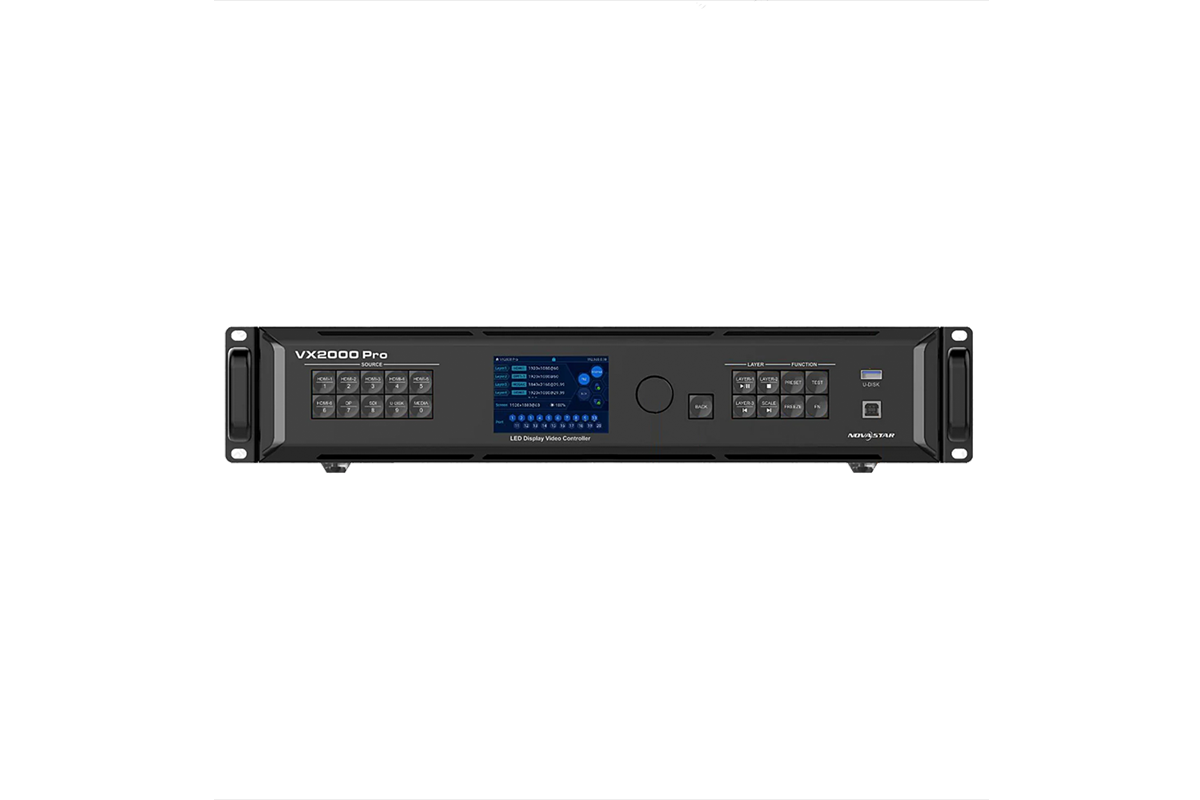
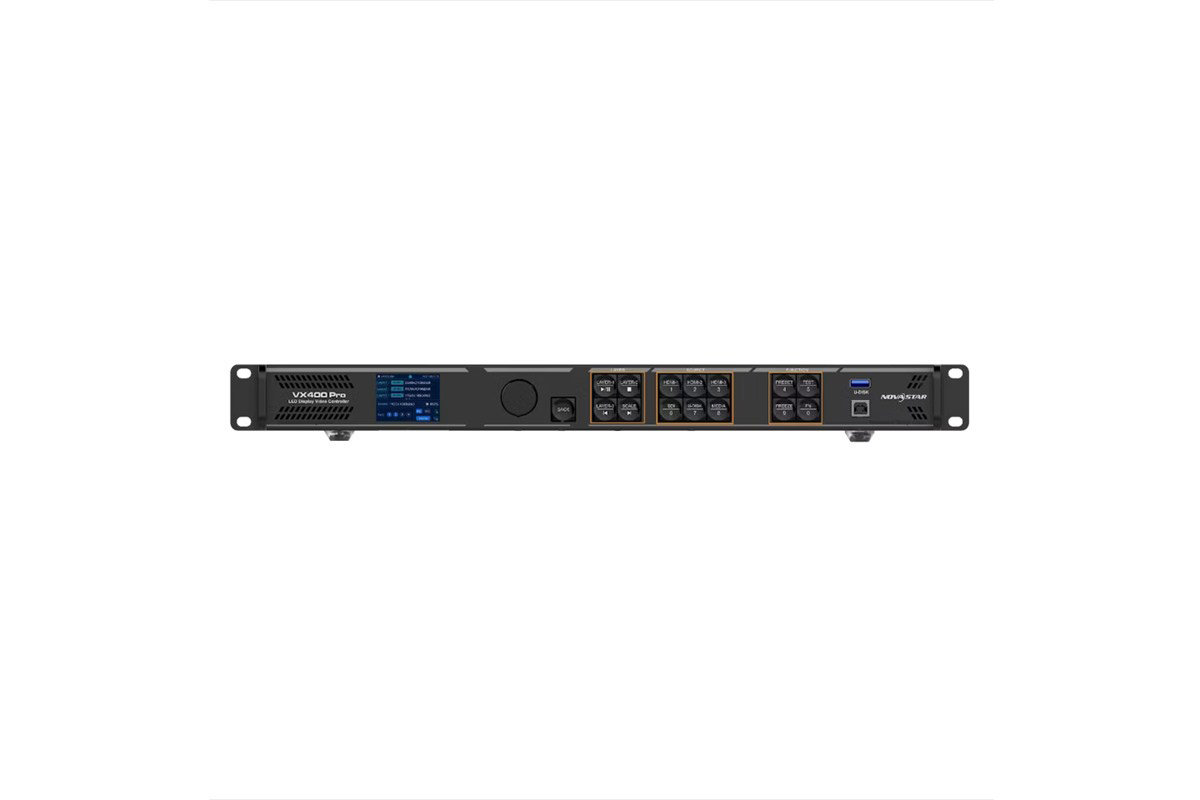
On the compact side of NovaStar H Series vs VX Series, the current VX Pro family includes VX400 Pro, VX600 Pro, VX1000 Pro, and VX2000 Pro. Their names align closely with four, six, ten, and twenty Ethernet outputs. Official loading capacities are 2.6, 3.9, 6.5, and 13 million pixels respectively.
Every current VX Pro model supports real 4K input through HDMI 2.0 at up to 4096 x 2160 at 60 Hz. The VX400 Pro, VX600 Pro, and VX1000 Pro provide six 2K layers, while VX2000 Pro provides twelve. The family also offers 256 presets, USB media input, OSD content, optical ports, and visualized control across macOS, Windows, and the web. For a deeper model-level comparison, see our VX1000 Pro vs VX600 Pro guide.
3. NovaStar H Series vs VX Series Comparison Table
The table below summarizes the architectural difference. Because both families contain several models and configurations, confirm the final pixel load, layer count, card type, and firmware against the exact product specification before ordering.
| Decision Factor | NovaStar H Series | NovaStar VX Pro Series |
|---|---|---|
| Architecture | Modular card-based chassis | Fixed-port all-in-one controller |
| Current models | H2, H5, H9, H15, H20 | VX400 Pro, VX600 Pro, VX1000 Pro, VX2000 Pro |
| Official loading range | 26 million to 520 million pixels, depending on chassis and output cards | 2.6 million to 13 million pixels |
| Input and output flexibility | Choose and combine HDMI, DP, DVI, SDI, IP, NDI, HDBaseT, RJ45, and optical cards | Predetermined connectors for each model |
| Layers | Up to 320 layers on H20; configuration-dependent | Six 2K layers on VX400/600/1000 Pro; twelve on VX2000 Pro |
| Presets | Up to 2,000 with preset playlist support | 256 |
| Redundancy | Input-source, device, and optional dual-power hot backup | Practical source and device backup options, but less system-level redundancy |
| Rack space | 2U to 20U | Compact appliance footprint |
| Best fit | Control rooms, broadcast, multi-screen and very large fine-pitch systems | Rental events, stages, meeting spaces and standard commercial LED walls |
| Expansion path | Add or change cards within chassis limits | Move to a larger VX model or add another controller |
4. NovaStar H Series vs VX Series: Performance
4.1 Pixel capacity and canvas size
Pixel capacity is the fastest way to narrow NovaStar H Series vs VX Series. A VX2000 Pro tops out at 13 million pixels, enough for many large 4K-class or unusually shaped LED walls. H2 already starts at 26 million pixels with the H_20xRJ45 sending card, while the larger H chassis scale far beyond that.
Do not size a controller from total pixels alone. Verify the maximum width and height, the pixel load of each Ethernet or optical output, cabinet mapping, refresh rate, bit depth, and the distribution of load across ports. A wall can be below the total limit and still fail the design if one output is overloaded.
4.2 Inputs, outputs, and future expansion
With VX, the selected model defines the connector set. This is a strength when the sources are known: one 4K laptop feed, a switcher output, an SDI camera return, and standard Ethernet runs. Commissioning is predictable, and replacing the controller is simple.
H Series is better when the connector mix is uncertain or specialized. An integrator can combine HDMI 2.1, DisplayPort 1.4, 12G-SDI, NDI, legacy DVI, HDBaseT, or optical cards. This flexibility is the biggest long-term advantage in NovaStar H Series vs VX Series, especially for venues that renovate sources without replacing the LED wall.
4.3 Layers, presets, and multi-screen operation
Layer demand is another dividing line in NovaStar H Series vs VX Series. A corporate stage may need only a background plus two picture-in-picture windows. Six 2K layers on a VX Pro can handle that comfortably. A command center may need dozens of independent windows across multiple canvases, synchronized screen control, OSD data, and rapid recall of many layouts. H Series provides the layer density and up to 2,000 presets needed for that workflow.
4.4 Reliability and control integration
For mission-critical installations, H Series supports a more comprehensive redundancy design, including input-source hot backup, optional dual power on H5 and larger chassis, and device-to-device hot backup. API, SNMP, TCP/IP, RS232, and Stream Deck compatibility also fit managed AV environments.
A VX Pro can still be deployed redundantly, and keeping a spare fixed unit is often the simplest event strategy. The real NovaStar H Series vs VX Series question is whether you need redundancy inside an integrated platform or prefer to swap a standardized appliance.
5. NovaStar H Series vs VX Series: Best Use Cases
5.1 Rental stages and live events
For rental buyers comparing NovaStar H Series vs VX Series, choose VX Pro when the show uses one primary LED canvas, a manageable number of sources, and a crew that values fast setup. Match VX400 Pro, VX600 Pro, VX1000 Pro, or VX2000 Pro to the final pixel map and port distribution. For touring inventory, standardizing several identical units can reduce training and spare-parts complexity.
Move to H Series when the production uses several large LED surfaces, many live inputs, complex window layouts, or centralized switching. In a multi-stage festival or broadcast-heavy event, H can consolidate equipment that would otherwise require separate processors, matrix routers, and controllers.
5.2 Corporate lobbies and retail LED walls
VX Pro is normally the efficient choice for a reception video wall, showroom, digital backdrop, or retail display. Its 4K input, scaling, presets, and OSD functions cover typical daily operation without an oversized system.
H becomes valuable when a headquarters combines a lobby wall, briefing center, executive boardroom, and data displays under one management system. The decision in NovaStar H Series vs VX Series should follow the entire signal workflow, not only the largest screen.
5.3 Control rooms, broadcast, and command centers
For control rooms evaluating NovaStar H Series vs VX Series, H Series is the clear default when operators must monitor many sources continuously, create complex layouts, recall large preset libraries, and maintain service through a component failure. NDI, SDI, IP, preview, API, and SNMP options make the platform easier to integrate with professional control infrastructure.
5.4 Fine-pitch and very large LED installations
Large fine-pitch walls can exceed the VX range quickly because tighter pixel pitch increases pixel count without increasing physical size. Start with a complete cabinet-level load map. If the project needs more than 13 million pixels, many outputs, or future canvas expansion, the H architecture is usually more economical than stacking fixed controllers and external processors.
6. NovaStar H Series vs VX Series: How to Choose
6.1 Calculate the real load
Multiply total screen width by total screen height in pixels, then add every independently controlled canvas. Keep practical headroom for mapping changes. Next, check port-by-port load and the controller’s maximum width and height. This step often eliminates half the options in NovaStar H Series vs VX Series.
6.2 List every source and destination
When specifying NovaStar H Series vs VX Series, record connector type, resolution, frame rate, HDCP requirement, color depth, and whether a loop output or preview feed is needed. If the list fits a VX Pro exactly, fixed I/O is an advantage. If it requires several standards or may change, price the appropriate H cards from the beginning.
6.3 Define layer and preset requirements
Count simultaneous windows, not just physical inputs. Then list the layouts operators must recall. VX Pro’s six or twelve 2K layers and 256 presets suit many productions; H Series is designed for far denser compositions and large preset libraries.
6.4 Decide your redundancy strategy
For a rental company, a spare VX unit may be cheaper and easier than a more elaborate architecture. For a 24/7 control room, hot-swappable signal paths, dual power, and monitored devices can justify H Series. Include the cost of downtime, not only the controller purchase price.
6.5 Match the controller to the team
A system is reliable only if the operators can support it. VX favors repeatable, appliance-style workflows. H rewards detailed engineering, card planning, documentation, and trained operators. Our NovaStar H Series guide and H2 review provide more detail for planning a modular system.
7. Common Buying Mistakes
- Comparing only total pixel capacity. Width, height, per-port loading, frame rate, and bit depth can be the real limits.
- Buying H Series without pricing the cards. A chassis is only the starting point; calculate the complete configured system.
- Choosing VX without expansion headroom. A model that is full on day one may force an early replacement.
- Assuming every model has identical connectors. Check the exact VX model or H card list, not a family-level summary.
- Ignoring operations and backup. The easiest controller to specify may not be the easiest to support during a live failure.
A disciplined NovaStar H Series vs VX Series comparison includes the screen map, signal schedule, layer plan, redundancy design, rack space, control protocol, and five-year expansion forecast.
8. Frequently Asked Questions
8.1 Is H Series always better than VX Series?
No. H Series offers much greater scale and flexibility, but VX Pro can be the better controller when the I/O and pixel load are known. It is smaller, faster to deploy, easier to standardize, and often more cost-effective for a single LED wall.
8.2 Can a VX Pro controller handle a 4K LED wall?
Yes, within the selected model’s loading and geometry limits. The current VX Pro family supports HDMI 2.0 input at up to 4096 x 2160 at 60 Hz. A 4K input format does not automatically mean every model can drive every 4K pixel canvas, so check total load and port mapping.
8.3 When should I move from VX1000 Pro to VX2000 Pro?
Move up when the design exceeds 6.5 million pixels, requires more than ten Ethernet outputs, or benefits from twelve 2K layers instead of six. VX2000 Pro supports 13 million pixels and twenty Ethernet outputs.
8.4 Which H chassis is the starting point?
H2 is the compact 2U entry and supports up to four input cards and two output cards. H5, H9, H15, and H20 add card slots, layers, and loading capacity. Choose from the required card count and expansion plan, not chassis size alone.
8.5 What information should I send for a controller recommendation?
Provide the cabinet resolution and quantity, complete screen dimensions, source formats, number of simultaneous windows, preferred connectors, cable distances, backup requirements, rack limits, and future expansion. With those details, a supplier can make a defensible NovaStar H Series vs VX Series recommendation instead of guessing from screen size.
9. Conclusion
NovaStar H Series vs VX Series is a choice between scalable system architecture and compact operational efficiency. Select VX Pro for defined single-screen workflows and rapid deployment. Select H Series for very high pixel loads, modular I/O, multi-screen layouts, centralized control, and mission-critical redundancy. Finalize the model only after checking the cabinet-level load map, connector schedule, layer count, and backup plan.